Slavery Advertisements Published May 9, 1774

GUEST CURATOR:  Elizabeth “Ellie” Chaclas

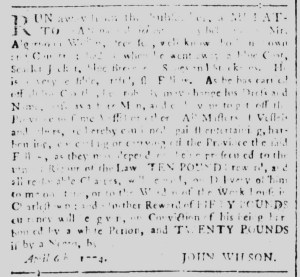
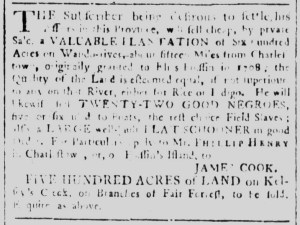
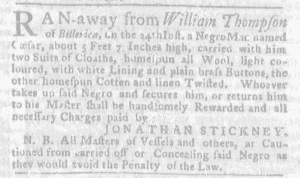
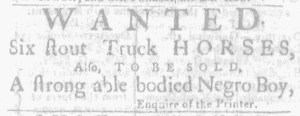
The Slavery Adverts 250 Project chronicles the role of newspaper advertising in perpetuating slavery in the era of the American Revolution. The project seeks to reveal the ubiquity of slavery in eighteenth-century life from New England to Georgia by republishing advertisements about enslaved people – for sale as individuals or in groups, wanted to purchase or for hire for short periods, runaways who liberated themselves, and those who were subsequently captured and confined in jails and workhouses – in daily digests on this site as well as in real time via the @SlaveAdverts250 Twitter feed, utilizing twenty-first-century media to stand in for the print media of the eighteenth century.

The project aims to provide modern audiences with a sense of just how often colonizers encountered these advertisements in their daily lives. Enslaved men, women, and children appeared in print somewhere in the colonies almost every single day. Those advertisements served as a constant backdrop for social, cultural, economic, and political life in colonial and revolutionary America. Colonizers who did not purport to own enslaved people were still confronted with slavery as well as invited to maintain the system by purchasing enslaved men, women, and children or assisting in the capture of so-called “runaways” who sought to free themselves from bondage. The frequency of these newspaper advertisements suggests just how embedded slavery was in colonial and revolutionary American culture in everyday interactions beyond the printed page.

These advertisements also testify to the experiences of enslaved men, women, and children, though readers must consider that those experiences have been remediated through descriptions offered by enslavers rather than enslaved people themselves. Often unnamed in the advertisements, enslaved men, women, and children were not invisible or unimportant in early America.

These advertisements appeared in colonial American newspapers 250 years ago today.
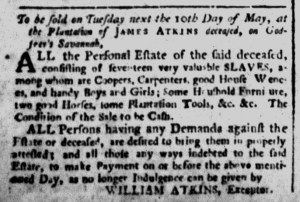
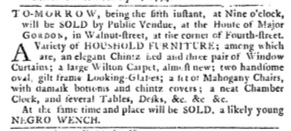
Boston Evening-Post (May 9, 1773).

**********
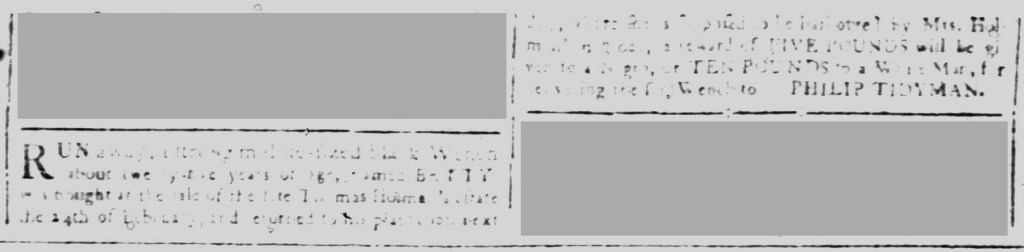
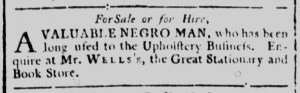
Boston Evening-Post (May 9, 1773).

**********

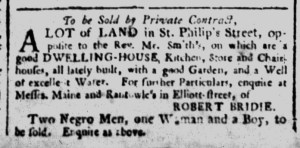
Supplement to the Boston-Gazette (May 9, 1773).

**********

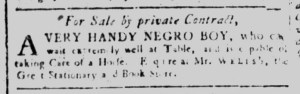
Supplement to the Boston-Gazette (May 9, 1773).

**********
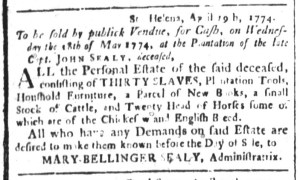
Supplement to the Boston-Gazette (May 9, 1773).

**********

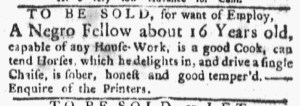
Dunlap’s Pennsylvania Packet (May 9, 1773).

**********

Dunlap’s Pennsylvania Packet (May 9, 1773).

**********

Postscript to Dunlap’s Pennsylvania Packet (May 9, 1773).

**********
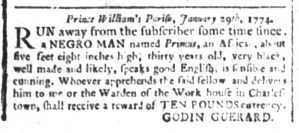
Massachusetts Gazette and Boston Post-Boy (May 9, 1773).

**********
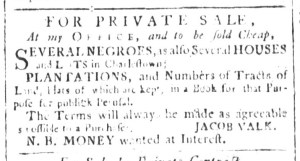
Newport Mercury (May 9, 1773).

**********

New-York Gazette and Weekly Mercury (May 9, 1773).

**********
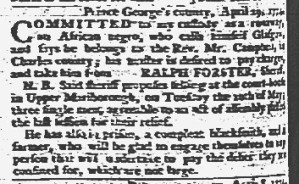
Supplement to the New-York Gazette and Weekly Mercury (May 9, 1773).

May 8

What was advertised in a colonial American newspaper 250 years ago this week?

Supplement to the Massachusetts Gazette and Boston Weekly News-Letter (May 5, 1774).

“City Tavern, Philadelphia.”

When the City Tavern opened in Philadelphia, Daniel Smith inserted advertisements in the Pennsylvania Gazette and the Pennsylvania Packet in February 1774.  The opening had been much anticipated in that city, following the efforts of some of the most prominent residents to erect the building via subscription.  In 1772, Samuel Powel entrusted the land to seven wealthy colonizers.  In turn, those “Gentlemen Proprietors” oversaw a “voluntary subscription of the principal gentlemen of the city” to raise funds to build the tavern and then selected Smith to lease and operate the City Tavern.

About three months after his advertisement ran in Philadelphia’s newspaper, it appeared in the Supplement to the Massachusetts Gazette and Boston Weekly News-Letter on May 5.  It featured identical copy and, except for the headline, identical format in terms of capitalization and italics.  Smith may have written it out exactly, but just as likely he clipped the advertisement from his local newspaper and sent it to Richard Draper’s printing office in Boston.  Alternately, he could have sent instructions to reprint the notice from a newspaper that Draper received via his exchange networks with other printers, but Smith would not have been certain that Draper received the issues that originally carried his advertisement.  Given that the tavernkeeper proclaimed that he “fitted up a genteel Coffee Room, … properly supplied with English and American papers and magazines,” he likely corresponded directly with Draper, ordering a newspaper subscription and arranging to run his advertisement in the public prints in Boston.

That advertisement provided a brief history of the City Tavern that would have been familiar to many residents of Philadelphia yet new to readers in Boston.  Smith hoped to impress prospective visitors to his city with the “largest and most elegant house occupied in that way [as a tavern, coffeehouse, and inn], in America.”  He emphasized his own “very great expence” in furnishing it with “every article of the first quality, in the stile of a London tavern.”  Indeed, when John Adams traveled to Philadelphia to attend the First Continental Congress several months later, he described it as “the most genteel [tavern] in America.”[1]  That was the reputation Smith hoped to cultivate, not only in his city but throughout the colonies.  He positioned the City Tavern as a destination itself, not just a place to eat, drink, and lodge while visiting Philadelphia.

**********
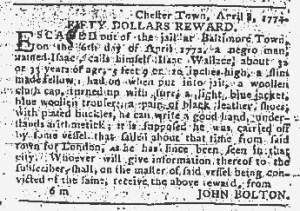
[1] See entry for August 29, 1774, in John Adams diary 21, 15 August – 3 September 1774 [electronic edition]. Adams Family Papers: An Electronic Archive. Massachusetts Historical Society. http://www.masshist.org/digitaladams/

May 7

What was advertised in a colonial American newspaper 250 years ago today?

Providence Gazette (May 7, 1774).

“His Customers may depend on having their Work done as neat as at Boston.”

When the mononymous Wright, “TAYLOR and HABIT-MAKER, from Boston,” arrived in Providence, he ran a newspaper advertisement to introduce himself to prospective clients in and near the growing port.  He advised the public that he “has taken a Shop opposite Messieurs Joseph and William Russell’s Store,” a prime location because everyone knew where the town’s most prominent merchants did business.  Readers might not know much about Wright, at least not yet, but they could certainly find their way to his new shop if they wished to find out more.

For his part, Wright sought to incite interest that would help in cultivating a clientele by telling the public more about himself and his plans for his new enterprise.  He reported that he “served his Apprenticeship to one of the best Taylors in Boston,” but did not give a name.  Whether they arrived from the other side of the Atlantic or from another colony, artisans often promoted the training they received in their trade, hoping that would give them some standing with prospective customers while they worked to establish their reputations in the local market.  Wright also asserted that he pursued “the Taylor’s Business, in all its Branches,” indicating that he was capable of any sort of work undertaken by tailors.  His apprenticeship had been extensive and complete.

The newcomer also emphasized quality and customer service.  He promised that he produced garments “in the neatest and best Manner.”  Indeed, given his prior experience, he pledged that “His Customers may depend on having their Work done as neat as at Boston, or elsewhere.”  Just because Boston and New York and Philadelphia were larger and more cosmopolitan did not mean that their tailors produced better work, at least not according to Wright as he appealed to prospective clients in Providence.  He may have even intended for the mononym to testify to the cachet associated with hiring him.  Wright was confident that he “shall give Satisfaction to all that may please to favour him with their Custom.”  Whether or not that was actually the case could not be gleaned from his advertisement, but the tailor did demonstrate that he was familiar with the various conventions for marketing his services commonly adopted by members of his trade during the era of the American Revolution.

May 6

What was advertised in a colonial American newspaper 250 years ago today?

Top to bottom: South-Carolina and American General Gazette (May 6, 1774); South-Carolina Gazette and Country Journal (May 10, 1774); Supplement to the South-Carolina Gazette (May 16, 1774).

“Whom he has had under his [illegible] these ten Years past.”

It had been a while since Mr. Pike, the dancing master, ran advertisements in any of the newspapers printed in Charleston in the 1770s.  In September 1773, he announced that he opened his “Dancing and Fencing SCHOOLS … for the Season.”  A little more than six months later, he once again took to the public prints with a final notice that he would leave “the Province some Time next Month” due to ill health.  It appeared in the May 6 edition of the South-Carolina and American General Gazette and the May 10 edition of the South-Carolina Gazette and Country Journal.  He likely placed it in the South-Carolina Gazette simultaneously, but some issues have not survived.  It ran in the Supplement to the South-Carolina Gazette on May 16, probably moved to that portion of the newspaper after appearing in the standard issue in previous weeks.  By placing his notice in all three newspapers published in the colony, Pike disseminated his farewell message widely, making his intended departure as visible as possible.

The reiteration of his advertisements across multiple newspapers eventually made it more accessible to historians and other modern readers, especially those who rely on digital surrogates.  However, Pike’s advertisement is fully legible in only one of the digital images of the issues listed above.  It is possible to make out most of the content of the advertisement from the South-Carolina and American General Gazette, but not all of it.  While it might be tempting to blame poor printing, that does not seem to be solely responsible for the quality of the image.  Robert Wells, the printer, would not have been able to keep his newspaper in business for years if the contents were not legible, especially when competing with two other newspapers.  Digital images of some, but not all, pages of the May 6 edition of the South-Carolina and American General Gazette are more legible.  Others are much less legible.  The primary problem seems to lie with the photography rather than the printing.  Technological errors that occurred during the digitization of the South-Carolina Gazette certainly made a portion of Pike’s advertisement in the May 16 supplement illegible.  A glitch of some sort cut off the bottom third of the first page of the supplement, presenting solid grey rather than an image of the advertisements on that portion of the page.  The first several lines of Pike’s advertisement are visible, but not the rest.  In contrast, the entire advertisement is legible in the digital image of the South-Carolina Gazette and Country Journal for May 10, though some combination of printing, wear over time, and modern photography has made some words more difficult to decipher than others.

These examples demonstrate that digitization is not a panacea for providing access to primary sources.  Digital images do not always offer the same access as examining the original documents.  The lower third of the page is not actually missing from the South-Carolina Gazette.  The South-Carolina and American General Gazette may be much more legible when viewed in person.  Unfortunately, the quality of the digital images undermines their accessibility.

Slavery Advertisements Published May 6, 1774

GUEST CURATOR:  Elizabeth “Ellie” Chaclas

The Slavery Adverts 250 Project chronicles the role of newspaper advertising in perpetuating slavery in the era of the American Revolution. The project seeks to reveal the ubiquity of slavery in eighteenth-century life from New England to Georgia by republishing advertisements about enslaved people – for sale as individuals or in groups, wanted to purchase or for hire for short periods, runaways who liberated themselves, and those who were subsequently captured and confined in jails and workhouses – in daily digests on this site as well as in real time via the @SlaveAdverts250 Twitter feed, utilizing twenty-first-century media to stand in for the print media of the eighteenth century.

The project aims to provide modern audiences with a sense of just how often colonizers encountered these advertisements in their daily lives. Enslaved men, women, and children appeared in print somewhere in the colonies almost every single day. Those advertisements served as a constant backdrop for social, cultural, economic, and political life in colonial and revolutionary America. Colonizers who did not purport to own enslaved people were still confronted with slavery as well as invited to maintain the system by purchasing enslaved men, women, and children or assisting in the capture of so-called “runaways” who sought to free themselves from bondage. The frequency of these newspaper advertisements suggests just how embedded slavery was in colonial and revolutionary American culture in everyday interactions beyond the printed page.

These advertisements also testify to the experiences of enslaved men, women, and children, though readers must consider that those experiences have been remediated through descriptions offered by enslavers rather than enslaved people themselves. Often unnamed in the advertisements, enslaved men, women, and children were not invisible or unimportant in early America.

These advertisements appeared in colonial American newspapers 250 years ago today.

Connecticut Gazette (May 6, 1774).

**********

Connecticut Journal (May 6, 1774).

**********

Connecticut Journal (May 6, 1774).

**********

New-Hampshire Gazette (May 6, 1774).

**********

South-Carolina and American General Gazette (May 6, 1774).

**********

South-Carolina and American General Gazette (May 6, 1774).

**********

South-Carolina and American General Gazette (May 6, 1774).

**********

South-Carolina and American General Gazette (May 6, 1774).

**********

South-Carolina and American General Gazette (May 6, 1774).

**********

South-Carolina and American General Gazette (May 6, 1774).

**********

South-Carolina and American General Gazette (May 6, 1774).

**********

South-Carolina and American General Gazette (May 6, 1774).

**********

South-Carolina and American General Gazette (May 6, 1774).

**********

South-Carolina and American General Gazette (May 6, 1774).

**********

South-Carolina and American General Gazette (May 6, 1774).

**********

South-Carolina and American General Gazette (May 6, 1774).

**********

South-Carolina and American General Gazette (May 6, 1774).

**********

South-Carolina and American General Gazette (May 6, 1774).

**********

South-Carolina and American General Gazette (May 6, 1774).

**********

South-Carolina and American General Gazette (May 6, 1774).

**********

South-Carolina and American General Gazette (May 6, 1774).

**********

South-Carolina and American General Gazette (May 6, 1774).

**********

South-Carolina and American General Gazette (May 6, 1774).

**********

South-Carolina and American General Gazette (May 6, 1774).

**********

South-Carolina and American General Gazette (May 6, 1774).

**********

South-Carolina and American General Gazette (May 6, 1774).

**********

South-Carolina and American General Gazette (May 6, 1774).

**********

South-Carolina and American General Gazette (May 6, 1774).

**********

South-Carolina and American General Gazette (May 6, 1774).

**********

South-Carolina and American General Gazette (May 6, 1774).

**********

South-Carolina and American General Gazette (May 6, 1774).

**********

South-Carolina and American General Gazette (May 6, 1774).

May 5

What was advertised in a colonial American newspaper 250 years ago today?

Massachusetts Gazette and Boston Weekly News-Letter (May 5, 1774).

“A very low State of Health, prevents his making Collection of Intelligence and Speculation.”

Printers often inserted notices about their own businesses immediately after any local news items they published, increasing the chances that readers would take note even if they did not closely examine the advertisements that followed.  Such was the case for a notice that Richard Draper placed in the May 5, 1774, edition of the Massachusetts Gazette and Boston Weekly News-Letter.  Right below news from Boston and Worcester, he declared, “The Publisher and Printer of this Paper being in a very low State of Health, prevents his making such Collection of Intelligence and Speculation, as his Customers must have expected to be given them.”  He especially lamented that he had been hampered in gathering news “since the arrival of the last Vessels,” acknowledging that ships arriving from London brought updates about Parliament’s reaction to the destruction of tea in Boston Harbor the previous December.  Colonial printers had to hustle to acquire the latest news and rumors from the other side of the Atlantic, learning what they could from captains and convincing merchants to share excerpts from the letters they received.

Even though a two-page supplement featuring “INTERESTING INTELLIGENCE” from London accompanied the May 5 edition, Draper did not consider himself up to the task of collecting and collating all the news flowing into the busy port.  That being the case, he addressed his subscribers, “beg[ging] their Indulgence till he recovers Strength, or till the Paper falls into other Hands.”  Planning for the latter, at least for the near future, he advised that a “Printer that understands collecting News, and carrying on a News Paper … may be concerned on very advantageous Terms” upon applying to Draper at his printing office.  His appeal met with success.  In the next issue he announced that he entered a “Co-Partnership with Mr. JOHN BOYLE, who was regularly brought up and has since carried on the Printing Business in this Town.”  Together, the partners would “Endeavor to support the Reputation the said Paper has had for many Years past.”  Draper alluded to the long publication history of the newspaper, established seventy years earlier.  In his History of Printing in America (1810), Isaiah Thomas described the Boston News-Letter (later the Massachusetts Gazette and Boston Weekly News-Letter) as “the first newspaper published in this country,” dismissing the single issue of Publick Occurences published in 1690.[1]  Thomas reported that Draper’s “ill health render[ed] him unable to attend closely to business” so Boyle “undertook the chief care and management of the newspaper.”[2]  A month later, Draper died.  Hs widow, Margaret, continued in partnership with Boyle for about a year, but they went their separate ways after the Revolutionary War began.  She then took John Howe as a partner, continuing to publish the newspaper “until the British troops left Boston in 1776.”  Thomas notes that it was the only newspaper “printed in Boston during the siege.”[3]  Despite Draper’s poor health and other turmoil, his newspaper lasted longer than any of the others published in Boston at the time he requested the “Indulgence” of his subscribers.

**********

[1] Isaiah Thomas, The History of Printing in America: With a Biography of Printers and an Account of Newspapers (1810; New York: Weathervane Book, 1970), 231.

[2] Thomas, History of Printing, 145.

[3] Thomas, History of Printing, 231.

Slavery Advertisements Published May 5, 1774

GUEST CURATOR:  Elizabeth “Ellie” Chaclas

The Slavery Adverts 250 Project chronicles the role of newspaper advertising in perpetuating slavery in the era of the American Revolution. The project seeks to reveal the ubiquity of slavery in eighteenth-century life from New England to Georgia by republishing advertisements about enslaved people – for sale as individuals or in groups, wanted to purchase or for hire for short periods, runaways who liberated themselves, and those who were subsequently captured and confined in jails and workhouses – in daily digests on this site as well as in real time via the @SlaveAdverts250 Twitter feed, utilizing twenty-first-century media to stand in for the print media of the eighteenth century.

The project aims to provide modern audiences with a sense of just how often colonizers encountered these advertisements in their daily lives. Enslaved men, women, and children appeared in print somewhere in the colonies almost every single day. Those advertisements served as a constant backdrop for social, cultural, economic, and political life in colonial and revolutionary America. Colonizers who did not purport to own enslaved people were still confronted with slavery as well as invited to maintain the system by purchasing enslaved men, women, and children or assisting in the capture of so-called “runaways” who sought to free themselves from bondage. The frequency of these newspaper advertisements suggests just how embedded slavery was in colonial and revolutionary American culture in everyday interactions beyond the printed page.

These advertisements also testify to the experiences of enslaved men, women, and children, though readers must consider that those experiences have been remediated through descriptions offered by enslavers rather than enslaved people themselves. Often unnamed in the advertisements, enslaved men, women, and children were not invisible or unimportant in early America.

These advertisements appeared in colonial American newspapers 250 years ago today.

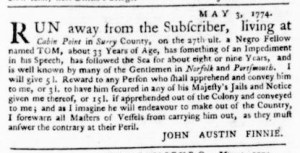
Maryland Gazette (May 5, 1774).

**********

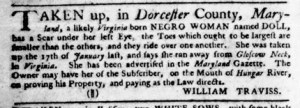
Maryland Gazette (May 5, 1774).

**********

Massachusetts Gazette and Boston Weekly News-Letter (May 5, 1774).

**********

Massachusetts Gazette and Boston Weekly News-Letter (May 5, 1774).

**********

Massachusetts Gazette and Boston Weekly News-Letter (May 5, 1774).

**********

Rivington’s New-York Gazetteer (May 5, 1774).

**********

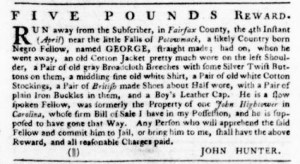
Virginia Gazette [Purdie and Dixon] (May 5, 1774).

**********

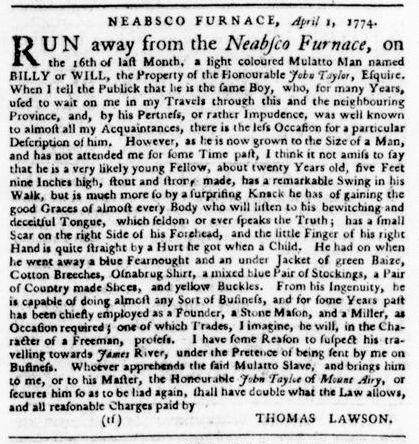
Virginia Gazette [Purdie and Dixon] (May 5, 1774).

**********

Virginia Gazette [Purdie and Dixon] (May 5, 1774).

**********

Virginia Gazette [Purdie and Dixon] (May 5, 1774).

**********

Virginia Gazette [Purdie and Dixon] (May 5, 1774).

**********

Virginia Gazette [Purdie and Dixon] (May 5, 1774).

**********

Virginia Gazette [Purdie and Dixon] (May 5, 1774).

**********

Virginia Gazette [Purdie and Dixon] (May 5, 1774).

May 4

What was advertised in a colonial American newspaper 250 years ago today?

Pennsylvania Journal (May 4, 1774).

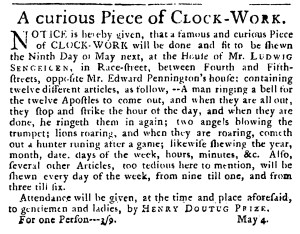
“A famous and curious Pieces of CLOCK-WORK.”

Advertisements in colonial newspapers sometimes testified to popular culture and entertainment options in port cities.  Such was the case with an advertisement about, as the headline proclaimed, a “curious Piece of CLOCK-WORK” that ran in the May 4, 1774, edition of the Pennsylvania Journal.  Henry Doutug Prize announced that he was in the process of assembling a “famous and curious Piece” to display “at the House of Mr. LUDWIG SENGEIGEN” on Race Street in Philadelphia.  Viewings would commence on May 9, but Prize took to the public prints in advance to incite interest and anticipation for this novelty.

The complex piece of machinery featured various figures, including a “man ringing a bell for the twelve Apostles to come out, and when they are all out, they stop and strike the hour of the day, and when they are done, he ringeth them in again.”  If that was not to delight viewers, the clockwork also had “two angels blowing the trumpet” as well as “lions roaring, and when they are roaring, cometh out a hunter running after a game.”  The animals that the hunter chased showed “the year, month, date, days of the week, hours, minutes,” and more.  Prize did not wish to reveal all the surprises that were part of the experience of viewing the clockwork.  Instead, he promised “several other Articles, too tedious to mention,” though his advertisement suggested that those figures were not “tedious” at all.  Readers had to see them to satisfy their curiosity.

In the next issue of the weekly Pennsylvania Journal, the proprietor of this mechanical wonder confirmed that assembly “is done, and fit to be seen” on any day of the week “from nine till one, and from three till six.”  For admission, he charged three shillings and nine pence per person for “gentlemen and ladies” to witness the clockwork in action, the angels with their trumpets, the apostles with their bells, the hunter with the animals, and everything else.  Prize offered a diversion to entertain audiences, something out of the ordinary that deserved their attention.  Even as he marketed a “curious Piece of CLOCK-WORK,” he appealed to the curiosity of readers who saw his advertisement and others who heard about mechanism as word spread.

Slavery Advertisements Published May 4, 1774

GUEST CURATOR:  Caroline Branch

The Slavery Adverts 250 Project chronicles the role of newspaper advertising in perpetuating slavery in the era of the American Revolution. The project seeks to reveal the ubiquity of slavery in eighteenth-century life from New England to Georgia by republishing advertisements about enslaved people – for sale as individuals or in groups, wanted to purchase or for hire for short periods, runaways who liberated themselves, and those who were subsequently captured and confined in jails and workhouses – in daily digests on this site as well as in real time via the @SlaveAdverts250 Twitter feed, utilizing twenty-first-century media to stand in for the print media of the eighteenth century.

The project aims to provide modern audiences with a sense of just how often colonizers encountered these advertisements in their daily lives. Enslaved men, women, and children appeared in print somewhere in the colonies almost every single day. Those advertisements served as a constant backdrop for social, cultural, economic, and political life in colonial and revolutionary America. Colonizers who did not purport to own enslaved people were still confronted with slavery as well as invited to maintain the system by purchasing enslaved men, women, and children or assisting in the capture of so-called “runaways” who sought to free themselves from bondage. The frequency of these newspaper advertisements suggests just how embedded slavery was in colonial and revolutionary American culture in everyday interactions beyond the printed page.

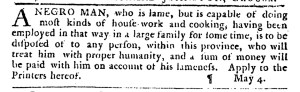
These advertisements also testify to the experiences of enslaved men, women, and children, though readers must consider that those experiences have been remediated through descriptions offered by enslavers rather than enslaved people themselves. Often unnamed in the advertisements, enslaved men, women, and children were not invisible or unimportant in early America.

These advertisements appeared in colonial American newspapers 250 years ago today.

Supplement to the Pennsylvania Gazette (May 4, 1774).

**********

Pennsylvania Journal (May 4, 1774).

**********

Pennsylvania Journal (May 4, 1774).

**********

Pennsylvania Journal (May 4, 1774).

**********

Pennsylvania Journal (May 4, 1774).

May 3

What was advertised in a colonial American newspaper 250 years ago today?

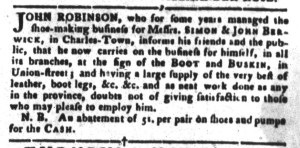
South-Carolina Gazette and Country Journal (May 3, 1774).

“He now carries on the business for himself … at the Sign of the BOOT and BUSKIN.”

When John Robinson launched his own business in the spring of 1774, he ran an advertisement in the South-Carolina Gazette and Country Journal.  He began by reminding prospective customers that he “for some years managed the shoe-making business for Messrs. SIMON & JOHN BERWICK.”  Now he was prepared to leverage that experience into operating his own enterprise, announcing to “his friends and the public, that he now carries on the business for himself.”  They could find him “at the sign of the BOOT and BUSKIN” on Union Street.

Robinson asserted that he pursued shoemaking “in all its branches,” deploying a familiar phrase that meant that he was capable of performing any task related to his occupation and producing any item associated with his trade.  The device that he chose to mark his location testified to that as well, depicting both a traditional boot and a buskin or a knee-high boot.  To that end, he acquired a “large supply of the very best of leather, boot legs,” and other materials, yet he also realized that the quality of the materials alone would not sell the items produced in his shop.  He declared his work “as neat … as any in the province,” simultaneously drawing on his experience managing the Berwicks’ workshop and drawing comparisons to competitors throughout Charleston and the rest of the colony.

To further entice prospective customers, Robinson concluded with a nota bene that promoted an “abatement of 5s. per pair on shoes and pumps for the CASH.”  He likely extended credit when necessary, but those who paid at the time of sale received a discount of five shillings.  The shoemaker likely hoped that bargain would attract the attention of even those not among his “friends” who knew him from his time at another workshop, convincing them to visit the “sign of the BOOT and BUSKIN” to check out the sale prices on shoes.