July 25

What was advertised in a colonial American newspaper 250 years ago today?
Newport Mercury (July 25, 1774)

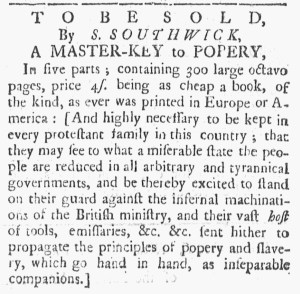
“A MASTER-KEY to POPERY … highly necessary to be kept in every protestant family.”

As the imperial crisis intensified in the summer of 1774, Solomon Southwick, printer of the Newport Mercury, peddled an American edition of A Master-Key to Popery.  For many months, Southwick circulated subscription proposals in his own newspaper and several others in New England, seeking to generate sufficient interest to make publishing the book a viable venture.  He took it to press in 1773 and distributed to subscribers the copies they had reserved.  Apparently, he produced surplus copies that he offered for sale at his printing office, perhaps anticipating opportunities to disseminate the assertions made by Antonio Gavin, formerly a “secular Priest in the Church of Rome, and since 1715, Minister of the Church of England.”  Who better than a priest who converted to Protestantism to reveal the true workings of the Catholic Church?

Southwick addressed the subscription proposal to “all Protestants of every Denomination, throughout America, and all other Friends to religious and civil LIBERTY.”  He considered an American edition necessary because “POPERY has lately been greatly encouraged, by the higher Powers in Great-Britain, in some Parts of America, and the West-Indies” and “if successful must prove fatal and destructive to every Liberty, Civil and Religious, which is dear to a rational Being.”  To guard against that, Southwick offered the book as a “more full Account of the wicked and abominable Practices of the Romish Priests, than any Piece ever printed in this Country.”  He echoed those sentiments when he advertised the book once again in the summer of 1774.  He promoted it as “highly necessary to be kept in every protestant family in this country; that they may see to what a miserable state the people are reduced in all arbitrary and tyrannical governments.”  In turn, they would “stand on their guard against the infernal machinations of the British ministry, and their vast host of tools, emissaries, &c. &c. sent hither to propagate the principles of popery and slavery, which go hand in hand, as inseparable companions.”  Puritans in New England and their descendants had long reviled Catholicism.  Within living memory, they had fought against (and defeated) Catholics in New France during the Seven Years War, often suspicious that Catholic agents had infiltrated their colonies.  In publishing and marketing A Master-Key to Popery, Southwick fanned the flames of anti-Catholic sentiment.

His new effort to sell the book occurred as Parliament passed the Coercive Acts in response to the Boston Tea Party.  When his advertisement appeared in the July 25, 1774, edition of the Newport Mercury, Boston’s harbor had already been closed and blockaded for nearly two months since the Boston Port Act went into effect and the colonies were learning of other legislation.  The text of the Massachusetts Government Act filled the first two pages of that issue.  In addition, colonial newspapers had recently published reports that Parliament considered the Quebec Act.  Colonizers anticipated that it would pass; indeed, a few weeks later they received word that the king had given royal assent to both the Quebec Act and the Quartering Act.  Among its various provisions, the Quebec Act allowed for residents to practice Catholicism freely and allowed the Catholic Church to impose tithes.  It also granted land in the Ohio Country to the province of Quebec, frustrating British colonizers who intended to settle there or earn fortunes as land speculators. Crown and Parliament seemed to favor Catholic enemies that colonizers in New England had helped to fight and defeat.

Southwick seemingly saw publishing A Master-Key to Popery as part of the information campaign that he waged against British authorities and their allies, “tools,” and “emissaries.”  Readers had their own responsibility to engage with what he published, both in the book and in his newspaper.  Among the local news in the July 25 edition of the Newport Mercury, Southwick reported that in the previous week he “received a considerable number of new subscribers” who “have stepped forth, at this time, not merely as friends to him, but as friends and supporters of the just and absolute rights of the colonies.”  For Southwick and many other colonizers, anti-Catholicism played a role in interpreting the political landscape and expressing their patriotism.

Slavery Advertisements Published July 25, 1774

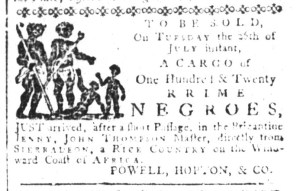
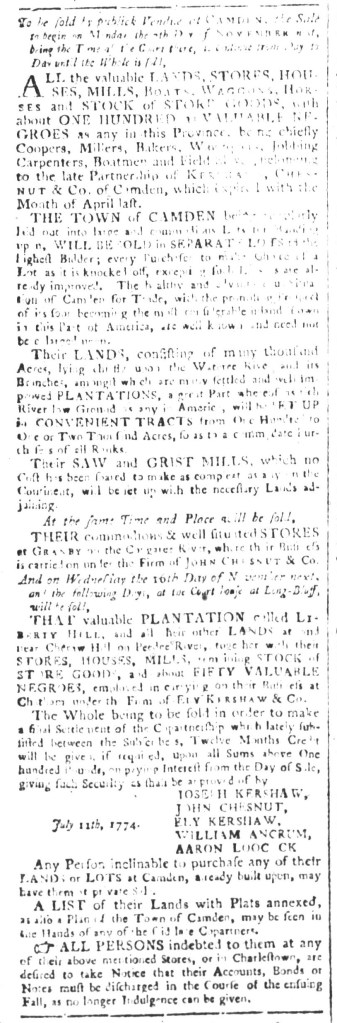
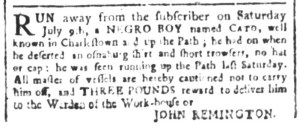
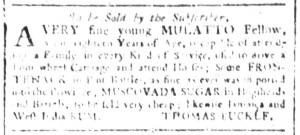
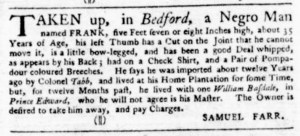
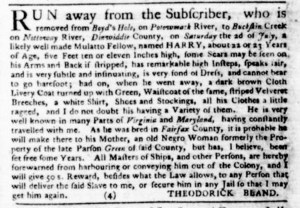
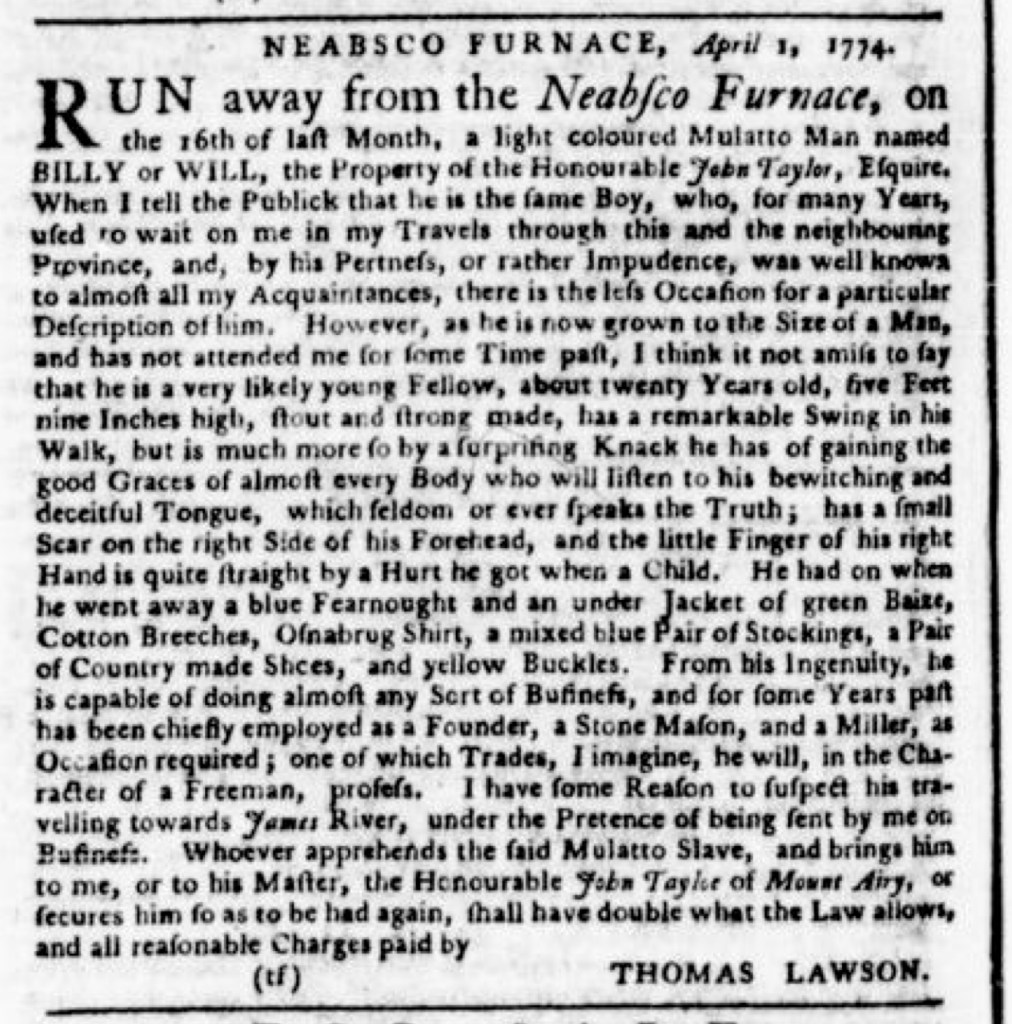
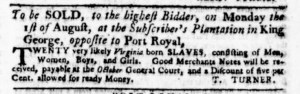
The Slavery Adverts 250 Project chronicles the role of newspaper advertising in perpetuating slavery in the era of the American Revolution. The project seeks to reveal the ubiquity of slavery in eighteenth-century life from New England to Georgia by republishing advertisements about enslaved people – for sale as individuals or in groups, wanted to purchase or for hire for short periods, runaways who liberated themselves, and those who were subsequently captured and confined in jails and workhouses – in daily digests on this site as well as in real time via the @SlaveAdverts250 Twitter feed, utilizing twenty-first-century media to stand in for the print media of the eighteenth century.

The project aims to provide modern audiences with a sense of just how often colonizers encountered these advertisements in their daily lives. Enslaved men, women, and children appeared in print somewhere in the colonies almost every single day. Those advertisements served as a constant backdrop for social, cultural, economic, and political life in colonial and revolutionary America. Colonizers who did not purport to own enslaved people were still confronted with slavery as well as invited to maintain the system by purchasing enslaved men, women, and children or assisting in the capture of so-called “runaways” who sought to free themselves from bondage. The frequency of these newspaper advertisements suggests just how embedded slavery was in colonial and revolutionary American culture in everyday interactions beyond the printed page.

These advertisements also testify to the experiences of enslaved men, women, and children, though readers must consider that those experiences have been remediated through descriptions offered by enslavers rather than enslaved people themselves. Often unnamed in the advertisements, enslaved men, women, and children were not invisible or unimportant in early America.

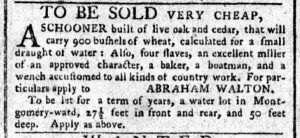
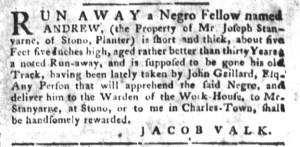
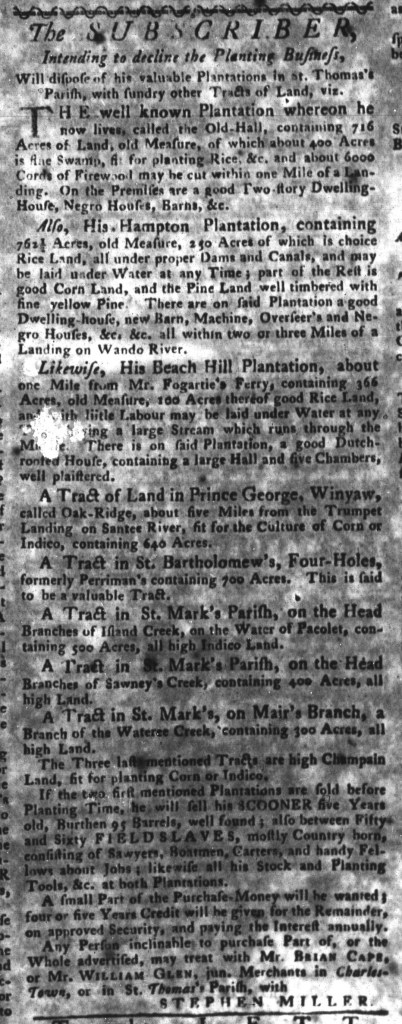
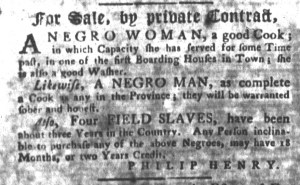
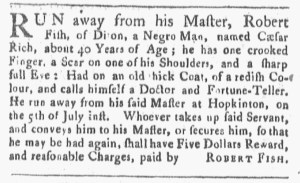
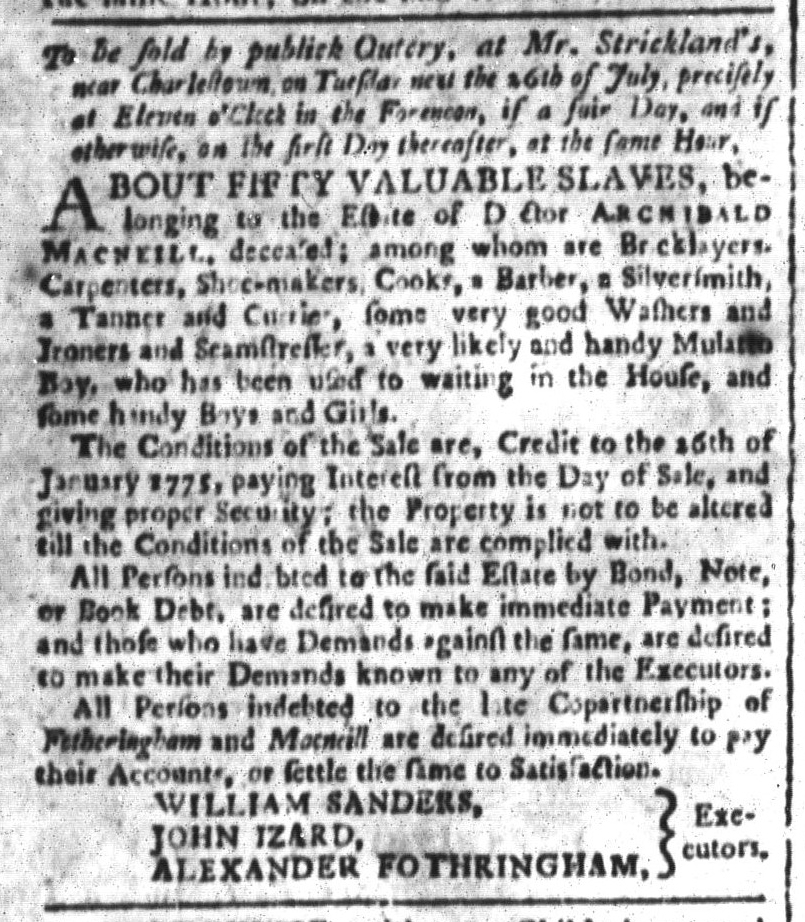
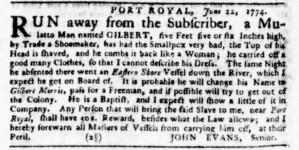
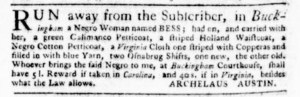
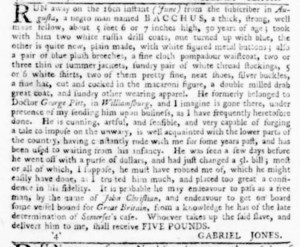
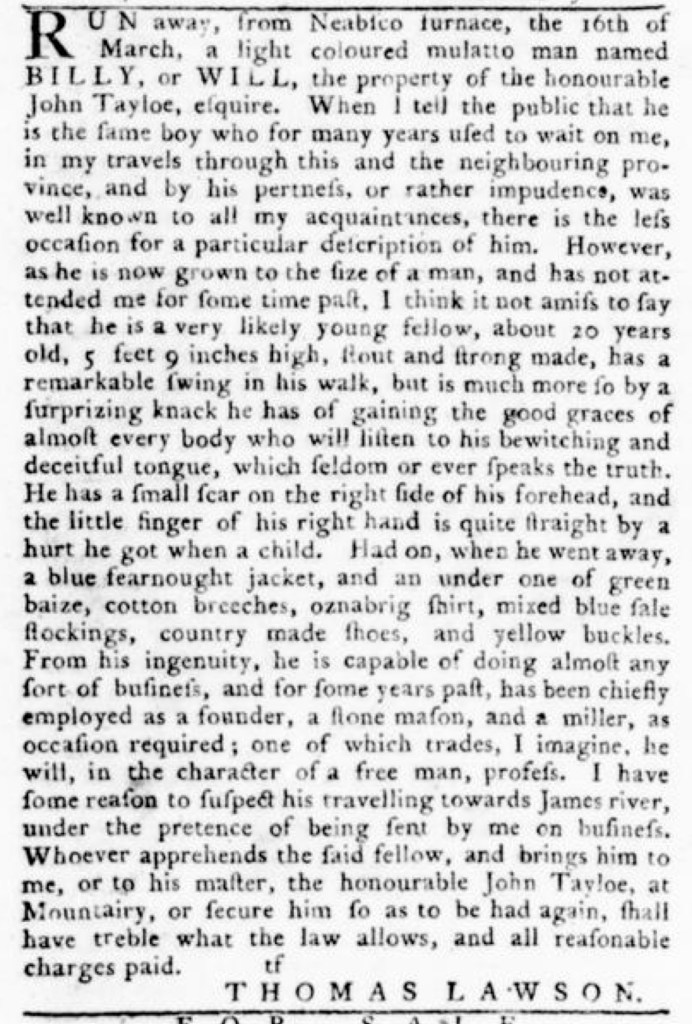
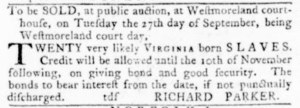
These advertisements appeared in colonial American newspapers 250 years ago today.

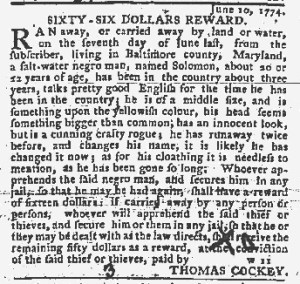
Boston Evening-Post (July 25, 1774).

**********

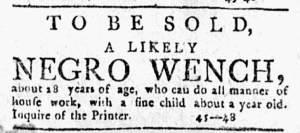
Boston-Gazette (July 25, 1774).

**********

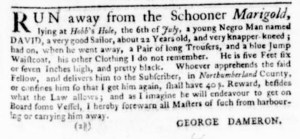
Postscript to Dunlap’s Pennsylvania Packet (July 25, 1774).

**********

New-York Gazette and Weekly Mercury (July 25, 1774).

**********

New-York Gazette and Weekly Mercury (July 25, 1774).

**********

South-Carolina Gazette (July 25, 1774).

**********

South-Carolina Gazette (July 25, 1774).

**********

South-Carolina Gazette (July 25, 1774).

**********

South-Carolina Gazette (July 25, 1774).

**********

Postscript to the South-Carolina Gazette (July 25, 1774).

**********

Postscript to the South-Carolina Gazette (July 25, 1774).

**********

Postscript to the South-Carolina Gazette (July 25, 1774).

**********

Postscript to the South-Carolina Gazette (July 25, 1774).

**********

Postscript to the South-Carolina Gazette (July 25, 1774).

July 24

What was advertised in a colonial American newspaper 250 years ago this week?

New-York Journal (July 21, 1774).

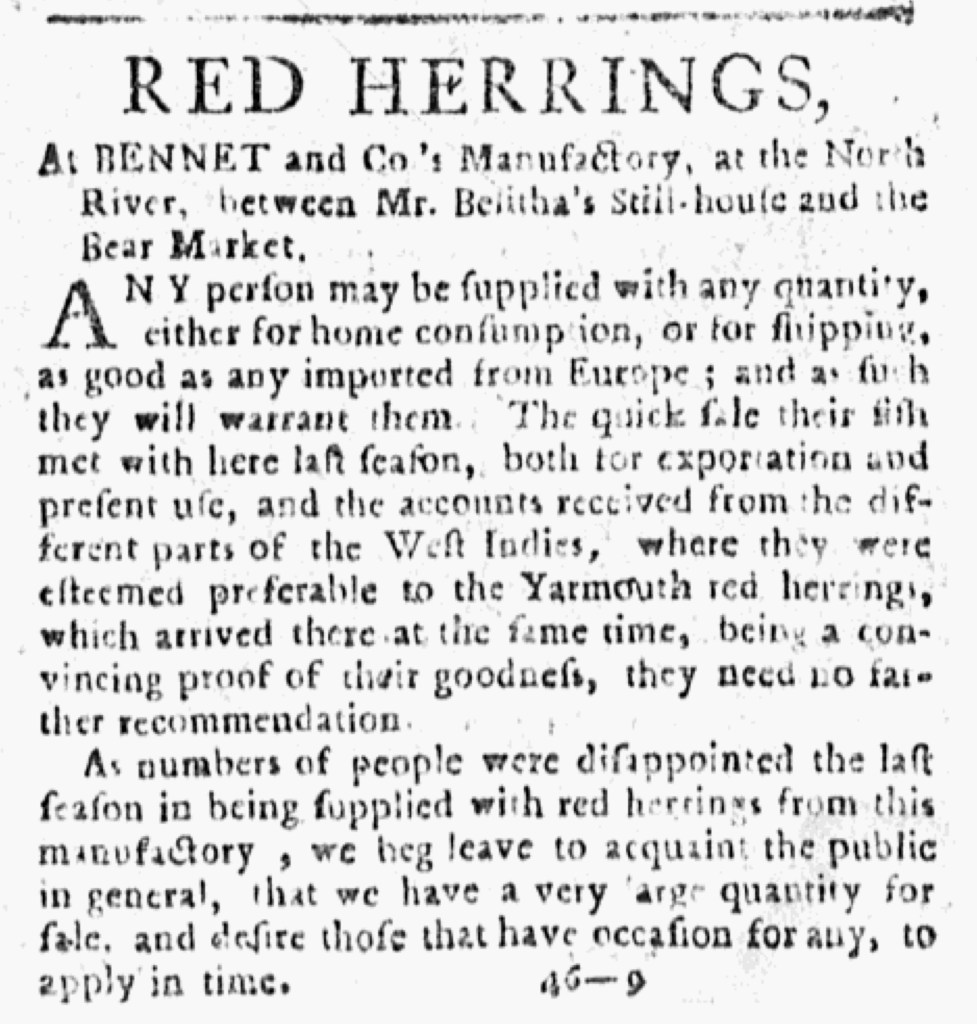
“The quick sale their fish met with here last season … being a convincing proof of their goodness.”

Bennet and Company offered a superior product that consumers did not want to miss.  That was their claim in an advertisement for “RED HERRINGS” that first appeared in the July 21, 1774, edition of the New-York Journal and continued for several weeks.  Bennet and Company began by comparing their herrings to imported alternatives, asserting that whether customers purchased them “for home consumption, or for shipping,” they would find them “as good as any imported from Europe.”  They were so confident in that claim that they “will warrant them” as such, extending a promise and a nonbinding guarantee.

Yet prospective customers did not have to take their word for it.  Bennet and Company offered other evidence to convince readers to choose their herrings over others.  They emphasized the “quick sale their fish met with here last season, both for exportation and present use.”  In addition, “the accounts received from the different parts of the West Indies … being a convincing proof of their goodness, they need no farther recommendation.”  Apparently, herrings from “BENNET and Co.’s Manufactory” in New York arrived in ports in the Caribbean at the same time as “Yarmouth red herrings” and consumers preferred the former over the latter.  Bennet and Company sought to build on that reputation.

To further make their case, they reported that “numbers of people were disappointed in the last season in being supplied with red herrings from this manufactory.”  Bennet and Company sold out before they could meet the demand for their product.  Keeping that in mind, they “acquaint[ed] the public in general, that we have a very large quantity for sale, and desire those that have occasion for any, to apply in time.”  In other words, Bennet and Company wished to serve as many customers as possible, but they could do so only while inventory lasted.  Readers had a limited time to purchase red herrings from Bennet and Company, the amount of time determined not by the producers themselves but by the speed of sales as consumers clamored for the popular product.  The advertisers highlighted demand as a strategy for inciting even greater demand.

July 23

What was advertised in a colonial American newspaper 250 years ago today?

Postscript Extraordinary to the Pennsylvania Journal (July 23, 1774).

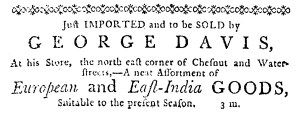
“Just IMPORTED … European and East-India GOODS.”

William Bradford and Thomas Bradford printed and distributed the Pennsylvania Journal on Wednesdays, but in the summer of 1774 they had news of such significance that they opted to issue a Postscript Extraordinary on a Saturday.  It bore the same number, 1650, as the weekly edition from July 20, but a different date, July 23, that confirms that the printers issued it a few days later than the weekly edition.  They had previously printed a two-page Supplement to the Pennsylvania Journal and a two-page Postscript to the Pennsylvania Journal, both dated July 20, that doubled the amount of content in the standard issue.  As the imperial crisis intensified, the Bradfords sought to provide extensive coverage for subscribers and other readers.

At the same time, they scooped the other newspapers printed in English in Philadelphia, Dunlap’s Pennsylvania Packetand the Pennsylvania Gazette.  The Postscript Extraordinary featured news from a “PROVINCIAL MEETING of DEPUTIES chosen by the several Counties in Pennsylvania; held at PHILADELPHIA” on July 15 and continuing for several days.  Dunlap’s Pennsylvania Packet carried the same news, perhaps reprinted from the Postscript Extraordinary, on Monday, July 25, its usual day of publication, two days after the Bradfords had disseminated it.  In turn, the Pennsylvania Gazette provided the same coverage in a Postscript that accompanied the weekly issue on Wednesday, July 27.  All three newspapers carried rhetoric that condemned the Boston Port Act and the anticipated passage of the Massachusetts Government Act as well as proposed instructions for Pennsylvania’s delegates who would attend “a Congress of Deputies from the several Colonies,” now known as the First Continental Congress.

Yet coverage of the meeting of delegates from throughout the colony did not fill both sides of the broadsheet.  A dozen advertisements completed the Postscript Extraordinary.  Disseminating the news provided an occasion provided another opportunity for circulating advertisements placed for various purposes, including notices for “European and East-India GOODS” sold by George Davis and “a large Assortment of DRY GOODS, and CROCKERY” imported by Alexander Bartram.  The Postscript Extraordinary gave those advertisements greater visibility, yet news from the meeting framed how colonizers might think about commerce and consumption in the current political environment.  Among their various resolutions, the deputies from across Pennsylvania’s counties supported a nonimportation agreement if the First Continental Congress determined that a boycott would aid in achieving their political goals.  At the same time, they cautioned that “the venders of Merchandize of every kind within this province, ought not to take advantage of Resolves relating to Non-Importation” by raising prices and gouging customers.  The news put all readers on notice about how to behave as consumers while also warning merchants, shopkeepers, and other purveyors of goods about how they should comport themselves.
Slavery Advertisements Published July 23, 1774

The Slavery Adverts 250 Project chronicles the role of newspaper advertising in perpetuating slavery in the era of the American Revolution. The project seeks to reveal the ubiquity of slavery in eighteenth-century life from New England to Georgia by republishing advertisements about enslaved people – for sale as individuals or in groups, wanted to purchase or for hire for short periods, runaways who liberated themselves, and those who were subsequently captured and confined in jails and workhouses – in daily digests on this site as well as in real time via the @SlaveAdverts250 Twitter feed, utilizing twenty-first-century media to stand in for the print media of the eighteenth century.

The project aims to provide modern audiences with a sense of just how often colonizers encountered these advertisements in their daily lives. Enslaved men, women, and children appeared in print somewhere in the colonies almost every single day. Those advertisements served as a constant backdrop for social, cultural, economic, and political life in colonial and revolutionary America. Colonizers who did not purport to own enslaved people were still confronted with slavery as well as invited to maintain the system by purchasing enslaved men, women, and children or assisting in the capture of so-called “runaways” who sought to free themselves from bondage. The frequency of these newspaper advertisements suggests just how embedded slavery was in colonial and revolutionary American culture in everyday interactions beyond the printed page.

These advertisements also testify to the experiences of enslaved men, women, and children, though readers must consider that those experiences have been remediated through descriptions offered by enslavers rather than enslaved people themselves. Often unnamed in the advertisements, enslaved men, women, and children were not invisible or unimportant in early America.

These advertisements appeared in colonial American newspapers 250 years ago today.

Postscript Extra to the Pennsylvania Journal (July 23, 1774).

**********

Providence Gazette (July 23, 1774).

July 22

What was advertised in a colonial American newspaper 250 years ago today?

South-Carolina and American General Gazette (July 22, 1774).

“Orders for Books, Stationary Wares, Book-binding & Printing Work.”

Like many other printers, Robert Wells, printer of the South-Carolina and American General Gazette used the colophon of his newspaper as an advertisement for that newspaper and a variety of goods and services available at his printing office.  His colophon, however, appeared in a different place than most others that ran either at the bottom of the final page or, less often, within the masthead at the top of the first page.  Wells placed his colophon at the bottom of the first page, extending across all four columns.  He sometimes devoted each of those columns to news, as was the case for the July 22, 1774, edition, yet other times included paid notices on the first page.  No matter what other content appeared, readers encountered an advertisement on the front page in the form of the colophon.  They did so repeatedly if they perused all four columns before examining the rest of the newspaper.

In that colophon, Wells gave a grand name to the site where he conducted business, calling it the “OLD PRINTING-HOUSE, GREAT STATIONARY and BOOK STORE.”  That name testified to his experience as a printer (“OLD”) and the quality and array of merchandise he stocked (“GREAT”).  He advised that he received “SUBSCRIPTIONS andADVERTISEMENTS for this Paper, which is circulated through all the SOUTHERN COLONIES, &c.”  That included Georgia and North Carolina in addition to South Carolina with “&c.” (et cetera) suggesting Virginia and Maryland as well.  The South-Carolina and American Gazette directly competed with the South-Carolina Gazette, printed by Peter Timothy, and the South-Carolina Gazette and Country Journal, printed by Charles Crouch, both published in Charleston.  In emphasizing the vast reach of his newspaper’s circulation, Wells sought to encourage advertisers who wished to disseminate information as widely as possible, whether they aimed to sell consumer goods, enslaved people, or real estate, or called on colonizers to settle accounts with businesses or the executors of estates or described enslaved people who had liberated themselves by running away from their enslavers.  The printer also accepted “Orders for Books, Stationary Wares, Book-binding & Printing Work,” a variety of goods and services enmeshed within the book trades.  “Printing Work” included broadsides, handbills, trade cards, catalogs, and other advertising ephemera for customers to distribute on their own, contributing to the culture of marketing in the colonies and disseminating information in print via means other than newspapers.  Wells wished to generate greater demand for printed materials, including advertisements, that would benefit both his customers and his business.  In doing so, he devised a colophon that did more than identify the location and printer of the South-Carolina and American General Gazette.

Slavery Advertisements Published July 22, 1774

The Slavery Adverts 250 Project chronicles the role of newspaper advertising in perpetuating slavery in the era of the American Revolution. The project seeks to reveal the ubiquity of slavery in eighteenth-century life from New England to Georgia by republishing advertisements about enslaved people – for sale as individuals or in groups, wanted to purchase or for hire for short periods, runaways who liberated themselves, and those who were subsequently captured and confined in jails and workhouses – in daily digests on this site as well as in real time via the @SlaveAdverts250 Twitter feed, utilizing twenty-first-century media to stand in for the print media of the eighteenth century.

The project aims to provide modern audiences with a sense of just how often colonizers encountered these advertisements in their daily lives. Enslaved men, women, and children appeared in print somewhere in the colonies almost every single day. Those advertisements served as a constant backdrop for social, cultural, economic, and political life in colonial and revolutionary America. Colonizers who did not purport to own enslaved people were still confronted with slavery as well as invited to maintain the system by purchasing enslaved men, women, and children or assisting in the capture of so-called “runaways” who sought to free themselves from bondage. The frequency of these newspaper advertisements suggests just how embedded slavery was in colonial and revolutionary American culture in everyday interactions beyond the printed page.

These advertisements also testify to the experiences of enslaved men, women, and children, though readers must consider that those experiences have been remediated through descriptions offered by enslavers rather than enslaved people themselves. Often unnamed in the advertisements, enslaved men, women, and children were not invisible or unimportant in early America.

These advertisements appeared in colonial American newspapers 250 years ago today.

New-Hampshire Gazette (July 22, 1774).

**********

South-Carolina and American General Gazette (July 22, 1774).

**********

South-Carolina and American General Gazette (July 22, 1774).

**********

South-Carolina and American General Gazette (July 22, 1774).

**********

South-Carolina and American General Gazette (July 22, 1774).

**********

South-Carolina and American General Gazette (July 22, 1774).

**********

South-Carolina and American General Gazette (July 22, 1774).

**********

South-Carolina and American General Gazette (July 22, 1774).

**********

South-Carolina and American General Gazette (July 22, 1774).

**********

South-Carolina and American General Gazette (July 22, 1774).

**********

South-Carolina and American General Gazette (July 22, 1774).

**********

South-Carolina and American General Gazette (July 22, 1774).

**********

South-Carolina and American General Gazette (July 22, 1774).

**********

South-Carolina and American General Gazette (July 22, 1774).

**********

South-Carolina and American General Gazette (July 22, 1774).

**********

South-Carolina and American General Gazette (July 22, 1774).

**********

South-Carolina and American General Gazette (July 22, 1774).

**********

South-Carolina and American General Gazette (July 22, 1774).

**********

South-Carolina and American General Gazette (July 22, 1774).

**********

South-Carolina and American General Gazette (July 22, 1774).

**********

South-Carolina and American General Gazette (July 22, 1774).

**********

South-Carolina and American General Gazette (July 22, 1774).

**********

South-Carolina and American General Gazette (July 22, 1774).

**********

South-Carolina and American General Gazette (July 22, 1774).

**********

South-Carolina and American General Gazette (July 22, 1774).

**********

South-Carolina and American General Gazette (July 22, 1774).

**********

South-Carolina and American General Gazette (July 22, 1774).

**********

South-Carolina and American General Gazette (July 22, 1774).

July 21

What was advertised in a colonial American newspaper 250 years ago today?

Supplement to Rivington’s New-York Gazetteer (July 21, 1774).

“He proposes to continue his business of pickling oysters and lobsters.”

James Rivington had sufficient content to include in the July 21, 1774, edition of Rivington’s New-York Gazetteer that he distributed a two-page supplement with the standard four-page issue.  The items in that supplement consisted entirely of paid notices, dozens of them.  In addition, advertising accounted for several columns alongside the news in the standard issue.  Only a few of those advertisements, however, featured visual images to aid in drawing the attention of readers.  Three had stock images of ships at sea, one for a sloop for sale, one seeking passengers and freight for a voyage to South Carolina, and one that “WANTS A FREIGHT, To any part of EUROPE.”  The printer supplied stock images for those notices.

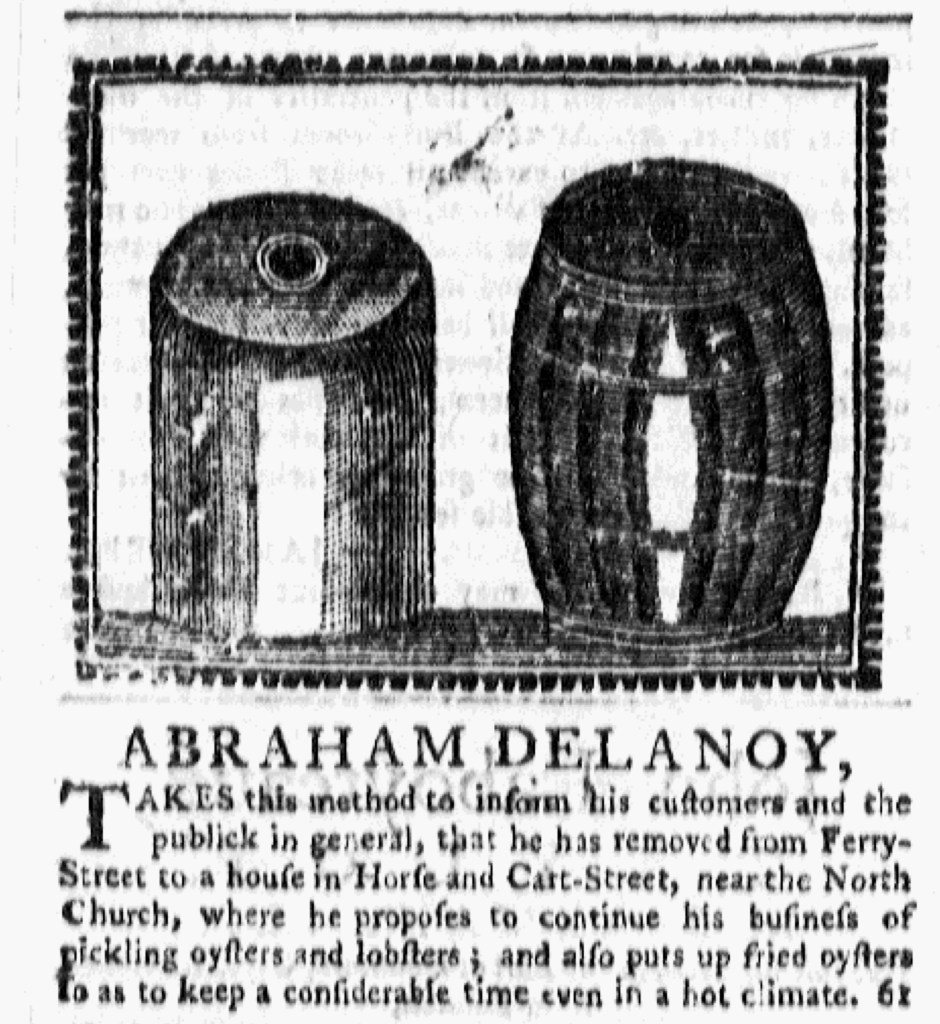
Three other advertisements sported woodcuts commissioned by the advertisers for their exclusive use, each of them providing a visual representation of some aspect of their business.  Thomas Ash, “WINDSOR CHAIR-MAKER,” once again incorporated the image of a chair that had accompanied his advertisements for several months.  Abraham Delanoy and James Webb also deployed images that had become familiar sights to readers over several weeks.  Delanoy advised readers that he moved to a new location where he “continue[d] his business of pickling oysters and lobsters” and “puts up fried oysters so as to keep a considerable time even in a hot climate.”  A woodcut depicting a lobster trap and an oyster cage appeared above his message to consumers.  Like Ash, Delanoy devoted as much space to his image as his copy, apparently believing that a picture was indeed worth a thousand words.  He trusted that the woodcut would as effectively market his wares as anything he might write.  He may have also figured that he had already established his reputation in the local marketplace so his primary purpose for the image could have been increasing the likelihood that customers saw his announcement that he had moved “from Ferry-Street to a house in Horse and Cart-Street.”

Supplement to Rivington’s New-York Gazetteer (July 21, 1774).

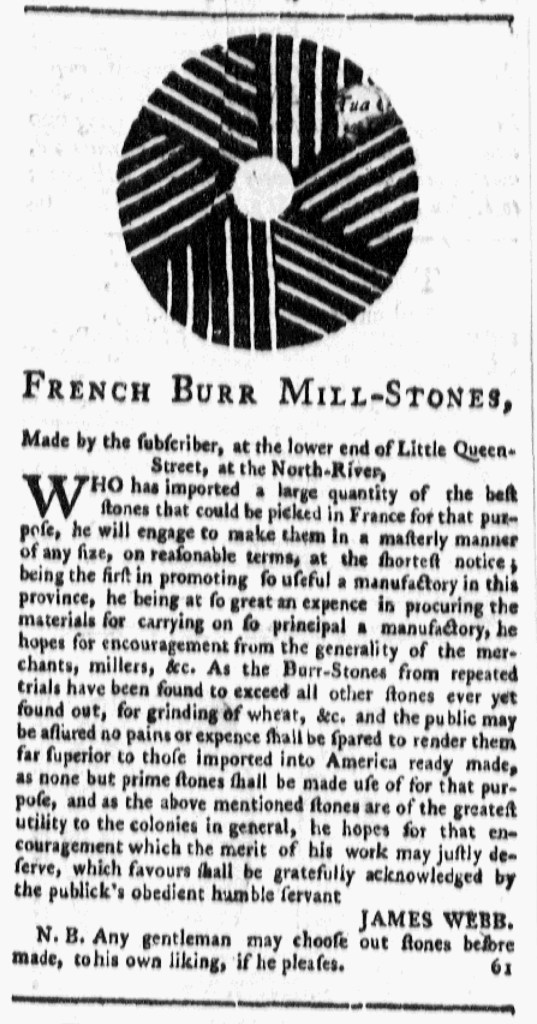
James Webb, on the other hand, used his woodcut of a millstone to advance a new endeavor unfamiliar to readers of Rivington’s New-York Gazetteer.  Accordingly, he devised significantly more copy to sell the “FRENCH BURR MILL-STONES” that he made from “the best stones that could be picked in France for that purpose.”  Webb claimed that he was “the first in promoting [or undertaking] so useful a manufactory in this province,” making it even more necessary that he provide an overview of his enterprise.  He asserted that he made millstones “in a masterly manner of any size, on reasonable terms, at the shortest notice,” succinctly incorporating appeals to quality, price, and convenience.  He suggested that millers, merchants, and others were already familiar with such millstones and knew that “from repeated trials [they] have been found to exceed all other stones ever yet found out.”  His millstones had the added advantage of being made in the colonies at a time that colonizers discussed the prospects of boycotting goods imported from Britain in response to the Coercive Acts passed by Parliament following the destruction of tea now known as the Boston Tea Party.  Webb pledged that “no pains or expence shall be spared to render [his millstones] far superior to those imported into America ready made,” while simultaneously reminding readers that they had a duty to support domestic manufactures.  To that end, his millstones “are of the greatest utility to the colonies in general.”  Just in case all of that did not convince prospective customers, Webb added a nota bene advising that “Any gentleman may choose out stones before made, to his own liking, if he pleases.”  In the end, that would yield even greater satisfaction with the finished product.

In each instance, the woodcuts that Ash, Delanoy, and Webb included in their advertisements happened to be the only visual images that appeared on that page of the July 21 edition of Rivington’s New-York Gazetteer.  Most likely that was by coincidence rather than design, yet it still helped in distinguishing their notices from others.  (The three images of ships appeared in a cluster, one after the other, on another page.)  Ash, Delanoy, and Webb had to pay additional fees to commission their woodcuts, but they very well may have determined that doing so was worth the investment.

Slavery Advertisements Published July 21, 1774

The Slavery Adverts 250 Project chronicles the role of newspaper advertising in perpetuating slavery in the era of the American Revolution. The project seeks to reveal the ubiquity of slavery in eighteenth-century life from New England to Georgia by republishing advertisements about enslaved people – for sale as individuals or in groups, wanted to purchase or for hire for short periods, runaways who liberated themselves, and those who were subsequently captured and confined in jails and workhouses – in daily digests on this site as well as in real time via the @SlaveAdverts250 Twitter feed, utilizing twenty-first-century media to stand in for the print media of the eighteenth century.

The project aims to provide modern audiences with a sense of just how often colonizers encountered these advertisements in their daily lives. Enslaved men, women, and children appeared in print somewhere in the colonies almost every single day. Those advertisements served as a constant backdrop for social, cultural, economic, and political life in colonial and revolutionary America. Colonizers who did not purport to own enslaved people were still confronted with slavery as well as invited to maintain the system by purchasing enslaved men, women, and children or assisting in the capture of so-called “runaways” who sought to free themselves from bondage. The frequency of these newspaper advertisements suggests just how embedded slavery was in colonial and revolutionary American culture in everyday interactions beyond the printed page.

These advertisements also testify to the experiences of enslaved men, women, and children, though readers must consider that those experiences have been remediated through descriptions offered by enslavers rather than enslaved people themselves. Often unnamed in the advertisements, enslaved men, women, and children were not invisible or unimportant in early America.

These advertisements appeared in colonial American newspapers 250 years ago today.

Maryland Gazette (July 21, 1774).

**********

Maryland Gazette (July 21, 1774).

**********

Maryland Gazette (July 21, 1774).

**********

Massachusetts Gazette and Boston Weekly News-Letter (July 21, 1774).

**********

Supplement to the New-York Journal (July 21, 1774).

**********

Virginia Gazette [Purdie and Dixon] (July 21, 1774).

**********

Virginia Gazette [Purdie and Dixon] (July 21, 1774).

**********

Virginia Gazette [Purdie and Dixon] (July 21, 1774).

**********

Virginia Gazette [Purdie and Dixon] (July 21, 1774).

**********

Virginia Gazette [Purdie and Dixon] (July 21, 1774).

**********

Virginia Gazette [Purdie and Dixon] (July 21, 1774).

**********

Virginia Gazette [Purdie and Dixon] (July 21, 1774).

**********

Virginia Gazette [Purdie and Dixon] (July 21, 1774).

**********

Virginia Gazette [Purdie and Dixon] (July 21, 1774).

**********

Virginia Gazette [Purdie and Dixon] (July 21, 1774).

**********

Postscript to the Virginia Gazette [Purdie and Dixon] (July 21, 1774).

**********

Postscript to the Virginia Gazette [Purdie and Dixon] (July 21, 1774).

**********

Postscript to the Virginia Gazette [Purdie and Dixon] (July 21, 1774).

**********

Virginia Gazette [Rind] (July 21, 1774).

**********

Virginia Gazette [Rind] (July 21, 1774).

**********

Virginia Gazette [Rind] (July 21, 1774).

**********

Virginia Gazette [Rind] (July 21, 1774).

**********

Virginia Gazette [Rind] (July 21, 1774).

**********

Virginia Gazette [Rind] (July 21, 1774).

**********

Virginia Gazette [Rind] (July 21, 1774).

July 20

What was advertised in a colonial American newspaper 250 years ago today?

Pennsylvania Gazette (July 20, 1774).

“Patterns of the different prints may be seen at the Manufactory.”

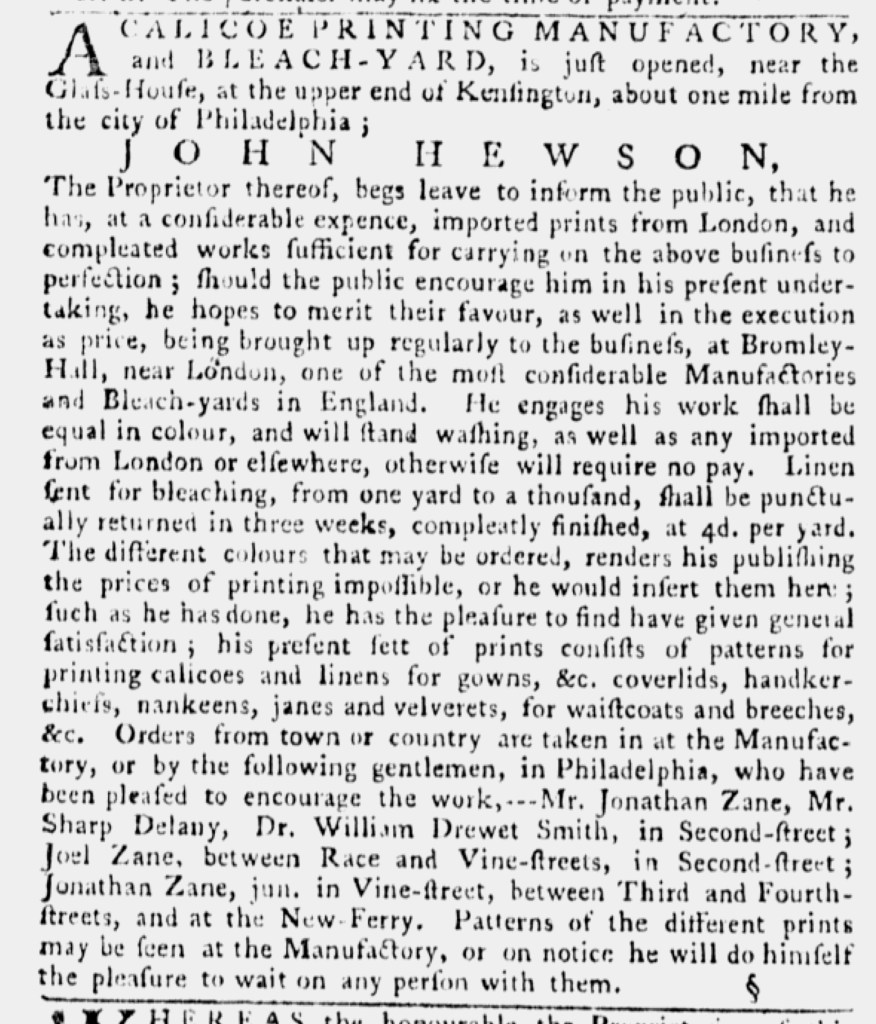
John Hewson joined the chorus of entrepreneurs promoting “domestic manufactures” or goods produced in the colonies as an alternative to imported goods when he announced that his “CALICOE PRINTING MANUFACTORY, and BLEACH-YARD, is just opened” on the outskirts of Philadelphia.  As the imperial crisis intensified, it became more important than ever for producers and consumers in the colonies to unite in opposition to the “oppressive and arbitrary yoke” of a “corrupt and designing Ministry.”  That was how an editorial addressed “To the INHABITANTS of the different COLONIES IN AMERICA” described current events.  The following pages of the July 20, 1774, edition of the Pennsylvania Gazette featured a “SUMMARY of Monday’s DEBATES on the BOSTON BILLS” (or the Coercive Acts), “RESOLUTIONS unanimously entered into by the Inhabitants of SOUTH-CAROLINA, at a General Meeting, held at Charles-Town,” and updates from other colonies about how they intended to respond to the Boston Port Act.

That made it an opportune time for Hewson to promote his new enterprise, one that he assured consumers rivaled in quality his competitors on the other side of the Atlantic.  At “considerable expence,” he had “imported prints from London, and completed works for carrying on [his] business to perfection.”  In addition, he possessed valuable experience, having been “brought up regularly to the business, at Bromley-Hall, near London, one of the most considerable Manufactories and Bleach-yards in England.”  Realizing that prospective customers may have been skeptical of his claims, Hewson offered a guarantee: “his work shall be equal in colour, and will stand washing, as well as any imported from London or elsewhere, otherwise will require no pay.”  Customers had nothing to lose if Hewson did not charge for work that they found unsatisfactory.  Furthermore, he charged reasonable prices for textile printing, though the extensive combinations of colors “renders his publishing the prices of printing impossible.”  Hewson had a variety of patterns for customers to order.  They could examine samples “at the Manufactory” or schedule appointments for Hewson to visit them.  They could also place orders “at the Manufactory” or leave them with one of several associates “who have been pleased to encourage the work” and, in turn, endorsed the endeavor by partnering with Hewson in receiving orders.

Hewson did not directly mention the deteriorating relationship between the colonies and Britain nor proposals for new nonimportation agreements intended to harness commerce as political leverage.  That hardly seemed necessary considering that readers almost certainly had current events in mind as they perused newspaper advertisements.  Hewson did not need to belabor the political advantages of supporting his “CALICOE PRINTING MANUFACTORY” when news items and editorials already did that work.