November 30

What was advertised in a colonial American newspaper 250 years ago today?
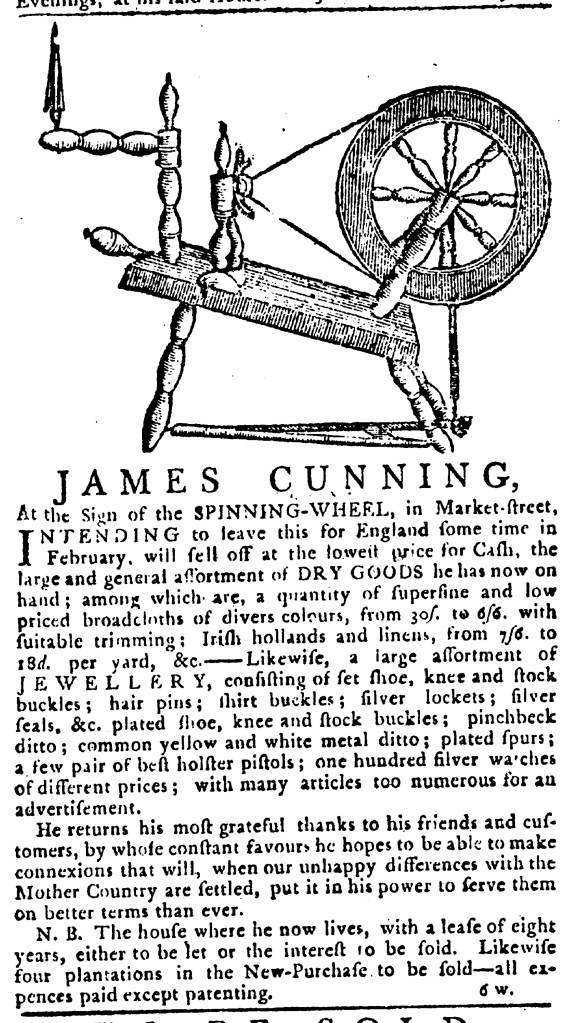
Pennsylvania Journal (November 30, 1774).

“The Sign of the SPINNING-WHEEL.”

James Cunning ran a shop “At the Sign of the SPINNING-WHEEL” in Philadelphia in the early 1770s, occasionally advertising in the local newspapers.  In the fall of 1774, he made plans to depart for England the following February.  His preparations included running a new notice and selling his remaining merchandise “at the lowest price for Cash.”  He did not indicate why he planned to leave Philadelphia or how long he would be away, but he did state that during his time on the other side of the Atlantic that he “hopes to be able to make connexions that will, when our unhappy differences with the Mother Country are settled, put it in his power to serve [his customers] on better terms than ever.”  Neither Cunning nor readers knew that armed conflict between the colonies and Britain would erupt in Massachusetts in April 1775 or that the “unhappy differences” would be settled with a war for independence that would last eight years.

They did know, however, that the imperial crisis had intensified to the point that delegates from twelve colonies convened the First Continental Congress in Philadelphia in September and October 1774.  They also knew that meeting resulted in the Continental Association, a nonimportation agreement intended to unify the colonies.  That pact was scheduled to go into effect on December 1, the day after Cunning’s advertisement made its first appearance in the Pennsylvania Journal. Envisioning the difficulty ahead, the shopkeeper may have decided to make the best of the situation by liquidating his inventory and making plans for what he hoped would be a better future.

Given the stakes, Cunning sought to increase the chances that readers would take note of his advertisement.  To that end, he included a woodcut that depicted a spinning wheel, the same device that marked the location of his shop.  He had incorporated that image into advertisements he placed in October 1771 and December 1772.  More recently, including in an advertisement in the December 6, 1773, edition of Dunlap’s Pennsylvania Packet, he did not feature a visual image.  When he decided to visit England, Cunning either remembered where he had stored the woodcut or managed to find it after some searching, determined to use it to his advantage during difficult times.  A nick in the spindle reveals that it was the same woodcut from his earlier advertisements, collected from the printing office where John Dunlap published the Pennsylvania Packet and later delivered to the printing office where William Bradford and Thomas Bradford published the Pennsylvania Journal.  The shopkeeper intended, at least one more time, to get a return on the investment he made when he commissioned the woodcut.

Slavery Advertisements Published November 30, 1774

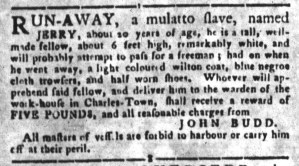
The Slavery Adverts 250 Project chronicles the role of newspaper advertising in perpetuating slavery in the era of the American Revolution. The project seeks to reveal the ubiquity of slavery in eighteenth-century life from New England to Georgia by republishing advertisements about enslaved people – for sale as individuals or in groups, wanted to purchase or for hire for short periods, runaways who liberated themselves, and those who were subsequently captured and confined in jails and workhouses – in daily digests on this site as well as in real time via the @SlaveAdverts250 Twitter feed, utilizing twenty-first-century media to stand in for the print media of the eighteenth century.

The project aims to provide modern audiences with a sense of just how often colonizers encountered these advertisements in their daily lives. Enslaved men, women, and children appeared in print somewhere in the colonies almost every single day. Those advertisements served as a constant backdrop for social, cultural, economic, and political life in colonial and revolutionary America. Colonizers who did not purport to own enslaved people were still confronted with slavery as well as invited to maintain the system by purchasing enslaved men, women, and children or assisting in the capture of so-called “runaways” who sought to free themselves from bondage. The frequency of these newspaper advertisements suggests just how embedded slavery was in colonial and revolutionary American culture in everyday interactions beyond the printed page.

These advertisements also testify to the experiences of enslaved men, women, and children, though readers must consider that those experiences have been remediated through descriptions offered by enslavers rather than enslaved people themselves. Often unnamed in the advertisements, enslaved men, women, and children were not invisible or unimportant in early America.

These advertisements appeared in colonial American newspapers 250 years ago today.

Pennsylvania Gazette (November 30, 1774).

November 29

What was advertised in a colonial American newspaper 250 years ago today?

Supplement to the South-Carolina Gazette and Country Journal (November 29, 1774).

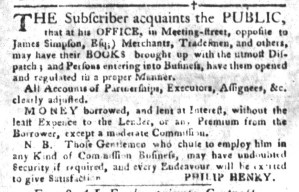
“Employ him in any Kind of Commission Business.”

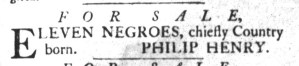
Philip Henry worked as a bookkeeper and a broker in Charleston on the eve of the American Revolution.  In an advertisement in the South-Carolina Gazette and Country Journal, he advised the public that “Merchants, Tradesmen, and others, may have their BOOKS brought up with the utmost Dispatch.”  Those considering embarking on a new endeavor could engage his services to have their accounts and ledgers “opened and regulated in a proper Manner” from the start.  In addition, he assisted with “any Kind of Commission Business,” whether commodities, real estate, or enslaved laborers.
As part of that aspect of his business, Henry placed many more advertisements on behalf of his clients.  In the supplement that accompanied the November 29, 1774, edition of the South-Carolina Gazette and Country Journal, for instance, his advertisement describing the variety of services he offered at his office on Meeting Street served as an introduction for a series of advertisements that ran immediately below it.  He inserted eight additional advertisements, six of them for real estate and two offering enslaved people for sale.  His brokerage business was good business for Charles Crouch, the printer of that newspaper.

Henry was not alone as a broker or as an advertiser.  Peter Bounetheau ran a similar notice, one that also served as an introduction to a series of other advertisements.  He placed eleven on another page of the supplement that included Henry’s notices, requiring enough space to fill an entire column and spill over into another.  Those included six about enslaved people, two about real estate, one on behalf of the executor of an estate, and one about several lots in the city, a plantation in the country, and “Several NEGROES.”  Similarly, Jacob Valk, another broker, inserted advertisements that accounted for a significant amount of space in November 29 edition.  He collated most of the real estate handled by his office into a single advertisement that filled a column, yet placed five separate advertisements about enslaved people as well as an estate notice and an advertisement about horses.

Henry, Bounetheau, and Valk industriously placed their notices in the South-Carolina and American General Gazette and the South-Carolina Gazette in addition to the South-Carolina Gazette and Country Journal.  Even though brokers ran offices in other urban ports, they did not adopt a similar advertising strategy as part of their business model.  That made the rhythm of advertising in South Carolina’s newspapers distinctive compared to those published in Boston, New York, and Philadelphia.

Slavery Advertisements Published November 29, 1774

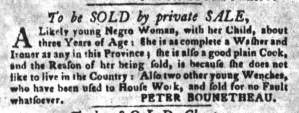
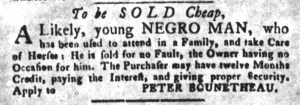
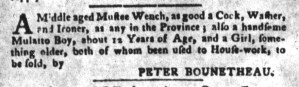
The Slavery Adverts 250 Project chronicles the role of newspaper advertising in perpetuating slavery in the era of the American Revolution. The project seeks to reveal the ubiquity of slavery in eighteenth-century life from New England to Georgia by republishing advertisements about enslaved people – for sale as individuals or in groups, wanted to purchase or for hire for short periods, runaways who liberated themselves, and those who were subsequently captured and confined in jails and workhouses – in daily digests on this site as well as in real time via the @SlaveAdverts250 Twitter feed, utilizing twenty-first-century media to stand in for the print media of the eighteenth century.

The project aims to provide modern audiences with a sense of just how often colonizers encountered these advertisements in their daily lives. Enslaved men, women, and children appeared in print somewhere in the colonies almost every single day. Those advertisements served as a constant backdrop for social, cultural, economic, and political life in colonial and revolutionary America. Colonizers who did not purport to own enslaved people were still confronted with slavery as well as invited to maintain the system by purchasing enslaved men, women, and children or assisting in the capture of so-called “runaways” who sought to free themselves from bondage. The frequency of these newspaper advertisements suggests just how embedded slavery was in colonial and revolutionary American culture in everyday interactions beyond the printed page.

These advertisements also testify to the experiences of enslaved men, women, and children, though readers must consider that those experiences have been remediated through descriptions offered by enslavers rather than enslaved people themselves. Often unnamed in the advertisements, enslaved men, women, and children were not invisible or unimportant in early America.

These advertisements appeared in colonial American newspapers 250 years ago today.

South-Carolina Gazette and Country Journal (November 29, 1774).

**********

South-Carolina Gazette and Country Journal (November 29, 1774).

**********

South-Carolina Gazette and Country Journal (November 29, 1774).

**********

South-Carolina Gazette and Country Journal (November 29, 1774).

**********

South-Carolina Gazette and Country Journal (November 29, 1774).

**********

South-Carolina Gazette and Country Journal (November 29, 1774).

**********

South-Carolina Gazette and Country Journal (November 29, 1774).

**********

South-Carolina Gazette and Country Journal (November 29, 1774).

**********

South-Carolina Gazette and Country Journal (November 29, 1774).

**********

South-Carolina Gazette and Country Journal (November 29, 1774).

**********

Supplement to the South-Carolina Gazette and Country Journal (November 29, 1774).

**********

Supplement to the South-Carolina Gazette and Country Journal (November 29, 1774).

**********

Supplement to the South-Carolina Gazette and Country Journal (November 29, 1774).

**********

Supplement to the South-Carolina Gazette and Country Journal (November 29, 1774).

**********

Supplement to the South-Carolina Gazette and Country Journal (November 29, 1774).

**********

Supplement to the South-Carolina Gazette and Country Journal (November 29, 1774).

**********

Supplement to the South-Carolina Gazette and Country Journal (November 29, 1774).

**********

Supplement to the South-Carolina Gazette and Country Journal (November 29, 1774).

**********

Supplement to the South-Carolina Gazette and Country Journal (November 29, 1774).

**********

Supplement to the South-Carolina Gazette and Country Journal (November 29, 1774).

**********

Supplement to the South-Carolina Gazette and Country Journal (November 29, 1774).

**********

Supplement to the South-Carolina Gazette and Country Journal (November 29, 1774).

**********

Supplement to the South-Carolina Gazette and Country Journal (November 29, 1774).

**********

Supplement to the South-Carolina Gazette and Country Journal (November 29, 1774).

**********

Supplement to the South-Carolina Gazette and Country Journal (November 29, 1774).

**********

Supplement to the South-Carolina Gazette and Country Journal (November 29, 1774).

**********

Supplement to the South-Carolina Gazette and Country Journal (November 29, 1774).

November 28

What was advertised in a colonial American newspaper 250 years ago today?

Supplement to the New-York Gazette and Weekly Mercury (November 28, 1774).

“All sorts of organs, harpsichords, spinnets and Fortepianoes.”

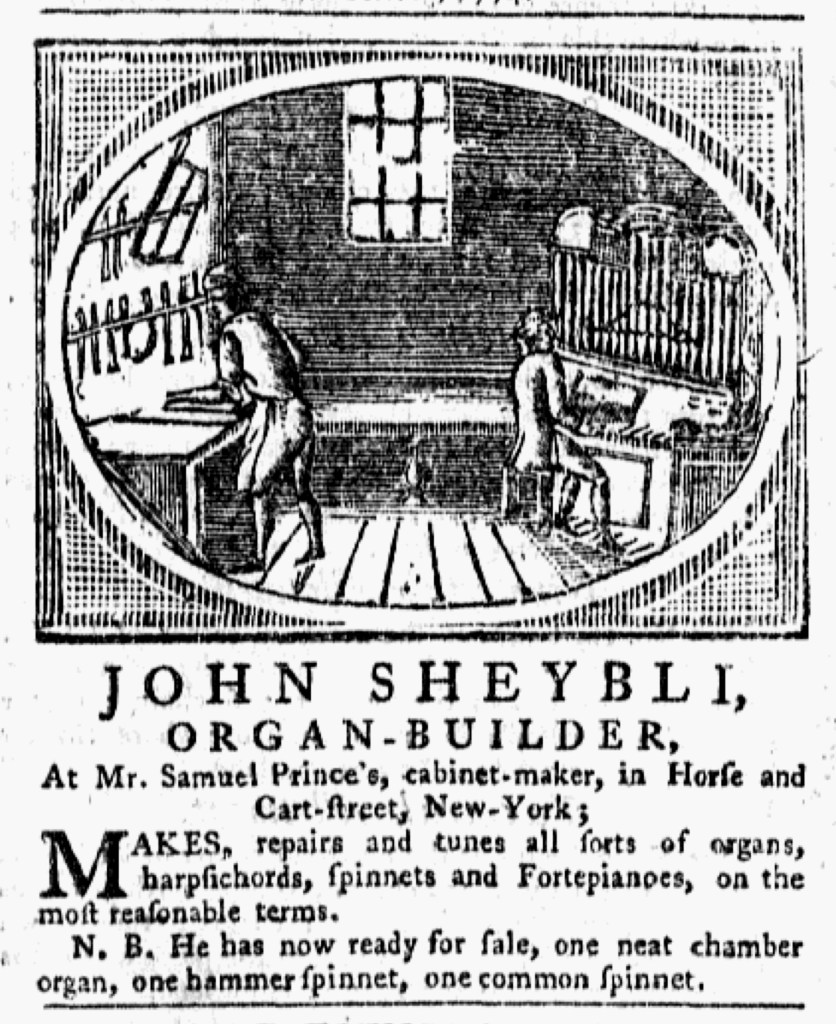
In the fall of 1774, John Sheybli, an “ORGAN-BUILDER,” took to the pages of the New-York Gazette and Weekly Mercury to advise the public that he “MAKES, repairs and tunes all sorts of organs, harpsichords, spinnets and Fortepianoes, on the most reasonable terms.”  In addition, he “has now ready for sale, one neat chamber organ, one hammer spinnet, [and] one common spinnet” at the workshop he shared with Samuel Prince, a cabinetmaker.

Readers of the New-York Gazette and Weekly Mercury likely perused the copy in Sheybli’s advertisement only after noticing the visual image that accompanied it.  A woodcut featured a scene with two men within an oval frame.  The man on the left stood at a workbench with an array of tools hanging on the wall over it and the man on the right was seated at an organ, maybe tuning it or maybe playing it.  Perhaps it was a depiction of the workshop where Sheybli built organs and other instruments on Horse and Cart Street, though it may have been an idealized portrait of the artisan at work and a customer enjoying the product of those labors.  Readers could determine for themselves how they wished to interpret it.

No matter which narrative they imagined, Sheybli treated them to a visual image unlike others they encountered in the New-York Gazette and Weekly Mercury and other newspapers.  Advertisers sometimes included woodcuts that represented some aspect of their business, but they focused on specific goods or replicated their shop signs.  They almost never showed people, neither at work producing the items offered for sale nor at leisure enjoying their purchases.  The November 28, 1774, edition of the New-York Gazette and Weekly Mercury and its supplement had three advertisements with woodcuts commissioned by the advertisers.  Lyon Jonas, a furrier, once again ran his notice with an image of some of the goods he produced, a muff and a tippet, while Nicholas Cox, a hatter, incorporated what may have been a variation of the sign that marked his location.  His woodcut showed a crown above a tricorne hat.  Readers were accustomed to those kinds of images, but much less often saw the sort of scene that Sheybli presented in his advertisement.  That almost certainly helped in making it memorable.

Slavery Advertisements Published November 28, 1774

The Slavery Adverts 250 Project chronicles the role of newspaper advertising in perpetuating slavery in the era of the American Revolution. The project seeks to reveal the ubiquity of slavery in eighteenth-century life from New England to Georgia by republishing advertisements about enslaved people – for sale as individuals or in groups, wanted to purchase or for hire for short periods, runaways who liberated themselves, and those who were subsequently captured and confined in jails and workhouses – in daily digests on this site as well as in real time via the @SlaveAdverts250 Twitter feed, utilizing twenty-first-century media to stand in for the print media of the eighteenth century.

The project aims to provide modern audiences with a sense of just how often colonizers encountered these advertisements in their daily lives. Enslaved men, women, and children appeared in print somewhere in the colonies almost every single day. Those advertisements served as a constant backdrop for social, cultural, economic, and political life in colonial and revolutionary America. Colonizers who did not purport to own enslaved people were still confronted with slavery as well as invited to maintain the system by purchasing enslaved men, women, and children or assisting in the capture of so-called “runaways” who sought to free themselves from bondage. The frequency of these newspaper advertisements suggests just how embedded slavery was in colonial and revolutionary American culture in everyday interactions beyond the printed page.

These advertisements also testify to the experiences of enslaved men, women, and children, though readers must consider that those experiences have been remediated through descriptions offered by enslavers rather than enslaved people themselves. Often unnamed in the advertisements, enslaved men, women, and children were not invisible or unimportant in early America.

These advertisements appeared in colonial American newspapers 250 years ago today.

Connecticut Courant (November 28, 1774).

**********

Postscript to Dunlap’s Pennsylvania Packet (November 28, 1774).

**********

Postscript to Dunlap’s Pennsylvania Packet (November 28, 1774).

**********

Newport Mercury (November 28, 1774).

**********

Newport Mercury (November 28, 1774).

**********

New-York Gazette and Weekly Mercury (November 28, 1774).

**********

Supplement to the New-York Gazette and Weekly Mercury (November 28, 1774).

November 27

What was advertised in a colonial American newspaper 250 years ago this month?

Massachusetts Gazette and Boston Weekly News-Letter (November 17, 1774).

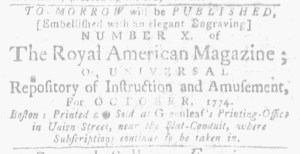
“NUMBER X. of The Royal American Magazine.”

The Adverts 250 Project has tracked advertisements for the Royal American Magazine from Thomas’s first notice, in May 1773, that he planned to distribute subscription proposals to newspapers advertisements in June, July, August, September, October, November, and December 1773 and January, February, March, April, May, and June 1774.  No magazine appeared in July 1774 because of the “Distresses,” yet they resumed in August, September, and October.

In the first week of November 1774, Joseph Greenleaf took to the pages of two of the newspapers printed in Boston to announce that he had published a new issue of the Royal American Magazine.  His advertisement for the September issue that already appeared in the October 31 edition of the Boston Evening-Post ran in that newspaper once again on November 7.  It actually appeared twice, once on the third page and once on the fourth.  The compositor likely made an error.  In addition, a similar advertisement appeared in the Massachusetts Gazette and Boston Weekly News-Letter on November 3, following up on a notice from October 27 that stated the magazine would be published the following day.

Greenleaf had been busy trying to catch up on overdue editions since he acquired the magazine from Isaiah Thomas in August.  Thomas had fallen behind due to the “Distresses of the Town of Boston” following the Boston Port Act and other Coercive Acts that went into effect in the summer of 1774.  He originally planned to suspend publication of the magazine, but then decided to transfer ownership to Greenleaf.  In the eighteenth century, monthly magazines usually appeared at the end of the month, so subscribers expected the October edition near the end of October or in the first week of November.  The September edition that Greenleaf advertised at the end of October and the beginning of November was a month overdue, yet the new publisher had made progress in getting back on schedule.

However, he may not have been able to improve on that progress.  The advertisements make it difficult to determine.  On November 17, Greenleaf placed advertisements in the Massachusetts Gazette and Boston Weekly News-Letter and the Massachusetts Spy.  In both, he stated that he would publish the October edition of the Royal American Magazine TO-MORROW.”  In the Massachusetts Gazette and Boston Weekly News-Letter, he noted that “an elegant Engraving” accompanied the magazine, though he did not reveal its subject, and stated that “Subscriptions continue to be taken in.”  If Greenleaf did indeed publish the October edition of the magazine on November 18, then he made gains on the delinquent issue, disseminating it less than three weeks behind schedule.

Yet no advertisements for the Royal American Magazine ran in any of Boston’s five newspapers throughout the remainder of the month.  For Greenleaf to publish a new issue and not advertise it deviated from the practice he had established during his time as proprietor.  No advertisement for the October edition of the Royal American Magazineappeared until a notice declared it “THIS DAY PUBLISHED” in the Boston Evening-Post on December 5.  Eighteenth-century readers knew that headline meant a book, almanac, pamphlet, magazine, or other publication was available for purchase, not necessarily that it was released for the first time on that date.  That means that the October edition could have been published any time between November 18 and December 5.  The date on the cover did not reveal the complicated publication history of that issue of the Royal American Magazine.

**********

JUST PUBLISHED … Royal American Magazine … For SEPTEMBER, 1774”

  • November 3 – Massachusetts Gazette and Boston Weekly News-Letter (first appearance)

THIS DAY PUBLISHED … NUMBER IX … Embellished with an elegant Engraving”

  • November 7 – Boston Evening-Post (second appearance and third appearance)

TO-MORROW will be PUBLISHED … Royal American Magazine … For OCTOBER, 1774”

  • November 17 – Massachusetts Gazette and Boston Weekly News-Letter (first appearance)

To-Morrow will be published, THE Royal American MAGAZINE, for OCTOBER, 1774”

  • November 17 – Massachusetts Spy (first appearance)

November 26

What was advertised in a colonial American newspaper 250 years ago today?

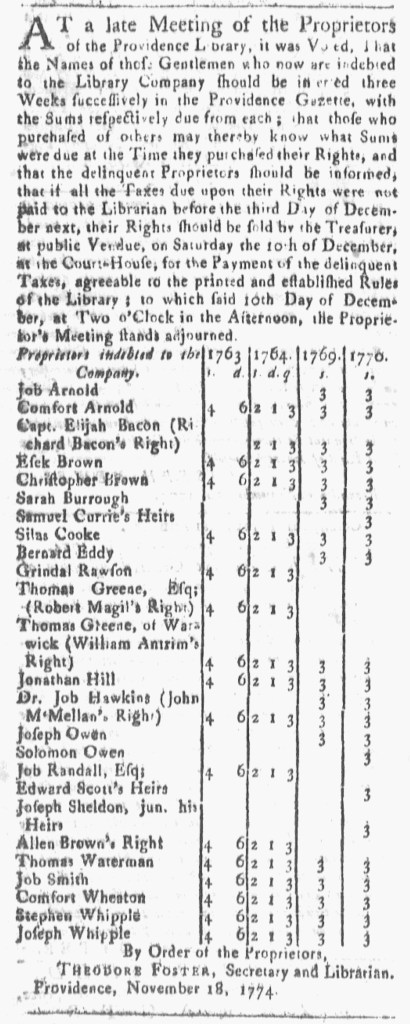
Providence Gazette (November 26, 1774).

“Names of those Gentlemen who are now indebted to the Library Company should be inserted … in the Providence Gazette.”

The Providence Library Company, a private subscription library, conducted some of its business in the public prints in the eighteenth century.  Early in the fall of 1774, Theodore Foster, the librarian, ran an advertisement in the Providence Gazette, requesting that “All Persons … who have any Books belonging to the Library … return the same immediately” so they could be “examined and numbered.”  In addition to conducting an inventory of the collection, the librarian was “ready to settle with the delinquent Proprietors” who had not paid their subscriptions.

At the end of November, Foster published a new advertisement in the wake of a vote at a recent “Meeting of the Proprietors.”  They had decided that “the Names of those Gentlemen who are now indebted to the Library Company should we inserted three Weeks successively in the Providence Gazette, with the Sums respectively due from each.”  That list consisted of more than two dozen subscribers, most of them with debts going back more than a decade.  The proprietors in good standing determined that the grace period had extended long enough.  Accordingly, the advertisement also informed the delinquent subscribers that if they did not make payment before December 3 then “their Rights should be sold by the Treasurer” at a public auction on December 10.  They took that action “agreeable to the printed and established Rules of the Library.”  The advertisement first ran on November 19 and again on November 26.  It made its final appearance on December 3, the deadline for settling accounts.  Perhaps Foster offered a little more leeway, provided subscribers paid before the auction on December 10, but the advertisement made clear that overdue subscriptions would be addressed, one way or another, “By Order of the Proprietors.”  Their next meeting was scheduled for the day of the auction, an opportunity to assess the outcome of their efforts to get everything in good order.

As was often the case, advertisements like this one relayed local news to the readers of the Providence Gazette.  John Carter, the printer, selected which news and editorials to publish elsewhere in the newspaper, yet purchasing advertising space gave individuals and organizations opportunities to become editors who decided on some of the information presented to the public.

Slavery Advertisements Published November 26, 1774

The Slavery Adverts 250 Project chronicles the role of newspaper advertising in perpetuating slavery in the era of the American Revolution. The project seeks to reveal the ubiquity of slavery in eighteenth-century life from New England to Georgia by republishing advertisements about enslaved people – for sale as individuals or in groups, wanted to purchase or for hire for short periods, runaways who liberated themselves, and those who were subsequently captured and confined in jails and workhouses – in daily digests on this site as well as in real time via the @SlaveAdverts250 Twitter feed, utilizing twenty-first-century media to stand in for the print media of the eighteenth century.

The project aims to provide modern audiences with a sense of just how often colonizers encountered these advertisements in their daily lives. Enslaved men, women, and children appeared in print somewhere in the colonies almost every single day. Those advertisements served as a constant backdrop for social, cultural, economic, and political life in colonial and revolutionary America. Colonizers who did not purport to own enslaved people were still confronted with slavery as well as invited to maintain the system by purchasing enslaved men, women, and children or assisting in the capture of so-called “runaways” who sought to free themselves from bondage. The frequency of these newspaper advertisements suggests just how embedded slavery was in colonial and revolutionary American culture in everyday interactions beyond the printed page.

These advertisements also testify to the experiences of enslaved men, women, and children, though readers must consider that those experiences have been remediated through descriptions offered by enslavers rather than enslaved people themselves. Often unnamed in the advertisements, enslaved men, women, and children were not invisible or unimportant in early America.

These advertisements appeared in colonial American newspapers 250 years ago today.

Providence Gazette (November 26, 1774).

November 25

What was advertised in a colonial American newspaper 250 years ago today?

South-Carolina and American General Gazette (November 25, 1774).

“EXTRACTS from the VOTES and PROCEEDINGS of the AMERICAN CONTINENTAL CONGRESS.”

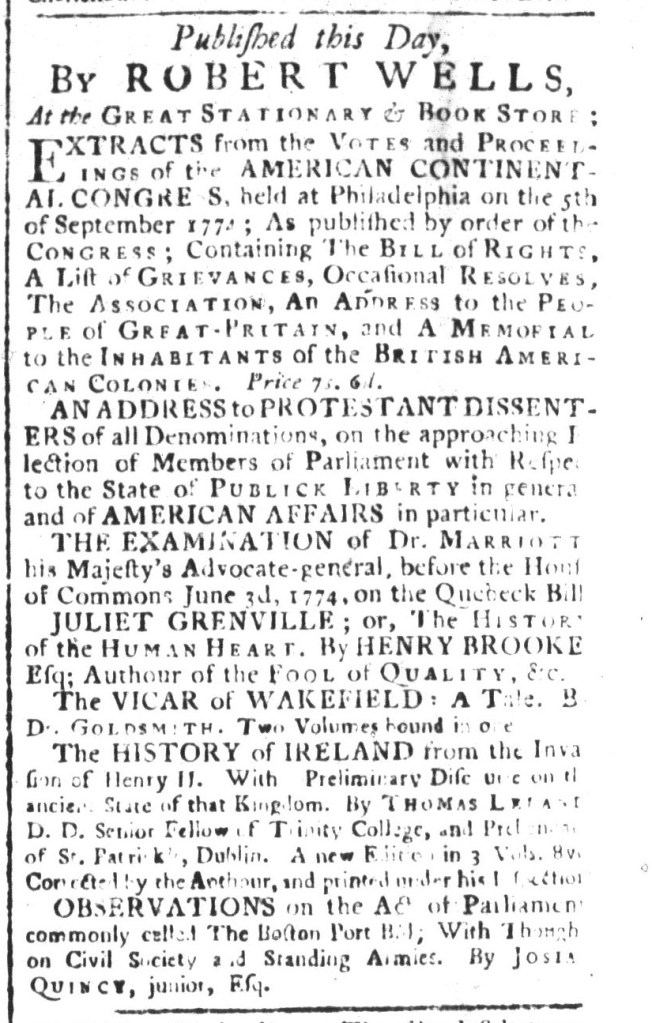
As soon as the First Continental Congress adjourned near the end of October 1774, printers set about publishing, advertising, and selling “EXTRACTS from the VOTES and PROCEEDINGS of the AMERICAN CONTINENTAL CONGRESS, held at Philadelphia.”  William Bradford and Thomas Bradford, printers of the Pennsylvania Journal, were the first to advertise this political pamphlet, but other printers soon advertised that they produced local editions in their own towns, helping to disseminate the news far and wide.  Conveniently packaging “The BILL of RIGHTS, A List of GRIEVANCES, Occasional RESOLVES, The ASSOCIATION, An ADDRESS to the PEOPLE of GREAT-BRITAIN, and A MEMORIAL to the INHABITANTS of the BRITISH AMERICAN COLONIES” in one volume, this pamphlet supplemented coverage in newspapers.  Its format allowed for easier reference than saving and scouring issue after issue of newspapers that relayed some but not all the contents of the Extracts.  The pamphlet met with such demand that some printers quickly printed second editions.  In the November 24 edition of the Norwich Packet, for instance, Alexander Robertson, James Robertson, and John Trumbull advertised the “second Norwich EDITION” of the Extracts.

The Adverts 250 Project has examined the publication and dissemination of the Extracts in Pennsylvania, the neighboring colonies of Maryland and New York, and multiple towns in New England.  It took a little longer for printers in southern colonies to publish the pamphlet, but within a month of the First Continental Congress finishing its business Robert Wells, the printer of the South-Carolina and American General Gazette, advised readers that they could purchase the Extracts at his “GREAT STATIONARY & BOOK STORE.”  Unlike other printers who ran separate advertisements for the pamphlet, Wells included it among a list of half a dozen titles he sold.  He gave it a privileged place, first on the list, acknowledging its importance and likely interest among readers.  The other items included a couple of novels and a history of Ireland, but Wells concluded the list with “OBSERVATIONS on the Act of Parliament commonly called The Boston Port Bill, With Thoughts on Civil Society and Standing Armies.  By JOSIAH QUINCY, junior, Esq.”  Among the many volumes available at his bookstore, Wells chose to emphasize two concerning current events as the imperial crisis intensified.  Like so many other printers, he marketed items that supplemented the news he published in his newspaper.