June 30

What was advertised in a revolutionary American newspaper 250 years ago today?
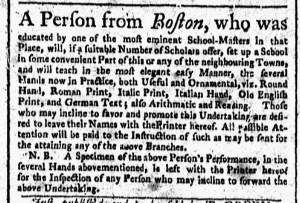
Connecticut Gazette (June 30, 1775).

“A Person from Boston … will teach … the several Hands now in Practice.”

A “Person from Boston” sought to open a school in southwestern Connecticut in the summer of 1775.  He placed an advertisement in the Connecticut Gazette in hopes of reaching prospective pupils and their families, stating that he would commence instruction in New Haven “or any of the neighbouring Towns” if a sufficient number of “Scholars” signed up for lessons.  In addition to reading and arithmetic, he taught “the several Hands now in Practice, both Useful and Ornamental,” including “Round Hand, Roman Print, Italic Print, Italian Hand, Old English Print, and German Text.”

The schoolmaster did not give his name, instead merely identifying himself as a “Person from Boston, who was educated by one of the most eminent School-Masters in that Place.”  He asked that those “who may incline to favor and promote this Undertaking … leave their Names with the Printer” of the Connecticut Gazette.  Timothy Green, the printer, likely did more than keep a list of names of interested students.  He served as a surrogate for the anonymous schoolmaster.  Even though residents of New Haven and the vicinity did not know the “Person from Boston,” they did know Green and could ask him for his impressions of the man, whether he seemed reputable and capable of the instruction he proposed. Furthermore, the unnamed schoolmaster left “A Specimen of the above Person’s Performance, in the several Hands mentioned” at the printing office “for the Inspection of any Person who may incline the forward the Undertaking.”  Anyone who visited the printing office for that purpose could chat with Green about the “Person from Boston” as they examined the “Specimen.”

They might have learned that he was a refugee from Boston who left the city following the battles at Lexington and Concord.  When the siege of Boston commenced, Governor Thomas Gage and the Massachusetts Provincial Congress negotiated an agreement that allowed Loyalists to enter the city and Patriots and others to depart.  Other refugees from Boston resorted to newspapers advertisements to attract customers and clients after taking up residence in new towns.  It may have been a similar situation for the “Person from Boston” who found himself in New Haven at the beginning of the Revolutionary War.
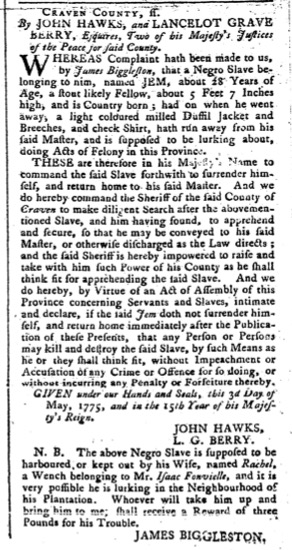
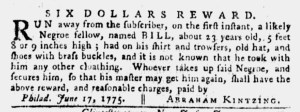
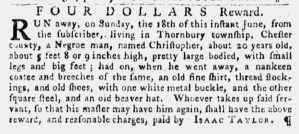
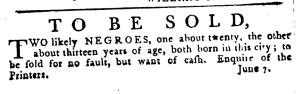
Slavery Advertisements Published June 30, 1775

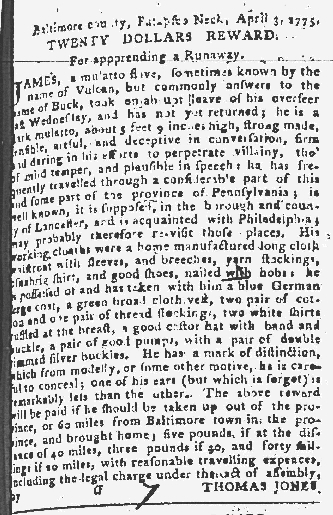
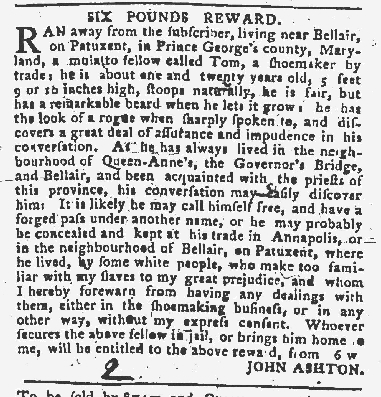
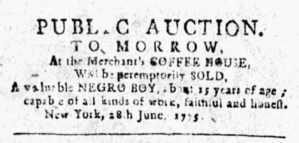
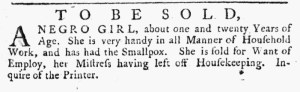
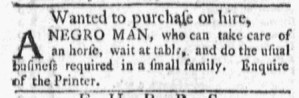
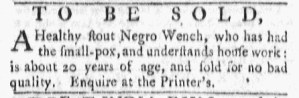
The Slavery Adverts 250 Project chronicles the role of newspaper advertising in perpetuating slavery in the era of the American Revolution. The project seeks to reveal the ubiquity of slavery in eighteenth-century life from New England to Georgia by republishing advertisements about enslaved people – for sale as individuals or in groups, wanted to purchase or for hire for short periods, runaways who liberated themselves, and those who were subsequently captured and confined in jails and workhouses – in daily digests on this site as well as in real time via the @SlaveAdverts250 Twitter feed, utilizing twenty-first-century media to stand in for the print media of the eighteenth century.

The project aims to provide modern audiences with a sense of just how often colonizers encountered these advertisements in their daily lives. Enslaved men, women, and children appeared in print somewhere in the colonies almost every single day. Those advertisements served as a constant backdrop for social, cultural, economic, and political life in colonial and revolutionary America. Colonizers who did not purport to own enslaved people were still confronted with slavery as well as invited to maintain the system by purchasing enslaved men, women, and children or assisting in the capture of so-called “runaways” who sought to free themselves from bondage. The frequency of these newspaper advertisements suggests just how embedded slavery was in colonial and revolutionary American culture in everyday interactions beyond the printed page.

These advertisements also testify to the experiences of enslaved men, women, and children, though readers must consider that those experiences have been remediated through descriptions offered by enslavers rather than enslaved people themselves. Often unnamed in the advertisements, enslaved men, women, and children were not invisible or unimportant in early America.

These advertisements appeared in colonial American newspapers 250 years ago today.

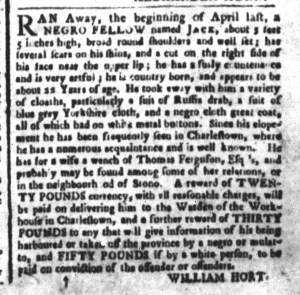
North-Carolina Gazette (June 30, 1775).

**********

North-Carolina Gazette (June 30, 1775).

**********

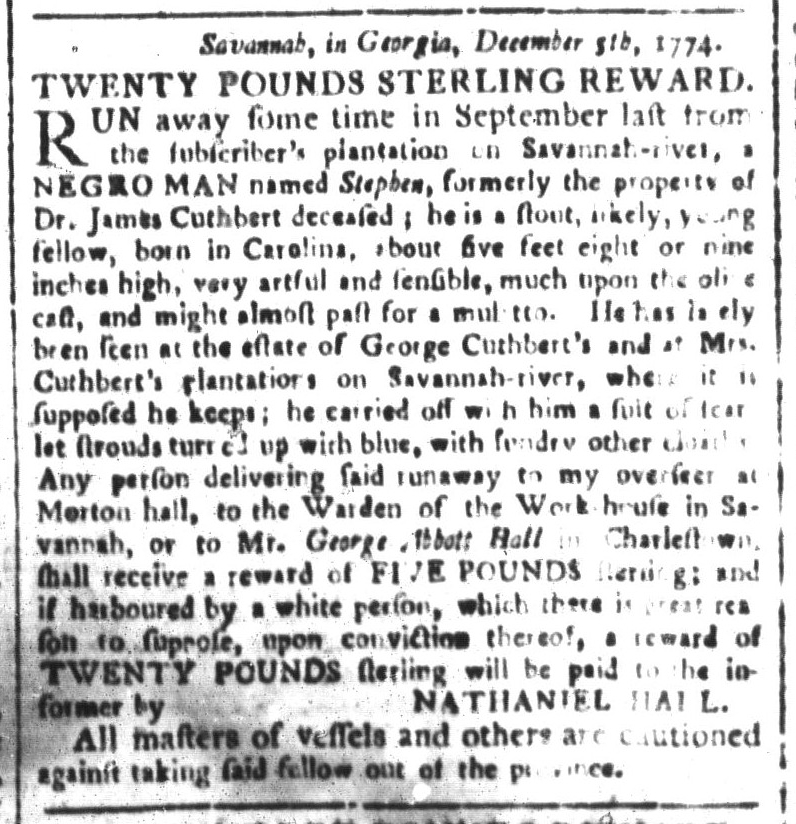
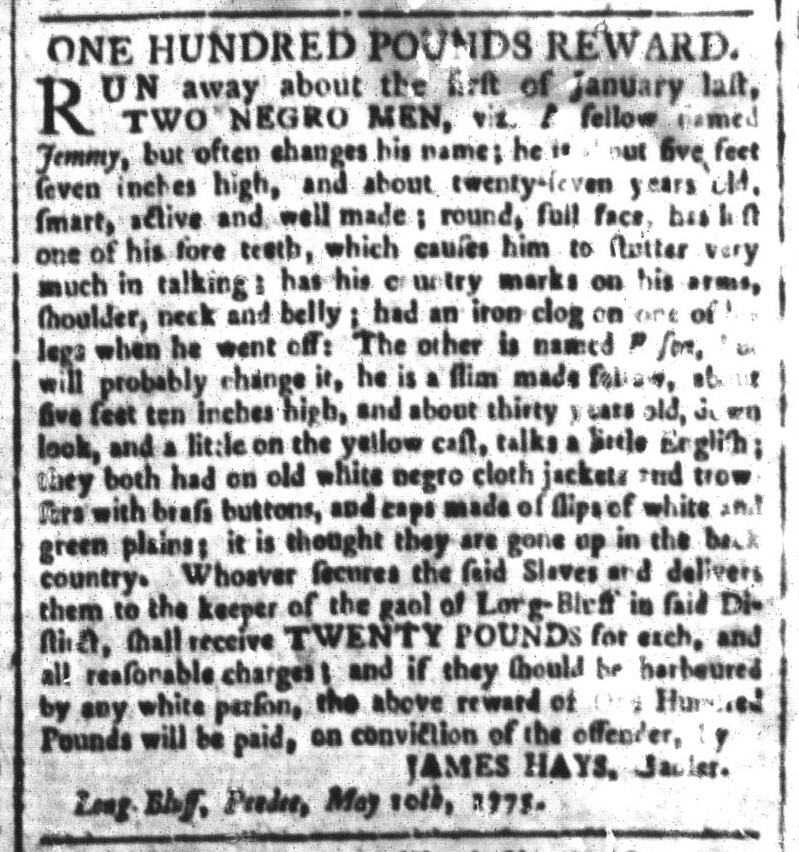
South-Carolina and American General Gazette (June 30, 1775).

**********

South-Carolina and American General Gazette (June 30, 1775).

**********

South-Carolina and American General Gazette (June 30, 1775).

**********

South-Carolina and American General Gazette (June 30, 1775).

**********

South-Carolina and American General Gazette (June 30, 1775).

**********

South-Carolina and American General Gazette (June 30, 1775).

**********

South-Carolina and American General Gazette (June 30, 1775).

**********

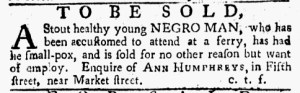
Story and Humphreys’s Pennsylvania Mercury (June 30, 1775).

**********

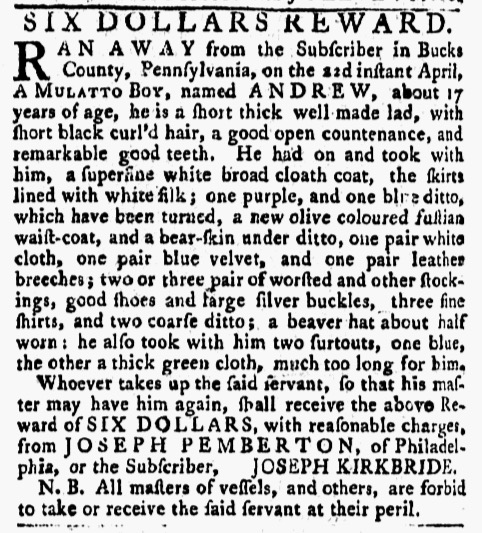
Supplement to Story and Humphreys’s Pennsylvania Mercury (June 30, 1775).

**********

Supplement to Story and Humphreys’s Pennsylvania Mercury (June 30, 1775).

**********

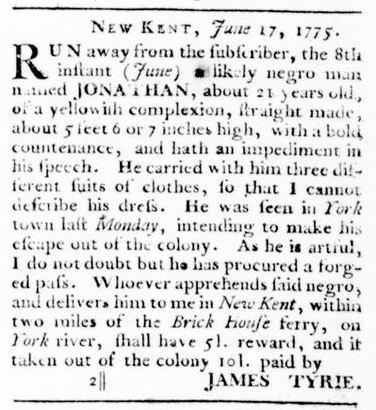
Virginia Gazette [Purdie] (June 30, 1775).

**********

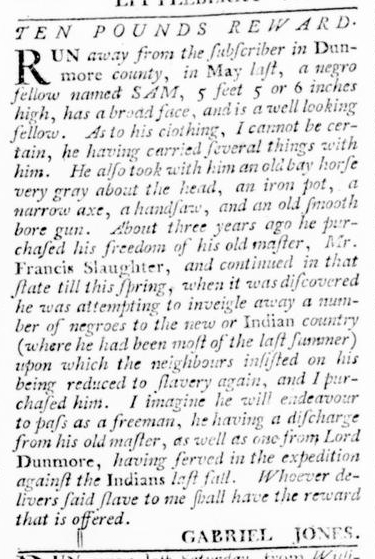
Virginia Gazette [Purdie] (June 30, 1775).

**********

Virginia Gazette [Purdie] (June 30, 1775).

**********

Virginia Gazette [Purdie] (June 30, 1775).

**********

Virginia Gazette [Purdie] (June 30, 1775).

**********

Virginia Gazette [Purdie] (June 30, 1775).

**********

Virginia Gazette [Purdie] (June 30, 1775).

June 29

What was advertised in a revolutionary American newspaper 250 years ago today?

Maryland Gazette (June 29, 1775).

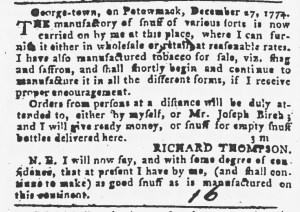
“THE manufactory of snuff of various sorts is now carried on by me at this place.”

On the eve of the American Revolution, Richard Thompson attempted to establish a market for snuff produced in Virginia.  In “The Beginnings of Tobacco Manufacture in Virginia,” Jacob M. Price argues that “there is not even a hint of a local manufacture” of snuff in Virginia from the middle of the 1730s through the late 1760s.  Most of the snuff came from Great Britain with  occasional “bottles, boxes, and kegs of snuff … appear from time to time in notices of arriving cargoes from Antigua, Boston, New York, and Salem.”  According to Price, Thompson “moved his business from Bladensburg [Maryland] to the falls of the Potomac and tried to crash the Virginia market in 1772,” placing a lengthy advertisements in the October 8 edition of William Rind’s Virginia Gazette.  “Little more is known,” Price continues, “of this early Maryland industrial pioneer and of his seemingly premature efforts to introduce a ‘patriotic’ tobacco and snuff manufacture into the Chesapeake.”[1]

An advertisement in the June 29, 1775, edition of the Maryland Gazette, published in Annapolis, reveals that Thompson continued to produce snuff at “George-town, on the Potowmack” at that time.  The “manufactory of snuff of various sorts is now carried on by me at this place,” Thompson proclaimed, “where I can furnish it either in wholesale or retail, at reasonable rates.”  In addition, Thompson had “manufactured tobacco for sale, viz. shag and saffron, and shall shortly begin and continue to manufacture it in all the different forms, if I receive proper encouragement.”  According to the date on the advertisement, Thompson first asked for that encouragement on December 27, 1774, no doubt hoping that the Continental Association, a nonimportation agreement devised by the First Continental Congress in response to the Coercive Acts, created favorable conditions for snuff produced in the colonies.  Patriotic colonizers had an obligation to support his enterprise, to give him that “proper encouragement,” but they did not have to settle for a product inferior to snuff produced elsewhere in the colonies.  In a nota bene, Thompson declared, “I will now say, and with some degree of confidence, that at present I have by me, (and shall continue to make) as good snuff as is manufactured on this continent.”  Even if his business got off to a rocky start, as Price suggests, Thompson asserted that he made improvements over time.  He composed his advertisement less than a month after the Continental Association went into effect (and a notation, “3m,” indicated that it would appear in the Maryland Gazette for three months), yet apparently decided that the time was right to revive it more than six months later after learning of the battles at Lexington and Concord.  Those battles and the events that followed meant that friends of the American cause, after all, had even more reason to support his endeavor.

**********

[1] Jacob M. Price, “The Beginnings of Tobacco Manufacture in Virginia,” Virginia Magazine of History and Biography 64, no. 1 (January 1956): 9, 12, 14.

Slavery Advertisements Published June 29, 1775

The Slavery Adverts 250 Project chronicles the role of newspaper advertising in perpetuating slavery in the era of the American Revolution. The project seeks to reveal the ubiquity of slavery in eighteenth-century life from New England to Georgia by republishing advertisements about enslaved people – for sale as individuals or in groups, wanted to purchase or for hire for short periods, runaways who liberated themselves, and those who were subsequently captured and confined in jails and workhouses – in daily digests on this site as well as in real time via the @SlaveAdverts250 Twitter feed, utilizing twenty-first-century media to stand in for the print media of the eighteenth century.

The project aims to provide modern audiences with a sense of just how often colonizers encountered these advertisements in their daily lives. Enslaved men, women, and children appeared in print somewhere in the colonies almost every single day. Those advertisements served as a constant backdrop for social, cultural, economic, and political life in colonial and revolutionary America. Colonizers who did not purport to own enslaved people were still confronted with slavery as well as invited to maintain the system by purchasing enslaved men, women, and children or assisting in the capture of so-called “runaways” who sought to free themselves from bondage. The frequency of these newspaper advertisements suggests just how embedded slavery was in colonial and revolutionary American culture in everyday interactions beyond the printed page.

These advertisements also testify to the experiences of enslaved men, women, and children, though readers must consider that those experiences have been remediated through descriptions offered by enslavers rather than enslaved people themselves. Often unnamed in the advertisements, enslaved men, women, and children were not invisible or unimportant in early America.

These advertisements appeared in colonial American newspapers 250 years ago today.

Maryland Gazette (June 29, 1775).

**********

Maryland Gazette (June 29, 1775).

**********

Maryland Gazette (June 29, 1775).

**********

Maryland Gazette (June 29, 1775).

**********

Maryland Gazette (June 29, 1775).

**********

New-England Chronicle (June 29, 1775).

**********

New-York Journal (June 29, 1775).

**********

Pennsylvania Evening Post (June 29, 1775).

**********

Rivington’s New-York Gazetteer (June 29, 1775).

**********

Rivington’s New-York Gazetteer (June 29, 1775).

**********

Rivington’s New-York Gazetteer (June 29, 1775).

**********

Virginia Gazette [Pinkney] (June 29, 1775).

**********

Virginia Gazette [Pinkney] (June 29, 1775).

June 28

What was advertised in a revolutionary American newspaper 250 years ago today?

Pennsylvania Gazette (June 28, 1775).

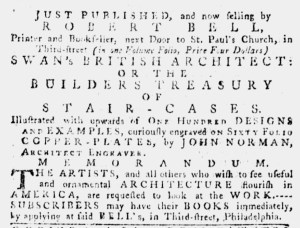
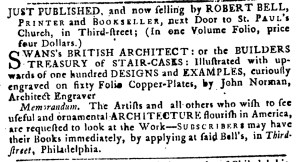
“JUST PUBLISHED … SWAN’s BRITISH ARCHITECT … Illustrated with upwards of ONE HUNDRED DESIGNS AND EXAMPLES.”

At the end of June 1775, Robert Bell, “Printer and Bookseller,” and John Norman, “Architect Engraver,” published an American edition of Abraham Swan’s British Architect: Or, the Builders Treasury of Staircases.  Norman had previously promoted the work with newspaper advertisements and proposals “with a specimen of the plates and letter press” that prospective subscribers could examine.  When the volume was ready for sale and for subscribers to collect the copies they reserved, Bell and Norman ran advertisements in the Pennsylvania Gazette and the Pennsylvania Journal on June 28.  The following day they placed the same advertisement in the Pennsylvania Evening Post.  On July 1, it appeared in the Pennsylvania Ledger and in Story and Humphreys’s Pennsylvania Mercury on July 7.  Of the newspapers printed in English in Philadelphia at the time, only Dunlap’s Pennsylvania Packet did not carry the advertisement.  Bell and Norman made a significant investment in marketing their edition of Swan’s British Architect.

Pennsylvania Journal (June 28, 1775).

To entice prospective customers, they specified that the book was “Illustrated with upwards of one hundred DESIGNS and EXAMPLES, curiously engraved on sixty Folio Copper-Plates” bound into the volume.  They also appended a “Memorandum” requesting that the “Artists and all others who wish to see useful and ornamental ARCHITECTURE flourish … look at the Work.”  If residents of the largest and most cosmopolitan urban port in the colonies wanted their city to maintain and enhance its level of sophistication, Bell and Norman implied, they needed to consider architecture and design important cultural pursuits.  To that end, they also marketed similar publications to those who purchased Swan’s British Architect.  Readers found to subscription proposals bound into the book.  The first one, advertising The Gentleman and Cabinet-Maker’s Assistant with drawings by John Folwell, a local cabinetmaker, and engravings by Norman (dated June 20), faced the title page.  The other, advertising an American edition of Swan’s Collection of Designs in Architecture, Containing New Plans and Elevations of Houses, for General Use (dated June 26), appeared immediately after the letterpress explanations of the engraved illustrations.  The dates on the subscription proposals suggest that they might have circulated separately, yet Bell and Norman made certain to place them before customers who already confirmed an interest in the subject matter.

Slavery Advertisements Published June 28, 1775

The Slavery Adverts 250 Project chronicles the role of newspaper advertising in perpetuating slavery in the era of the American Revolution. The project seeks to reveal the ubiquity of slavery in eighteenth-century life from New England to Georgia by republishing advertisements about enslaved people – for sale as individuals or in groups, wanted to purchase or for hire for short periods, runaways who liberated themselves, and those who were subsequently captured and confined in jails and workhouses – in daily digests on this site as well as in real time via the @SlaveAdverts250 Twitter feed, utilizing twenty-first-century media to stand in for the print media of the eighteenth century.

The project aims to provide modern audiences with a sense of just how often colonizers encountered these advertisements in their daily lives. Enslaved men, women, and children appeared in print somewhere in the colonies almost every single day. Those advertisements served as a constant backdrop for social, cultural, economic, and political life in colonial and revolutionary America. Colonizers who did not purport to own enslaved people were still confronted with slavery as well as invited to maintain the system by purchasing enslaved men, women, and children or assisting in the capture of so-called “runaways” who sought to free themselves from bondage. The frequency of these newspaper advertisements suggests just how embedded slavery was in colonial and revolutionary American culture in everyday interactions beyond the printed page.

These advertisements also testify to the experiences of enslaved men, women, and children, though readers must consider that those experiences have been remediated through descriptions offered by enslavers rather than enslaved people themselves. Often unnamed in the advertisements, enslaved men, women, and children were not invisible or unimportant in early America.

These advertisements appeared in colonial American newspapers 250 years ago today.

Connecticut Journal (June 28, 1775).

**********

Pennsylvania Gazette (June 28, 1775).

**********

Pennsylvania Gazette (June 28, 1775).

**********

Pennsylvania Journal (June 28, 1775).

June 27

What was advertised in a revolutionary American newspaper 250 years ago today?

New-Hampshire Gazette (June 27, 1775).

Warrantee and Quitclaim Deeds, Justices Writs, Shipping Papers, Bail Bonds, &c Sold at the Printing Office.”

Daniel Fowle, the printer of the New-Hampshire Gazette, managed to keep publishing his newspaper after the battles of Lexington and Concord, though he warned readers that they could not depend on him doing so.  On April 28, 1775, just over a week after the battles, he asked for those who owed money to settle accounts.  “The Boston News Papers we hear are all stopt, and no more will be printed for the present,” Fowle noted, “and that must be done here unless the Customers attend to this call.”  Two weeks later, he stated, “The publisher of this Paper Designs, if possible, to continue it a while longer, provided the Customers who are in Arrear pay off Immediately, to enable him to purchase Paper.”  Fowle asserted that he had to price paper “at a great Distance and Charge.”  Disruptions in his paper supply and “the disorder’d State of the Continent” (as Fowle described the aftermath of the battles at Lexington and Concord) led him to reduce the size of many issues to two pages instead of the usual four.

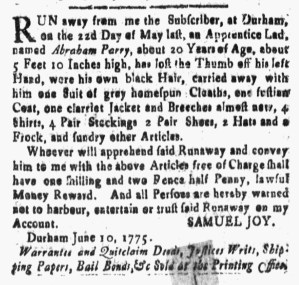
The June 27 edition was one of those, the third consecutive one.  Fowle squeezed in as much news as he could, including updates from the Continental Congress meeting in Philadelphia, the Massachusetts Provincial Congress in Watertown, and the New Hampshire Provincial Congress in Exeter.  He also published an account of the Battle of Bunker Hill that occurred ten days earlier.  The printer found one space for a couple of advertisements, including one that described Abraham Parry, an apprentice who ran away from Samuel Joy of Durham on May 22.  The young man took advantage of the “disorder’d State” to get away from his master, though Joy offered a reward to “Whoever will apprehend said Runaway and convey him to me.”  As the very last item on the second (and final) page, Fowle inserted an advertisement, just two lines, for printed blanks: “Warrantee and Quitclaim Deeds, Justices Writs, Shipping Papers, Bail Bonds, &c Sold at the Printing Office.”  Such notices often appeared in newspapers during the era of the American Revolution, perhaps more frequently in the New-Hampshire Gazette than most others, because printers sought to diversity their revenue streams.  Many of them printed and sold “blanks,” blank forms used for common legal and commercial transactions.  In this instance, Fowle did not have enough space to insert a line to separate his notice from the advertisement above it, though he did use italics to distinguish it from Joy’s notice.  More than ever, the printer needed whatever revenue he could get.  He made sure to remind readers that he stocked and sold blanks.

Slavery Advertisements Published June 27, 1775

The Slavery Adverts 250 Project chronicles the role of newspaper advertising in perpetuating slavery in the era of the American Revolution. The project seeks to reveal the ubiquity of slavery in eighteenth-century life from New England to Georgia by republishing advertisements about enslaved people – for sale as individuals or in groups, wanted to purchase or for hire for short periods, runaways who liberated themselves, and those who were subsequently captured and confined in jails and workhouses – in daily digests on this site as well as in real time via the @SlaveAdverts250 Twitter feed, utilizing twenty-first-century media to stand in for the print media of the eighteenth century.

The project aims to provide modern audiences with a sense of just how often colonizers encountered these advertisements in their daily lives. Enslaved men, women, and children appeared in print somewhere in the colonies almost every single day. Those advertisements served as a constant backdrop for social, cultural, economic, and political life in colonial and revolutionary America. Colonizers who did not purport to own enslaved people were still confronted with slavery as well as invited to maintain the system by purchasing enslaved men, women, and children or assisting in the capture of so-called “runaways” who sought to free themselves from bondage. The frequency of these newspaper advertisements suggests just how embedded slavery was in colonial and revolutionary American culture in everyday interactions beyond the printed page.

These advertisements also testify to the experiences of enslaved men, women, and children, though readers must consider that those experiences have been remediated through descriptions offered by enslavers rather than enslaved people themselves. Often unnamed in the advertisements, enslaved men, women, and children were not invisible or unimportant in early America.

These advertisements appeared in colonial American newspapers 250 years ago today.

Postscript to Dunlap’s Maryland Gazette (June 27, 1775).

**********

South-Carolina Gazette and Country Journal (June 27, 1775).

**********

South-Carolina Gazette and Country Journal (June 27, 1775).

**********

South-Carolina Gazette and Country Journal (June 27, 1775).

**********

South-Carolina Gazette and Country Journal (June 27, 1775).

**********

South-Carolina Gazette and Country Journal (June 27, 1775).

**********

South-Carolina Gazette and Country Journal (June 27, 1775).

**********

South-Carolina Gazette and Country Journal (June 27, 1775).

June 26

What was advertised via subscription proposals in revolutionary American 250 years ago today?

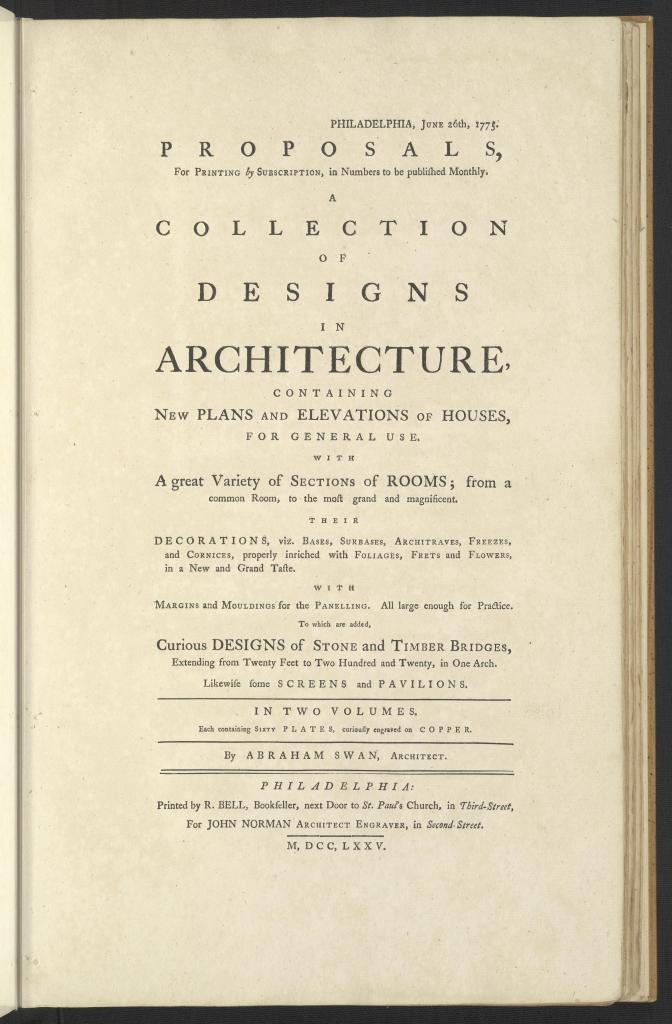
Subscription proposals bound in Abraham Swan, The British Architect: Or, the Builders Treasury of Stair-Cases (Philadelphia: Robert Bell, Bookseller, for John Norman, Architect Engraver, 1775). Courtesy Library of Congress.

“A COLLECTION OF DESIGNS IN ARCHITECTURE … By ABRAHAM SWAN.”

The Adverts 250 Project recently featured subscription proposals for The Gentleman and Cabinet-Maker’s Assistant with drawings by John Folwell and engravings by John Norman bound into the American edition of Abraham Swan’s British Architect published by Norman in collaboration with Robert Bell in the summer of 1775.  Those proposals, facing the title page, were not the only ones in that volume.  Other subscription proposals appeared after the text and before the engravings.  Norman and Bell once again attempted to entice subscribers and other readers of Swan’s British Architect to purchase a book undoubtedly of interest to them, Swan’s Collection of Designs in Architecture.

In contrast to the proposals for The Gentleman and Cabinet-Maker’s Assistant, the proposals for Designs in Architecture ran on two pages facing each other instead of on a single page.  The “CONDITIONS” appeared on the left and the full title, author, and publishers on the right.  Those “CONDITIONS” specified that the volume would be “printed on One Hundred and Twenty Folio Copper-Plates, with Explanations in Letter-Press, in Twelve Numbers, and published Monthly.”  A new “Number containing Ten Folio Copper-Plates, with Explanations” would be ready for subscribers on the first Monday of every month, amounting to “the Whole of the London Edition” over the course of a year.  Subscribers paid five shilling for each “Number” or three pounds altogether, a bargain compared to the four pounds and ten shilling charged for the London edition.  As with the British Architect and The Gentleman and Cabinet-Maker’s Assistant, “the Names of the Encouragers will be printed in the Book.”  The same local agents in Philadelphia, Annapolis, Baltimore, Charleston, and New York accepted subscriptions, except for John Folwell, the designer who supplied the drawings for The Gentleman and Cabinet-Maker’s Assistant but apparently did not have a stake in the American edition of Swan’s Designs in Architecture.
Subscription proposals bound in Abraham Swan, The British Architect: Or, the Builders Treasury of Stair-Cases (Philadelphia: Robert Bell, Bookseller, for John Norman, Architect Engraver, 1775). Courtesy Library of Congress.

The proposals for The Gentleman and Cabinet-Maker’s Assistant could be removed from the British Architect, but that was not the case for the proposals for Designs in Architecture.  The “CONDITIONS” for that proposed work appeared on the verso of the final page of the text, making it impossible for subscribers, bookbinders, or anyone else to remove that portions of the advertisement from the book.  That did not, however, eliminate the possibility of distributing the subscription proposals separately.  Norman and Bell could have issued a broadside that featured just the title, author, and publishers or a broadsheet with the title, author, and publishers on one side and the “CONDITIONS” on the other.  In his Supplement to Charles Evans’ American Bibliography, renowned bibliographer Roger P. Bristol identifies a broadside with the title, author, and publishers as a separate item, but the catalog maintained by the American Antiquarian Society indicates that he did so based solely on a copy in the collections of the Historical Society of Pennsylvania.  That broadside “may be excised” from a copy of the British Architect.  Extant copies do not yield a conclusive answer, but Bell, in particular, was such a savvy advertiser that he very well may have distributed the proposals for Designs in Architecture separately.
**********

I have worked with the copy of Swan’s British Architect in the collections of the American Antiquarian Society for this entry.  That copy has been digitized, yet it remains behind a subscription paywall.  Its features described here match those of copies in the collections of the Gerry Research Institute and the Library of Congress that have been digitized and are accessible to the public.

Slavery Advertisements Published June 26, 1775

The Slavery Adverts 250 Project chronicles the role of newspaper advertising in perpetuating slavery in the era of the American Revolution. The project seeks to reveal the ubiquity of slavery in eighteenth-century life from New England to Georgia by republishing advertisements about enslaved people – for sale as individuals or in groups, wanted to purchase or for hire for short periods, runaways who liberated themselves, and those who were subsequently captured and confined in jails and workhouses – in daily digests on this site as well as in real time via the @SlaveAdverts250 Twitter feed, utilizing twenty-first-century media to stand in for the print media of the eighteenth century.

The project aims to provide modern audiences with a sense of just how often colonizers encountered these advertisements in their daily lives. Enslaved men, women, and children appeared in print somewhere in the colonies almost every single day. Those advertisements served as a constant backdrop for social, cultural, economic, and political life in colonial and revolutionary America. Colonizers who did not purport to own enslaved people were still confronted with slavery as well as invited to maintain the system by purchasing enslaved men, women, and children or assisting in the capture of so-called “runaways” who sought to free themselves from bondage. The frequency of these newspaper advertisements suggests just how embedded slavery was in colonial and revolutionary American culture in everyday interactions beyond the printed page.

These advertisements also testify to the experiences of enslaved men, women, and children, though readers must consider that those experiences have been remediated through descriptions offered by enslavers rather than enslaved people themselves. Often unnamed in the advertisements, enslaved men, women, and children were not invisible or unimportant in early America.

These advertisements appeared in colonial American newspapers 250 years ago today.

Dunlap’s Pennsylvania Packet (June 26, 1775).

**********

Dunlap’s Pennsylvania Packet (June 26, 1775).

**********

Dunlap’s Pennsylvania Packet (June 26, 1775).

**********

New-York Gazette and Weekly Mercury (June 26, 1775).

**********

New-York Gazette and Weekly Mercury (June 26, 1775).

**********

New-York Gazette and Weekly Mercury (June 26, 1775).

**********

Norwich Packet (June 26, 1775).