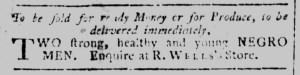
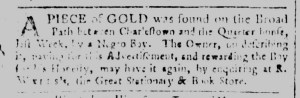
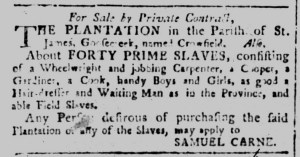
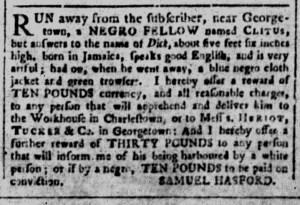
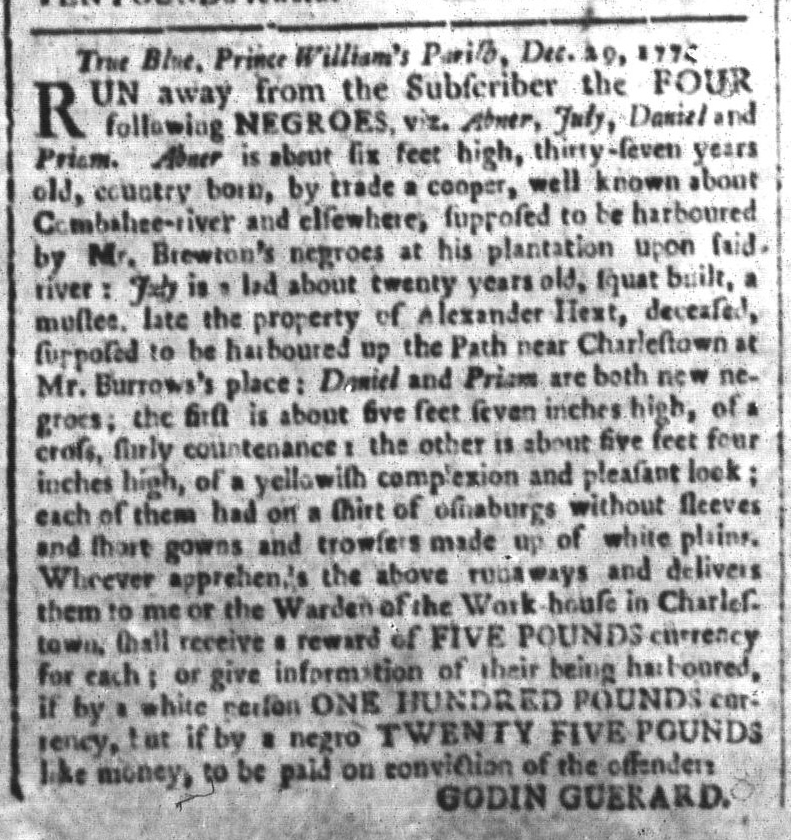
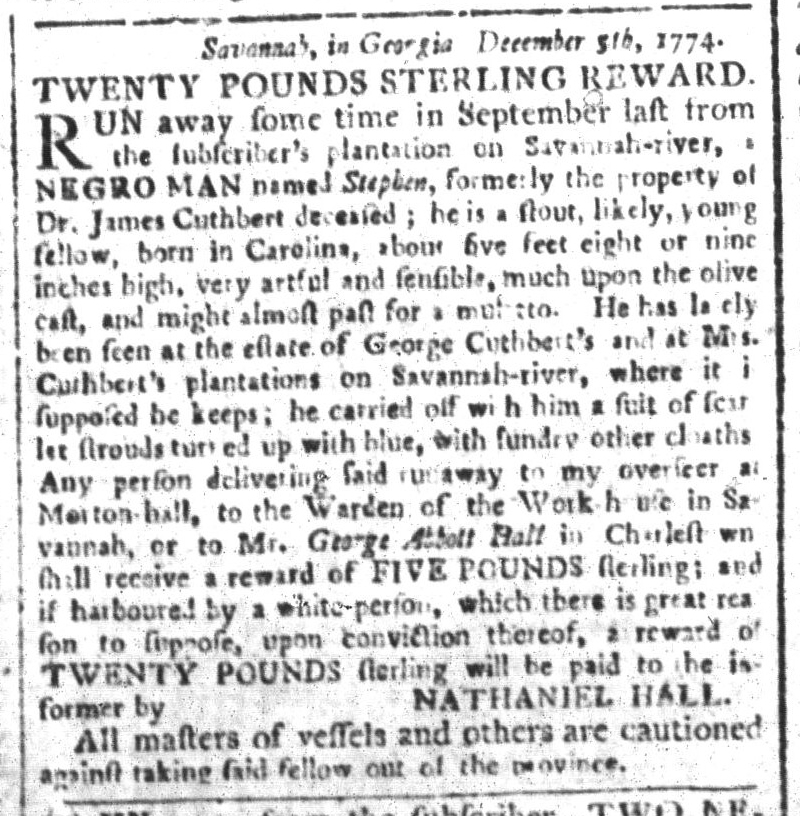
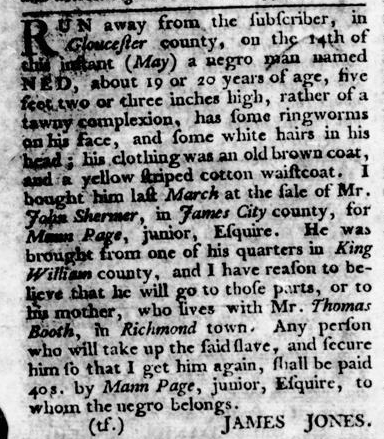
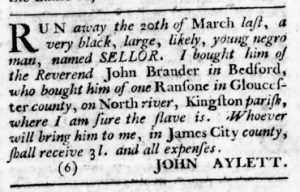
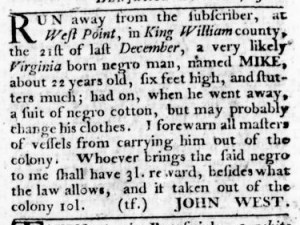
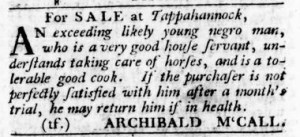
The Slavery Adverts 250 Project chronicles the role of newspaper advertising in perpetuating slavery in the era of the American Revolution. The project seeks to reveal the ubiquity of slavery in eighteenth-century life from New England to Georgia by republishing advertisements about enslaved people – for sale as individuals or in groups, wanted to purchase or for hire for short periods, runaways who liberated themselves, and those who were subsequently captured and confined in jails and workhouses – in daily digests on this site as well as in real time via the @SlaveAdverts250 Twitter feed, utilizing twenty-first-century media to stand in for the print media of the eighteenth century.
The project aims to provide modern audiences with a sense of just how often colonizers encountered these advertisements in their daily lives. Enslaved men, women, and children appeared in print somewhere in the colonies almost every single day. Those advertisements served as a constant backdrop for social, cultural, economic, and political life in colonial and revolutionary America. Colonizers who did not purport to own enslaved people were still confronted with slavery as well as invited to maintain the system by purchasing enslaved men, women, and children or assisting in the capture of so-called “runaways” who sought to free themselves from bondage. The frequency of these newspaper advertisements suggests just how embedded slavery was in colonial and revolutionary American culture in everyday interactions beyond the printed page.
These advertisements also testify to the experiences of enslaved men, women, and children, though readers must consider that those experiences have been remediated through descriptions offered by enslavers rather than enslaved people themselves. Often unnamed in the advertisements, enslaved men, women, and children were not invisible or unimportant in early America.
These advertisements appeared in colonial American newspapers 250 years ago today.
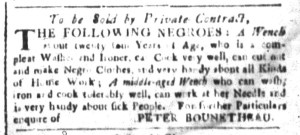
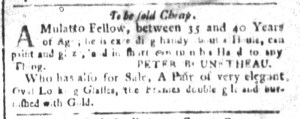
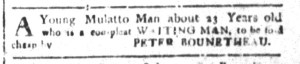
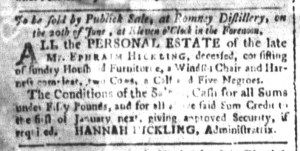
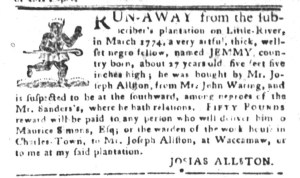
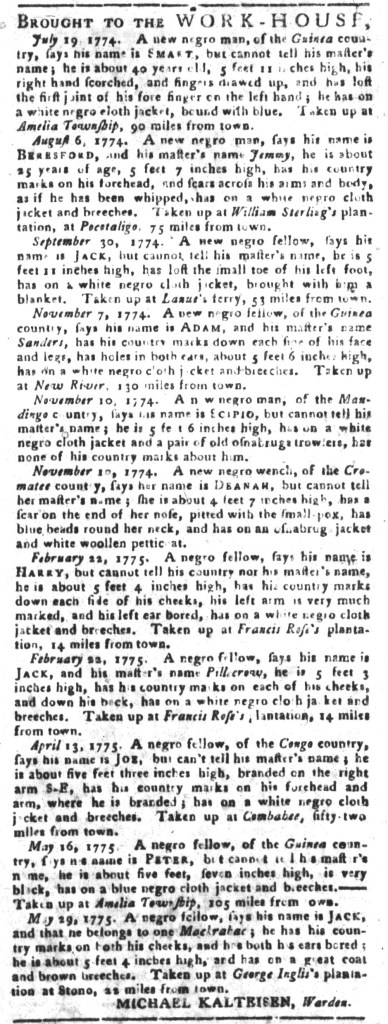
South-Carolina and American General Gazette (June 9, 1775).
**********
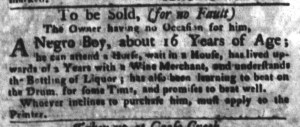
South-Carolina and American General Gazette (June 9, 1775).
**********
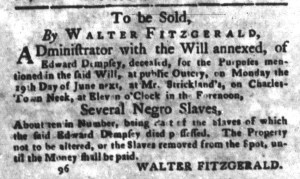
South-Carolina and American General Gazette (June 9, 1775).
**********
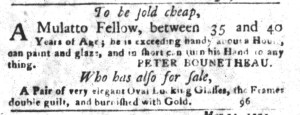
South-Carolina and American General Gazette (June 9, 1775).
**********
South-Carolina and American General Gazette (June 9, 1775).
**********
South-Carolina and American General Gazette (June 9, 1775).
**********
South-Carolina and American General Gazette (June 9, 1775).
**********
South-Carolina and American General Gazette (June 9, 1775).
**********
South-Carolina and American General Gazette (June 9, 1775).
**********
South-Carolina and American General Gazette (June 9, 1775).
**********
South-Carolina and American General Gazette (June 9, 1775).
**********
South-Carolina and American General Gazette (June 9, 1775).
**********
South-Carolina and American General Gazette (June 9, 1775).
**********
South-Carolina and American General Gazette (June 9, 1775).
**********
South-Carolina and American General Gazette (June 9, 1775).
**********
South-Carolina and American General Gazette (June 9, 1775).
**********
South-Carolina and American General Gazette (June 9, 1775).
**********
South-Carolina and American General Gazette (June 9, 1775).
**********
South-Carolina and American General Gazette (June 9, 1775).
**********
South-Carolina and American General Gazette (June 9, 1775).
**********
South-Carolina and American General Gazette (June 9, 1775).
**********
South-Carolina and American General Gazette (June 9, 1775).
**********
Story and Humphreys’s Pennsylvania Mercury (June 9, 1775).
What was advertised in a revolutionary American newspaper 250 years ago today?
New-England Chronicle (June 8, 1775).
“I am ready to assist them in their Struggles for Liberty and Freedom.”
A year later, John Prentice of Londonderry, New Hampshire, had second thoughts about having signed an address lauding Governor Thomas Hutchinson when he left office and departed Massachusetts for England. On June 6, 1775, Prentice wrote about the mistake he made, acknowledged that he misjudged the governor’s motives, vowed his support for the American cause, and submitted his missive for publication in the New-England Chronicle. “I the Subscriber was so unfortunate (some Time since),” he explained, “as to sign an Address to the late Governor Hutchinson, so universally and so justly deemed an Enemy to American Liberty and Freedom.” Prentice claimed he had not understood that in the spring of 1774 – “at the Time I signed the said Address, I intended the Good of my Country” – but now understood his error. He lamented that to his “Sorrow” signing the address had “a quite contrary Effect.”
Some of the “contrary Effect” that Prentice regretted, however, may have been the reception that he received from his neighbors and others in his community who refused to associate with him socially or to conduct business with him. Such treatment had previously prompted others who signed the address to the governor to recant and to beg for forgiveness. Yet Prentice did not mention how others treated him, nor did he apologize, though he did “hope that my injured and affronted Fellow Countrymen will overlook my past Misconduct.” Perhaps the battles at Lexington and Concord and the ensuing siege of Boston inspired a sincere change of heart, inspiring Prentice to “renounce the same Address in every Part” and proclaim that he was “ready to assist [his countrymen] in their Struggles for Liberty and Freedom, in whatever Way I shall be called upon by them.”
How did Prentice really feel about the address? Did it matter to readers of the New-England Chronicle? William Huntting Howell argues that the authenticity of such a conversion was not nearly as important as the ability of a local Committee of Safety or similar panel of Patriots to induce those who signed the address to make public declarations – in print – that they renounced their past actions and now supported the American cause.[1] The June 8, 1775, edition of the New-England Chronicle carried other letters similar to the one submitted by Prentice, though an adjudication accompanied each of those. The Committee of Safety in Salem, for instance, absolved thirteen signers of the address who “now to our Sorrow find ourselves mistaken” and “Wish to live in Harmony with our Neighbours” and “to promote to the utmost of our Power the Liberty, the Welfare and Happiness of our country, which is inseparably connected with our own.” The same committee accepted a more succinct petition from Alexander Walker, while the Committee of Correspondence for Groton accepted Samuel Dana’s apology for “adopt[ing] Principles in Politics different from the Generality of my Countrymen” that contributed to “the Injury of my Country.”
No such endorsement appeared with Prentice’s letter. In addition, the layout of the issue that carried it suggests that it could have been a letter to the editor that the printers, Samuel Hall and Ebenezer Hall, chose to publish because it matched their political principles or an advertisement that Prentice paid to insert because he considered it so important to place before the public. Either way, it buttressed the narrative that more and more colonizers recognized the tyranny perpetrated against them once fighting commenced in Massachusetts in the spring of 1775.
**********
[1] William Huntting Howell, “Entering the Lists: The Politics of Ephemera in Eastern Massachusetts, 1774,” Early American Studies 9, no. 1 (Winter 2011): 208-215.
The Slavery Adverts 250 Project chronicles the role of newspaper advertising in perpetuating slavery in the era of the American Revolution. The project seeks to reveal the ubiquity of slavery in eighteenth-century life from New England to Georgia by republishing advertisements about enslaved people – for sale as individuals or in groups, wanted to purchase or for hire for short periods, runaways who liberated themselves, and those who were subsequently captured and confined in jails and workhouses – in daily digests on this site as well as in real time via the @SlaveAdverts250 Twitter feed, utilizing twenty-first-century media to stand in for the print media of the eighteenth century.
The project aims to provide modern audiences with a sense of just how often colonizers encountered these advertisements in their daily lives. Enslaved men, women, and children appeared in print somewhere in the colonies almost every single day. Those advertisements served as a constant backdrop for social, cultural, economic, and political life in colonial and revolutionary America. Colonizers who did not purport to own enslaved people were still confronted with slavery as well as invited to maintain the system by purchasing enslaved men, women, and children or assisting in the capture of so-called “runaways” who sought to free themselves from bondage. The frequency of these newspaper advertisements suggests just how embedded slavery was in colonial and revolutionary American culture in everyday interactions beyond the printed page.
These advertisements also testify to the experiences of enslaved men, women, and children, though readers must consider that those experiences have been remediated through descriptions offered by enslavers rather than enslaved people themselves. Often unnamed in the advertisements, enslaved men, women, and children were not invisible or unimportant in early America.
These advertisements appeared in colonial American newspapers 250 years ago today.
What was advertised in a revolutionary American newspaper 250 years ago today?
Connecticut Journal (June 7, 1775).
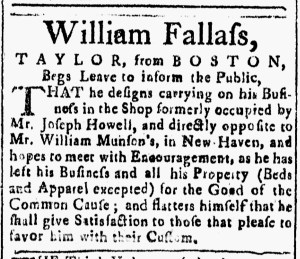
“He has left his Business and all his Property … for the Good of the Common Cause.”
In the summer of 1775, William Fallass, a “TAYLOR, from BOSTON,” relocated to New Haven, Connecticut. Upon arriving in town, he placed a newspaper advertisement to introduce himself to his new neighbors and prospective customers. Fallass announced that he “designs carrying on his Business in the Shop formerly occupied by Mr. Joseph Howell … and hopes to meet with Encouragement.” The locals did not yet know him or his work by reputation, prompting him to declare that he “flatters himself that he shall give Satisfaction to those that please to favor him with their Custom.” The newcomer pledged his best efforts for his clients.
He also offered another reason that residents of New Haven should hire his services. He had not planned to relocate to another town but instead “left his Business and all his Property (Beds and Apparel excepted) for the Good of the Common Cause.” The battles at Lexington and Concord and the ensuing siege of Boston upended Fallass’s life and livelihood. In late April, the Massachusetts Provincial Congress, meeting in Watertown, negotiated with General Thomas Gage, the governor, for safe passage in or out of Boston. Loyalists could move into the city; Patriots and others could depart. In each instance, they could take their “Effects” with them, “excepting their Fire-Arms and Ammunition.” The unfortunate Fallass did not manage to move most of his “Effects,” just his clothing and bedding. He hoped that sacrifice “for the Good of the Common Cause” would endear him to prospective clients and entice them to do business with him, a refugee.
In that regard, Fallass made a more explicit appeal than Polly Allen and Lucy Allen, milliners and mantuamakers from Boston, did when they ran a newspaper advertisement in Providence earlier in the week. In both cases, however, advertisements help in tracing the movement of men and women who departed Boston during the siege. They did not merely leave the city for the countryside; many relocated to other colonies and attempted to revive their businesses in new places as the Revolutionary War began. Articles and “letters of intelligence” relayed some accounts of current events, yet advertisements played another role in revealing the effects of the war on some colonizers.
The Slavery Adverts 250 Project chronicles the role of newspaper advertising in perpetuating slavery in the era of the American Revolution. The project seeks to reveal the ubiquity of slavery in eighteenth-century life from New England to Georgia by republishing advertisements about enslaved people – for sale as individuals or in groups, wanted to purchase or for hire for short periods, runaways who liberated themselves, and those who were subsequently captured and confined in jails and workhouses – in daily digests on this site as well as in real time via the @SlaveAdverts250 Twitter feed, utilizing twenty-first-century media to stand in for the print media of the eighteenth century.
The project aims to provide modern audiences with a sense of just how often colonizers encountered these advertisements in their daily lives. Enslaved men, women, and children appeared in print somewhere in the colonies almost every single day. Those advertisements served as a constant backdrop for social, cultural, economic, and political life in colonial and revolutionary America. Colonizers who did not purport to own enslaved people were still confronted with slavery as well as invited to maintain the system by purchasing enslaved men, women, and children or assisting in the capture of so-called “runaways” who sought to free themselves from bondage. The frequency of these newspaper advertisements suggests just how embedded slavery was in colonial and revolutionary American culture in everyday interactions beyond the printed page.
These advertisements also testify to the experiences of enslaved men, women, and children, though readers must consider that those experiences have been remediated through descriptions offered by enslavers rather than enslaved people themselves. Often unnamed in the advertisements, enslaved men, women, and children were not invisible or unimportant in early America.
These advertisements appeared in colonial American newspapers 250 years ago today.
Who was the subject of an advertisement in a revolutionary American newspaper published 250 years ago today?
Pennsylvania Evening Post (June 6, 1775).
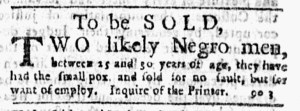
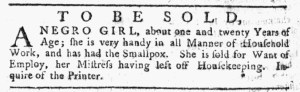
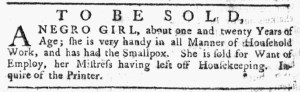
“TO BE SOLD, A NEGRO GIRL… Inquire of the Printer.”
The June 6, 1775, edition of the Pennsylvania Evening Post carried only two advertisements. One announced that the Ann from Bristol arrived with a “NUMBER of healthy Men and Women SERVANTS, among whom are Tradesmen, also Sawyers, Footmen, [and] Labourers.” William and Fisher and Son sold the “Times” of these indentured servants, each of whom willingly made the voyage across the Atlantic. In exchange for their passage, they agreed to serve for a certain number of years, their “Times,” as specified in their indentures or contracts.
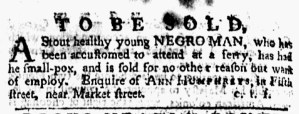
The other advertisement offered a “NEGRO GIRL, about one and twenty Years of Age,” for sale, describing her as “very handy in all Manner of Household Work.” In addition, she “has had the Smallpox,” which meant that she would not contract the disease again. As a result, potential buyers could feel more secure in their investment if they bought her. Furthermore, the advertisement explained that the young woman “is sold for Want of Employ, her Mistress having left off Housekeeping.” Again, the seller sought to offer reassurances. The enslaved woman was not sick nor disobedient, just unnecessary. Rather than free the young woman, her enslaver opted to sell her. Unlike the servants featured in the other advertisement, she would not gain her freedom in a few years. She did not have a contract. She did not serve willingly.
Benjamin Towne, on the other hand, willingly acted as a slave broker in facilitating the transaction. The advertisement instructed anyone interested in purchasing the enslaved woman to “Inquire of the Printer.” Towne had been printing the Pennsylvania Evening Post, one of the first tri-weekly newspapers in the colonies, since late January 1775. This advertisement was the first that offered an enslaved person for sale as well as the first that positioned the printer as a broker. That it took more than four months does not seem to have been the result of any principles exercised by Towne, though that could have been a factor initially. Instead, the Pennsylvania Evening Post, printed on a smaller sheet than other newspapers published in Philadelphia, carried fewer advertisements than its competitors. That seems like the most probable explanation for taking so long to carry an “Inquire of the Printer” advertisement that presented an enslaved person for sale. Even if Towne had misgivings about such notices when he embarked on publishing the newspaper, the need to generate revenue and remain competitive with Philadelphia’s other newspapers won out.
The Slavery Adverts 250 Project chronicles the role of newspaper advertising in perpetuating slavery in the era of the American Revolution. The project seeks to reveal the ubiquity of slavery in eighteenth-century life from New England to Georgia by republishing advertisements about enslaved people – for sale as individuals or in groups, wanted to purchase or for hire for short periods, runaways who liberated themselves, and those who were subsequently captured and confined in jails and workhouses – in daily digests on this site as well as in real time via the @SlaveAdverts250 Twitter feed, utilizing twenty-first-century media to stand in for the print media of the eighteenth century.
The project aims to provide modern audiences with a sense of just how often colonizers encountered these advertisements in their daily lives. Enslaved men, women, and children appeared in print somewhere in the colonies almost every single day. Those advertisements served as a constant backdrop for social, cultural, economic, and political life in colonial and revolutionary America. Colonizers who did not purport to own enslaved people were still confronted with slavery as well as invited to maintain the system by purchasing enslaved men, women, and children or assisting in the capture of so-called “runaways” who sought to free themselves from bondage. The frequency of these newspaper advertisements suggests just how embedded slavery was in colonial and revolutionary American culture in everyday interactions beyond the printed page.
These advertisements also testify to the experiences of enslaved men, women, and children, though readers must consider that those experiences have been remediated through descriptions offered by enslavers rather than enslaved people themselves. Often unnamed in the advertisements, enslaved men, women, and children were not invisible or unimportant in early America.
These advertisements appeared in colonial American newspapers 250 years ago today.
Dunlap’s Maryland Gazette (June 6, 1775).
**********
Pennsylvania Evening Post (June 6, 1775).
**********
South-Carolina Gazette and Country Journal (June 6, 1775).
**********
South-Carolina Gazette and Country Journal (June 6, 1775).
**********
South-Carolina Gazette and Country Journal (June 6, 1775).
**********
South-Carolina Gazette and Country Journal (June 6, 1775).
**********
South-Carolina Gazette and Country Journal (June 6, 1775).
**********
South-Carolina Gazette and Country Journal (June 6, 1775).
**********
South-Carolina Gazette and Country Journal (June 6, 1775).
What was advertised in a revolutionary American newspaper 250 years ago today?
Boston-Gazette (June 5, 1775).
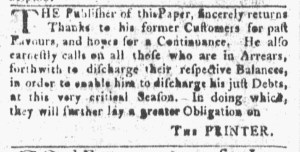
“THE Publisher of this Paper, sincerely returns Thanks to his former Customers for past Favours, and hopes for a Continuance.”
It was the first issue of the Boston-Gazette published in seven weeks. It was also the first issue of the Boston-Gazette published in nearby Watertown rather than in Boston. The newspaper underwent other changes following the battles at Lexington and Concord. A notice placed by the printer (rather than by the printers) hinted at some of them.
Benjamin Edes and John Gill had been partners in publishing the Boston-Gazette since April 7, 1755. Over the course of two decades, they developed a reputation as two of the printers who most ardently supported the Patriot cause. In his diary entry for September 3, 1769, John Adams recorded that he joined Edes and Gill and other Sons of Liberty in spending the evening “preparing for the Next Days Newspaper – a curious Employment. Cooking up Paragraphs, Articles, Occurences, &c. – working the political Engine!” When the Revolutionary War began, all the newspapers in Boston either folded, relocated, or suspended publication. Edes and Gill published their last issue on April 17, two days before the momentous events at Lexington and Concord. They then dissolved their partnership. Edes moved to Watertown and resumed publication with continuous numbering despite the change in location. The Boston-Gazetteremained there more than a year with a new issue every Monday. The last Watertown issue appeared on October 28, 1776. On November 4, Edes once again published the Boston-Gazette in Boston.
The first issue in Watertown featured only four advertisements, two of them placed by the printer. In one, Edes expressed his appreciation “to his former Customers for past Favours, and hope[d] for a Continuance” of their subscriptions. He also needed “also those who are in Arrears, forthwith to discharge their respective Balances, in order to enable him to discharge his just Debts, at this very critical Season.” In addition to cash, Edes needed other resources to continue publishing the Boston-Gazette. Another advertisement announced, “CASH given for clean Cotton and Linnen RAGS, at the Printing Office in Watertown.” Those rags would be made into paper. Edes had limited access to that essential item; throughout most of the summer his newspaper consisted of only two pages (a half sheet) rather than the usual four pages (a full sheet). The other two advertisements offered employment opportunities, one to “Journeymen Taylors” and the other to “Journeymen Saddlers.” In addition, a notice at the top of the first column on the first page invited “THOSE Persons who are possessed of any of Governor Hutchinson’s Letters … to forward them to the Printer hereof, in order for Publication.” Edes wished to embarrass the former governor and score political points, as he had done two years earlier. The printer moved his press to Watertown, yet he continued the same political activism.
The Slavery Adverts 250 Project chronicles the role of newspaper advertising in perpetuating slavery in the era of the American Revolution. The project seeks to reveal the ubiquity of slavery in eighteenth-century life from New England to Georgia by republishing advertisements about enslaved people – for sale as individuals or in groups, wanted to purchase or for hire for short periods, runaways who liberated themselves, and those who were subsequently captured and confined in jails and workhouses – in daily digests on this site as well as in real time via the @SlaveAdverts250 Twitter feed, utilizing twenty-first-century media to stand in for the print media of the eighteenth century.
The project aims to provide modern audiences with a sense of just how often colonizers encountered these advertisements in their daily lives. Enslaved men, women, and children appeared in print somewhere in the colonies almost every single day. Those advertisements served as a constant backdrop for social, cultural, economic, and political life in colonial and revolutionary America. Colonizers who did not purport to own enslaved people were still confronted with slavery as well as invited to maintain the system by purchasing enslaved men, women, and children or assisting in the capture of so-called “runaways” who sought to free themselves from bondage. The frequency of these newspaper advertisements suggests just how embedded slavery was in colonial and revolutionary American culture in everyday interactions beyond the printed page.
These advertisements also testify to the experiences of enslaved men, women, and children, though readers must consider that those experiences have been remediated through descriptions offered by enslavers rather than enslaved people themselves. Often unnamed in the advertisements, enslaved men, women, and children were not invisible or unimportant in early America.
These advertisements appeared in colonial American newspapers 250 years ago today.
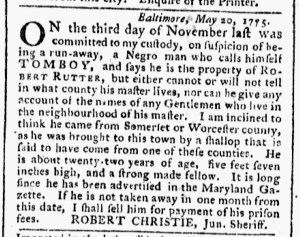
Dunlap’s Pennsylvania Packet (June 5, 1775).
**********
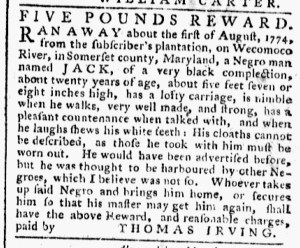
Dunlap’s Pennsylvania Packet (June 5, 1775).
**********
Dunlap’s Pennsylvania Packet (June 5, 1775).
**********
Dunlap’s Pennsylvania Packet (June 5, 1775).
**********
Newport Mercury (June 5, 1775).
**********
New-York Gazette and Weekly Mercury (June 5, 1775).
**********
New-York Gazette and Weekly Mercury (June 5, 1775).
What was advertised in a revolutionary American newspaper 250 years ago this week?
New-York Journal (June 1, 1775).
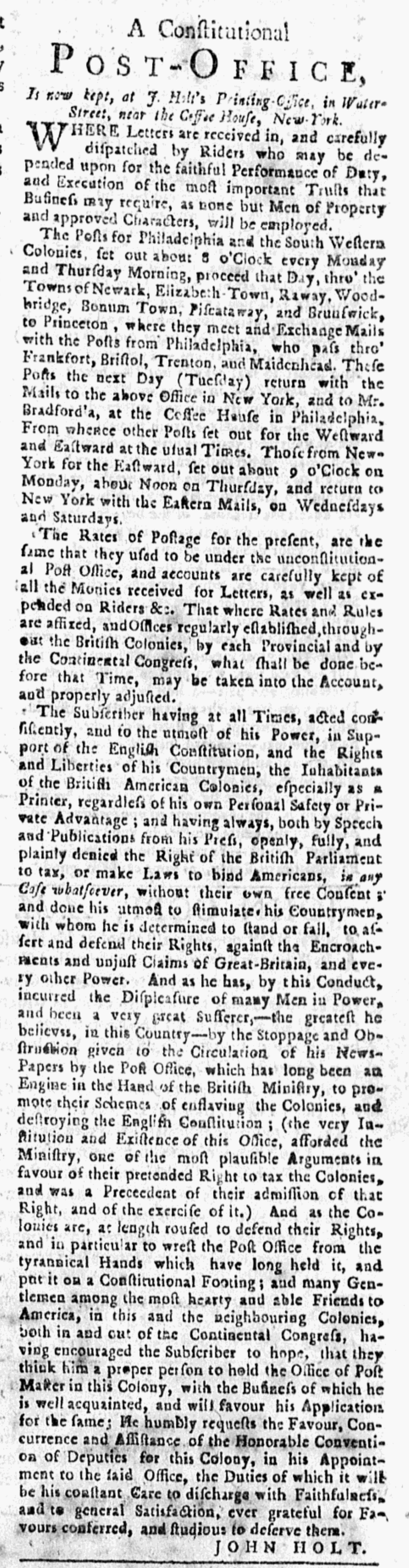
“A Constitutional POST-OFFICE, Is now kept, at J. Holt’s Printing-Office, in … New-York.”
William Goddard’s Pennsylvania Chronicle had a reputation for supporting the Patriot cause, so much so that the Crown Post drove it out of business by refusing to deliver it. That prompted Goddard to establish the Constitutional Post, independent of British authority, as an alternative. That service began with a route that connected Baltimore and Philadelphia in the summer of 1773. The network expanded, yet the First Continental Congress decided to table Goddard’s plan rather than endorse it when he submitted it for consideration in the fall of 1774. The Second Continental Congress took it up again following the battles at Lexington and Concord, adopting the plan on July 16, 1775. To Goddard’s disappointment, the delegates named Benjamin Franklin as the first Postmaster General; he settled for serving as Riding Surveyor.
By the time that the Second Continental Congress acted on the measure, Goddard and others had already made progress putting an infrastructure in place. For instance, newspaper advertisements confirm that “CONSTITUTIONAL Post-Riders” operated in Connecticut in the summer of 1774 and Massachusetts in the spring of 1775. In June 1775, John Holt, the printer of the New-York Journal, advertised that a “Constitutional POST-OFFICE, Is now kept” at his printing office in New York. He provided a schedule and noted that the “Rates of Postage for the present, are the same that they used to be under the unconstitutional Post Office.” He would adjust the “Rates and Rules” as provincial congresses in the several colonies and the Continental Congress approved them. In addition, “accounts are carefully kept of all the Monies received for Letters, as well as expended on Riders” and other costs. Holt anticipated that the Continental Congress would indeed adopt Goddard’s plan for the Constitutional Post in the aftermath of Lexington and Concord. Seeking an appointment as postmaster for New York, he devoted half of his advertisement to giving his credentials in hopes of attracting the attention of the delegates and other who might influence them:
“The Subscriber having at all Times, acted consistently, and to the utmost of his Power, in Support of the English Constitution, and the Rights and Liberties of his Countrymen, the Inhabitants of the British American Colonies, especially as a Printer, regardless of his own Personal Safety or Private Advantage; and having always, both by Speech and Publications from his Press, openly, fully, and plainly denied the Right of the British Parliament to tax, or make Laws to bind Americans, in any Case whatsoever, without their own free Consent; and done his utmost to stimulate his Countrymen, with whom he is determined to stand or fall, to assert and defend their Rights, against the Encroachment and unjust Claims of Great-Britain, and every other Power.”
That rationale corresponded to arguments advanced far and wide by Patriots. Holt continued making his case with a review of the consequences he endured for his devotion to the cause: “And as he has, by this Conduct, incurred the Displeasure of many Men in Power, and been a very great Sufferer,– the greatest he believes, in this Country – by the Stoppage and Obstruction given to the Circulation of his News-Papers by the Post Office, which has long been an Engine in the Hands of the British Ministry, to promote their Schemes of enslaving the Colonies, and destroying the English Constitution.”
With the siege of Boston continuing, Holt asserted that “the Colonies are, at length roused to defend their Rights, and in particular to wrest the Post Office from the tyrannical Hands which have long held it, and put it on a Constitutional Footing.” Having established a Constitutional Post Office in New York, Holt hoped that the Continental Congress would appoint him “Post Master in this Colony.” To that end, he “humbly requests the Favour, Concurrence and Assistance of the Honorable Convention of Deputies for this Colony, in his Appointment to the said Office,” pledging that “it will be his constant Care to discharge” the duties “with Faithfulness.” From Holt’s perspective, there was no better candidate for the position.
The printer’s lengthy advertisement served two purposes. He attempted to attract customers for the Constitutional Post Office now that New York had a branch at his printing office. He did so by deploying familiar rhetoric that outlined the stance taken by those who supported the American cause against the abuses of Parliament. He intended that as both a reason for colonizers to entrust their letters to the Constitutional Post Office and a demonstration of his devotion to the cause that merited an appointment as postmaster for the colony. Holt supplemented familiar arguments with his own experience, further demonstrating that he deserved to be appointed as postmaster. He sought the patronage of those who could award him the position while simultaneously seeking patrons for the Constitutional Post Office.