June 14

Who was the subject of an advertisement in a revolutionary American newspaper 250 years ago today?
Massachusetts Spy (June 14, 1775).

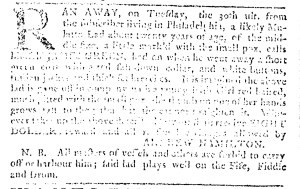
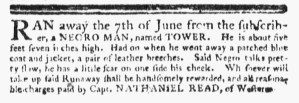
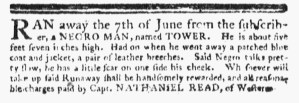
“RAN away … a NEGRO MAN, named TOWER.”

Isaiah Thomas, the printer of the Massachusetts Spy, left Boston just before the battles at Lexington and Concord in April 1775.  He had previously advertised that he intended to establish a printing office in Worcester and install a junior partner there to print the town’s first newspaper.  When he decided to leave Boston to escape the ire of British officials he had angered with his advocacy for the Patriot cause, however, he revised his plans.  Instead of a junior partner printing a new newspaper, Thomas moved the Massachusetts Spy to Worcester and continued publishing it there, safely beyond the reach of Tories in Boston.  Although the numbering of the newspaper continued uninterrupted, it gained a new subtitle, American Oracle of Liberty, and a warning that ran across the top of the masthead, “Americans! — Liberty or Death! — Join or Die.”

When published in Boston, the Massachusetts Spy carried advertisements that offered enslaved people for sale and notices that described enslaved people who liberated themselves by running away from their enslavers and offered rewards for their capture and return.  Despite the new subtitle and the admonitions in the masthead, Thomas continued to earn revenue for his newspaper by printing those advertisements in the Massachusetts Spy after moving it to Worcester.  Away from the colony’s largest urban port, colonizers did not resort to such notices as often, but they did submit them to the printing office and Thomas did publish them. The June 14, 1775, edition of the Massachusetts Spy, the seventh issue printed in Worcester, carried an advertisement about a “NEGRO MAN, named TOWER” who “RAN away” from Nathaniel Read of the nearby town of Western.  Read stated that “Whoever will take up said Runaway shall be handsomely rewarded.”  That advertisement appeared immediately below a news update that confirmed that residents of Charleston, South Carolina, had received word of “a skirmish, or in fact rather an engagement, which happened between his Majesty’s troops and the Provincials” on April 19.  The extract of the letter, written by a British officer in Boston and sent to a correspondent in Charleston, acknowledged that “On the whole the Provincials behaved with unexpected bravery.”  Tower also acted with courage, though not necessarily “unexpected bravery,” as he enacted his own plan for “Liberty or Death!”  Neither Read nor most readers allowed for that possibility, though an item that appeared in the next issue of the Massachusetts Spyindicated that some colonizers in Massachusetts did grapple with the meaning of freedom for enslaved people and the applied the rhetoric of the Revolution to them as well.  The Adverts 250 Project will feature that item next week.
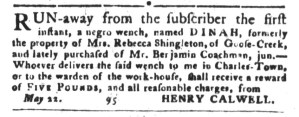
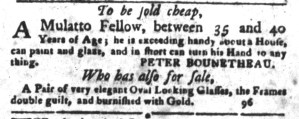
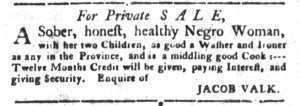
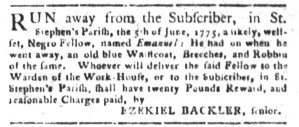
Slavery Advertisements Published June 14, 1775

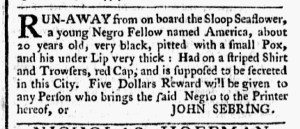
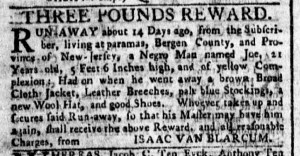
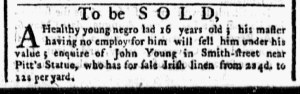
The Slavery Adverts 250 Project chronicles the role of newspaper advertising in perpetuating slavery in the era of the American Revolution. The project seeks to reveal the ubiquity of slavery in eighteenth-century life from New England to Georgia by republishing advertisements about enslaved people – for sale as individuals or in groups, wanted to purchase or for hire for short periods, runaways who liberated themselves, and those who were subsequently captured and confined in jails and workhouses – in daily digests on this site as well as in real time via the @SlaveAdverts250 Twitter feed, utilizing twenty-first-century media to stand in for the print media of the eighteenth century.
The project aims to provide modern audiences with a sense of just how often colonizers encountered these advertisements in their daily lives. Enslaved men, women, and children appeared in print somewhere in the colonies almost every single day. Those advertisements served as a constant backdrop for social, cultural, economic, and political life in colonial and revolutionary America. Colonizers who did not purport to own enslaved people were still confronted with slavery as well as invited to maintain the system by purchasing enslaved men, women, and children or assisting in the capture of so-called “runaways” who sought to free themselves from bondage. The frequency of these newspaper advertisements suggests just how embedded slavery was in colonial and revolutionary American culture in everyday interactions beyond the printed page.

These advertisements also testify to the experiences of enslaved men, women, and children, though readers must consider that those experiences have been remediated through descriptions offered by enslavers rather than enslaved people themselves. Often unnamed in the advertisements, enslaved men, women, and children were not invisible or unimportant in early America.

These advertisements appeared in colonial American newspapers 250 years ago today.

Massachusetts Spy (June 14, 1775).

**********

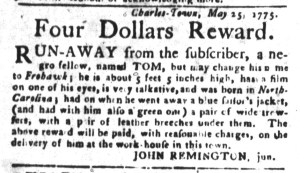
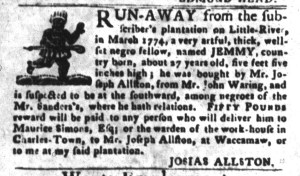
Pennsylvania Journal (June 14, 1775).

**********

Pennsylvania Journal (June 14, 1775).

June 13

What was advertised in a revolutionary American newspaper 250 years ago today?

South-Carolina Gazette and Country Journal (June 13, 1775).

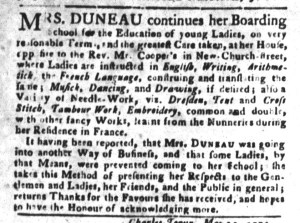
“MRS. DUNEAU continues her Boarding School for the Education of young Ladies.”

In an advertisement in the June 13, 1775, edition of the South-Carolina Gazette and Country Journal, Mrs. Duneau assured the public that she “continues her Boarding School for the Education of young Ladies … at her House, opposite to the Rev. Mr. Cooper’s in New-Church-street” in Charleston.  She may have intended to suggest that her proximity to the minister contributed to the “greatest Care” that she took of her pupils.  The schoolmistress also provided an overview of the curriculum at her school: “English, Writing, Arithmetic, the French Language, construing and translating the same; Musick, Dancing, and Drawing.”  The education they received from Duneau helped in forming her students into genteel young ladies.  In addition, they learned a “Variety of Needle-Work,” likely intended to demonstrate their devotion to leisurely pursuits rather prepare them occupations to support themselves.  Those included “Dresden, Tent and Cross Stitch, Tambour Work, [and] Embroidery, common and double,” along with “other fancy Works” that Duneau “learnt from the Nunneries during her Residence in France.”

Although advertisements for boarding schools regularly appeared in newspapers published in Charleston on the eve of the American Revolution, Duneau may have considered it especially necessary to insert this notice to attract students.  “It having been reported,” she stated, “that Mrs. DUNEAU was going into another Way of Business, … some Ladies, by that Means, were prevented coming to her School.”  What kinds of reports had circulated?  Who was responsible for suggesting that she planned to pursue another occupation, perhaps putting her skill with a needle to use in the marketplace?  Had a rival schoolmistress spread rumors as a means of undercutting Duneau and enrolling students who otherwise would have attended her school?  Duneau did not provide further details in her advertisement.  Instead, she focused on “presenting her Respects to the Gentlemen and Ladies, her Friends, and the Public in general,” expressing her gratitude for “the Favours she has received” when entrusted with students in the past and requesting “the Honour of acknowledging more.”  Whatever readers may have heard about whether Duneau continued to operate her school, she wanted the parents of prospective students to know that she was prepared to teach their daughters.

Slavery Advertisements Published June 13, 1775

The Slavery Adverts 250 Project chronicles the role of newspaper advertising in perpetuating slavery in the era of the American Revolution. The project seeks to reveal the ubiquity of slavery in eighteenth-century life from New England to Georgia by republishing advertisements about enslaved people – for sale as individuals or in groups, wanted to purchase or for hire for short periods, runaways who liberated themselves, and those who were subsequently captured and confined in jails and workhouses – in daily digests on this site as well as in real time via the @SlaveAdverts250 Twitter feed, utilizing twenty-first-century media to stand in for the print media of the eighteenth century.

The project aims to provide modern audiences with a sense of just how often colonizers encountered these advertisements in their daily lives. Enslaved men, women, and children appeared in print somewhere in the colonies almost every single day. Those advertisements served as a constant backdrop for social, cultural, economic, and political life in colonial and revolutionary America. Colonizers who did not purport to own enslaved people were still confronted with slavery as well as invited to maintain the system by purchasing enslaved men, women, and children or assisting in the capture of so-called “runaways” who sought to free themselves from bondage. The frequency of these newspaper advertisements suggests just how embedded slavery was in colonial and revolutionary American culture in everyday interactions beyond the printed page.

These advertisements also testify to the experiences of enslaved men, women, and children, though readers must consider that those experiences have been remediated through descriptions offered by enslavers rather than enslaved people themselves. Often unnamed in the advertisements, enslaved men, women, and children were not invisible or unimportant in early America.

These advertisements appeared in colonial American newspapers 250 years ago today.

Dunlap’s Maryland Gazette (June 13, 1775).

**********

Pennsylvania Evening Post (June 13, 1775).

**********

South-Carolina Gazette and Country Journal (June 13, 1775).

**********

South-Carolina Gazette and Country Journal (June 13, 1775).

**********

South-Carolina Gazette and Country Journal (June 13, 1775).

**********

South-Carolina Gazette and Country Journal (June 13, 1775).

**********

South-Carolina Gazette and Country Journal (June 13, 1775).

**********

South-Carolina Gazette and Country Journal (June 13, 1775).

**********

South-Carolina Gazette and Country Journal (June 13, 1775).

**********

South-Carolina Gazette and Country Journal (June 13, 1775).

**********

South-Carolina Gazette and Country Journal (June 13, 1775).

**********

South-Carolina Gazette and Country Journal (June 13, 1775).

**********

South-Carolina Gazette and Country Journal (June 13, 1775).

**********

South-Carolina Gazette and Country Journal (June 13, 1775).

**********

South-Carolina Gazette and Country Journal (June 13, 1775).

**********

South-Carolina Gazette and Country Journal (June 13, 1775).

**********

South-Carolina Gazette and Country Journal (June 13, 1775).

**********

South-Carolina Gazette and Country Journal (June 13, 1775).

**********

South-Carolina Gazette and Country Journal (June 13, 1775).

**********

South-Carolina Gazette and Country Journal (June 13, 1775).

June 12

What was advertised in a revolutionary American newspaper 250 years ago today?

Connecticut Courant (June 12, 1775).

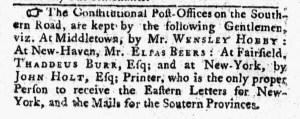
“The Constitutional Post-Offices on the Southern Road, are kept by the following Gentlemen.”

Although William Goddard established the Constitutional Post as an alternative to the British Post Office in 1773, advertisements for the service appeared in colonial newspapers only sporadically until after the battles at Lexington and Concord in April 1775.  After the Revolutionary War began, however, the number and frequency of newspaper notices promoting the Constitutional Post increased, especially in New England, New York, and Pennsylvania.  In May 1775, for instance, Nathan Bushnell, Jr., a postrider in Connecticut, stated that he was affiliated with the Constitutional Post in advertisements that ran in both the New-England Chronicle, published in Cambridge, Massachusetts, and the Connecticut Gazette, published in New-London.  John Holt, the printer of the New-York Journal, inserted a lengthy advertisement to advise readers that a “Constitutional POST-OFFICE, Is now kept” at his printing office in early June.

An unsigned advertisement in the June 12, 1775, edition of the Connecticut Courant, published by Ebenezer Watson in Hartford, listed four branches: “The Constitutional Post-Offices on the Southern Road, are kept by the following Gentlemen, viz. At Middletown, by the Mr. WENSLEY HOBBY: At New-Haven, Mr. ELIAS BEERS: At Fairfield, THADDEUS BURR, Esq; and at New-York, by JOHN HOLT, Esq; Printer.”  Holt may have been responsible for the notice, considering that it described him as “the only proper Person to receive the Eastern Letters for New-York, and the Mails for the Sout[h]ern Provinces.”  One of the other postmasters could have placed the notice, though Watson may have done it of his own volition as a public service.  Joseph M. Adelman persuasively argues that “printers had a direct financial and business interest in promoting a post office to their liking both because it distributed their newspapers and other print goods and because they were the chief beneficiaries of a patronage system centering on the post office.”[1]  He also acknowledges that printers “enlisted merchants and members of the revolutionary elite … to provide financial and political support.”[2]  The notice in the Connecticut Courant included only one printer, John Holt, among the four postmasters.  Fairfield and Middletown did not have newspapers, but they did have need of reliable post offices and trustworthy postmasters.  In New Haven, Thomas Green and Samuel Green printed the Connecticut Journal, yet the notice did not indicate that they had an affiliation with the Constitutional Post Office.  While printers played an important role in establishing the service, they worked alongside postmasters from other occupations in creating an infrastructure for disseminating news and information.

**********

[1] Joseph M. Adelman, “‘A Constitutional Conveyance of Intelligence, Public and Private,’: The Post Office, the Business of Printing, and the American Revolution,” Enterprise and Society 11, no. 4 (December 2010): 713.

[2] Adelman, “Constitutional Conveyance,” 709.

Slavery Advertisements Published June 12, 1775

The Slavery Adverts 250 Project chronicles the role of newspaper advertising in perpetuating slavery in the era of the American Revolution. The project seeks to reveal the ubiquity of slavery in eighteenth-century life from New England to Georgia by republishing advertisements about enslaved people – for sale as individuals or in groups, wanted to purchase or for hire for short periods, runaways who liberated themselves, and those who were subsequently captured and confined in jails and workhouses – in daily digests on this site as well as in real time via the @SlaveAdverts250 Twitter feed, utilizing twenty-first-century media to stand in for the print media of the eighteenth century.

The project aims to provide modern audiences with a sense of just how often colonizers encountered these advertisements in their daily lives. Enslaved men, women, and children appeared in print somewhere in the colonies almost every single day. Those advertisements served as a constant backdrop for social, cultural, economic, and political life in colonial and revolutionary America. Colonizers who did not purport to own enslaved people were still confronted with slavery as well as invited to maintain the system by purchasing enslaved men, women, and children or assisting in the capture of so-called “runaways” who sought to free themselves from bondage. The frequency of these newspaper advertisements suggests just how embedded slavery was in colonial and revolutionary American culture in everyday interactions beyond the printed page.

These advertisements also testify to the experiences of enslaved men, women, and children, though readers must consider that those experiences have been remediated through descriptions offered by enslavers rather than enslaved people themselves. Often unnamed in the advertisements, enslaved men, women, and children were not invisible or unimportant in early America.

These advertisements appeared in colonial American newspapers 250 years ago today.

Dunlap’s Pennsylvania Packet (June 12, 1775).

**********

Newport Mercury (June 12, 1775).

**********

New-York Gazette and Weekly Mercury (June 12, 1775).

**********

New-York Gazette and Weekly Mercury (June 12, 1775).

**********

New-York Gazette and Weekly Mercury (June 12, 1775).

**********

New-York Gazette and Weekly Mercury (June 12, 1775).

**********

New-York Gazette and Weekly Mercury (June 12, 1775).

June 11

What was advertised in a revolutionary American newspaper 250 years ago this week?

Connecticut Gazette (June 9, 1775).

“SEIZE the ROGUE!”

Most articles in eighteenth-century newspapers did not have headlines.  Considering that most issues consisted of only four pages and most newspapers were published just once a week, printers did not have the space to include short summaries of the content.  They expected subscribers and others would engage in practices of intensive reading, working their way through the articles, letters, and other “intelligence” that appeared in their newspapers.  Some regular features did have headlines, such as “THOMAS ALLEN’s Marine List” and the “POET’S CORNER” in the Connecticut Gazette, but most articles did not.

Advertisers, on the other hand, sometimes devised headlines for the notices they paid to insert in early American newspapers.  Quite often their names served as the headline.  Such as the case for an advertisement placed by Nathan Bushnell, Jr., in the June 9, 1775, edition of the Connecticut Gazette.  He ran the same advertisement in the New-England Chronicle, deploying the name of the service he provided, “CONSTITUTIONAL POST,” as a secondary headline.  Elsewhere in the Connecticut Gazette, an advertisement intended to raise funds for “Building a Meeting-House, for Public Worship” in Stonington deployed a headline to inform readers that it contained the “Scheme of a LOTTERY” that listed the number of tickets and the available prizes.

John Holbrook of Pomfret intended to attract attention with the headline for his advertisement: “SEIZE the ROGUE!”  Holbrook explained that a “noted thief” had stolen various items from his house during the night of April 28, 1775.  He described “a large silver WATCH with a silver-twist chain, a clarat colour’d coat lately let out at the sides and at the outsides of the sleeves, a jacket near the same colour, both of them lined, … [and] a psalm book with the names of Asa Sharper and Caleb Sharpe in it,” along with other pilfered items.  Holbrook offered a reward to “Whoever brings said villain … with the above articles” or a smaller reward for just “the said thief without the articles.”  Given the amount of time that had passed, there was a good chance that the thief had fenced or sold the stolen items, giving some colonizers greater access to consumer culture through what Serena Zabin has termed an informal economy.  Whatever the fate of the watch, coat, and psalm book, Holbrook used a lively headline to increase the chances that readers would take note of his advertisement.  He did so at a time that editors and others employed in printing offices did not yet craft headlines for most of the news they published.

June 10

What was advertised in a revolutionary American newspaper 250 years ago today?

Providence Gazette (May 10, 1775).

“A regular Intercourse between the Colonies, at this critical Juncture, is of the utmost Importance.”

As the imperial crisis intensified in the spring of 1775, Isaiah Thomas, the printer of the Massachusetts Spy, left Boston just before the battles at Lexington and Concord.  He had previously planned to establish a printing office in Worcester, setting up a junior partner to publish the town’s first newspaper.  When he left Boston because his political principles and advocacy put him in jeopardy with royal officials, however, he also decided to transfer his newspaper to Worcester and become the local printer.  After revising his plans, he set about expanding the infrastructure for collecting and distributing news in central Massachusetts.

Worcester, previously lacking a printer and a newspaper, became a much more important hub for disseminating information.  Tarent Putnam aimed to be part of that transformation, announcing in the Providence Gazette that he “has began to ride Post from Providence to Worcester, and proposes, on receiving proper Encouragement, to continue his Ride weekly.”  He departed Providence on Saturdays, “immediately after the Publication of the Providence Gazette,” and returned on the following Thursday.  Thomas published the Massachusetts Spy (now branded the Massachusetts Spy, Or, American Oracle of Liberty) on Wednesdays, which meant that Putnam carried newspapers hot off the presses in both directions.  In addition to carrying letters, the postrider accepted subscriptions “for the Providence or Worcester Papers” and promised that he would “faithfully execute any other Business that may be entrusted to him.”

Yet he did not offer these services merely to earn his own livelihood.  Instead, he asked colonizers to consider the impact they could have on current events if they supported his undertaking.  Putnam asserted that “a regular Intercourse between the Colonies, at this critical Juncture, is of the utmost Importance.”  Accordingly, he “flatters himself that the Friends of Liberty and the Rights of Mankind will afford him every Encouragement.”  Putnam did more than move letters and newspapers from one town to another; he made important contributions to the flow of information that kept citizens informed as the siege of Boston continued and the imperial crisis became a war for independence.  The stakes were high … and readers had an opportunity to play their part by supporting Putnam’s “POST from Providence to Worcester.”  In hiring his services, they simultaneously became better informed themselves and aided the American cause by keeping communities in New England and beyond better connected and aware of the latest information regarding current events.

Slavery Advertisements Published June 10, 1775

The Slavery Adverts 250 Project chronicles the role of newspaper advertising in perpetuating slavery in the era of the American Revolution. The project seeks to reveal the ubiquity of slavery in eighteenth-century life from New England to Georgia by republishing advertisements about enslaved people – for sale as individuals or in groups, wanted to purchase or for hire for short periods, runaways who liberated themselves, and those who were subsequently captured and confined in jails and workhouses – in daily digests on this site as well as in real time via the @SlaveAdverts250 Twitter feed, utilizing twenty-first-century media to stand in for the print media of the eighteenth century.

The project aims to provide modern audiences with a sense of just how often colonizers encountered these advertisements in their daily lives. Enslaved men, women, and children appeared in print somewhere in the colonies almost every single day. Those advertisements served as a constant backdrop for social, cultural, economic, and political life in colonial and revolutionary America. Colonizers who did not purport to own enslaved people were still confronted with slavery as well as invited to maintain the system by purchasing enslaved men, women, and children or assisting in the capture of so-called “runaways” who sought to free themselves from bondage. The frequency of these newspaper advertisements suggests just how embedded slavery was in colonial and revolutionary American culture in everyday interactions beyond the printed page.

These advertisements also testify to the experiences of enslaved men, women, and children, though readers must consider that those experiences have been remediated through descriptions offered by enslavers rather than enslaved people themselves. Often unnamed in the advertisements, enslaved men, women, and children were not invisible or unimportant in early America.

These advertisements appeared in colonial American newspapers 250 years ago today.

Providence Gazette (June 10, 1775).

**********

Virginia Gazette [Dixon and Hunter] (June 10, 1775).

**********

Virginia Gazette [Dixon and Hunter] (June 10, 1775).

**********

Virginia Gazette [Dixon and Hunter] (June 10, 1775).

**********

Virginia Gazette [Dixon and Hunter] (June 10, 1775).

**********

Virginia Gazette [Dixon and Hunter] (June 10, 1775).

June 9

What was advertised in a revolutionary American newspaper 250 years ago today?

Essex Journal (June 9, 1775).

“The Editor being driven from his house and business by the perfidious [Thomas] Gage.”

Like so many other Bostonians, Joseph Greenleaf, the publisher of the Royal American Magazine, became a refugee who fled from the city during the siege that followed the battles at Lexington and Concord.  When the governor, General Thomas Gage, and the Massachusetts Provincial Congress agreed that Loyalists could enter the city and Patriots and others could depart, each with any of their effects they could transport (except for firearms and ammunition), Greenleaf removed to Watertown.  He crafted his own narrative of what happened in an advertisement that ran in the June 9, 1775, edition of the Essex Journal: “The Editor [was] driven from his house and business by the perfidious –– Gage in public violation of his most sacred engagements, leaving ALL (except Beds and some Clothing) behind.”  Apparently, Greenleaf had not managed to take his press or any of his supplies and other equipment with him.

He found himself in desperate need of money, deprived of his livelihood in Boston.  In his advertisement in the Essex Journal, published in Newburyport, Greenleaf called on “Subscribers for the American Magazine at Newbury, Newbury-Port, and the vicinity … to pay their respective ballances to the month of March, being fifteen months, to Bulkeley Emerson of Newbury-Port,” his local agent in that town.  In a single sentence, Greenleaf gave an abbreviated history of the Royal American Magazine.  The publication, first proposed by Isaiah Thomas in May 1773, had commenced publication with the January 1774 issue.  Thomas published several issues, fell behind, and then suspended the magazine due to the “Distresses” that he and everyone else in Boston experienced due to the Boston Port Act closing the harbor until colonizers made restitution for the tea destroyed there in December 1773.  Almost as soon as he announced that he suspended the Royal American Magazine, Thomas informed subscribers and the public that Greenleaf became the new proprietor.  From August 1774 through April 1775, Greenleaf worked diligently to publish the delinquent issues and get the magazine back on schedule.  He succeeded … until the beginning of the Revolutionary War became too disruptive to continue.

When Greenleaf became the proprietor of the magazine, Thomas transferred all the accounts to him.  Some subscribers thus owed for the entire fifteen months of the magazine’s run from January 1774 through March 1775.  Under the circumstances, the publisher could no longer afford to extend credit to them.  He prorated the subscription fees, but expected that “being driven from his house and business … will no doubt excite the Subscribers to be kindly Punctual, as it is at present the only dependence for support of the Person and Family of their Humble Servant.”  The war meant that Greenleaf could no longer do business as usual.  After leaving Boston, he needed subscribers to pay what they owed.

**********

The Adverts 250 Project has tracked the entire marketing campaign for the Royal American Magazine from Thomas’s first mention of distributing subscription proposals to Greenleaf’s last advertisements for the final issue.