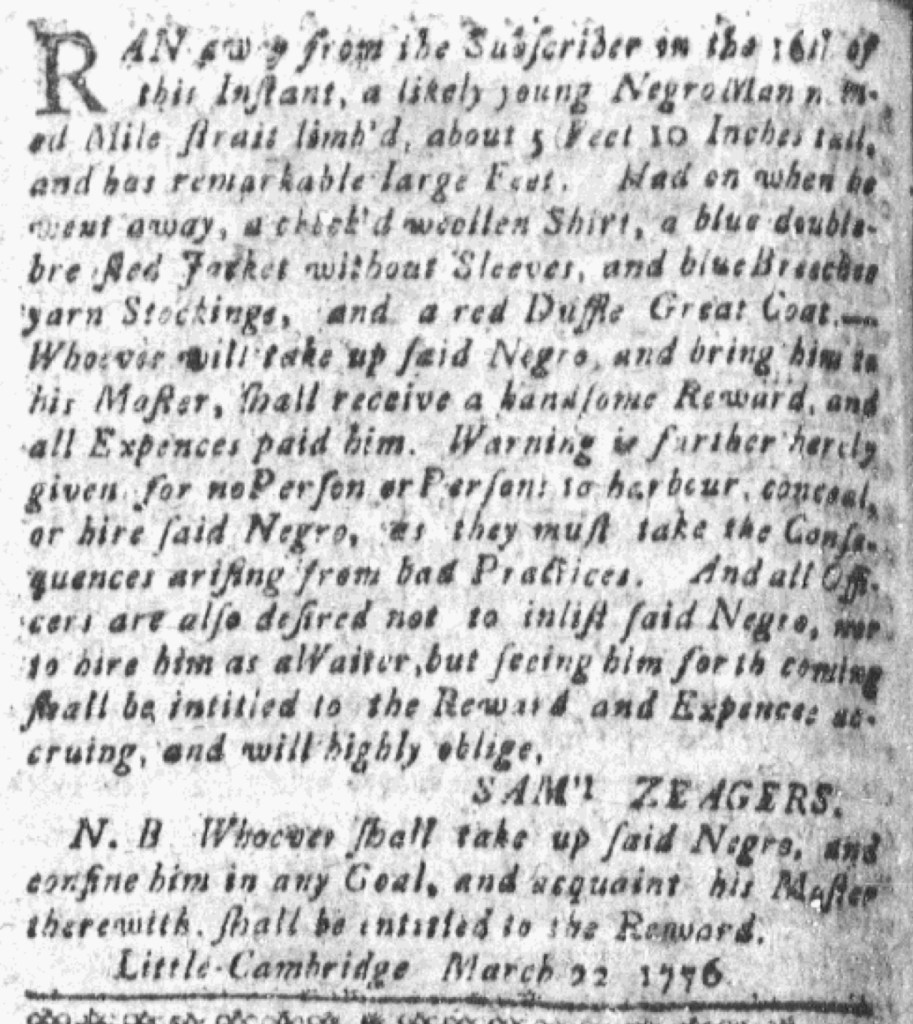
What was advertised in a revolutionary American newspaper 250 years ago today?
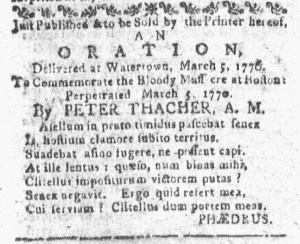
“AN ORATION … To Commemorate the Bloody Massacre at Boston: Perpetrated March 5, 1770.”
The annual tradition continued during the first year of the Revolutionary War. Each year since the Boston Massacre, residents of the city gathered to mark the anniversary, honor the men who died when British regulars fired into a crowd of protestors, and hear an oration about the dangers of a standing army stationed in an urban port during times of peace. James Lovell delivered the address in 1771, followed by Joseph Warren in 1772, Benjamin Church in 1773, and John Hancock in 1774. In March 1775, Joseph Warren gave the last oration before the Revolutionary War commenced with the battles at Lexington and Concord on April 19. Three months later, he was killed in action at the Battle of Bunker Hill.
Patriots made adjustments to the ritual in 1776. The British occupation of Boston continued. The Continental Army, commanded by George Washington, continued the siege of the city. The Massachusetts Provincial Congress met at Watertown. It was from there that William Cooper, the “Town Clerk of Boston” in exile, announced that according to a “vote in a town-meeting legally assembled” on March 5, 1775, “an ORATION will be delivered at the meeting-house, in Watertown, on the 5th of March next, … to commemorate the horrid Massacre perpetrated in Boston, on the evening of the 5th of March, 1770, by a party of Soldiers of the 29th Regiment, under the command of Capt. Thomas Preston.” Refugees from Boston and the inhabitants of Watertown and other nearby towns gathered in Watertown for the annual oration about “the ruinous tendency of Standing armies being placed in large and populous cities, in time of peace.” It was also a rally for asserting “the necessity of such exertions as the inhabitants of Boston then manifested, whereby the designs of the conspirators against the public safety, have been frustrated.”
Although circumstances forced those “who were inhabitants of Boston” to shift the location for the annual commemoration, other aspects remained constant, including the printing, marketing, and dissemination of the oration a few weeks after the gathering occurred. This time, Peter Thacher delivered “AN ORATION … To Commemorate the Bloody Massacre at Boston: Perpetrated March 5, 1770.” Benjamin Edes, who had relocated the Boston-Gazette from Boston to Watertown, printed the pamphlet and sold it at his printing office. As had been the case with previous orations, this gave those who had been present an opportunity to experience Thacher’s address again and as many times as they wished to read it. The pamphlet also gave those who had not attended a chance to read what Thacher said and imbibe the arguments made in support of the American cause. Gathering for the oration was an important civic act, yet the circulation of the oration in print may have had an impact just as significant.