
What was advertised in a revolutionary American newspaper 250 years ago today?
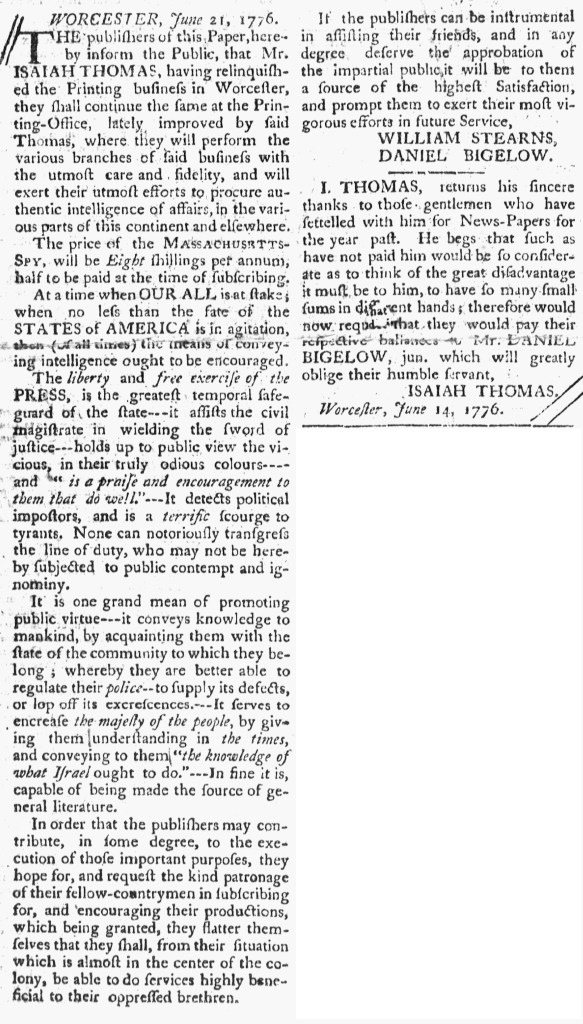
“ISAIAH THOMAS, having relinquished the Printing business in Worcester.”
The title changed from Thomas’s Massachusetts Spy to The Massachusetts Spy with issue “NUMB. 269” on June 21, 1776. Two months earlier, Isaiah Thomas informed readers that he intended to remain in Worcester “for the present,” but since then he decided to pursue new opportunities in Salem. He previewed that decision in a notice in the May 31 edition, the last one he published. In a lengthy address on the first page, William Stearns and Daniel Bigelow, the new “publishers of this Paper,” informed the public that Thomas “relinquished the Printing business in Worcester” to them. They now occupied the printing office “near the COURT-HOUSE,” where they undertook “the various branches of said business with the utmost care and fidelity, and will exert their utmost efforts to procure authentic intelligence of affairs, in the various parts of this continent and elsewhere.” They hoped to attract customers for job printing as well and maintain and expand their subscribers.
The title shifted slightly, but the subtitle, American Oracle of Liberty, remained the same. Stearns and Bigelow made their editorial stance clear in their address. “At a time when OUR ALL is at stake, when no less than the fate of the STATES of AMERICA is in agitation,” they proclaimed, “then (of all times) the means of conveying intelligence ought to be encouraged.” That meant that subscribers had a duty to continue to subscribe and others had a responsibility to support Worcester’s only newspaper by becoming subscribers, placing advertisements, and sharing news as they received it in letters and by other means. In turn, the printers would do their civic duty. “The liberty and free exercise of the PRESS,” Stearns and Bigelow continued, “is the greatest temporal safeguard of the state—it assists the civil magistrate in wielding the sword of justice—holds up to public view the vicious, and in their odious colours— … —It detects political impostors, and is a terrific scourge to tyrants.” Readers could expect the same vigilance and advocacy for the American cause from Stearns and Bigelow that Thomas had a reputation for delivering.
Following Stearns and Bigelow’s address, Thomas inserted a brief notice in which he expressed “sincere thanks to those gentlemen who have settelled with him for News-Papers for the year past.” The spelling error may have been an actual error rather than an eighteenth-century variation. Despite their pledge to “do services highly beneficial to their oppressed brethren” in central Massachusetts, their skill as printers paled in comparison to Thomas. For his part, the printer did not offer words of encouragement or general expressions of gratitude as he departed Worcester. After thanking subscribers who already settled accounts, he called on those who still owed to “pay their respective balances” to Stearns and Bigelow. After a hiatus of three weeks, a new issue of the Massachusetts Spy carried news (and a couple of advertisements) to readers. When news of the Declaration of Independence reached Worcester about three weeks later, Thomas may (or may not) have made the first public reading in New England, but he no longer ran his own newspaper. He published an account of the battles at Lexington and Concord in the first edition of the Massachusetts Spy printed in Worcester, but now others would cover the Declaration of Independence and its reception in the commonwealth of Massachusetts and other states.