
What was advertised in a revolutionary American newspaper 250 years ago today?
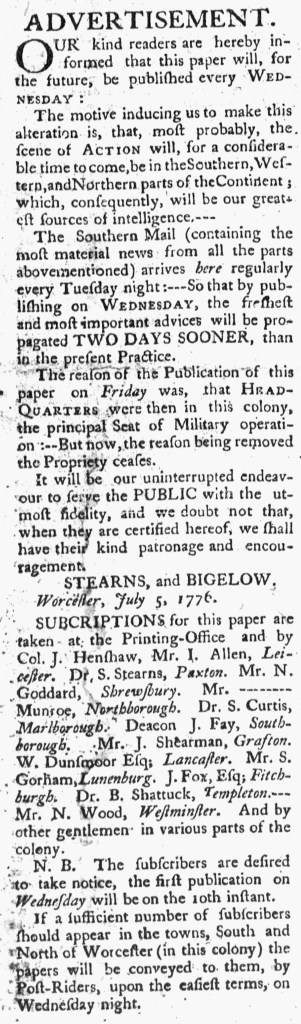
“The freshest and most important advices will be propagated TWO DAYS SOONER.”
After the siege of Boston ended, Isaiah Thomas considered seeking new opportunities in the city where he had formerly operated a printing office or perhaps in Salem or elsewhere along the coast. In the spring of 1775, he relocated to Worcester just before the battles at Lexington and Concord. He had already planned to open a printing office there, establish the town’s first newspaper, and install a junior partner to oversee both endeavors, but the outbreak of hostilities caused him to transfer the Massachusetts Spy from Boston to Worcester and print it himself. Once the British evacuated Boston in March 1776, Thomas contemplated what to do next. In June, he transferred the Massachusetts Spyto William Stearns and Daniel Bigelow.
Two weeks after publishing their first issue, Stearns and Bigelow inserted an announcement in the July 5 edition to inform readers that they were changing the publication day of the weekly newspaper from Friday to Wednesday. They explained the “motive inducing us to make this alteration is, that, most probably, the scene of ACTION will, for a considerable time to come, be in the Southern, Western, and Northern parts of the Continent; which, consequently, will be our greatest sources of intelligence.” In other words, now that Boston was not at the center of the war, the printers adjusted the publication day to accommodate when they received news from the south, through networks that included New York and Philadelphia, rather than from Boston and its surrounding towns to the east. “The reason of the Publication of this paper on Friday,” Stearns and Bigelow elaborated, “was, that HEAD-QUARTERS were then in this colony, the principal Seat of Military operation.” Since that was no longer the case, “the Propriety [of publishing the Massachusetts Spy on Friday] ceases.” Instead, the “Southern Mail (containing the most material news from all the parts abovementioned) arrives here regularly every Tuesday night.” By moving publication to Wednesday, “the freshest and most important advices will be propagated TWO DAYS SOONER, than in the present practice.” Stearns and Bigelow framed this as part of their “uninterrupted endeavour to serve the PUBLIC with the utmost fidelity.” The printers planned to make the change immediately. The next issue would be published on Wednesday, July 10, just five days after the issue announcing the change.
At the same time, Stearns and Bigelow attempted to increase the number of subscribers. In addition to receiving subscriptions at the printing office in Worcester, they also designated local agents in a dozen towns in central Massachusetts and noted that “other gentlemen in various parts of the colony” collected the names of subscribers. They also planned to hire riders to carry the Massachusetts Spy to other towns on Wednesday night “[i]f a sufficient number of subscribers should appear.”
Thomas had built his reputation through his long experience as a printer. Stearns and Bigelow did not have the same advantage, yet they likely hoped that proactively adjusting the day of publication, enlisting local agents to accept subscriptions, and hiring riders to deliver newspapers if the number warranted doing so would cultivate confidence among current and prospective subscribers. They did not have Thomas’s experience, but they demonstrated that they were responsive to changing conditions and would cater to the convenience of their customers.