
What was advertised in a revolutionary American newspaper 250 years ago today?
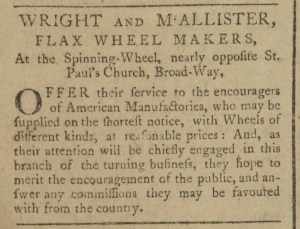
“WRIGHT AND McALLISTER, FLAX WHEEL MAKERS, … OFFER their service to the encouragers of American Manufactories.”
Wright and McAllister, “FLAX WHEEL MAKERS,” marked their location “nearly opposite St. Paul’s Church, Broad-Way,” in New York with a sign depicting a spinning wheel. The placed an advertisement in the June 27, 1776, edition of the New York Packet to “OFFER their service to the encouragers of American Manufactories.” In so doing, they echoed the language that so often appeared in editorials about producing goods in the colonies rather than importing them from Great Britain, in advertisements that promoted such products, and in nonimportation agreements adopted as acts of resistance. The eighth article of the Continental Association, the most significant of the nonimportation agreements, for instance, stated, “That we will, in our several Stations, encourage Frugality, Economy, and Industry; and promote Agriculture, Arts, and the Manufactures of this Country.” That meant producing homespun textiles as alternatives to the array of imported fabrics that dominated newspaper advertisement for imported goods, yet colonizers could not focus solely on the final product. Purchasing and wearing homespun depended on having the equipment necessary for producing it.
Wright and McAllister aimed to do their part in such a worthy endeavor. They made “Wheels of different kinds” that they sold “at reasonable prices.” Under other circumstances they might have described themselves as turners rather than “FLAX WHEEL MAKERS,” but they decided that “their attention will be chiefly engaged in this branch of the turning business” on the eve of the Second Continental Congress declaring independence. They joined other entrepreneurs who marketed American-made equipment for producing textiles, including Robert White and David Poe, who both made spinning wheels, and Fergus McIllroy, who made looms. Given the service that they undertook on behalf of the American cause, Wright and McAllister “hope[d] to merit the encouragement of the public” in New York as well as “answer any commissions they may be favoured with from the county.” In turn, their work would enable others, especially women, to participate in politics through their activities in the marketplace, not only as consumers but also as producers of the thread necessary for producing homespun textiles.
[…] Wright and McAllister, “FLAX WHEEL MAKERS,” marked their location “nearly opposite St. Paul’s Church, Broad-Way,” in New York with a sign depicting a spinning wheel. The placed an advertisement in the June 27, 1776, edition of the New York Packet to “OFFER their service to the encouragers of American Manufactories.” In so doing, they echoed the language that so often appeared in editorials about producing goods in the colonies rather than importing them from Great Britain, in advertisements that promoted such products, and in nonimportation agreements adopted as acts of resistance. The eighth article of the Continental Association, the most significant of the nonimportation agreements, for instance, stated, “That we will, in our several Stations, encourage Frugality, Economy, and Industry; and promote Agriculture, Arts, and the Manufactures of this Country.” That meant producing homespun textiles as alternatives to the array of imported fabrics that dominated newspaper advertisement for imported goods, yet colonizers could not focus solely on the final product. Purchasing and wearing homespun depended on having the equipment necessary for producing it. Wright and McAllister aimed to do their part in such a worthy endeavor. Read more… […]