
What was advertised in a revolutionary American newspaper 250 years ago today?
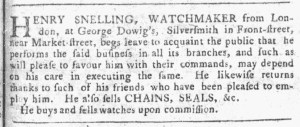
“He likewise returns thanks to such of his friends who have been pleased to employ him.”
Henry Snelling apparently thought that advertising worked. In the spring of 1776, the “WATCHMAKER from London” inserted an advertisement in the April 20 edition of the Pennsylvania Evening Post. Three months later, he ran another advertisement on July 18. Another three months after that, he placed yet another advertisement “to acquaint the public that he performs the said business in all its branches.” He promised that customers who “will please to favour him with their commands, may depend on his care in executing the same.”

Comparing the format of the three advertisements reveals some of the decisions that Snelling made as he tinkered with the copy each time that he ran a new notice. He retained nearly identical copy throughout the three advertisements, but he seemingly did not alert the printing office that he would likely run subsequent advertisements after the one that ran in April. The printer broke down the type and set it again when Snelling resumed advertising in July. The new advertisement featured identical copy, making it almost indistinguishable from the previous one except for differences in line breaks near the end. In addition, Snelling added a note: “Clocks and Watches bought and sold by commission.” A manicule directed attention to the addition. Once again, Snelling apparently did not indicate that he planned to run the same advertisement again in a few months. The October version had almost identical copy with a minor revision to the final note about buying and selling watches on commission. Significant changes in format make it clear at a glance that the printer rest the type. The new version had a drop cap for the “H” in “HENRY,” while the previous version had a drop cap for the “B” in “BEGS.” The words “CHAINS” and “SEALS” appeared in all capitals in the October advertisement but not in the July version. The manicule on the final line disappeared. None of the line breaks repeated.
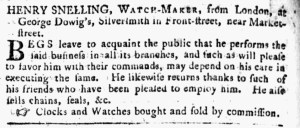
These changes in format demonstrate that Snelling made new decisions to invest in advertising once again, first in July and then in October. If he did not consider his previous notices effective, he likely would not have continued to pay for additional advertisements, especially not a third time. In the absence of market research that reveals the effectiveness of newspaper advertising in eighteenth-century America, the reiteration and updating of advertisements suggests that the advertisers at least believed that placing notices yielded results.