
What was advertised in a revolutionary American newspaper 250 years ago today?
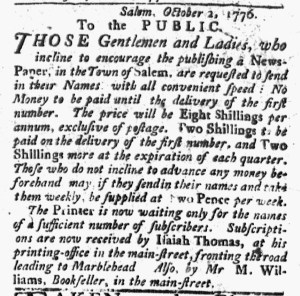
“The Printer is now waiting only for the names of a sufficient number of subscribers.”
In early October 1776, Isaiah Thomas took to the pages of the Independent Chronicle to provide an update about the newspaper he proposed publishing in Salem, Massachusetts. In a previous notice, dated August 28, he announced that he “intends publishing a NEWS-PAPER, as soon as a sufficient Number of Subscribers appear to support it, which, it is supposed, will be in about four Weeks from the Date hereof.”
More than four weeks passed without Thomas printing and circulating the first issue of the newspaper. He explained that he was “now waiting only for the names of a sufficient number of subscribers,” suggesting that his previous advertisements had not yielded as much demand as he anticipated. Ther printer once again appealed to “THOSE Gentlemen and Ladies, who incline to encourage the publishing a News-Paper, in the Town of Salem … to send in their Names” and to do so “with all convenient speed.” Subscribers could submit their names directly to Thomas “at his printing-office in the main-street” or to his associate, “Mr. M. Williams, Bookseller, in the main-street.” The printer did not ask for any payment in advance but only upon “delivery of the first number.” This time around, Thomas did not make any predictions about when subscribers would receive that “first number.”
He did, however, provide an overview of the price, which he had not done in his previous advertisement. Perhaps he thought more “Gentlemen and Ladies” would subscribe upon learning that that the newspaper cost “Eight Shillings per annum, exclusive of Postage,” with only two shillings due each quarter. Alternately, Thomas allowed for subscribers “who do not incline to advance any money beforehand” to pay a slightly higher rate of two pence for each weekly issue. In the end, neither option enticed enough subscribers for Thomas to print the “first number” or any other issue of his proposed newspaper in Salem. After a couple of years, he returned to Worcester and resumed printing the Massachusetts Spy after leasing that newspaper to other printers during his time in Salem.