What was advertised in a revolutionary American newspaper 250 years ago today?
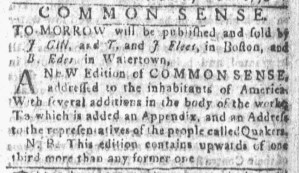
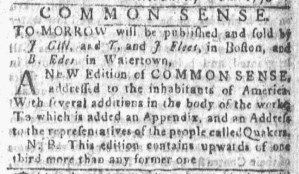
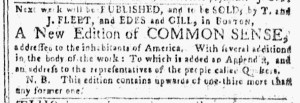
“TO-MORROW will be published … A NEW Edition of COMMON SENSE.”
The April 8, 1776, edition of the Boston-Gazette featured an update about the local edition of Thomas Paine’s Common Sense announced in the New-England Chronicle four days earlier. On a Thursday, readers learned that “Next week will be PUBLISHED, and to be SOLD … in BOSTON, A New Edition of COMMON SENSE.” The following Monday, an advertisement with a headline that proclaimed “COMMON SENSE” informed the public that “TO-MORROW will be published and sold … A NEW Edition of COMMON SENSE.” In less than a week, the Boston edition went from in the press to in stock and for sale.
The new advertisement included a clarification about where readers could acquire copies: from “J. Gill, and T. and J. Fleet, in Boston, and B. Edes in Watertown.” The previous version listed only Boston locations, though Benjamin Edes had relocated to Watertown to print the Boston-Gazette there throughout the siege of Boston. Although the British departed on March 17, Edes and the Boston-Gazette remained in Watertown until the end of October. Customers could purchase Common Sense from Edes in Watertown or from John Gill, his former partner in publishing the newspaper, in Boston. In addition, Thomas Fleet and John Fleet, who had printed the Boston Evening-Post before it folded soon after the battles at Lexington and Concord, also sold Common Sense in Boston.
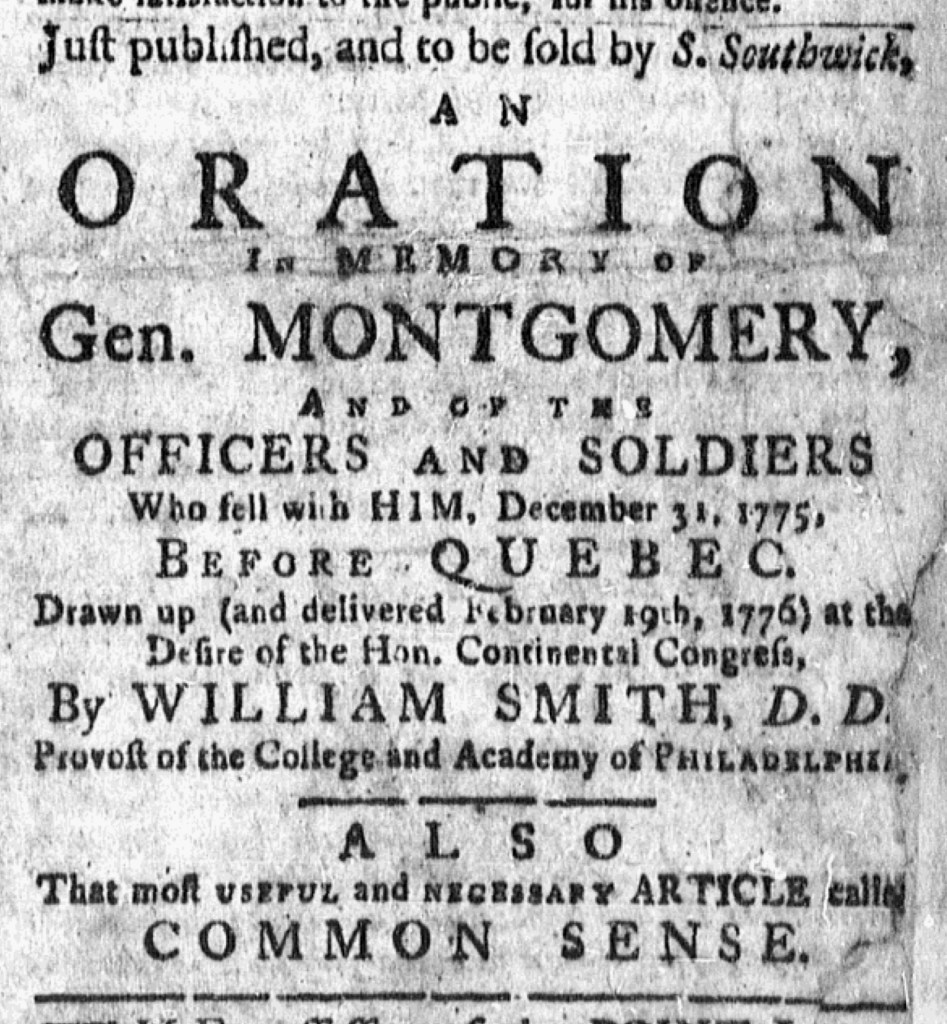
As the number of local editions of Common Sense proliferated in 1776, so did the number of advertisements promoting the popular political pamphlet and the number of newspapers disseminating advertisements about it. The number of retailers who sold Common Sense also increased. Although the printers in Boston and Watertown did not do so, others listed the price for a single copy and offered discounts for buying a dozen or more, encouraging booksellers, shopkeepers, and others to purchase copies to sell far and wide. Counting the number of local editions of Common Sense demonstrates the popularity of the pamphlet compared to other political tracts published during the era of the American Revolution, yet that does not reveal the timing of their publication and sale to readers. Advertisements for Common Sense, on the other hand, demonstrate when local editions became available to readers.