March 14

What was advertised in a colonial American newspaper 250 years ago today?

Pennsylvania Evening Post (March 14, 1775).

“A FUND for establishing and carrying on an AMERICAN MANUFACTORY.”

The organizers of a “FUND for establishing and carrying on an AMERICAN MANUFACTORY, of LINEN, WOOLLEN,” and other textiles in Philadelphia and its hinterland called a meeting to rally support.  In an advertisement that first appeared in the March 11, 1775, edition of the Pennsylvania Evening Post, they announced that all “Subscribers” to that enterprise should meet “at the CARPENTERS HALL” on March 16 “to consider of a Plan for carrying the same into Execution.”  It was an especially appropriate place to meet considering that the organizers sought to put into effect one of the provisions of the Continental Association that the First Continental Congress had devised when the delegates held their meetings at Carpenters’ Hall in September and October 1774.  In addition to boycotting goods imported from Britain, the eighth article specified that colonizers should “encourage Frugality, Economy, and Industry; and promote Agriculture, Arts, and the Manufactures of this Country, especially that of Wool.”

Apparently, “general Proposals” had been printed and disseminated ahead of the meeting, perhaps by Benjamin Towne, the printer of the Pennsylvania Evening Post, or perhaps in the printing office operated by William Bradford and Thomas Bradford.  The notice stated that “one of the Subscription Papers [had been] left with WILLIAM BRADFORD, at the London Coffee-House.”  In addition, the Pennsylvania Journal, the newspaper printed by the Bradfords also carried the notice on the eve of the meeting.  No matter which printer produced the “Subscription Papers,” it was not too late for colonizers to sign their names and show their support for “this important and very interesting Undertaking” by becoming “Subscribers.”  They could visit the London Coffee House to add their names, but those who “may not have an Opportunity of Subscribing before the Day of meeting” could arrive early at Carpenters’ Hall to add their names.  For two hours before the meeting was scheduled to begin at three o’clock, some of the organizers would be present “for that Purpose.”  With subscription papers circulating, prospective supporters could examine who had already committed to the project.  That had the potential to inspire others to do so, provided colonizers actively engaged with printed materials that circulated in Philadelphia as the imperial crisis intensified.  Newspaper advertisements and subscription papers delivered news about the proposed “AMERICAN MANUFACTORY” that encouraged colonizers who encountered them to get involved by signing their names, attending meetings, and making donations.
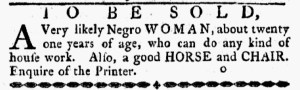
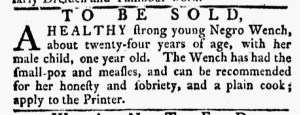
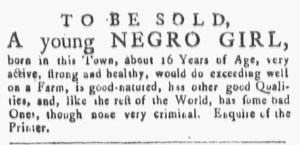
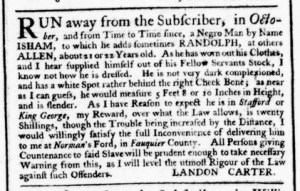
Slavery Advertisements Published March 14, 1775

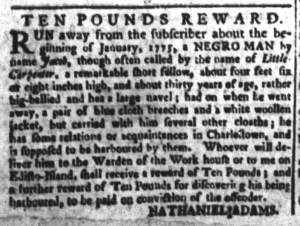
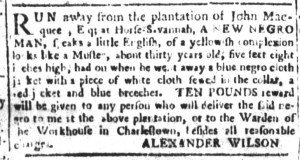
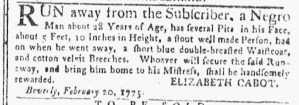
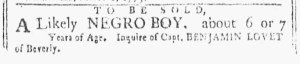
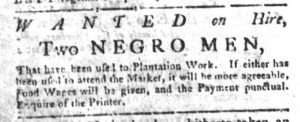
The Slavery Adverts 250 Project chronicles the role of newspaper advertising in perpetuating slavery in the era of the American Revolution. The project seeks to reveal the ubiquity of slavery in eighteenth-century life from New England to Georgia by republishing advertisements about enslaved people – for sale as individuals or in groups, wanted to purchase or for hire for short periods, runaways who liberated themselves, and those who were subsequently captured and confined in jails and workhouses – in daily digests on this site as well as in real time via the @SlaveAdverts250 Twitter feed, utilizing twenty-first-century media to stand in for the print media of the eighteenth century.

The project aims to provide modern audiences with a sense of just how often colonizers encountered these advertisements in their daily lives. Enslaved men, women, and children appeared in print somewhere in the colonies almost every single day. Those advertisements served as a constant backdrop for social, cultural, economic, and political life in colonial and revolutionary America. Colonizers who did not purport to own enslaved people were still confronted with slavery as well as invited to maintain the system by purchasing enslaved men, women, and children or assisting in the capture of so-called “runaways” who sought to free themselves from bondage. The frequency of these newspaper advertisements suggests just how embedded slavery was in colonial and revolutionary American culture in everyday interactions beyond the printed page.

These advertisements also testify to the experiences of enslaved men, women, and children, though readers must consider that those experiences have been remediated through descriptions offered by enslavers rather than enslaved people themselves. Often unnamed in the advertisements, enslaved men, women, and children were not invisible or unimportant in early America.

These advertisements appeared in colonial American newspapers 250 years ago today.

Essex Gazette (March 14, 1775).

**********

Essex Gazette (March 14, 1775).

**********

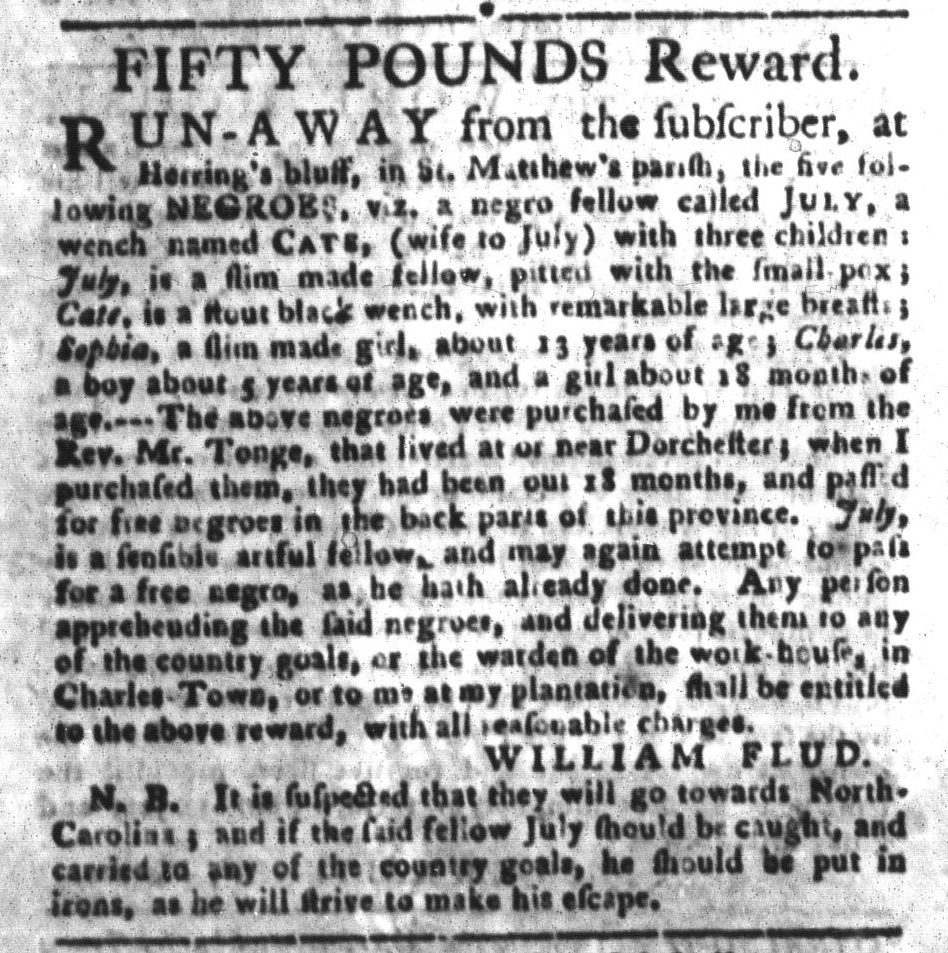
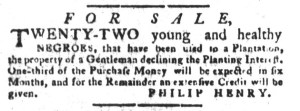
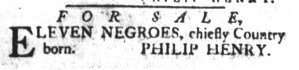
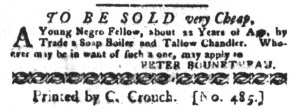
South-Carolina Gazette and Country Journal (March 14, 1775).

**********

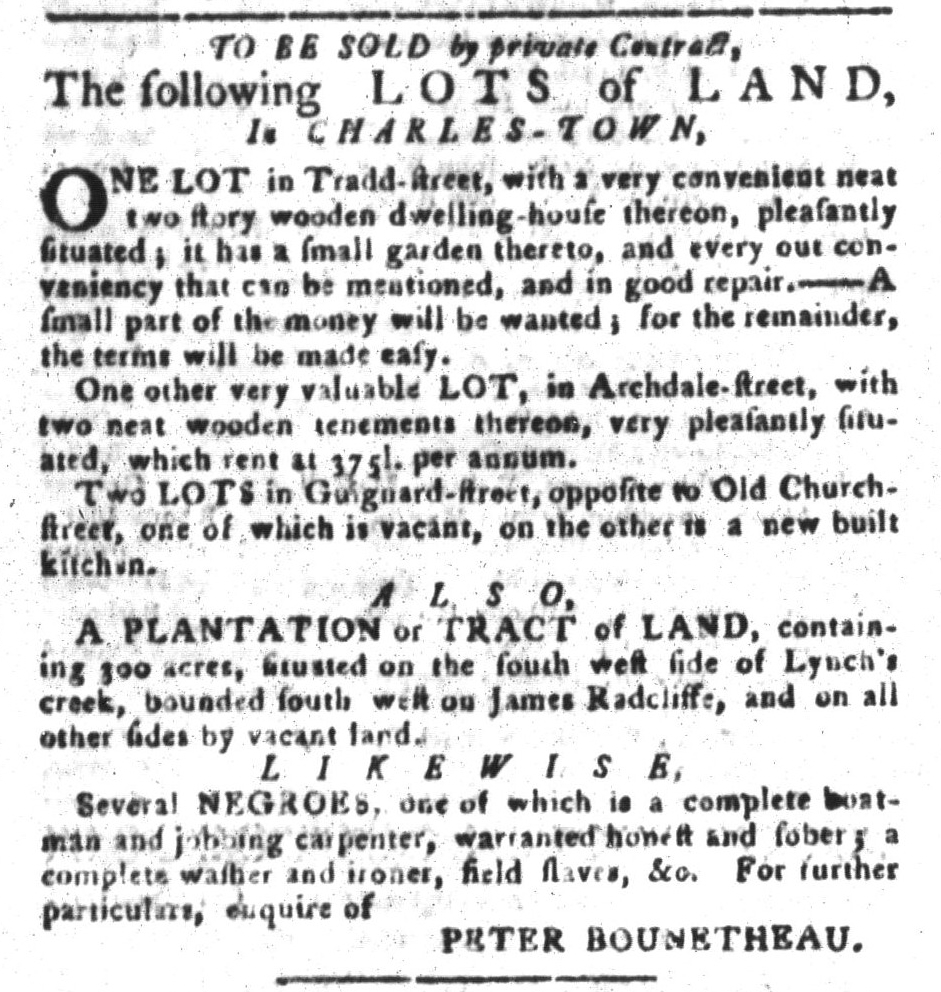
South-Carolina Gazette and Country Journal (March 14, 1775).

**********

South-Carolina Gazette and Country Journal (March 14, 1775).

**********

South-Carolina Gazette and Country Journal (March 14, 1775).

**********

South-Carolina Gazette and Country Journal (March 14, 1775).

**********

South-Carolina Gazette and Country Journal (March 14, 1775).

**********

South-Carolina Gazette and Country Journal (March 14, 1775).

**********

South-Carolina Gazette and Country Journal (March 14, 1775).

**********

South-Carolina Gazette and Country Journal (March 14, 1775).

**********

South-Carolina Gazette and Country Journal (March 14, 1775).

**********

South-Carolina Gazette and Country Journal (March 14, 1775).

**********

South-Carolina Gazette and Country Journal (March 14, 1775).

**********

South-Carolina Gazette and Country Journal (March 14, 1775).

**********

South-Carolina Gazette and Country Journal (March 14, 1775).

**********

South-Carolina Gazette and Country Journal (March 14, 1775).

**********

South-Carolina Gazette and Country Journal (March 14, 1775).

**********

South-Carolina Gazette and Country Journal (March 14, 1775).

**********

South-Carolina Gazette and Country Journal (March 14, 1775).

**********

South-Carolina Gazette and Country Journal (March 14, 1775).

**********

South-Carolina Gazette and Country Journal (March 14, 1775).

March 13

What was advertised in a colonial American newspaper 250 years ago today?

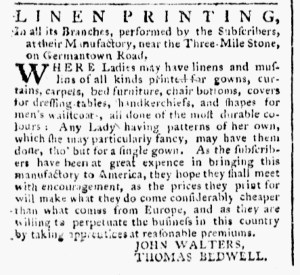
Dunlap’s Pennsylvania Packet (March 13, 1775).

“LINEN PRINTING … at their Manufactory … on Germantown Road.”

When the Continental Association prohibited importing goods from Great Britain it called on colonizers “in our several Stations, [to] encourage Frugality, Economy, and Industry; and promote Agriculture, Arts, and the Manufactures of this Country.”  John Walters and Thomas Bedwell answered the call to give consumers alternatives to imported textiles.  In an advertisement in the March 13, 1775, edition of Dunlap’s Pennsylvania Packet, those entrepreneurs announced that they undertook “LINEN PRINTING, In all its Branches … at their Manufactory … on Germantown Road.”

Walters and Bedwell targeted “Ladies,” declaring that they “may have linens and muslins of all kinds printed for gowns, curtains, carpets, bed furniture, chair bottoms, covers for dressing-tables, handkerchiefs, and shapes for men’s waistcoats.”  Perhaps the men who would wear those vests were just as interested in how they would maintain appearances while the Continental Association remained in effect, but discourse in the public prints often associated women with consumption even though men participated in the marketplace just as actively.  No job was too small for Walters and Bedwell.  “Any Lady having patterns of her own, which she may particularly fancy” they declared, “may have them done, tho’ but for a single gown.”  They hoped such attention to even the smallest order would gain the approval of prospective customers.

In addition, Walters and Bedwell attempted to leverage their investment in their business to convince consumers that they had a responsibility to support their endeavor.  They “have been at great expence in bringing this manufactory to America” for domestic production as an alternative to importing printed linens.  Accordingly, they “hope they shall meet with encouragement” from customers who considered it their duty to put their political principles into practice in the marketplace.  They also sought to entice “Ladies” (and gentlemen as well) with promises that “the prices they print for will make what they do come considerably cheaper than what comes from Europe.”  Walters and Bedwell did their part for the American cause in establishing their “manufactory.”  Now they needed consumers to rise to the occasion “to perpetuate the business in this country.”  Adhering to the Continental Association created opportunities for both producers and consumers.

Slavery Advertisements Published March 13, 1775

The Slavery Adverts 250 Project chronicles the role of newspaper advertising in perpetuating slavery in the era of the American Revolution. The project seeks to reveal the ubiquity of slavery in eighteenth-century life from New England to Georgia by republishing advertisements about enslaved people – for sale as individuals or in groups, wanted to purchase or for hire for short periods, runaways who liberated themselves, and those who were subsequently captured and confined in jails and workhouses – in daily digests on this site as well as in real time via the @SlaveAdverts250 Twitter feed, utilizing twenty-first-century media to stand in for the print media of the eighteenth century.

The project aims to provide modern audiences with a sense of just how often colonizers encountered these advertisements in their daily lives. Enslaved men, women, and children appeared in print somewhere in the colonies almost every single day. Those advertisements served as a constant backdrop for social, cultural, economic, and political life in colonial and revolutionary America. Colonizers who did not purport to own enslaved people were still confronted with slavery as well as invited to maintain the system by purchasing enslaved men, women, and children or assisting in the capture of so-called “runaways” who sought to free themselves from bondage. The frequency of these newspaper advertisements suggests just how embedded slavery was in colonial and revolutionary American culture in everyday interactions beyond the printed page.

These advertisements also testify to the experiences of enslaved men, women, and children, though readers must consider that those experiences have been remediated through descriptions offered by enslavers rather than enslaved people themselves. Often unnamed in the advertisements, enslaved men, women, and children were not invisible or unimportant in early America.

These advertisements appeared in colonial American newspapers 250 years ago today.

Boston Evening-Post (March 13, 1775).

**********

Boston Evening-Post (March 13, 1775).

**********

Boston Evening-Post (March 13, 1775).

**********

Dunlap’s Pennsylvania Packet (March 13, 1775).

**********

Dunlap’s Pennsylvania Packet (March 13, 1775).

**********

Newport Mercury (March 13, 1775).

**********

South-Carolina Gazette (March 13, 1775).

**********

South-Carolina Gazette (March 13, 1775).

**********

South-Carolina Gazette (March 13, 1775).

**********

South-Carolina Gazette (March 13, 1775).

**********

South-Carolina Gazette (March 13, 1775).

**********

South-Carolina Gazette (March 13, 1775).

**********

South-Carolina Gazette (March 13, 1775).

**********

South-Carolina Gazette (March 13, 1775).

**********

South-Carolina Gazette (March 13, 1775).

March 12

What was advertised in a colonial American newspaper 250 years ago this week?

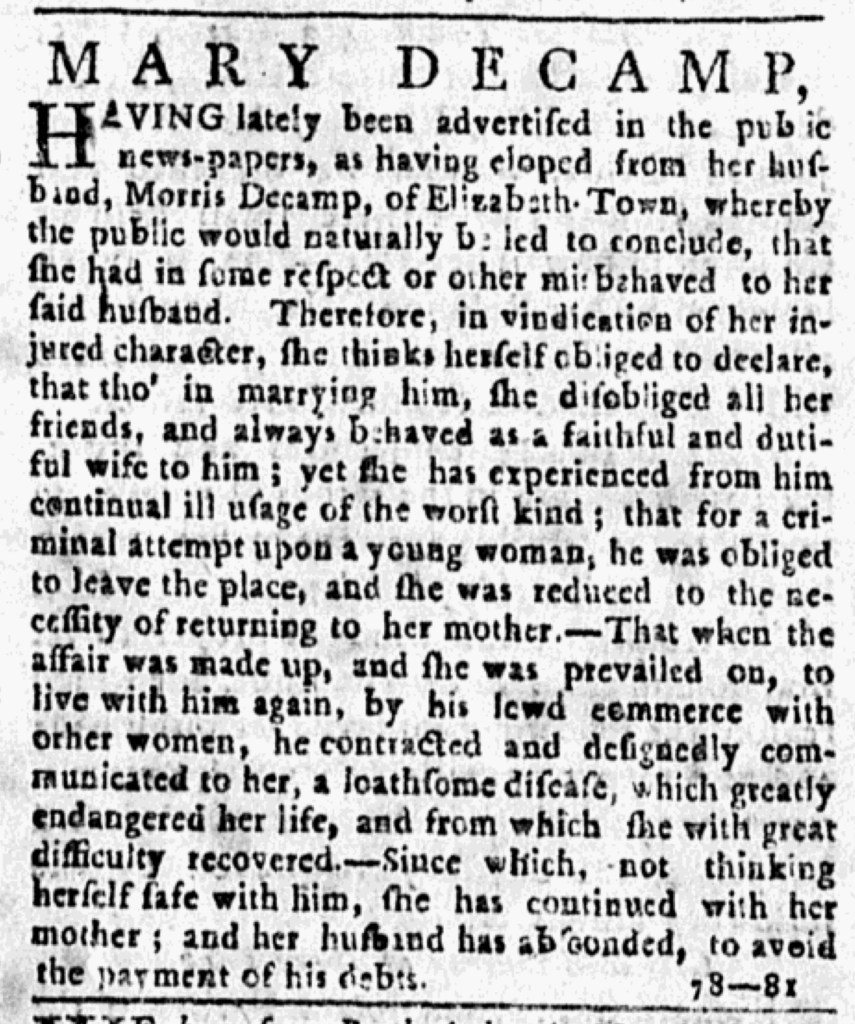
New-York Journal (March 9, 1772).

“Her husband has absconded, to avoid the payment of his debts.”

It began as a standard “runaway wife” advertisement in the January 19, 1775, edition of the New-York Journal.  “WHEREAS my Wife Mary has lately eloped from me, and my perhaps endeavour to run me into Debt,” Morris Decamp proclaimed, “these are therefore to warn all Persons not to Trust or entertain her on my Account, as I will pay no Debts she may contract.”  That advertisement ran for four weeks, but not without going unnoticed or unanswered by Mary.

Most women who appeared in the public prints as the subject of such advertisements did not have the means or opportunity to respond.  Mary, however, did, perhaps with assistance from some of her relations.  Her own advertisement began its run in the March 2 edition of the New-York Journal, placing it before the eyes of the same readers who saw her husband’s missive.  She acknowledged that “the public would naturally be led to conclude, that she had in some respect or other misbehaved to her said husband” based on what they knew from his advertisement.  On the contrary, she asserted, she “always behaved as a faithful and dutiful wife to him.”  The misbehavior had been solely on his part.  Mary “experienced from him continual ill usage of the worst kind,” yet his villainy extended beyond their household.  The aggrieved wife alleged that Morris committed “a criminal attempt upon a young woman” that resulted in him having to leave town.  Abandoned by her husband, Mary “was reduced to the necessity of returning to her mother.”  Morris somehow managed to resolve that situation; Mary did not provide details but reported that “when the affair was made up, … she was prevailed on, to live with him again,” much to her regret.  Her husband remained unreformed: “by his lewd commerce with other women, he contracted and designedly communicated to [Mary], a loathsome disease, which greatly endangered her life, and from which she with great difficulty recovered.”
The real story, Mary insisted, reflected poorly on her husband, not on her.  She took to the pages of the New-York Journal“in vindication of her injured character.”  Rather than “eloping” from Morris, she had returned to her mother because she did not consider herself safe with him.  It was actually Morris who “has absconded, to avoid the payment of his debts.”  Even as he tried to cut her off from his credit, her notice likely prompted others to think twice about doing business with him.  Wives rarely placed rebuttals to the advertisements published by their husbands.  In the rare instances that they did, women like Mary Decamp attempted to harness the power of the press to defend their reputations by setting the record straight.
March 11

What was advertised in a colonial American newspaper 250 years ago today?

Virginia Gazette [Hunter and Dixon] (March 11, 1775).

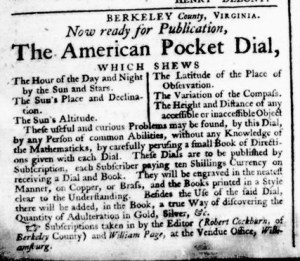
“The American Pocket Dial.”

It was an unusual publication promoted in the March 11, 1775, edition of John Dixon and William Hunter’s Virginia Gazette.  Was it really a publication at all?  A subscription notice proclaimed that “The American Pocket Dial” was “Now ready for Publication.”  This handy device, according to “the Editor,” Robert Cockburn of Berkeley County, showed the “Hour of the Day and Night by the Sun and Stars” as well as the “Sun’s Place and Declination,” the “Sun’s Altitude,” the “Latitude of the Place of Observation,” and the “Height and Distance of any accessible or inaccessible Object.”  That it also showed the “Variation of the Compass” suggests that the pocket sundial had a magnetic compass embedded in it.  Each dial came with a “small Book of Directions” easily understood by “any Person of common Abilities, without any Knowledge of the Mathematicks.”  In “European Pocket Sundials for Colonial Use in American Territories,” Sara H. Schechner notes that “tables of latitude, known as gazetteers” were sometimes “printed in a broadsheet, which was a sundial accessory.”[1]

Cockburn declared that the American Pocket Dials “are to be published by Subscription.”  With the Continental Association in effect, colonizers were not supposed to import or purchase finished goods from Great Britain.  Instead, that pact called on them to “encourage … Industry” and “promote … the Manufactures of this Country.”  Schechner notes that when Anthony Lamb advertised “large Pocket Compasses, with or without Dials” in the April 7, 1760, edition of the New-York Mercury that he likely sold imported items.[2]  Fifteen years later, the political turmoil of the imperial crisis presented an opportunity to market an American alternative, though Cockburn did not take the risk of producing or “publishing” the American Pocket Dial without first lining up buyers or “subscribers.”  He asserted that the sundials “will be engraved in the neatest Manner, on Copper, or Brass.”  Did he find “subscribers” for this project?  During the American Revolution, Schechner states, “American patriots favored compass sundials” while their French allies preferred inclining dials but does not indicate that American makers like Cockburn “published” and sold such products to officers and soldiers.[3]  Addressing that question falls beyond the scope of Schechner’s chapter on “European Pocket Sundials for Colonial Use in American Territories.”  Having encountered Cockburn’s “subscription proposal,” I am curious to see if he published additional advertisements, especially any calling on “subscribers” to collect their pocket sundials once he “published” them.  I will also be looking for other work on early American scientific instruments to learn whether Cockburn and others established an industry during the American Revolution.

**********

[1] Sara J. Schechner, “European Pocket Sundials for Colonial Use in American Territories” in How Scientific Instruments Have Changed Hands, ed. A.D. Morrison-Low, Sara J. Schechner, and Paolo Brenni (Leiden: Brill, 2017), 125.

[2] Schechner, “European Pocket Sundials,” 148.

[3] Schechner, “European Pocket Sundials,” 147.

Slavery Advertisements Published March 11, 1775

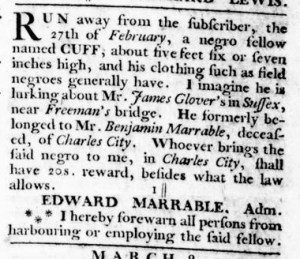
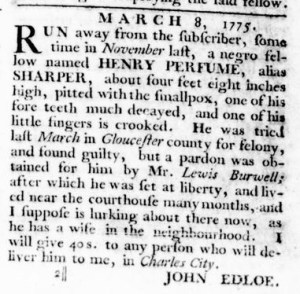
The Slavery Adverts 250 Project chronicles the role of newspaper advertising in perpetuating slavery in the era of the American Revolution. The project seeks to reveal the ubiquity of slavery in eighteenth-century life from New England to Georgia by republishing advertisements about enslaved people – for sale as individuals or in groups, wanted to purchase or for hire for short periods, runaways who liberated themselves, and those who were subsequently captured and confined in jails and workhouses – in daily digests on this site as well as in real time via the @SlaveAdverts250 Twitter feed, utilizing twenty-first-century media to stand in for the print media of the eighteenth century.

The project aims to provide modern audiences with a sense of just how often colonizers encountered these advertisements in their daily lives. Enslaved men, women, and children appeared in print somewhere in the colonies almost every single day. Those advertisements served as a constant backdrop for social, cultural, economic, and political life in colonial and revolutionary America. Colonizers who did not purport to own enslaved people were still confronted with slavery as well as invited to maintain the system by purchasing enslaved men, women, and children or assisting in the capture of so-called “runaways” who sought to free themselves from bondage. The frequency of these newspaper advertisements suggests just how embedded slavery was in colonial and revolutionary American culture in everyday interactions beyond the printed page.

These advertisements also testify to the experiences of enslaved men, women, and children, though readers must consider that those experiences have been remediated through descriptions offered by enslavers rather than enslaved people themselves. Often unnamed in the advertisements, enslaved men, women, and children were not invisible or unimportant in early America.

These advertisements appeared in colonial American newspapers 250 years ago today.

Pennsylvania Ledger (March 11, 1775).

**********

Pennsylvania Ledger (March 11, 1775).

**********

Providence Gazette (March 11, 1775).

**********

Virginia Gazette [Hunter and Dixon] (March 11, 1775).

**********

Virginia Gazette [Hunter and Dixon] (March 11, 1775).

**********

Virginia Gazette [Hunter and Dixon] (March 11, 1775).

**********

Virginia Gazette [Hunter and Dixon] (March 11, 1775).

**********

Virginia Gazette [Hunter and Dixon] (March 11, 1775).

**********

Virginia Gazette [Hunter and Dixon] (March 11, 1775).

March 10

What was advertised in a colonial American newspaper 250 years ago today?

Connecticut Gazette (March 10, 1775).

“Please to make your Cloth suitable … and not expect a Silk Purse to be made of a Sow’s Ear.”

As spring approached in 1775, Nathaniel Wollys, “Silk-Dyer and Clothier,” took to the pages of the Connecticut Gazetteto advise the public that “he carries on the Clothing-Business” in “several Branches.”  Those included “fulling, colouring, shearing, pressing and dressing of Bays, Fustian, Ratteen and Bearskin,” dying “Cotton and linnen Yarn blue,” “dy[ing] and dress[ing] Silks of all Kinds,” and “tak[ing] out Colours, Spots or Stains of any Kind.”  Colonizers certainly knew the differences among the various textiles Wollys named, even if they are now unfamiliar to most consumers in the twenty-first century.  Like other advertisers who provided services, Wollys emphasized both his own engagement with customers, his “Fidelity and Dispatch,” and the quality of his work, done in “the neatest and best Manner.”

However, the fuller appended a lively nota bene that reminded prospective customers to have reasonable expectations for what he could accomplish with the textiles they delivered to his mill for treatment or cleaning.  Some feats were beyond the skills of any clothier, no matter how experienced.  “Please to make your Cloth suitable for the Work you intend it for,” Wollys bluntly instructed, “and not expect a Silk Purse to be made of a Sow’s Ear.”  Perhaps he reacted to customers who had recently expressed displeasure or dissatisfaction with the finished product, seeking to set the terms for new clients before they hired his services.  If that was the case, former customers may have given voice to the frustration they experienced as they participated in boycotts of imported fabrics and substituted homespun textiles.  While using such cloth became a mark of distinction permeated with political meaning, garments and other items made from homespun were not of the same quality as those made from imported textiles.  Even as consumers made sacrifices in support of their political principles, some of Wollys’s customers may have transferred their disappointment in not having access to the same finery to the clothier who processed the cloth that they increasingly incorporated into their everyday routines.  Wollys could accomplish a lot when he treated cloth “in the neatest and best Manner,” yet clients also needed to be realistic about the anticipated outcomes.

Slavery Advertisements Published March 10, 1775

The Slavery Adverts 250 Project chronicles the role of newspaper advertising in perpetuating slavery in the era of the American Revolution. The project seeks to reveal the ubiquity of slavery in eighteenth-century life from New England to Georgia by republishing advertisements about enslaved people – for sale as individuals or in groups, wanted to purchase or for hire for short periods, runaways who liberated themselves, and those who were subsequently captured and confined in jails and workhouses – in daily digests on this site as well as in real time via the @SlaveAdverts250 Twitter feed, utilizing twenty-first-century media to stand in for the print media of the eighteenth century.

The project aims to provide modern audiences with a sense of just how often colonizers encountered these advertisements in their daily lives. Enslaved men, women, and children appeared in print somewhere in the colonies almost every single day. Those advertisements served as a constant backdrop for social, cultural, economic, and political life in colonial and revolutionary America. Colonizers who did not purport to own enslaved people were still confronted with slavery as well as invited to maintain the system by purchasing enslaved men, women, and children or assisting in the capture of so-called “runaways” who sought to free themselves from bondage. The frequency of these newspaper advertisements suggests just how embedded slavery was in colonial and revolutionary American culture in everyday interactions beyond the printed page.

These advertisements also testify to the experiences of enslaved men, women, and children, though readers must consider that those experiences have been remediated through descriptions offered by enslavers rather than enslaved people themselves. Often unnamed in the advertisements, enslaved men, women, and children were not invisible or unimportant in early America.

These advertisements appeared in colonial American newspapers 250 years ago today.

South-Carolina and American General Gazette (March 10, 1775).

**********

South-Carolina and American General Gazette (March 10, 1775).

**********

South-Carolina and American General Gazette (March 10, 1775).

**********

South-Carolina and American General Gazette (March 10, 1775).

**********

South-Carolina and American General Gazette (March 10, 1775).

**********

South-Carolina and American General Gazette (March 10, 1775).

**********

South-Carolina and American General Gazette (March 10, 1775).

**********

South-Carolina and American General Gazette (March 10, 1775).

**********

South-Carolina and American General Gazette (March 10, 1775).

**********

South-Carolina and American General Gazette (March 10, 1775).

**********

South-Carolina and American General Gazette (March 10, 1775).

**********

South-Carolina and American General Gazette (March 10, 1775).

**********

South-Carolina and American General Gazette (March 10, 1775).

**********

South-Carolina and American General Gazette (March 10, 1775).

**********

South-Carolina and American General Gazette (March 10, 1775).

**********

South-Carolina and American General Gazette (March 10, 1775).

**********

South-Carolina and American General Gazette (March 10, 1775).

**********

South-Carolina and American General Gazette (March 10, 1775).

**********

Virginia Gazette [Purdie] (March 10, 1775).

**********

Virginia Gazette [Purdie] (March 10, 1775).

March 9

What was advertised in a colonial American newspaper 250 years ago today?

Massachusetts Spy (March 9, 1775).

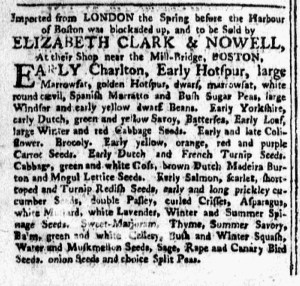
“Imported from LONDON the Spring before the Harbour of Boston was blockade up.”

Although marketing began a little later in the season than in recent years, several retailers placed advertisements for garden seeds in Boston’s newspaper in early March 1775.  The March 9 edition of the Massachusetts Spy, for instance, once again carried Susannah Renken’s advertisement as well notices placed by John Adams, Elizabeth Clark and Elizabeth Nowell, and Ebenezer Oliver.  Each of these purveyors of seeds took to the public prints as spring approached each year, though many familiar names did not yet appear.  More than half a dozen women usually advertised garden seeds that they sold in Boston, but the imperial crisis, especially the closing of the harbor because of the Boston Port Act, disrupted that annual ritual.

Renken, one of the most enterprising of those female seed sellers, apparently acquired her inventory from a ship that landed at Salem.  She identified the captain of the vessel that had transported them across the Atlantic.  Adams and Oliver both declared that they sold seeds “Imported from London,” but did not provide additional details to allow prospective customers in the eighteenth century (or historians in the twenty-first century) to reach conclusions about when and how they came into possession of those seeds.  Clark and Nowell, on the other hand, made clear that their seeds had been “Imported from LONDON the Spring before the Harbour of Boston was blockade up.”  They received their seeds at least nine months earlier, a factor that may or may not have been an advantage.  Adams declared that he “warrants [his seeds] good, and of the last Year’s Growth.”  Similarly, Renken described her seeds as “New and warranted of the last Year’s Growth.”  Clark and Nowell could not make such claims.  Instead, they attempted to leverage the date of delivery as a point in their favor.  Although not “new,” their seeds also were not so old that they would not germinate, especially if Clark and Nowell had stored them carefully.  They asked prospective customers to take into account the challenges that they all faced due to the blockade, hoping that a sense of mutual support would convince consumers to select their seeds over the ones offered by their competitors.