January 8

What was advertised in a colonial American newspaper 250 years ago today?
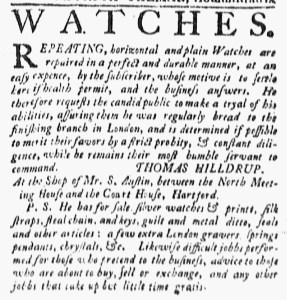
Connecticut Journal (January 8, 1773).

“Whose motive is to settle here if health permit[s], and the business answers.”

When Thomas Hilldrup arrived in Hartford in the fall of 1772, he commenced an advertising campaign to advise prospective customers that he repaired watches “in a perfect and durable manner, at an easy expence.”  Throughout late September and into October, November, and December, he consistently ran his advertisement in the Connecticut Courant, alerting readers that he planned “to settle here if health permit[s], and the business answers.”  That being the case, he invited the public “to make a trial of his abilities.”  In addition to repairing watches, Hilldrup also sold watches and accessories and provided ancillary services, including consultations with “those who are about to buy, sell or exchange.”

Hilldrup continued placing his advertisement in the Connecticut Courant in the new year.  He also decided to expand his advertising campaign to another newspaper, the Connecticut Journal and New-Haven Post-Boy.  Doing so extended the reach of his advertising and gave him access to a new market.  Why did the watchmaker decide to advertise in another publication?  Did he believe that the notice in the Connecticut Courant had been sufficiently successful to merit advertising in a newspaper in another town?  Among colonizers who perused multiple newspapers as they circulated far and wide in Connecticut and beyond, that certainly likely enhanced Hilldrup’s visibility and name recognition.  That he continued to invest in advertisements in the Connecticut Courant also suggests that he considered the outcomes so far worth the expense.

On the other hand, those advertisements may not have been as successful as Hilldrup hoped.  Perhaps placing the same notice in the Connecticut Journal and attempting to capture a portion of an adjacent market was an attempt to generate enough business to make remaining in Hartford a viable option.  Whatever his reasons for choosing to run his advertisement in an additional newspaper in January 1773, Hilldrup eventually determined that he cultivated a large enough clientele to remain in Hartford.  He continued advertising watches and repairs in newspapers published in that town for nearly two decades.  In the coming months, the Adverts 250 Project will examine some of his subsequent newspaper notices.

January 4

What was advertised in a colonial American newspaper 250 years ago today?

Massachusetts Gazette and Boston Post-Boy (January 4, 1773).

“More certificates may be seen, and any other particulars concerning them fully explained.”

Michael B. Goldthwait placed an advertisement for “Dr. KEYSER’S celebrated PILLS” in the January 4, 1773, edition of the Massachusetts Gazette and Boston Post-Boy, yet he had little to do with generating the copy.  Instead, he republished an advertisement that previously ran in the New-York Gazette and Weekly Mercury.  James Rivington, a printer and bookseller in New York, hawked the patent medicine to generate additional revenue.  He placed an advertisement that made a patient’s “certificate” or testimonial about the efficacy of Keyser’s pills its main focus.  Goldthwait may have worked with Rivington when he decided to reprint the advertisement in one of Boston’s newspapers.  Given the wide circulation of colonial newspapers, however, he Goldthwait may have seen Rivington’s advertisement in a copy of the New-York Gazette and Weekly Mercury that made its way to Boston and decided to appropriate it for his own use.

Goldthwait made only a few revisions to the notice before submitting it to a local printing office.  He altered the headline from “KEYSER’s PILLS” to “Dr. KEYSER’S celebrated PILLS” and streamlined the introductory paragraph that gave context for William Shipman’s testimonial, softening some of the language about the “purchase money” necessary to acquire the medicine.  The entire testimonial appeared, including Shipman’s assertion that it “is a faithful relation of my Case, and I can with an honest confidence recommend the Medicine to those who are afflicted with any Rheumatic complaints.”  Goldthwait did devise one significant embellishment.  Rivington concluded the original advertisement with an offer to provide “very satisfactory information” to anyone “desirous of enquiring further to the efficacy of this medicine,” but Goldthwait claimed that he had “more certificates” or testimonials at his shop near the Mill Bridge.  Those certificates likely included testimonials he published in an advertisement in August 1772.  Furthermore, Goldthwait could supply “other particulars” that “fully explained” those certificates.

When it came to advertisements appearing in multiple newspapers published in a town or city, merchants, shopkeepers, artisans, and other purveyors of goods and services often placed the same notice in more than one publication.  In terms of advertisements for consumer goods appearing in multiple newspapers published in different cities, that most often occurred with subscription notices for books, pamphlets, newspapers, and other printed materials as printers attempted to generate sufficient demand to make those ventures viable.  Apothecaries, shopkeepers, printers, and others throughout the colonies advertised Keyser’s pills, but they did not coordinate their marketing messages.  Shipman’s testimonial running in newspapers in Boston and New York was a rare instance of entrepreneurs in two towns exposing consumers to the same marketing campaign.

December 16

What was advertised in a colonial American newspaper 250 years ago today?

Pennsylvania Journal (December 16, 1772).

“Physicians prescriptions, or family receipts put up in the most careful manner.”

Moses Bartram ran a shop that he called “the OLD MEDICINAL STORE.”  In December, 1772, he ran a newspaper advertisement advising residents of Philadelphia that he “CONTINUES to carry on the business in its various branches” and offered a variety of goods and services.  He stocked “a fresh and general assortment of DRUGS and MEDICINES, Chymical and Galenical preparations of the best quality.”  He also carried patent medicines and, like many apothecaries, both “shop furniture for Practitioners” and “painters colours for either oil or water.”  Bartram filled “orders from town and country.”  He also prepared “Physicians prescriptions” and “family receipts” or remedies “in the most careful manner.”

In marketing the goods and services available at the Old Medicinal Store, Bartram placed his advertisement in three of the five newspapers published in Philadelphia at the time.  Doing so helped him achieve greater market saturation with his notices.  His notice first appeared in the Wöchentliche Pennsylvanische Staatsbote, a German-language newspaper, on December 15.  A note that ran across the bottom of the masthead advised “All ADVERTISEMENTS to be inserted in this Paper, or printed single by HENRY MILLER, Publisher hereof, are by him translated gratis.”  The following day, Bartram’s advertisement ran in both the Pennsylvania Gazette and the Pennsylvania Journal.

Wöchentliche Pennsylvanische Staatsbote (December 15, 1772).

The apothecary chose not to place his advertisement in the two newest newspapers published in the city, the Pennsylvania Chronicle and the Pennsylvania Packet.  Both of them had a healthy number of advertisements each week, suggesting that other advertisers had confidence in the circulation numbers for those newspapers.  The Pennsylvania Packet frequently distributed a two-page supplement to accommodate all of the advertisements submitted to the printing office.  In making his choices about where to advertise, Bartram clustered the dissemination of his notices on Tuesdays (Wöchentliche Pennsylvanische Staatsbote) and Wednesdays (Pennsylvania Gazette and Pennsylvania Journal).  He could have spread out the days by placing his advertisements in the Pennsylvania Packet, published on Mondays, or the Pennsylvania Chronicle, published on Saturdays.

Given that all of these newspapers were published only once a week rather than daily, allowing readers more time to peruse the contents before discarding an earlier issue in favor of the newest one, Bartram may not have considered it necessary to spread out the days that his advertisements initially appeared in print.  Other factors, including price, his existing relationships with the various printers, and his perceptions of the circulation of each newspaper, may have been more important to Bartram in choosing where (and when) to advertise.

November 29

What was advertised in a colonial American newspaper 250 years ago this week?

Supplement to the Massachusetts Gazette and Boston Weekly News-Letter (November 26, 1772).

“Serges,           Flannels.”

The partnership of Amorys, Taylor, and Rogers had confidence in the advertising copy they published in Boston’s newspapers in 1772, so much confidence that they ran the same advertisement in the November 26 edition of the Massachusetts Gazette and Boston Weekly News-Letter that previously appeared in the February 19 edition of the Boston Evening-Post.  After nine months, they continued to use a headline that proclaimed “GOODS EXTREMELY CHEAP” and a nota bene that declared that they “constantly keep by them a large Assortment of almost every Kind of Goods usually imported from Great-Britain.”  They explained that hey received their merchandise “immediately from the Manufacturors,” skipping the English merchants that often acted as middlemen, and passed along the savings to their customers.

Although the copy remained the same, the format changed from newspaper to newspaper.  In general, advertisers usually composed copy for their notices and then entrusted graphic design decisions to compositors.  That seems to have been the case with these advertisements.  The first headline, “GOODS EXTREMELY CHEAP,” appeared in all capitals in both newspapers, but the second headline, “Amorys, Taylor and Rogers,” incorporated italics in the Boston Evening-Post but not in the Massachusetts Gazette and Boston Weekly News-Letter.  Similar variations occurred throughout the two versions of the same advertisement in those newspapers.

In addition, the compositor for Massachusetts Gazette and Boston Weekly News-Letter reduced the amount of space required for the advertisement.  The version in the Boston Evening-Post featured two columns with one item listed in each column.  That created significant white space to aid readers in navigating the advertisement.  The new iteration, however, appeared more cluttered as a result of the compositor placing two items on a line when space allowed.  The new design had space between items that now shared lines, creating a winding trail of white space in the center of the column on the left.  Since advertisers paid by the amount of space their notices occupied rather than the number of words, Amorys, Taylor, and Rogers may have requested this modification in order to save space and reduce their costs.  More likely, the compositor made the decision to suit the needs of the newspaper, reserving space for news and other advertisements.

October 9

What was advertised in a colonial American newspaper 250 years ago today?

New-London Gazette (October 9, 1772).

“Staffordshire and Liverpool Warehouse, in Kingstreet, BOSTON.”

Ebenezer Bridgham continued his efforts to create a regional market for his “Staffordshire and Liverpool Warehouse” in Boston with an advertisement in the October 9, 1772, edition of the New-London Gazette.  That advertisement featured copy identical to a notice in the October 2 edition of the New-Hampshire Gazette, though the compositors in the two printing offices made very different decisions about the format of the advertisements.  Bridgham’s advertisement ran a second time in the New-Hampshire Gazette (less the headline announcing “Crockery Ware”) the same day that it first appeared in the New-London Gazette.  He likely dispatched letters to the printing offices on the same day, but, given the distance, the New-London Gazette received its letter later and published his advertisement in the next edition after its arrival.

With advertisements in newspapers in Connecticut and New Hampshire in the fall of 1772, Bridgham continued a project that commenced more than a year earlier with advertisements in the Connecticut Courant, the Essex Gazette, and the Providence Gazette in September 1771.  He added the New-London Gazette the next month.  He placed a subsequent notice in the Connecticut Courant in June 1772, but he did not pursue the same coordinated campaign that he launched in the fall of 1771.  Although his “Crockery Ware” advertisement appeared in both the New-London Gazette and the New-Hampshire Gazette in early October 1772, it did not run in the other newspapers at that time.

That may have been the result of Bridgham learning which advertisements in which newspapers generated orders from country shopkeepers and other customers … and which did not.  His prior experience may have constituted a rudimentary form of market research that guided his decisions about where to focus his advertising efforts.  Alternately, Bridgham may have been delinquent in submitting payment for his advertisements, causing printers not to run them until he settled his debts.  His “Crockery Ware” advertisement eventually ran in Hartford’s Connecticut Courant on November 17.  In February 1772, Ebenezer Watson, printer of the Connecticut Courant, inserted a notice that “No Advertisements will for the future be published in this paper, without the money is first paid.”  The delay in publishing Bridgham’s “Crockery Ware” advertisement may have been due to waiting for payment.  Beyond these possibilities, Bridgham may have been haphazard in submitting his “Crockery Ware” advertisement to various printing offices.  If so, that deviated from the coordination he demonstrated in the fall of 1771.

September 30

What was advertised in a colonial American newspaper 250 years ago today?

Pennsylvania Journal (September 30, 1772).

“WILLIAM SMITH, HAS removed his Medicinal Store from Front-street.”

In the fall of 1772, William Smith placed newspaper advertisements to inform the public that he recently moved yet “continues to carry on the Drug Business.”  He invited customers to visit his “Medicinal Store” at his new location, the Rising Sun on Second Street in Philadelphia.  He pledged that he was “determined always to pay particular attention to the quality of his medicines, and hopes by his care and fidelity to render full satisfaction to Practitioners in Physic, and others, who may please to favour him with their custom.”

In an effort to enlarge his share of the market, Smith placed the same advertisement in multiple newspapers.  On Wednesday, September 30, it ran in both the Pennsylvania Gazette and the Pennsylvania Journal.  Later in the week, it also appeared in the Pennsylvania Chronicle on Saturday, October 3.  The advertisements in the three newspapers featured identical copy, though the compositors made different decisions about format, including font sizes and capitalization.

Smith did not choose to place his advertisement in the city’s remaining English-language newspaper, the Pennsylvania Packet, on Monday, October 5, nor did he insert it in the Wochentliche Pennsylvanische Staatsbote for the benefit of German-speaking residents in and near Philadelphia.  The printer, had a standing offer in the masthead that “All ADVERTISEMENTS to be inserted in this Paper, or printed single, by HENRY MILLER, Publisher hereof, are by him translated gratis,” but Smith did not avail himself of that service.  Perhaps the apothecary felt that advertising in three newspapers was sufficient.  Perhaps he spent as much as he considered prudent on marketing so opted to forego the other two newspapers.

Whatever the reason, Smith aimed for a greater level of market saturation than advertising in just one publication allowed.  That may have been especially important to him considering that he ran his shop from a new location.  He did not want customers to experience any frustration upon visiting his former location and then decide to visit competitors who continued to do business in familiar locations.  After all, Robert Bass and Townsend Speakman, both prolific advertisers, continued operating their own apothecary shops on Market Street.  Smith did not wish to lose customers to either of them, making his advertisements in three newspapers a sound investment.

September 28

What was advertised in a colonial American newspaper 250 years ago today?

Massachusetts Gazette and Boston Post-Boy (September 28, 1772).

“FALL and WINTER / GOODS / OF ALL KINDS, / AND EXCELLENT / BROAD CLOTHS.”

In their efforts to capture as much of the market as they could, merchants and shopkeepers in cities with multiple newspapers often advertised in more than one publication.  They submitted identical copy to each printing office, but the compositors usually exercised discretion over the appearance of the advertisements in their newspapers.  This resulted in all sorts of variations in capitalization, italics, font sizes, line breaks, and white space.

Consider, for instance, an advertisement that Jonathan Williams, Jr., placed in the Boston-Gazette and the Massachusetts Gazette and Boston Post-Boy on September 28, 1772.  The two notices had identical copy, but what appeared as “Fall and Winter GOODS / of all Kinds,—and excellent / BROAD CLOTHS” on three lines in the Gazette ran as “FALL and WINTER / GOODS / OF ALL KINDS, / AND EXCELLENT / BROAD CLOTHS” over five lines in the Post-Boy.  Similar variations occurred throughout the remainder of the advertisements.  The version in the Post-Boy also occupied more space relative to other advertisements than the one in the Gazette.  Longer than it was wide, Williams’s advertisement in the Post-Boy filled nearly two “squares” of space.  In contrast, his advertisement in the Gazette was wider than it was long, filling a little less than one square.

Boston-Gazette (September 28, 1772).

Despite the differences in size and format, both advertisements featured borders made of decorative type that distinguished them from other notices.  It hardly seems likely that this happened by chance, that compositors working independently in two printing offices just happened to create borders for Williams’s notice.  This suggests that the advertiser played some role in designing those advertisements.  That may have involved brief conversations with the printers or compositors, but more likely resulted from submitting written instructions.

Williams certainly did not invent this strategy of making his advertisements distinctive compared to others that did not incorporate borders or other decorative type.  In July 1766, Jolley Allen placed the same advertisement in four newspapers published in Boston.  They had identical copy but different formats.  Borders enclosed all of them, though the compositors made different decisions about what kind of decorative type formed those borders.  Other advertisers occasionally adopted a similar strategy, hoping the borders would help draw attention to their advertisements across multiple newspapers.

August 13

What was advertised in a colonial American newspaper 250 years ago today?

New-York Journal (August 13, 1772).

“J. BAILEY, Cutler. from Sheffield.”

Several cutlers in New York competed for customers by inserting advertisements with elaborate woodcuts depicting an array of items available at their shops in the New-York Gazette and Weekly Mercury in the summer of 1772.  James Youle, “CUTLER FROM SHEFFIELD,” adapted an image that he and former partner J. Bailey previously ran in that newspaper a year earlier.  Lucas and Shephard, “WHITESMITHS and CUTLERS, From BIRMINGHAM and SHEFFIELD,” ran their own advertisement adorned with an image of many items included among their merchandise.

Bailey apparently determined that his competitors had an advantage, so he commissioned his own woodcut that featured both text, “J. BAILEY, Cutler. from Sheffield,” and an image that included two swords among a variety of cutlery.  The advertisement stated that Bailey was located “At the Sign of the CROSS SWORDS,” indicating that he sought to increase the effectiveness of the image beyond the efforts of his competitors with their woodcuts by closely associating it with the sign that marked his shop in addition to the goods he made and sold.  He also enhanced his advertisement by incorporating another image, that one depicting shears, below a note that he “has now for sale fullers shears.”

Those did not constitute Bailey’s only innovations relative to the advertising campaigns of his competitors.  Those advertisements all ran in the New-York Gazette and Weekly Mercury.  On August 13, Bailey expanded the number of colonizers who saw his advertisement by inserting it in the New-York Journal.  That advertisement featured the same two woodcuts and the same copy that appeared in the other newspaper, giving Bailey an advantage over his former partner and other competitors who invested in woodcuts for their advertisements.  Some or all of these cutlers may have also advertised in another newspaper, the New-York Gazette or Weekly Post-Boy.  Unfortunately, issues of that newspaper from 1771 through 1773 have not been digitized, so I have not been able to consult them as readily as the other two newspapers published in New York City in 1772.  Whether or not any of these cutlers advertised in the New-York Gazette or Weekly Post-Boy, Bailey was the first to seek customers among the readers of the New-York Journal.  That meant arranging to have his woodcuts transferred from one printing office to another.  The available evidence suggests that Bailey put even more thought into his advertising campaign than his competitors who already made efforts to distinguish their notices from others in the New-York Gazette and Weekly Mercury.

August 5

Who was the subject of an advertisement in a colonial American newspaper 250 years ago today?

Pennsylvania Gazette (August 5, 1772).

“Probably will endeavour to pass for a freeman.”

Jem, a “Mulattoe SLAVE,” made his escape during the night of July 15, 1772, liberating himself from Thomas May in Elk Forge, Maryland.  In his efforts to capture Jem and return him to enslavement, May ran an advertisement in which he described Jem as a “cunning ingenious fellow” who “probably will endeavour to pass for a freeman.”  Jem possessed several skills that may have helped him elude May, but those skills also made him even more valuable to the enslaver.  In addition to being able to read “pretty well” and speak Dutch, Jem was a “good workman in a forge, either in finery or chafery, can do any kind of smith’s or carpenter’s work, necessary about a forge, [and] can also do any kind of farming business.”  May also described the clothes that Jem wore when he liberated himself.  No doubt Jem would have offered other details had he been given an opportunity to publish his own narrative.  Even in Jem’s absence, May exerted control over his depiction in the public prints.

Wochentliche Pennsylvanische Staatsbote (August 4, 1772).

May also made decisions about how widely to disseminate advertisements describing Jem and offering “FIVE POUNDS REWARD” for capturing him.  His advertisement appeared in both the Pennsylvania Gazette and the Pennsylvania Journal on August 5.  Of the newspapers published in Philadelphia at the time, those had the longest publication history.  That likely gave May confidence that those newspapers circulated to many readers in Pennsylvania, Maryland, Delaware, and New Jersey.  Apparently, however, he did not consider that sufficient.  May was so invested in capturing and returning Jem to enslavement at the forge that he also placed advertisements in the Pennsylvania Chronicle on August 8 and the Pennsylvania Packet on August 10.  Considering the skills that Jem possessed, May probably thought it well worth the fees to place notices in all four English-language newspapers published in Philadelphia at the time.  He even took advantage of the translation services that Henry Miller, printer of the Wochentliche Pennsylvanische Staatsbote, offered to advertisers in a nota bene that appeared at the bottom of the masthead.  May’s advertisement describing Jem ran in that newspaper on August 4, further increasing the number of colonizers who might read it, carefully observe Black men they encountered, and participate in capturing the fugitive seeking freedom.  Thomas May expended significant money and effort in attempting to re-enslave Jem, using the power of the press to overcome the various advantages Jem sought to use to his own benefit.

July 6

What was advertised in a colonial American newspaper 250 years ago today?

Boston Evening-Post (July 6, 1772).

“THE STAGE-COACH Between NEW-YORK and BOSTON.”

In the early 1770s, Jonathan Brown and Nicholas Brown placed advertisements seeking “encouragement” for stagecoach service they wished to establish between Boston and New York.  In addition to calling on the public to support them by traveling on their stagecoaches, the Browns sought investors “willing to become adventurers … in said undertaking.”  They outlined the various benefits of this service, including increasing commerce in the Connecticut as colonizers traveled through the province instead of bypassing it by sailing from New York to Providence and then continuing overland to Boston.

When summer arrived, the Browns launched the service on a trial basis.  They initially placed an advertisement in the June 25 edition of the New-York Journal to announce that the “STAGE COACH BETWEEN NEW-YORK AND BOSTON … for the first Time sets out this Day.”  In the following days, they placed additional advertisements in the Connecticut Courant, published in Hartford, and the Connecticut Journal, published in New Haven.  On July 6, their advertisement from the New-York Journal appeared in the Boston Evening-Post, alerting the public at that end of the line that the stagecoach paused in Hartford for a week and would arrive in Boston on July 11.  The Browns planned for the next trip to depart on July 11, so prospective passengers had nearly a week to make plans if they wished to travel at that time.  If demand warranted, the operators intended to “perform the Stage once a Week.”

The advertisement in the Boston Evening-Post included one element not included in the New-York Journal.  A woodcut depicting horses, a driver, and a stagecoach with a passenger visible inside appeared at the top of the advertisement.  That helped to draw attention to their notice by distinguishing it from others, especially since it was the only advertisement in that issue that incorporated an image (though Jolley Allen’s notice on the following page did feature his trademark border).

In hopes that their “Trial” would find sufficient “Encouragement” to establish a permanent route that ran once a week, the Browns placed advertisements in several newspapers along their route.  They did not, however, advertise as extensively as possible, perhaps due to budgetary constraints.  They could have flooded the market with advertising, placing notices in both newspapers printed in New York, all five in Boston, and even any in Philadelphia for prospective passengers who planned to travel north.  Perhaps they wished to assess the return on their investment for their initial round of advertising before expanding to additional publications.