August 5

Who was the subject of an advertisement in a colonial American newspaper 250 years ago today?

Pennsylvania Gazette (August 5, 1772).

“Probably will endeavour to pass for a freeman.”

Jem, a “Mulattoe SLAVE,” made his escape during the night of July 15, 1772, liberating himself from Thomas May in Elk Forge, Maryland.  In his efforts to capture Jem and return him to enslavement, May ran an advertisement in which he described Jem as a “cunning ingenious fellow” who “probably will endeavour to pass for a freeman.”  Jem possessed several skills that may have helped him elude May, but those skills also made him even more valuable to the enslaver.  In addition to being able to read “pretty well” and speak Dutch, Jem was a “good workman in a forge, either in finery or chafery, can do any kind of smith’s or carpenter’s work, necessary about a forge, [and] can also do any kind of farming business.”  May also described the clothes that Jem wore when he liberated himself.  No doubt Jem would have offered other details had he been given an opportunity to publish his own narrative.  Even in Jem’s absence, May exerted control over his depiction in the public prints.

Wochentliche Pennsylvanische Staatsbote (August 4, 1772).

May also made decisions about how widely to disseminate advertisements describing Jem and offering “FIVE POUNDS REWARD” for capturing him.  His advertisement appeared in both the Pennsylvania Gazette and the Pennsylvania Journal on August 5.  Of the newspapers published in Philadelphia at the time, those had the longest publication history.  That likely gave May confidence that those newspapers circulated to many readers in Pennsylvania, Maryland, Delaware, and New Jersey.  Apparently, however, he did not consider that sufficient.  May was so invested in capturing and returning Jem to enslavement at the forge that he also placed advertisements in the Pennsylvania Chronicle on August 8 and the Pennsylvania Packet on August 10.  Considering the skills that Jem possessed, May probably thought it well worth the fees to place notices in all four English-language newspapers published in Philadelphia at the time.  He even took advantage of the translation services that Henry Miller, printer of the Wochentliche Pennsylvanische Staatsbote, offered to advertisers in a nota bene that appeared at the bottom of the masthead.  May’s advertisement describing Jem ran in that newspaper on August 4, further increasing the number of colonizers who might read it, carefully observe Black men they encountered, and participate in capturing the fugitive seeking freedom.  Thomas May expended significant money and effort in attempting to re-enslave Jem, using the power of the press to overcome the various advantages Jem sought to use to his own benefit.

July 6

What was advertised in a colonial American newspaper 250 years ago today?

Boston Evening-Post (July 6, 1772).

“THE STAGE-COACH Between NEW-YORK and BOSTON.”

In the early 1770s, Jonathan Brown and Nicholas Brown placed advertisements seeking “encouragement” for stagecoach service they wished to establish between Boston and New York.  In addition to calling on the public to support them by traveling on their stagecoaches, the Browns sought investors “willing to become adventurers … in said undertaking.”  They outlined the various benefits of this service, including increasing commerce in the Connecticut as colonizers traveled through the province instead of bypassing it by sailing from New York to Providence and then continuing overland to Boston.

When summer arrived, the Browns launched the service on a trial basis.  They initially placed an advertisement in the June 25 edition of the New-York Journal to announce that the “STAGE COACH BETWEEN NEW-YORK AND BOSTON … for the first Time sets out this Day.”  In the following days, they placed additional advertisements in the Connecticut Courant, published in Hartford, and the Connecticut Journal, published in New Haven.  On July 6, their advertisement from the New-York Journal appeared in the Boston Evening-Post, alerting the public at that end of the line that the stagecoach paused in Hartford for a week and would arrive in Boston on July 11.  The Browns planned for the next trip to depart on July 11, so prospective passengers had nearly a week to make plans if they wished to travel at that time.  If demand warranted, the operators intended to “perform the Stage once a Week.”

The advertisement in the Boston Evening-Post included one element not included in the New-York Journal.  A woodcut depicting horses, a driver, and a stagecoach with a passenger visible inside appeared at the top of the advertisement.  That helped to draw attention to their notice by distinguishing it from others, especially since it was the only advertisement in that issue that incorporated an image (though Jolley Allen’s notice on the following page did feature his trademark border).

In hopes that their “Trial” would find sufficient “Encouragement” to establish a permanent route that ran once a week, the Browns placed advertisements in several newspapers along their route.  They did not, however, advertise as extensively as possible, perhaps due to budgetary constraints.  They could have flooded the market with advertising, placing notices in both newspapers printed in New York, all five in Boston, and even any in Philadelphia for prospective passengers who planned to travel north.  Perhaps they wished to assess the return on their investment for their initial round of advertising before expanding to additional publications.

June 11

What was advertised in a colonial American newspaper 250 years ago today?

Massachusetts Spy (June 11, 1772).

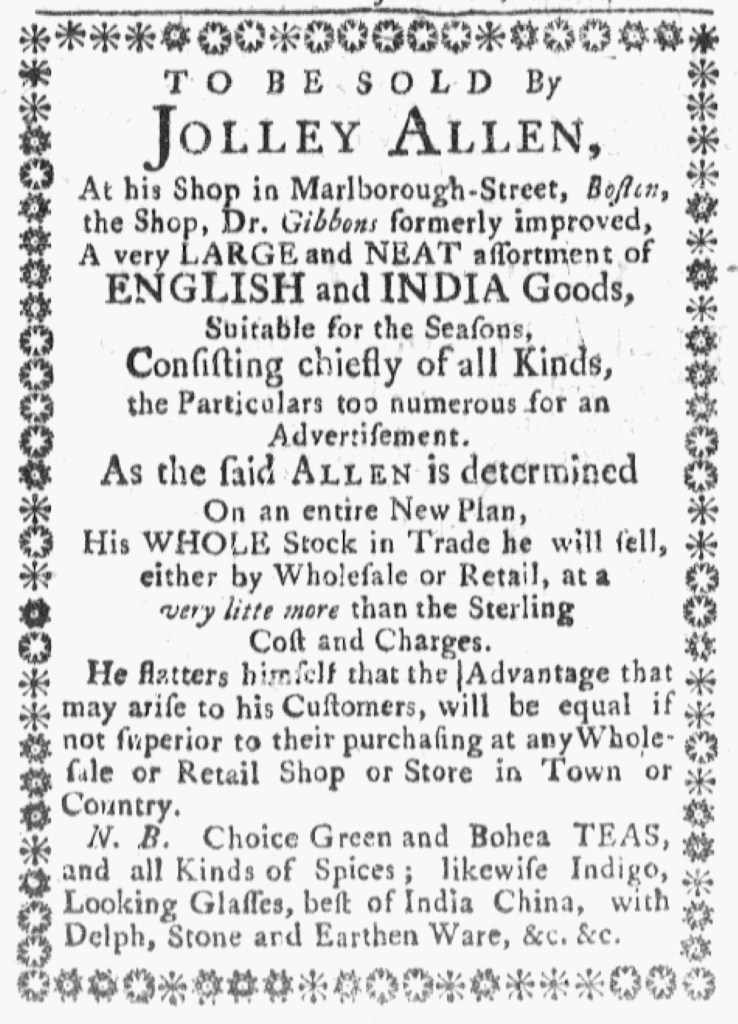
“The Particulars too numerous for an Advertisement.”

Thanks to a signature design element, a border comprised of decorative type, readers easily spotted Jolley Allen’s advertisements in several newspapers published in Boston in late spring in 1772.  The Massachusetts Gazette and Boston Weekly News-Letter, for instance, carried his advertisement with its distinctive border on June 11.  Three days earlier, the Boston-Gazette and the Massachusetts Gazette and Boston Post-Boy featured Allen’s advertisement, complete with the border.  On June 1, the Boston Evening-Post did so as well.

On the same day that the Massachusetts Gazette and Boston Weekly News-Letter carried Allen’s advertisement, it also ran in the Massachusetts Spy.  That completed Allen’s efforts to disseminate his notice as widely as possible by inserting it in all five newspapers printed in Boston at the time.  Yet the version in the Massachusetts Spy differed in format, though not in copy, from Allen’s advertisements in the other four newspapers.  No border enclosed the shopkeeper’s pronouncement that he “determined on an entire New Plan” for selling “His WHOLE Stock in Trade … at very little more than the Sterling cost and charges.”

Other design elements replicated Allen’s advertisements in the other newspapers.  For instance, the compositor centered the copy of the first portion, creating distinctive white space that helped draw attention to the notice, before resorting to a dense block of text that went to the left and right margins for the final portion.  Allen most likely requested a border when he submitted the copy to the printing office.  After all, he made an effort to make a consistent visual presentation throughout the other newspapers that carried his advertisement.  The compositor for the Massachusetts Spy allowed for some distinctiveness in the format of the notice, but apparently considered incorporating a border too much of a deviation.

The Massachusetts Spy already included borders comprised of thin lines around all advertisements, the only newspaper printed in Boston at the time to do so.  Perhaps the compositor exercised judgment in determining that a border within a border would appear too crowded, overruling instructions or preferences expressed by the advertiser.  This example hints at the conversations about graphic design that may have taken place between advertisers and those who worked in printing offices in early America.  How extensively did printers, compositors, and advertisers consult each other about the format of newspaper notices that customers paid to insert?

May 25

What was advertised in a colonial American newspaper 250 years ago today?

Massachusetts Gazette and Boston Post-Boy (May 25, 1772).

“ALLEN … will sell … at a very little more than the Sterling Cost.”

Jolley Allen made his advertisements in the Boston Evening-Post, the Boston Gazette, the Massachusetts Gazette and Boston Post-Boy, and the Massachusetts Gazette and Boston Weekly News-Letter easy to recognize in the spring of 1772.  Each of them featured a border comprised of ornamental type that separated Allen’s notices from other content.  Allen previously deployed this strategy in 1766 and then renewed it in the May 21, 1772, edition of the Massachusetts Gazette and Boston Weekly News-Letter.  Four days later, advertisements with identical copy and distinctive borders ran in three other newspapers printed in town.  Allen apparently gave instructions to the compositors at the Boston Evening-Post and the Massachusetts Gazette and Boston Post-Boy.  Those advertisements had copy identical to the notice in the Massachusetts Gazette and Boston Weekly News-Letter, but the compositors made different decisions about the format (seen most readily in the border of Allen’s advertisement in the Massachusetts Gazette and Boston Post-Boy).  Allen’s advertisement in the Boston-Gazette, however, had exactly the same copy and format as the one in the Massachusetts Gazette and Boston Weekly News-Letter.  For some of their advertisements, newspapers in Boston apparently shared type already set in other printing offices.

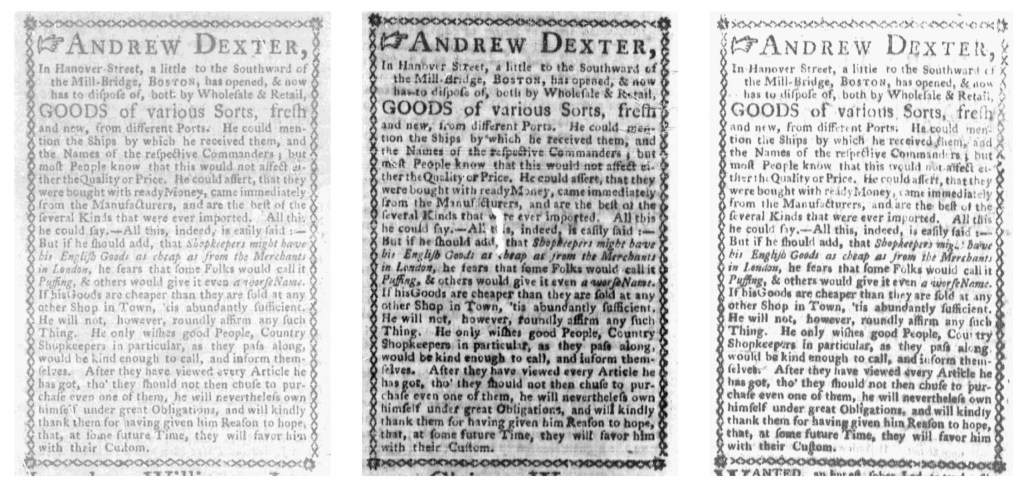
That seems to have been the case with Andrew Dexter’s advertisement.  He also included a border around his notice in the May 21 edition of the Massachusetts Gazette and Boston Weekly News-Letter.  The same advertisement ran in the Boston Evening-Post four days later.  It looks like this was another instance of transferring type already set from one printing office to another.  The compositor for the Boston Evening-Post may have very carefully replicated the format of Dexter’s advertisement that ran in the Massachusetts Gazette and Boston Weekly Mercury, but everything looks too similar for that to have been the case.  In particular, an irregularity in closing the bottom right corner of the border suggests that the printing offices shared the type once a compositor set it.  They might have also shared with the Boston-Gazette.  Dexter’s advertisement also ran in that newspaper on May 25.  It had the same line breaks and italics as Dexter’s notices in the other two newspapers.  The border looks very similar, but does not have the telltale irregularity in the lower right corner.  Did the compositor make minor adjustments?

It is important to note that these observations are based on examining digitized copies of the newspapers published in Boston in 1772.  Consulting the originals might yield additional details that help to clarify whether two or more printing offices shared type when publishing these advertisements.  At the very least, the variations in Allen’s advertisements make clear that he intentionally pursued a strategy of using borders to distinguish his advertisements in each newspaper that carried them.  The extent that Dexter meant to do the same or simply benefited from the printing offices sharing type remains to be seen after further investigation.

**********

Left to Right: Massachusetts Gazette and Boston Weekly Mercury (May 21, 1772); Boston-Gazette (May 25, 1772); Boston Evening-Post (May 25, 1772); Massachusetts Gazette and Boston Post-Boy (May 25, 1772).

**********

Left to Right: Massachusetts Gazette and Boston Weekly News-Letter (May 21, 1772); Boston Evening-Post (May 25, 1772); Boston-Gazette (May 25, 1772).

May 13

What was advertised in a colonial American newspaper 250 years ago this week?

Supplement to the Boston-Gazette (May 11, 1772).

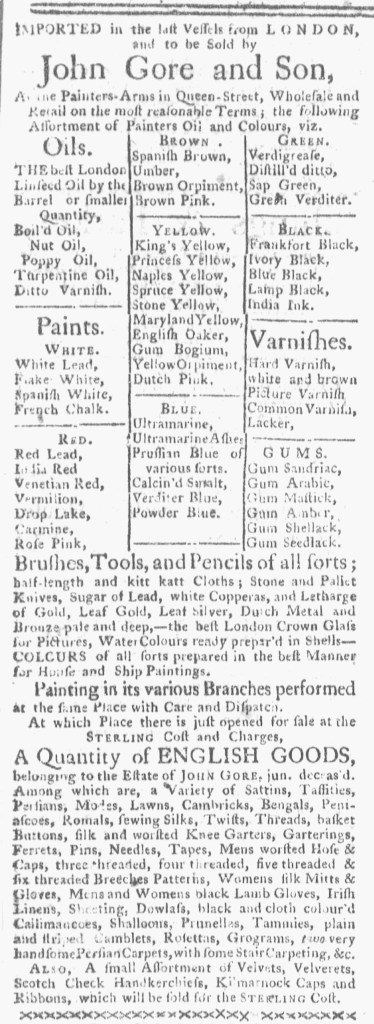
“Oils…  Paints…  Varnishes… GUMS.”

When it appeared in the Supplement to the Boston-Gazette on May 11, 1772, John Gore and Son’s advertisement for paint and supplies may have looked familiar to readers who regularly perused that newspaper.  After all, it ran two weeks earlier in the April 27 edition.  By the time the notice appeared in the Boston-Gazette a second time, it had also appeared in the Massachusetts Gazette and Boston Weekly News-Letter twice, first on April 23 and then on May 7.  The format made it memorable, an extensive list of oils, paints, varnishes, and gums arranged as a table.  That table had sections for various shades of whites, reds, browns, yellows, blues, greens, and blacks, suggesting the many choices available to customers.  No other advertisement in any of the newspapers published in Boston at the time incorporated that distinctive design.

It was not uncommon for advertisers to place notices in multiple newspapers in order to reach more consumers and increase their share of the market.  When they did so, they usually submitted copy to the printing offices and then compositors made decisions about the design of each advertisement when they set the type.  That meant that advertisements with identical copy had variations in line breaks, font sizes, italics, and capitalization from newspaper to newspaper, depending on the decisions made by compositors.  In some instances, advertisers made requests or included instructions.  For example, some merchants and shopkeepers preferred for their merchandise to appear in two columns with only one item on each line rather than in a dense block of text.  In such cases, compositors still introduced variations in graphic design, even when working with identical copy.

That did not happen with Gore and Son’s advertisement.  Instead, the same advertisement ran in both the Massachusetts Gazette and Boston Weekly News-Letter and the Boston-Gazette.  Workers in the two offices transferred type already set back and forth multiple times.  When the time the advertisement appeared in the Supplement to the Boston-Gazette, three transfers had taken place, first from Richard Draper’s printing office to the Benjamin Edes and John Gill’s printing office, then a return to Draper’s office, and once again to Edes and Gill’s office.  Early American printers frequently reprinted content from one newspaper to another.  That was standard practice for disseminating news, but it did not involve the coordination and cooperation required for sharing type.  Gore and Son’s advertisement suggests even greater collaboration among printers in Boston, a relationship that merits further investigation to understand how they ran their businesses.

May 7

What was advertised in a colonial American newspaper 250 years ago today?

Massachusetts Gazette and Boston Weekly News-Letter (May 7, 1772.)

“Oils…  Paints… Varnishes… GUMS.”

John Gore and Son’s advertisement for an “Assortment of Painters Oil and Colours” available “At the Painters-Arms in Queen-Street” ran once again in the May 7, 1772, edition of the Massachusetts Gazette and Boston Weekly News-Letter.  It featured a table of “Oils… Paints… Varnishes… [and] GUMS” of various colors, making it distinct from other advertisements and easy to recognize.  Among the various paints, the table offered choices that ranged from “Princess Yellow, Naples Yellow, [and] Spruce Yellow” to “India Red, Venetian Red, [and] Vermilion.”  The format both delineated the many choices available to consumers and challenged them to imagine the possibilities.

Readers of the Massachusetts Gazette and Boston Weekly Mercury had seen this advertisement before.  It ran two weeks earlier in the April 23 edition.  Unlike other advertisements that ran for consecutive weeks, however, Gore and Son’s advertisement did not appear in the subsequent issue on April 30.  Instead, it ran in the Boston-Gazette on April 27.  That was not merely a case of an advertiser submitting the same copy to two newspapers.  Careful examination reveals that the notices in the Massachusetts Gazette and Boston Weekly News-Letter and the Boston-Gazette featured identical format, indicating that someone transferred the type from one printing office to another.  That made publishing Gore and Son’s advertisement a collaborative effort among competitors.  It was not the only paid notice that originated in the Massachusetts Gazette and Boston Weekly Mercury and then ran in identical format in another newspaper in the spring of 1772.  The type for Gore and Son’s advertisement eventually found its way back to Richard Draper’s printing office, where the compositor added a final line about “A few Casks of NEW RICE” but otherwise did not make any adjustments to the format.

This raised all kinds of questions about the business of printing in early America.  What kinds of bookkeeping practices did this entail?  How did Draper and other printers keep track of which type belonged to them or to competitors?  How did they go about charging advertisers for notices that ran in multiple newspapers?  Did advertisers receive a discount from those printing offices that did not have to set the type?  Or did the work involved in transferring type from one office to another balance the labor required to set type?  Printers in Boston sometimes collaborated in publishing almanacs and pamphlets.  To what extent did they collaborate in publishing the advertisements that generated significant revenue for their newspapers?

April 29

What was advertised in a colonial American newspaper 250 years ago this week?

Boston-Gazette (April 27, 1772).

“Oils … Paints … Varnishes … GUMS.”

John Gore and Son’s advertisement in the April 27, 1772, edition of the Boston-Gazette raises all sorts of interesting questions.  An identical advertisement appeared in the April 23 edition of the Massachusetts Gazette and Boston Weekly News-Letter.  This does not seem to have been just a case of an advertiser inserting the same notice in multiple newspapers.  That was quite common in the 1770s, especially in Boston.  Yet this was not simply an instance of an advertiser writing out the copy more than once and then submitting it to more than one printing office.  Yes, the copy was identical … but so was the format and every aspect of typography, from the design of the table listing different kinds of paints to the line breaks to font sizes to capitalization of certain words.  Rather than a compositor copying an advertisement as it appeared in another newspaper, this looks like Richard Draper’s printing office outright transferred type already set for the Massachusetts Gazette and Boston Weekly News-Letter to Benjamin Edes and John Gill’s printing office for publication in the Boston-Gazette.

That was not the only instance of such a transfer in the April 27 edition of the Boston-Gazette.  John Barrett and Sons ran an extensive advertisement that previously appeared in Draper’s newspaper on April 23.  So did Joseph Peirce.  To further complicate matters, both of these advertisements also ran in the April 27 edition of the Boston Evening-Post. Once again, this does not seem to have been merely an instance of a compositor consulting an advertisement in another newspaper when setting type.  Instead, the type from one printing office found its way to another printing office.

The placement of these advertisements on the page in each newspaper contributes to some confusion about the sequence of events.  Take into consideration that a standard issue consisted of four pages created by printing two pages on each side of a broadsheet and then folding it in half.  Printers often printed the front and back pages first, filling them with the masthead, colophon, and advertisements.  They saved the second and third pages for the latest news.  Peirce’s advertisement ran on the fourth page of the April 27 edition of the Boston-Gazette, suggesting that the compositor received the type from the April 23 edition of the Massachusetts Gazette and Boston Weekly Mercury fairly quickly.  That also allowed sufficient time to pass along the type to the Boston-Evening Post for inclusion in a two-page supplement that consisted entirely of advertising.  That timing makes sense.

The timing for inserting Barrett and Sons’ advertisement in each newspaper, however, does not seem as clear.  It ran on the first page of the April 27 edition of the Boston-Gazette, printed at the same time that Peirce’s advertisement was printed on the fourth page.  It did not, however, run in the supplement to the Boston Evening-Post or even on the second or third pages among the last items inserted in the standard issue.  Instead, it appeared on the fourth page, presumably making it one of the first items printed for that issue.  The compositor did eliminate the final eight lines listing several imported goods in order to make the advertisement fit among the other content on the page, but did not make other alterations.  That someone transferred the type from one printing office to another so quickly for it to appear in the Boston-Gazette and the Boston Evening-Post on the same day suggests a very efficient operation.

This raises questions about the organization and collaboration between printing offices.  Who assumed the responsibility for transferring the type for these advertisements from one printing office to another?  Did they make sure that the type was returned to its original printing office?  Did any of the printing offices adjust the prices they charged for running these advertisements based on whether they invested time and labor in setting type?  How extensive were these practices of transferring type from one printing office to another?  These are all questions that merit further investigation.

Left: Massachusetts Gazette and Boston Weekly News-Letter (April 23, 1772). Right: Boston-Gazette (April 27, 1772).

**********

Left: Massachusetts Gazette and Boston Weekly News-Letter (April 23, 1772). Center: Boston-Gazette (April 27, 1772). Right: Boston Evening-Post (April 27, 1772).

April 22

What was advertised in a colonial American newspaper 250 years ago this week?

Massachusetts Gazette and Boston Post-Boy (April 20, 1772).

“Infants Morocco Shoes, and / Pumps, Womens / Lynn made / Ditto.”

Duncan Ingraham, Jr., hoped that the format of his advertisement would help to draw attention to the goods that he imported from London and sold at his shop on Union Street in Boston in the spring of 1772.  Most merchants and shopkeepers who advertised in the newspapers published in the bustling port city adopted one of two methods of listing their merchandise.  They either included everything in a single dense paragraph or they divided their advertisement into columns with one item per line.  Ingraham rejected both in favor of arranging his list of goods in the shape of a diamond. Such an unusual format almost certainly caught the eyes of readers as they perused the Boston Evening-Post and the Massachusetts Gazette and Boston Post-Boy.

A variation of Ingraham’s advertisement appeared in both newspapers.  The notices contained nearly identical copy, but the compositors made different decisions about line breaks for both the introduction that gave directions to Ingraham’s shop and the diamond that listed the goods.  When he wrote out the advertisement by hand, Ingraham may have experimented with creating a diamond.  Alternately, he may have submitted instructions about his preferences and left it to the compositors to figure out the particulars.  Either way, Ingraham likely provided some sort of guidance for the compositors.  They did not independently decide to introduce the same innovation into his advertisement in two newspapers.

In most cases, eighteenth-century advertisers played little role in designing their advertisements beyond writing the copy, but Ingraham more actively assumed responsibility for some of the visual aspects of his notice.  He apparently did not consider his advertisement a mere announcement that he carried certain goods.  Instead, he sought to shape his advertisement in a manner likely to increase the chances that prospective customers would take note of it and the various appeals to low prices and good customer service he included in the introduction.

March 14

What was advertised in a colonial American newspaper 250 years ago today?

Postscript to the Censor (March 14, 1772).

“WILLIAM WINGFIELD, At his Shop in Union-Street, BOSTON.”

Like many advertisers who resided in town with more than newspaper, shopkeeper William Wingfield attempted to capture a larger share of the market by inserting notices into multiple newspapers.  On Monday, March 9, 1772, he ran an advertisement for a “General Assortment” of textiles and “all sorts of Goods suitable for all seasons” in the Massachusetts Gazette and Boston Post-Boy.  On Thursday, March 12, he placed the same advertisement in the Massachusetts Gazette and Boston Weekly News-Letter.  By then, his advertisement ran in both newspapers for several weeks.  Wingfield ended the week with the same advertisement in the Postscript to the Censor on Saturday, March 14.  Ezekiel Russell, the printer of The Censor, had only recently expanded that magazine of political essays to include a half sheet supplement that featured news and advertising.  Wingfield was among the first colonizers to place an advertisement in that supplement.

What prompted Wingfield to make that decision?  Russell had not established an extensive circulation for The Censor and its supplement.  Indeed, the publication folded just two months later because Russell could not find sufficient readers in Boston who appreciated the Tory perspective promoted in his magazine.  If Wingfield wanted to place his advertisement before greater numbers of readers and prospective customers, then he would have been better served by placing it in the Boston Evening-Post or the Massachusetts Spy, two other newspapers published in Boston at the time.  Politics did not seem to be the defining factor.  The Massachusetts Gazette and Boston Post-Boy and the Massachusetts Gazette and Boston Weekly News-Letter were friendly to the British government, suggesting that Wingfield may have made a political decision when expanding his advertising campaign to the Postscript to the Censor.  However, he had also been publishing his advertisement in the Boston-Gazette.  Benjamin Edes and John Gill, the printers of that newspaper, consistently advocated the patriot cause, making the Boston-Gazette as much of a nuisance to colonial officials as Isaiah Thomas’s Massachusetts Spy.  Before inserting advertisements in the Postscript to the Censor became an option, Wingfield already distributed his advertisements among newspapers that took various political positions.  Choosing to advertise in the Postscript to the Censor neither bolstered his affiliation with publications that expressed Tory views nor diversified his outreach to consumers according to the politics of the publications they read.  What else might have explained his decision to start advertising in the Postscript to the Censor but not the Boston Evening-Post or the Massachusetts Spy?  Perhaps Russell, the printer, offered good deals on advertising in his attempts to cultivate a new clientele.  In his advertisement, Wingfield noted that he carried “too many [goods] to enumerate in an Advertisement,” suggesting a certain frugality compared to competitors who published much longer lists of their merchandise.  If Russell offered bargains on advertising, then Wingfield might have seized the opportunity.  Whatever his reasons for advertising in the Postscript to the Censor, Wingfield expanded his advertising campaign from three of the six weekly publications in Boston to four of the six in March 1772.

March 4

What was advertised in a colonial American newspaper 250 years ago this week?

Boston-Gazette (March 2, 1772).

“THE FRUGAL HOUSEWIFE … By SUSANNAH CARTER.”

In 1772, Benjamin Edes and John Gill, printers of the Boston-Gazette, published an American edition of The Frugal Housewife, or Complete Woman Cook by Susannah Carter of London.  The book included “Five Hundred approved Receipts” for everything from roasting and frying to sauces and soups to tarts and puddings to jellies and custards as well as instructions for preserving, pickling, and candying various foods.  In addition, Carter provided “Various BILLS of FARE, For DINNERS and SUPPERS in every Month of the Year” to guide readers in consulting the many recipes and choosing which items to prepare together.  The book also featured “a copious Index of the whole” to help readers find the recipes.  Edes and Gill promised that “Any Person, by attending to the Instructions given in this Book, may soon attain to a compleat Knowledge in the Art of Cookery.”

The printers marketed The Frugal Housewife in their own newspaper, but they also turned to other publications in their effort to create a larger market for what they believed had the potential to be a popular American edition of a cookbook first published in London in the 1760s.  On March 2, 1772, they ran advertisements in both the Boston Evening-Post and the Boston-Gazette.  Three days later, they placed an advertisement in the Massachusetts Spy.  The notices in the other newspapers were not as elaborate as the one that appeared in their own.  The version in the Boston-Evening Post, for instance, did not include the price nor the nota bene assuring prospective customers that they would acquire “a complete Knowledge” of cooking.  The version in the Massachusetts Spy, on the other hand, included both of those items as well as a note that the book “contains more in Quantity than most other Books of a much higher Price.”  It did not, however, feature the distinctive typography with only two items on each line that made the notices in the other newspapers occupy significantly more space.  Instead, a dense list of the contents comprised most of the content of the advertisement in the Massachusetts Spy.

Edes and Gill sought to expand their marketing and sales by placing advertisements in multiple newspapers.  Though they exercised control over the copy, they did not exert as much influence when it came to the format.  Compositors who labored in other printing offices made decisions about the appearance of Edes and Gill’s advertisements for The Frugal Housewife.