May 24

What was advertised in a revolutionary American newspaper 250 years ago today?
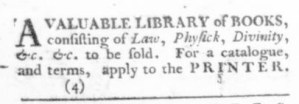
Supplement to the Virginia Gazette [Purdie] (May 24, 1776).

“For a catalogue, and terms, apply to the PRINTER.”

In the spring of 1776, Alexander Purdie’s Virginia Gazette carried and advertisement for “A VALUABLE LIBRARY of BOOKS, consisting of Law, Physick, Divinity, &c. &c.”  Using “&c.” (the abbreviation for et cetera commonly used in the eighteenth century) indicated that the library included books on many other topics.  The advertisement did not list any titles but instead instructed interested parties to “apply to the PRINTER” to receive a catalogue and learn more about the terms of the sale.  Purdie may have generated additional revenue by printing the catalogue for the anonymous advertiser …
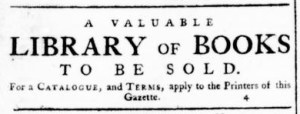
Virginia Gazette [Dixon and Hunter] (May 25, 1776).

… or his competitors, John Dixon and William Hunter, may have printed the catalog.  An advertisement with nearly identical copy simultaneously ran in their newspaper.  It announced, “A VALUABLE LIBRAY OF BOOKS TO BE SOLD.”  It also told readers how to learn more: “For a CATALOGUE, and TERMS, apply to Printers of this Gazette.”  Perhaps the catalogue was an example of the “PRINTING WORK done at this Office in the NEATEST Manner, with Care and Expedition,” that Dixon and Hunter promoted in the masthead.  Both advertisements included a notation to remind the compositor to run the advertisement for four weeks.  The two advertisements almost certainly referred to the same “LIBRARY of BOOKS” for sale and the same catalogue.

The anonymous advertiser arranged for an additional form of marketing media, a catalogue, to supplement the notices that appeared in the newspapers printed in Williamsburg.  That catalogue may have been a small pamphlet, though it could have been a broadside printed only on one side or a broadsheet printed on both, depending on how many books it listed and the preferences of the advertiser and the decisions of the compositor.  The advertiser most likely did not have catalogues printed in both printing offices.  That meant coordinating the delivery of the catalogue from one printing office to the other.  No matter which printing office produced the catalogue, it increased the amount of advertising media available and circulating in Virginia in the 1770s.  Newspaper advertisements suggest that other kinds of marketing materials were more prevalent than the number of those that have survived in research libraries, historical societies, and private collections.

May 21

What was advertised in a colonial American newspaper 250 years ago this week?

May 21 - 5:18:1769 Pennsylvania Journal
Pennsylvania Journal (May 18, 1769).

“Particular care will be taken to do Advertisements, Blanks, &c. on very short notice.”

When Joseph Crukshank opened a printing office in Philadelphia in 1769, he attempted to attract clients by placing an advertisement in the Pennsylvania Journal. He pledged that his customers “may depend on having their work done in a neat and correct manner.” Crukshank anticipated that his job printing would include producing “Advertisements, Blanks, &c. on very short notice.” In that regard, he emphasized some of the same services as some newspaper printers regularly promoted in the colophons of their publications. The colophon on the final page of the Georgia Gazette, for instance, stated, “Hand-Bills, Advertisements, &c. printed at the shortest Notice.” Similarly, the colophon for the Pennsylvania Chronicle concluded with “Blanks and Hand-Bills in particular are done on the shortest Notice, in a neat and correct Manner.”

Printers generated revenue by printing handbills and other advertisements. For those who published newspapers, this revenue supplemented what they earned from subscriptions and advertisements inserted in the newspapers. For those who did not publish newspapers, like Crukshank, advertisements were an especially important component of their business. Handbills accounted for some of that work, but a variety of other sorts of advertising media came off of eighteenth-century printing presses, including trade cards, billheads, broadsides, furniture labels, catalogs, subscription notices, and magazine wrappers. Crukshank even promoted a catalog of the books he sold, inviting prospective customers to visit his shop to pick up their own copies.

All advertising could be considered ephemeral, but these other forms of advertising proved to be even more ephemeral than newspaper advertisements. Printers and others created repositories of eighteenth-century newspapers at the time of their creation, but handbills, trade cards, and other printed media deployed as advertising did not benefit from the same systematic collection and preservation. As a result, the sources for reconstructing the history of advertising in the colonial and revolutionary eras are skewed in favor of newspaper advertisements. Certainly newspaper advertisements were the most common form of advertising and merit particular attention, but they do not tell the entire story. The scattered billheads found among household accounts, labels still affixed to furniture, and other relatively rare eighteenth-century advertising media in modern libraries and archives belie their original abundance, according to the frequent references to “Hand-Bills, Advertisements, &c.” and “catalogues” in newspaper advertisements and colophons. Printers’ ledgers and correspondence also include references to advertisements with no known extant copies. These various sources indicate that, especially in the second half of the eighteenth century, Americans encountered a rich visual and textual landscape of advertising as they went about their daily lives.