What was advertised in a revolutionary American newspaper 250 years ago today?
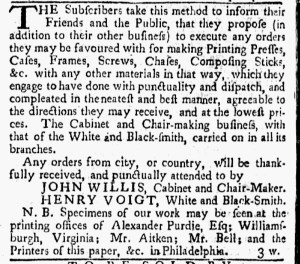
“Specimens of our work may be seen at the printing offices of Alexander Purdie … and the Printers of this paper.”
John Willis, a “Cabinet and Chair-Maker,” and Henry Voigt,” a “White and Black-Smith,” launched a new endeavor in the spring of 1775. They took to the pages of Story and Humphreys’s Pennsylvania Mercury to advise “their Friends and the Public,” especially those in the printing trade, that they would “execute any orders they may be favoured with for making Printing Presses, Cases, Frames, Screws, Chases, Composing Sticks,” and other equipment.
Willis and Voight did not rely solely on their advertisement to market the printing equipment they produced. They also bolstered their reputations by encouraging prospective customers to examine “Specimens” of their work “at the printing offices of Alexander Purdie, Esq; Williamsburgh, Virginia; Mr. Aitken; Mr. Bell; and the Printers of this paper, &c. in Philadelphia.” Purdie commenced publishing his Virginia Gazette earlier in the year after dissolving his partnership with William Dixon. Having started as a bookseller and bookbinder, Robert Aitken opened a printing office in 1774 and launched the Pennsylvania Magazine in January 1775. Robert Bell, on the other hand, had several years of experience as a bookseller, printer, and publisher, one who advertised his projects widely in newspapers throughout the colonies. Enoch Story and Daniel Humphreys, “the Printers of this paper,” had been publishing their newspaper for only a month when it carried Willis and Voight’s advertisement. Both newcomers and veterans in the trade had turned to Willis and Voight to produce equipment they needed to operate their printing shops.
Although their names did not appear in the imprints of any books or pamphlets or in the colophons of any newspapers, Willis and Voight made their own contributions to the dissemination of news and information as the imperial crisis became a war for independence. They did not refer to current events in their advertisement, but the timing suggests that they saw new opportunities when they heard about the battles at Lexington and Concord. The cabinetmaker and the blacksmith likely anticipated an expanding market for the equipment necessary for printing the news, prompting them to advertise services “in addition to their other business.”