November 19

What was advertised in a revolutionary American newspaper 250 years ago this week?

Rivington’s New-York Gazetteer (November 16, 1775).

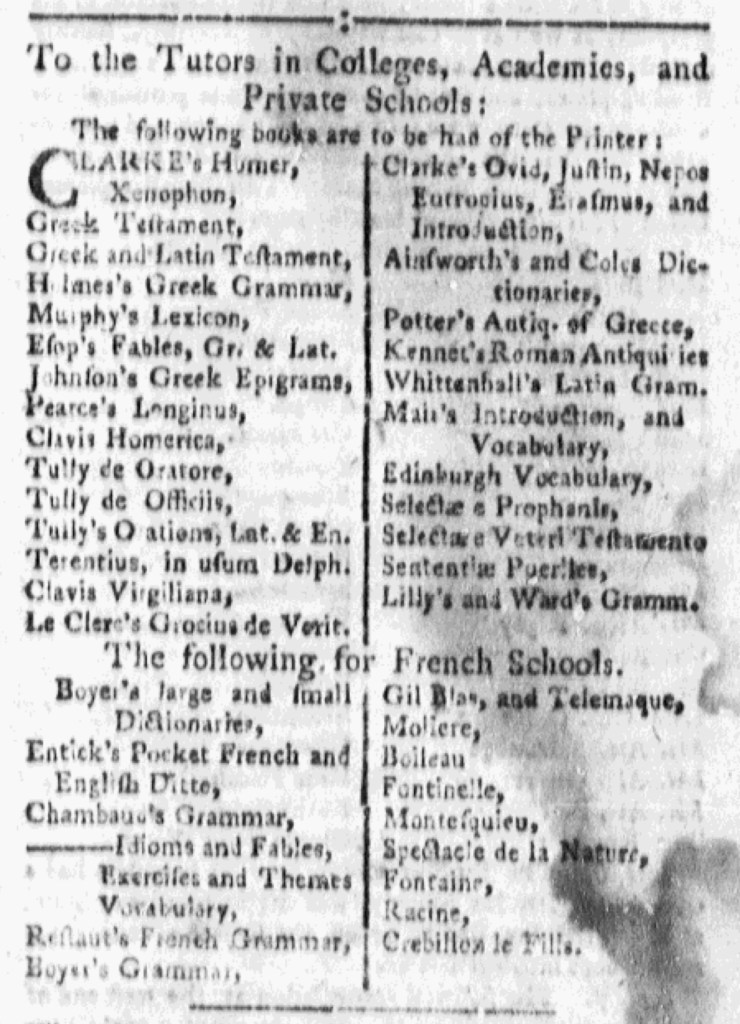
“To the Tutors in Colleges, Academies, and Private Schools.”

James Rivington, the printer of Rivington’s New-York Gazetteer, sold books as an additional revenue stream rather than relying solely on subscriptions and advertisements.  Such was the case with other printers throughout the colonies, their printing offices doubling as bookstores.  Rivington’s newspaper often carried advertisements for books, pamphlets, and almanacs that he stocked.  He printed some of them, acquired others from other colonial printers, and imported most of them from England.  Some advertisements featured a single title.  The November 16, 1775, edition, for instance, featured an advertisement for “A DICTIONARY OF THE Holy Bible” that included the prints, size, and number of volumes along with a description of the contents.  Other advertisements listed multiple titles without providing additional information.

On occasion, Rivington ran advertisements that promoted books and pamphlets with a common theme.  With a headline proclaiming, “The American Controversy,” an advertisement published in February 1775 listed ten pamphlets “published on both sides, in the unhappy dispute with Great-Britain.”  He deployed the same strategy in another notice that ran on November 16, this time addressing “the Tutors in Colleges, Academies, and Private Schools.”  He then gave the titles of more than two dozen books he considered suitable for classrooms, such as “CLARKE’s Homer,” “Greek and Latin Testament,” “Esop’s Fable, Gr[eek] & Lat[in],” “Tully’s Orations, Lat[in] & En[glish],” “Ainsworth’s and Coles Dictionaries,” “Whittenhall’s Latin Gram[mar],” and “Lilly’s and Wards Gramm[ar].”  Rivington implied that those books should have been familiar to tutors.  In addition to those titles, he devoted the final third of the advertisement to books “for French Schools,” including “Boyer’s large and small Dictionaries,” “Entick’s Pocket French and English [Dictionary],” “Chambaud’s Grammar,” “[Chambaud’s] Exercises and Themes,” “Moliere,” and “Montesquieu.”  While Rivington usually marketed most books and pamphlets to general audiences and prospective customers of all backgrounds, especially when his advertisements consisted of catalogs of books available at his printing office, he occasionally attempted to boost sales by directing particular kinds of readers to carefully curated lists of titles.  In this case, tutors and schoolmasters did not need to pore over lengthy lists of books and pamphlets not relevant or not appropriate to their lessons when Rivington presented a specialized catalog for their convenience.

November 18

What was advertised in a revolutionary American newspaper 250 years ago today?

Pennsylvania Evening Post (November 18, 1775).

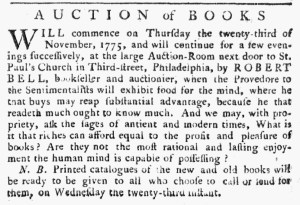
“The Provedore to the Sentimentalists will exhibit food for the mind.”

Readers of the November 18, 1775, edition of the Pennsylvania Evening Post encountered two advertisements promoting an “AUCTION of BOOKS,” one placed by Charles Mouse, “auctionier,” and the other by Robert Bell, “bookseller and auctionier.”  Mouse operated a “vendue store,” a combination of an auction house and a flea market, where he had a “large and choice collection of the most useful and entertaining [books].”  He invited those who had books to sell and “will[ing] to take their chance by auction” to deliver them to his vendue store on Second Street in Philadelphia.  The auctions would begin “precisely at six each evening” and “continue till the whole are sold.”  Mouse provided a straightforward account of this endeavor.

Robert Bell, on the other hand, crafted a more elaborate advertisement.  One of the most prominent American booksellers in the second half of the eighteenth century, Bell already established a reputation throughout the colonies by the time he advertised an auction “at the large Auction-Room next door to St. Paul’s Church in Third-street, Philadelphia,” scheduled for November 23.  He colorfully referred to himself in the third person as “the Provedore to the Sentimentalists” who would “exhibit food for the mind” to bidders and curious observers.  Those who made purchases, Bell declared, “may reap substantial advantage, because he that readeth much ought to know much.”  He further mused that “we may, with propriety, ask the sages of antient and modern times, What is it that riches can afford equal to the profit and pleasure of books?  Are they not the most rational and lasting enjoyment the human mind is capable of possessing?”  Mouse’s description of his “large and choice collection of the most useful and entertaining [books]” paled in comparison to the appeals that Bell made to readers.

Bell deployed another strategy to entice prospective bidders.  In a nota bene, he informed them that “[p]rinted catalogues of the new and old books will be ready to be given to all who choose to call or send for them.”  Those catalogues gave a preview of the sale and allowed Bell to disseminate information about the books up for bids more widely.  Those who visited his “Auction-Room” to collect a catalogue likely had an opportunity to browse the books, yet they could take their time going through the entries in the catalogue in the comfort of their own homes or offices or even at a coffeehouse with friends.  Those who sent for catalogues enjoyed the same benefit.  By distributing catalogs, Bell encouraged interest and prompted readers to imagine themselves bidding on the books they selected in advance.  He may have believed that prospective bidders were more likely to bid higher prices if they had spent time with the catalogue in advance and, as a result, became more committed to acquiring the books that interested them.

November 6

What was advertised in a revolutionary American newspaper 250 years ago today?

Boston-Gazette (November 6, 1775).

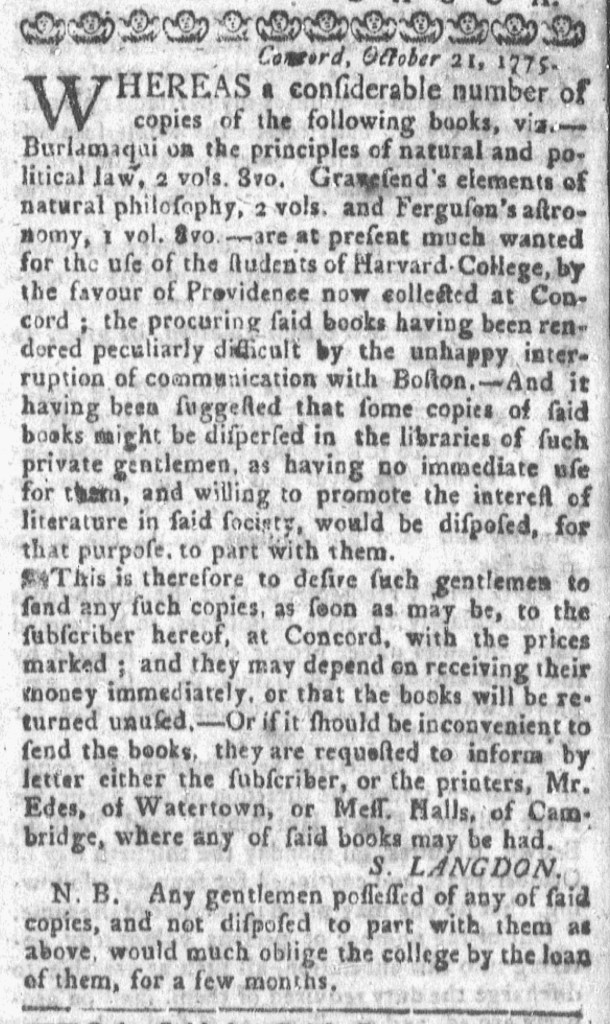
“The following books … are at present much wanted for the use of the students of Harvard College.”

Samuel Langdon, the president of Harvard College, issued a plea in the fall of 1775.  His students needed books!  As he explained in his advertisement in the November 6, 1775, edition of the Boston-Gazette, the college held classes in Concord while the siege of Boston continued … yet students could not acquire many of the texts that they needed because of “the unhappy interruption of communication” and trade with booksellers (and other purveyors of goods and services) in Boston.  Similarly, Benjamin Edes had moved the Boston-Gazette to Watertown following the battles at Lexington and Concord.

Langdon sought “a considerable number of copies” of “Burlamaqui on the principles of natural and political law, 2 vols. 8vo. Gravesend’s elements of natural philosophy, 2 vols. And Ferguson’s astronomy, 1 vol. 8vo.”  In specifying both the number of volumes and the size (“8vo” or octavo) of the books, Langdon made clear that the college preferred certain editions.  He reported that others “suggested” to him “that some copies of said books might be dispersed in the libraries of such private gentlemen” who did not have immediate use for them and thus might be willing to “part with them” to “promote the interest of literature” among the youth attending Harvard College.

Langdon requested that “such gentleman” who did have those books “send any such copies, as soon as may be … with the prices marked.”  They could “depend on receiving their money immediately, or that the books will be returned unused.”  Langdon understood that some readers might not wish to part with volumes from their personal libraries.  Alternately, he suggested that that it would “much oblige the college” if they would loan those volumes “for a few months.”  With classes continuing despite the disruptions caused by the outbreak of hostilities at Lexington and Concord the previous spring, Langdon engaged in an eighteenth-century version of crowdsourcing in his effort to procure books for his students.  The college survived a fire in its library a decade earlier, requesting donations of books to recover.  Now Harvard faced other obstacles and once again turned to the public to provide the books that the college needed.

September 11

What was advertised in a revolutionary American newspaper 250 years ago today?

Newport Mercury (September 11, 1775).

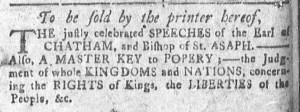
“THE justly celebrated SPEECHES of the Earl of CHATHAM, and Bishop of St. ASAPH.—Also, A MASTER KEY to POPERY.”

To fill the space at the bottom of the last column on the final page of the September 11, 1775, edition of the Newport Mercury, Solomon Southwick, the printer, inserted a short advertisement that listed several books and pamphlet that he sold at his printing office.  Most of them had been featured in longer advertisements, including “the Judgment of whole KINGDOMS and NATIONS, concerning the RIGHTS of Kings, the LIBERTIES of the People, &c.”  Southwick’s edition was one of three printed in the colonies in the past two years.  The printer also stocked the “justly celebrated SPEECHES of the Earl of CHATHAM, and Bishop of St. ASAPH.”  The bishop, a member of Parliament, opposed “altering the Charters of the Colony of Massachusetts Bay,” one of the Coercive Acts enacted by Parliament in retaliation for the Boston Tea Party.  When prevented from delivering his speech during deliberations, he instead published it.  That earned him significant acclaim in the colonies.  William Pitt, the first earl of Chatham, had been “dear to AMERICA” for a decade thanks to his opposition to the Stamp Act.  Southwick’s printing office was clearly a place for Patriots to shop for reading material.

The books on offer included “A MASTER KEY to POPERY.”  Southwick promoted that volume widely even before taking it to press, disseminating subscription proposals in newspapers throughout New England.  They promised an extensive anti-Catholic screed, an exposé of “popery” by a former priest.  Southwick either gained enough subscribers to make the project viable or felt strongly enough about the supposed dangers of Catholicism that he printed the book.  Once he had copies ready for sale, he linked religion and politics in an advertisement that condemned “the infernal machinations of the British ministry, and their vast host of tools, emissaries, &c. &c. sent hither to propagate the principles of popery and slavery, which go hand in hand, as inseparable companions.”  Such prejudices resonated as colonizers expressed dismay over the Quebec Act, yet another of their grievances against Parliament.  That legislation gave several benefits to Catholic settlers in territory gained from the French during the Seven Years War, an insult to Protestants in New England who had sacrificed so much in fighting the British Empire’s Catholic enemies.  For Southwick and many of the readers of the Newport Mercury, support for the American cause and anti-Catholicism went hand in hand during the imperial crisis and the beginning of the Revolutionary War.

December 30

What was advertised in a colonial American newspaper 250 years ago this week?

Maryland Gazette (December 27, 1770).

“Catalogues may be had at Mr. Thomas Williams and Company’s Store in Annapolis.”

Newspaper advertisements were the most common form of marketing media in eighteenth-century America, but they were not the only means of advertising.  Entrepreneurs also produced and distributed broadsides, handbills, trade cards, billheads, furniture labels, subscription papers, circular letters, and catalogs.  Given the ephemeral quality of those genres, they have not survived in the same numbers as newspaper advertisements, but those that have been identified in research libraries, historical societies, and private collections suggest that various forms of advertising circulated widely.

Sometimes newspaper advertisements from the period made reference to other advertising materials that consumers discarded after the served their purpose, especially subscription papers for books and other publications, auction catalogs for an array of goods, and book catalogs that often also included stationery wares.  Such was the case in an advertisement for “LAW BOOKS” in the December 27, 1770, edition of the Maryland Gazette.  Thomas Brereton advertised that he sold law books in Baltimore.  Seeking to serve prospective customers beyond that town, he advised readers that they could acquire catalogs “at Mr. Thomas Williams and Company’s Store in Annapolis.”  Consumers could shop from the catalog and place orders via the post, the eighteenth-century version of mail order.

Brereton likely recognized benefits of simultaneously distributing two forms of marketing.  The newspaper advertisements went into widespread circulation throughout the colony and beyond, enlarging his market beyond Baltimore.  Yet the rates for publishing lengthy newspaper advertisements, such as a list of titles from a book catalog, may have been prohibitively expensive.  Instead, resorting to job printing for a specified number of catalogs may have been the more economical choice.  In addition, doing so created an item devoted exclusively to the sale of Brereton’s law books without extraneous materials.  Interested parties who encountered Brereton’s advertisement in newspapers they read in coffeehouse or taverns or borrowed from friends or acquaintances could request their own copies of the catalog to carry with them, mark up, and otherwise treat as they pleased.

Compared to the frequency that newspapers advertisements promoted book catalogs as ancillary marketing materials, relatively few have survived.  Some historians suspect that advertisers did not produce all of the catalogs they mentioned in their newspaper notices, especially those that advertisers promised would soon become available.  Despite that possibility, it did not serve Brereton to direct prospective customers to a catalog that did not exist.  In this instance, he noted that the catalogs were already available, increasing the likelihood that he did indeed produce and circulate them.

June 11

What was advertised in a colonial American newspaper 250 years ago today?

Jun 11 - 6:11:1770 New-York Gazette and the Weekly Mercury
New-York Gazette and Weekly Mercury (June 11, 1770).

“With an APPENDIX, containing the Distiller’s Assistant.”

In the spring of 1770, the New-York Gazette and Weekly Mercury carried a series of advertisements from “I. FELL, at No. 14, in Pater-noster-Row, London.”  Two of them appeared in the June 11 edition.  The first, a subscription notice for the bible “On a PLAN never before attempted … By a SOCIETY of CLERGYMEN,” listed Fell as one of the booksellers.  This subscription notice stated that “the Printer hereof,” Hugh Gaine, acted as a local agent.  Interested parties needed to make arrangements with Gaine rather than contacting Fell.  As local agent, Gaine compiled a list of subscribers that he sent to Fell, collected payments, and distributed the book after it went to press.  The other advertisement listed eight titles that Fell sold at his shop.  It did not indicate that Gaine served as a local agent, though customers may very well have had the option of submitting orders through him.

Fell’s second advertisement differed from most others placed by booksellers.  They usually took one of two forms.  Some, like the subscription notice, promoted a single title, describing both the contents and the material qualities of the publication.  Others, like an advertisement placed by James Rivington in the same issue of the New-York Gazette and Weekly Mercury, listed books for sale but provided little elaboration beyond the titles.  Rivington’s advertisement listed dozens of books; others listed hundreds.  In contrast to either of those standard approaches, Fell’s advertisement featured eight books and provided a blurb about each to incite interest.

In general, Fell did not compose those blurbs.  Instead, he incorporated the extensive subtitles that tended to be a feature of many books published in the eighteenth century.  Thus “THE MEMOIRS OF Miss Arabella Bolton” became “THE MEMOIRS OF Miss Arabella Bolton, CONTAINING a genuine Account of her Seduction, and the barbarous Treatment she afterwards received from the Honourable Col. L—–L, the present supposed M—–r for the County of MIDDLESEX.  With Various other Misfortunes and Embarrasments, into which this unhappy young Woman has been cruelly involved, through the Vicissitudes of Life, and the Villainy of her Seducer.  The whole taken from the Original Letters of the said. Col. L—-L to Dr. KELLY, who attended her in the greatest Misfortunes and Distresses under which she labored:  And also from sever Original Letters to Dr. KELLY and Miss BOLTON, and from other authenticated Papers in the Hands of the Publisher.”  In addition, Fell listed the price.

Each book in Fell’s advertisement received the same treatment, though not all had subtitles as extensive as The Memoirs of Miss Arabella Bolton.  If prospective customers were unfamiliar with a particular volume, they could consult the blurb to get a better sense of what it contained.  The entry for The Country Brewer’s Assistant and English Vintner’s Instructor, for instance, rehearsed the table of contents and noted that it concluded with “an APPENDIX, containing the Distiller’s Assistant.”  In contrast to that practical guide, The Complete Wizzard included “a Collection of authentic and entertaining Narratives of the real Existence and Appearance of Ghosts, Demons, and Spectres:  Together with several wonderful Instances of the Effects of Witchcraft.  To which is prefixed, An Account of Haunted Houses, and subjoined a Treatise on the Effects of Magic.”  Several books in the advertisement included appendices or additional materials not evident in the main title alone.  The Imperial Spelling Dictionary also included a “Compendious English Grammar.”  Wilke’s Jests, or The Patriot Wit also gathered together a “pleasing Variety of Patriotic Toasts and Sentiments.”  But wait, there’s more!  The publisher also added “THE FREE-BORN MUSE; OR SELECT PIECES OF POETRY, by Mr. Wilkes, and other Gentlemen distinguished for their Wit and Patriotism.”

Fell likely intended that these blurbs would convince readers of the New-York Gazette and Weekly Mercury to purchase the books he sold.  His advertisement revealed not only the contents of each volume but also the added value of supplemental materials not readily apparent in the main titles alone.  Fell did not want readers to skim a list of titles quickly or pass over the advertisement entirely; instead, he sought to arouse greater interest by providing more elaborate overviews to capture their attention and convince them to purchase his books so they could read more.

December 5

What was advertised in a colonial American newspaper 250 years ago today?

Dec 5 - 12:5:1768 Pennsylvania Chronicle
Pennsylvania Chronicle (December 5, 1768).

“To be sold by SARAH GODDARD.”

Even after retiring and relocating from Providence to Philadelphia, it did not take long for Sarah Goddard to appear among the advertisers in the Pennsylvania Chronicle. The final advertisement in the December 5, 1768, announced that the former printer of the Providence Gazette sold books “in Chestnut Street, between Second and Third Streets.” Just a month earlier she published a farewell address in the Providence Gazette, the newspaper that she had published for more than two years. In that notices she turned over operations to John Carter, her partner at the printing office for more than a year, and announced that she planned “in a few days to embark for Philadelphia.” She regretted leaving Providence, stating that “in her advanced age” only the “endearing Ties of Nature which exist between a Parent and an only Son, who is now settled in the City of Philadelphia” prompted her departure. Indeed, William Goddard ran “the NEW PRINTING-OFFICE in Market-Street” in Philadelphia, where he had been publishing the Pennsylvania Chronicle for nearly two years.

It did not take long after her arrival in Philadelphia for Goddard to make her entrepreneurial spirit known, though her advertisement does not indicate the scope of her activities. It listed nine books for sale, but did not indicate whether Goddard offered a single copy of each. She may have been reducing the size of her own library, placing an advertisement for secondhand goods like many other colonists who were not shopkeepers. The “&c.” (an eighteenth-century abbreviation for et cetera) that concluded her list of available titles suggested that she also sold other books. Perhaps Goddard ran a small shop to generate some supplemental income in her retirement, an enterprise significantly smaller than the printing office in Providence. To help her get established in a new city, her son may have inserted her notice gratis in his newspaper. Whatever the extent of her bookselling business, Goddard did not remain in (partial) retirement for long. William was frequently absent and did not provide effective management of the Pennsylvania Chronicle, so Sarah once again found herself overseeing a printing office in 1769. Her advertisement from December 1768 previewed the visibility she would achieve as a printer and entrepreneur in the largest urban port in the colonies.

July 24

What was advertised in a colonial American newspaper 250 years ago this week?

Jul 24 - 7:21:1768 Pennsylvania Journal
Supplement to the Pennsylvania Journal (July 21, 1768).

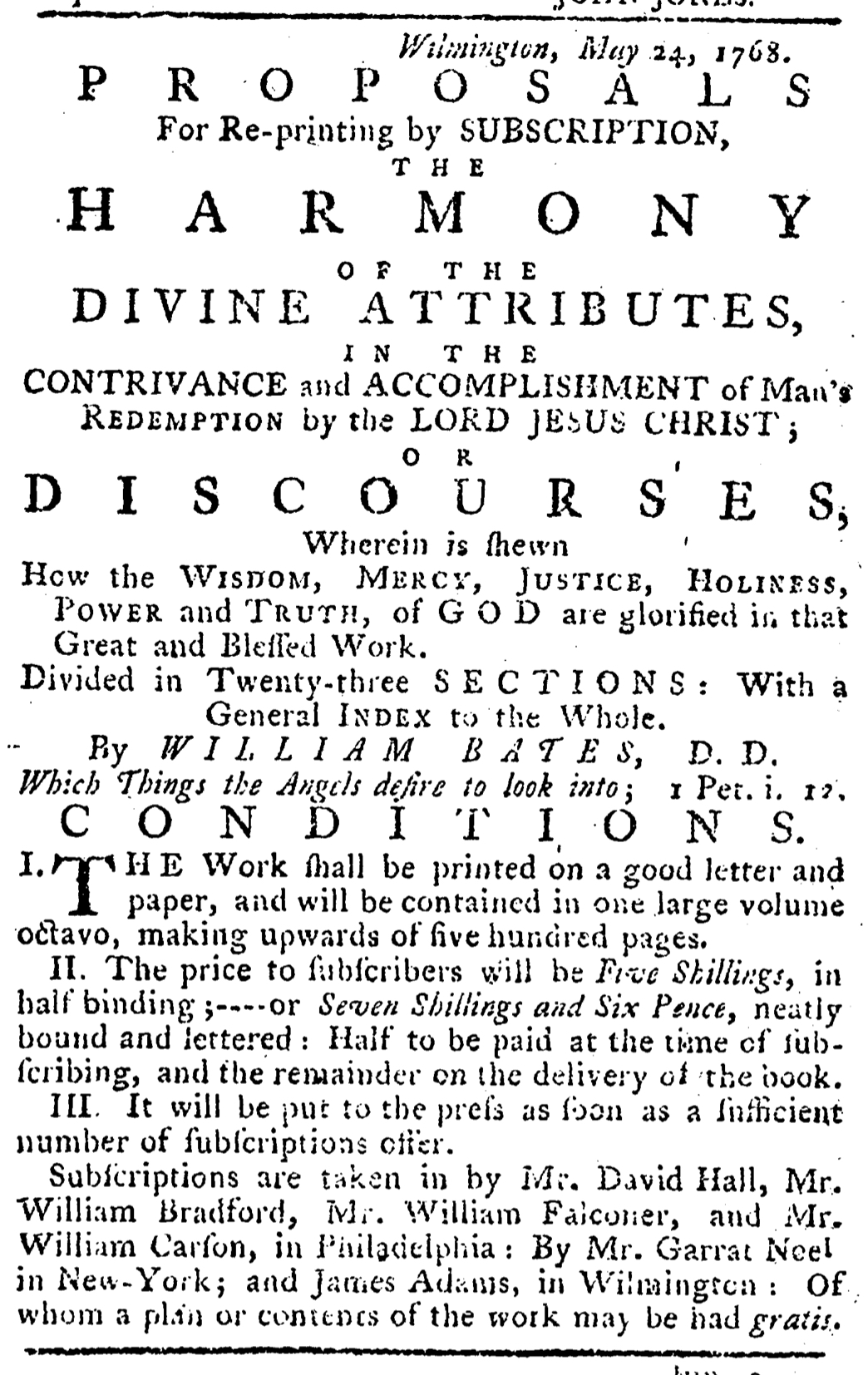
“PROPOSALS For Re-printing by SUBSCRIPTION.”

In the summer of 1768 James Adams, a printer in Wilmington, Delaware, advertised a product that was not yet available for sale, one that might not ever hit the market. He wished to reprint a book originally published in London, William Bates’s Harmony of the Divine Attributes in the Contrivance and Accomplishment of Man’s Redemption by the Lord Jesus Christ. Yet taking on this enterprise would be a significant investment for the printer, so he first sought to gauge interest and incite demand by issuing a subscription notice.

Printers throughout the colonies regularly distributed subscription notices before committing to publishing books. In them, they described the proposed publication, both the contents and the material aspects, and asked prospective customers interested in purchasing the book to become subscribers who paid a portion in advance and the remainder upon delivery. For instance, the extensive subtitle of Harmony of the Divine Attributes provided a general outline – “How the WISDOM, MERCY, JUSTICE, HOLINESS, POWER and TRUTH, of GOD are glorified in that Great and Blessed Work” – for the twenty-three sections of the book. Furthermore, it included an index to guide readers to specific topics. In terms of the material qualities of the book, Adams stated that it “shall be printed on a good letter and paper, and will be contained in one large volume octavo, making upwards of five hundred pages.” Adams invited potential subscribers to contact him for even more information, stating that “a plan or contents of the work may be had gratis.” The printer had generated additional marketing materials to supplement the subscription notices that appeared in newspapers.

Adams’s subscription notice was not the only one in the July 21, 1768, edition of the Pennsylvania Journal. Two others sought subscribers for John Thompson’s Explication of the Shorter Catechism and John Warden’s System of Revealed Religion. Each listed subscription agents in more than one town. In addition to accepting subscriptions in Wilmington, Adams had agents in two much larger cities, Philadelphia and New York. Not all subscription notices resulted in publications, but Adams’s reprint of Harmony of the Divine Attributes eventually went to the press in 1771. A variety of challenges may have slowed down the production process, but the amount of time that lapsed between Adams issuing his subscription notice and finally printing the book suggests that attracting sufficient subscribers was among those challenges. Distributing subscription notices helped the printer incite sufficient demand to publish an American edition of Harmony of the Divine Attributes, but those notices did not guarantee success. All the same, responses to the subscription notices provided valuable information about whether and when Adams should move forward with the proposed project.

May 27

What was advertised in a colonial American newspaper 250 years ago today?

May 27 - 5:27:1768 Connecticut Journal
Connecticut Journal (May 27, 1768).

“A few of the so much esteem’d FARMER’s Letters.”

Isaac Beers and Elias Beers sold a variety of goods at their shop in New Haven. In the spring of 1768 they enumerated many of their wares in an advertisement in the Connecticut Journal, listing textiles and adornments that ranged from “blue, bluegrey, and blossom colour’d German Serges” to “A very large Assortment of Buttons, Bindings, and all kind of Trimmings for Mens Cloathes” to “A genteel Assortment of the newest fashion’d Ribbons.” They stocked grocery items, including tea, cofeem and sugar, as well as “Pigtail Tobacco” and snuff.

Although they were not booksellers or stationers, the Beers included writing supplies and books among their inventory. Like other shopkeepers, they carried “Writing Paper” and wax wafers for making seals. They also sold bibles and spelling books as well as “A few of the so much esteem’d FARMER’s Letters.” (Although that portion of the advertisement has been damaged in the copy of the May 27, 1768, edition of the Connecticut Journal seen above, the same advertisement appeared the next week in an issue that has not been damaged.)

The Beers did not need to provide any further explanation for prospective customers to identify the pamphlet that contained all twelve of John Dickinson’s “Letters from a Farmer in Pennsylvania” previously printed and reprinted in newspapers throughout the colonies, starting in December 1767 and continuing into the spring of 1768. In these “Letters,” Dickinson, under the pseudonym of “A Farmer,” presented a dozen essays that explained how Parliament overstepped its authority in passing the Townshend Act and other measures that usurped the authority of colonial legislatures. He encouraged colonists to resist Parliament’s designs or risk even greater abuses.

Upon completion of the series, industrious printers in Boston, New York, and Philadelphia collected all twelve “Letters” in pamphlets. Printers and booksellers in several colonies advertised that they sold the “Letters,” but supplying the public with that pamphlet was not the province of the book trade alone. Shopkeepers like the Beers purchased “A few” copies to retail alongside general merchandise in their own shops, considering the “Letters” significant enough to merit particular mention in their advertisements. In so doing, they assisted in disseminating some of the arguments that eventually transformed resistance into a revolution. The choices they made as retailers and advertisers helped to shape the rhetoric of the Revolution.

May 10

What was advertised in a colonial American newspaper 250 years ago this week?

May 10 - 5:9:1768 South Carolina Gazette
South-Carolina Gazette (May 9, 1768).

“PROPOSALS For Publishing by SUBSCRIPTION, ALL THE ACTS and ORDINANCES.”

John Rutledge placed a particular sort of advertisement in the May 9, 1768, edition of the South-Carolina Gazette: a subscription notice for a proposed book that had not yet been printed. This was a common practice among printers and publishers in eighteenth-century America. It allowed them to promote a book in advance, yet also gauge interest to determine if publication would yield profits. Buyers made commitments in advance to purchase proposed books, becoming “subscribers” to the enterprise. Not all subscription notices yielded publications.

Rutledge proposed publishing the acts and ordinances passed by the “GENERAL ASSEMBLY of this Province.” In a separate subscription notice in the same issue, he also proposed publishing a related work consisting of statutes passed in Great Britain “Which are expressly made of Force in this Province, by ACTS of the GENERAL ASSEMBLY.” Publication of one, however, was not contingent on publication of the other.

To encourage as many subscribers as possible, Rutledge described several attractive aspects of the proposed book. In addition to the acts and ordinances, it would also include an index, marginal notes, and references to aid readers in navigating and understanding the contents. Rutledge also commented on the material aspects of the text, noting that it would be “printed on good Paper, with a fair new Type.”

The publisher also warned that interested readers needed to reserve their copy in advance rather than assume that they could purchase a surplus copy after the book went to press. “No more Copies will be printed,” he declared, “than shall be subscribed for by the first Day of November next, when the Subscriptions will be closed.” Furthermore, “if a sufficient Number be not then obtained, the Work will not be put to the Press.” Rutledge allowed six months for subscribers to commit to paying “Thirty Pounds Currency” for the proposed work, but it was an all-or-nothing proposition. He would not move forward unless he had enough subscribers and he would not print additional copies. Rutledge cultivated a sense of urgency by suggesting that prospective customers would miss out if they lacked the necessary resolution to subscribe promptly.

Rutledge advertised a product that did not yet exist. Doing so allowed him to assess the market as well as incite demand. The minimal cost for inserting subscription notices in the South-Carolina Gazette presented an alternative to publishing a book that ended up being a poor investment.