February 27

What was advertised in a revolutionary American newspaper 250 years ago today?
Pennsylvania Evening Post (February 27, 1776).

“BOTTLES wanted by ROBERT HARE and Co. at their Porter Brewery.”

During the first year of the Revolutionary War, Robert Hare and Company gained a following for “HARE’s best AMERICAN DRAUGHT PORTER.”  Hare, the son of an English brewer, arrived in Philadelphia in 1773.  He established a brewery, reportedly the first to produce porter in the colonies.  As the imperial crisis intensified and Americans leveraged their participation in the marketplace for political purpose, Hare’s porter became a popular alternative to imported beer.

Tavernkeepers, innkeepers, and others promoted Hare’s porter when they invited patrons to their establishments.  In the November 25, 1775, edition of the Pennsylvania Evening Post, for instance, William Dibley, the proprietor of the Fountain and White Horse Inn, announced that he would soon “open a TAP” of Hare’s porter and declared that he “has no doubt but that the sturdy friends of American freedom will afford due honor to this new and glorious manufacture.”  Not long after that, Patrick Meade invited the “TRUE FRIENDS to LIBERTY” to the Harp and Crown in Southwark, just outside of Philadelphia, to enjoy “HARE’s and Co. AMERICAN PORTER, which he will sell in its purity.”  Rather than offer a selection of beverages, he stated that he “intends no beer of any other kind shall enter his doors.”  As far as Meade was concerned, it was the only beer for the “Associators of Freedom.”  He hoped they would “give the encouragement to the American Porter it deserves.”  Joseph Price also served Hare’s porter “in the greatest purity and goodness” to “all the SONS of AMERICAN LIBERTY” at the “sign of the Bull and Dog” in Philadelphia.  Jeremiah Baker served Hare’s porter at the “sign of Noah’s Ark.”  Lewis Nicola opened an “AMERICAN PORTER HOUSE” where he no doubt served Hare’s porter.

With all that buzz for their beer, Hare and Company did not need to advertise in the public prints, at least not to gain customers.  They did, however, need supplies.  At the end of February 1776, the brewers placed an advertisement soliciting bottles “at their Porter Brewery.”  Readers could show their support for the American cause by drinking Hare’s porter, but that was not the only way.  They could also supply the brewery with bottles to aid in distributing the porter to even more consumers who wanted to drink beer produced in America rather than imported from England.

January 7

What was advertised in a revolutionary American newspaper 250 years ago this week?

Pennsylvania Evening Post (January 6, 1776).

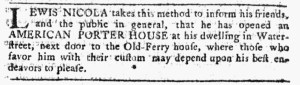
“He has opened an AMERICAN PORTER HOUSE.”

During the first week of 1776, Lewis Nicola took to the pages of the Pennsylvania Evening Post “to inform his friends, and the public in general, that he has opened an AMERICAN PORTER HOUSE at his dwelling in Water-street” in Philadelphia.  He promised that “those who favor him with their custom may depend upon his best endeavors to please.

Nicola assumed that readers knew who brewed the porter that he served at his establishment.  After all, “Mr. HARE’s best AMERICAN DRAUGHT PORTER” had been the subject of several advertisements that recently ran in the Pennsylvania Evening Post.  William Dibley served “this new and glorious manufacture” at the Fountain and White Horse Inn on Chestnut Street.  Joseph Price encouraged “all the SONS of AMERICAN LIBERTY” to drink “Messrs. HARE’s and Co. best DRAUGHT and BOTTLED AMERICAN PORTER” at his tavern “at the sign of the Bull and Dog” on Market Street.  Similarly, Patrick Meade offered “Messrs. HARE and Co. AMERICAN PORTER” to “the TRUE FRIENDS to LIBERTY” at the Harp and Crown in nearby Southwark.

Robert Hare, the son of an English brewer who specialized in porter, arrived in Philadelphia in 1773.  He established his own brewery where he brewed porter, “the first person to brew the drink in America.”  The timing worked well for Hare; he commenced brewing American porter as the imperial crisis intensified and the Revolutionary War began.  Colonizers looked to support local enterprises by purchasing “domestic manufactures” while they boycotted goods imported from England.  That positioned Hare’s brewery for success.

Just as significantly, consumers liked his porter (unlike some of the substitutes for imported tea that some colonizers concocted).  When John Adams attended the First Continental Congress in the fall of 1774, he lauded Hare’s porter in a letter to Abigail: “I drink no Cyder, but feast upon Phyladelphia Beer, and Porter.  A Gentleman, one Mr. Hare, has lately set up in this City a Manufactory of Porter, as good as any that comes from London.  I pray We may introduce it into the Massachusetts.  It agrees with me, infinitely better than Punch, Wine, or Cyder, or any other Spirituous Liquor.”  With Hare’s porter having such a reputation, Nicola did not need to mention the brewer when he opened his “AMERICAN PORTER HOUSE.”  The public knew the porter came from Hare’s brewery.

November 16

What was advertised in a colonial American newspaper 250 years ago today?

Pennsylvania Journal (November 16, 1774).

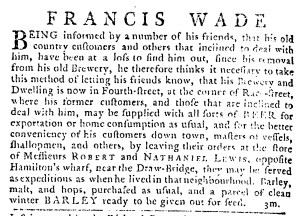
“For the better conveniency of his customers … leav[e] their orders at the store of Messieurs ROBERT and NATHANIEL LEWIS.”

Moving to a new location had caused some difficulty for Francis Wade, a brewer, prompting him to insert an advertisement in the Pennsylvania Journal in hopes of remedying the situation.  He formerly operated his brewery in the vicinity of “Hamilton’s Wharf, near the Draw-Bridge,” in Philadelphia, but in the fall of 1774 he could be found on Fourth Street “at the corner of Race-street.”  Wade reported that he had been “informed by a number of his friends,” likely including some of his former neighbors, “that his old country customers and other that inclined to deal with him, have been at a loss to find him out” since he moved.  Although many residents of the city knew about his new location, his “former customers” from the countryside did not have the same familiarity with the happenings in Philadelphia.  Since the Pennsylvania Journal circulated far beyond Philadelphia, Wade hoped that his notice would reach them and encourage them to seek him out on Fourth Street.

The brewer realized that his new location might not have been as convenient for some customers as his old one, so he used his advertisement as an opportunity to offer them an alternative.  Wade instructed “his customers down town, masters of vessels, shallopmen, and others” that they could place their orders at the store operated by Robert Lewis and Nathaniel Lewis.  When they did so, they could expect that they would “be served as expeditious as when he lived in that neighbourhood.”  Wade enlisted the aid of associates in his efforts to maintain and grow his client base, seeking to ameliorate an obstacle that he encountered following “his removal from his old Brewery.”  Working with the Lewises allowed him to maintain a presence in the vicinity of his former location.  Running newspaper advertisements made that presence visible to his “country customers” and other prospective customers.  Wade endeavored to sell “all sorts of BEER for exportation or home consumption as usual,” yet his move caused him to devise new methods of doing business that had not been part of his usual routine.

March 25

What was advertised in a colonial American newspaper 250 years ago this week?

Boston-Gazette (March 23, 1772).

“Elizabeth Coleman … Continues the Brewing-Business.”

Women who advertised that they provided goods and services usually fell into one of several occupational groups. Female shopkeepers promoted a variety of imported goods, especially textiles and accessories for making clothing. Milliners and seamstresses advertised the hats and garments they made for clients.  Schoolmistresses invited prospective students and their parents to lessons that included reading, writing, and sewing.

On occasion, however, women who pursued other occupations ran advertisements in the public prints.  Elizabeth Coleman, for instance, informed the public that she “Continues the Brewing-Business” in a notice that ran in the March 23, 1772, edition of the Boston-Gazette.  She pledged to “serve with Dispatch, the best of double and single Malt and Spruce Beer in as large or small quantities as is wanted.”  No order was too large or too small for Coleman!  Furthermore, she set prices “at as reasonable Rate as good Beer can be afforded.”

Although Coleman operated a “Brewing-Business,” she may have been the proprietor and employer rather a brewer herself.  She indicated that she “now employed a Person brought up to the Business.”  Perhaps that employee’s knowledge, skill, and experience supplemented her own, expanding the number of brewers affiliated with Coleman’s business.  Perhaps as a woman in a predominantly male occupation she sought to downplay her own contributions as brewer in favor by giving credit to an employee “brought up to the Business,” believing that strategy would attract more customers.

Whatever the extent of Coleman’s active participation as a brewer, she was an entrepreneur who ran her own business and sought visibility for it in the public prints.  In addition to selling beers produced by her “Brewing-Business,” she also marketed “the best of Philadelphia and Baltimore Beer” imported from other colonial ports.  Her customers could choose from among a selection of beers to suit their tastes and budgets.  They could even enjoy their beverages, perhaps with some food, at Coleman’s establishment.  She declared that she “keeps good Entertainment for Man and Horses.”  In addition to retailing beer, she ran a tavern with access to a stable as part of her larger operation.  That made her as industrious an entrepreneur as any of the male merchants, shopkeepers, and artisans who also placed advertisements in the Boston-Gazette.

March 2

What was advertised in a colonial American newspaper 250 years ago today?

New-York Gazette and Weekly Mercury (March 2, 1772).

“NEW-YORK BEER.”

Benjamin Williams, a brewer, touted his skill and experience when he placed an advertisement in the March 2, 1772, edition of the New-York Gazette and Weekly Mercury.  He invited both “Gentlemen in Town” and “Captains of Vessels” to purchase beer at his “Store-Cellar, upon HUNTER’S-QUAY.”  To convince them to choose his beer over others, Williams informed the public that through “great Experience and Application, in Brewing, Managing, and Bottling NEW-YORK BEER” he “brought it to that Perfection, which, with Pleasure, he can boast superior to any Attempt of the Kind in this, or in any other Colony on the Continent of North-America.”  That was a bold claim!  Today, brewers continue to promote the quality of their products and, in many instances, the years of experience and tradition associated with their breweries. When they do so, they echo marketing strategies already deployed by brewers during the era of the American Revolution.

Williams encouraged local consumption of his “NEW-YORK BEER,” informing “Gentlemen in Town” that they could acquire it for ten shillings for a dozen bottles.  If they returned the bottles, consumers enjoyed a discount of three shillings.  The brewer also sought customers among “Captains of Vessels” headed to ports in other places, including the Caribbean.  He assured them that “Repeated Trials have prov’d” that his beer “will stand the West Indies” rather than go bad during transport.  Here again, Williams’s “great Experience and Application” played a role in marketing his product to prospective customers.  He also promoted another product, “Fine Cyder, of a peculiar Quality and Flavour,” for consumers interested in beverages beyond beer.  In the 1770s, he diversified his line of products in much the same way that many breweries have recently done by offering ciders and, especially, seltzers and other flavor-infused malt beverages.  Both Williams and his modern counterparts hoped that familiarity with the quality and reputation of one beverage would lead to purchasing others from the same brewer.

June 4

What was advertised in a colonial American newspaper 250 years ago this week?

Jun 4 - 6:1:1769 South-Carolina Gazette
South-Carolina Gazette (June 1, 1769).

“BREW-HOUSE.”

John Calvert and Company placed a brief advertisement in the June 1, 1769, edition of the South-Carolina Gazette to advise readers that they sold “ALE, TABLE and SHIP BEER.” The partners also offered a convenient service for their customers: delivery to “any part of the town,” provided that the buyer purchased at least five gallons.

Decorative typography, however, rather than the copy accounted for the most notable part of Calvert and Company’s advertisement. Like some other advertisers, they included a headline to draw attention: “BREW-HOUSE.” Unlike other advertisers, they arranged for a decorative border to enclose the headline, distinguishing the advertisement from almost every other in the South-Carolina Gazette. One other notice did feature a similar layout, an advertisement for the “Sloop MONTAGU” to be sold at public auction. Its headline announced “SALE by the Provost-Marshal,” also enclosed in decorative type.

The South-Carolina Gazette frequently featured such advertisements for goods, property, or enslaved men, women, and children seized by the provost marshal and to be sold to settle debts or resolve other legal disputes. Such notices benefited from the unique format, the headline in the decorative border, but other advertisements for goods and services placed by merchants, shopkeepers, artisans, and others did not incorporate such distinctive typography. Although the compositor could have made the decision independently, this suggests that Calvert and Company negotiated for that particular element of their advertisement, realizing that the headline and border would make it more visible among the advertisements that filled the final pages of the South-Carolina Gazette. Alternately, the partners could have commissioned a woodcut to spruce up their advertisement, but that likely would have incurred greater expense compared to utilizing decorative type the printer already had in hand.

In general, advertisers generated copy for newspaper notices in eighteenth-century America, but printers and compositors made decisions about graphic design. Calvert and Company’s notice suggests that advertisers sometimes observed distinctive design elements that they wished to incorporate into their own advertisements. Some likely suspected that distinctive visual elements made advertisements more effective and yielded a greater return on their investment, prompting them to borrow styles that they regularly encountered when they perused the newspapers.

October 9

What was advertised in a colonial American newspaper 250 years ago this week?

Oct 9 - 10:6:1768 Boston Weekly News-Letter
Boston Weekly News-Letter (October 6, 1768).

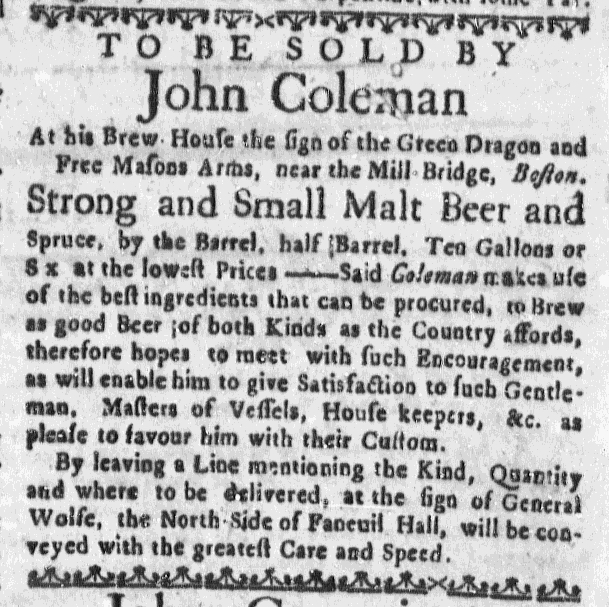
“Strong and Small Malt Beer and Spruce, by the Barrel.”

In the fall of 1768 John Coleman advertised the several varieties of beer he sold at “his Brew House [at] the sign of the Green Dragon and Free Masons Arms, near the Mill Bridge” in Boston. He advised “Gentlem[e]n, Masters of Vessels, House keepers” and others that he brewed spruce beer and two sorts of malt beer, strong and small. His spruce beer may or may not have contained alcohol. Many consumers, including “Masters of Vessels,” purchased it as a means of warding off scurvy. His small beer contained less alcohol than strong beer. A safer alternative to water, some customers likely served small beer to children, servants, and other members of their households. Coleman marketed his beers in several quantities – “by the Barrel, half Barrel, Ten Gallons or Six” – and allowed his customers to choose according to their needs.

The brewer made many of the most common appeals that appeared in advertisements throughout the eighteenth century. He made an appeal to price, stating that he sold his beer “at the lowest Prices.” He also made an appeal to quality, stating that he brewed “as good Beer of both Kinds as the Country affords.” His beer was equal to any other produced in the colonies. In another regard, however, Coleman deviated from the marketing strategies deployed in most other advertisements of the era. For the convenience of his customers, he provided delivery service. He concluded with these instructions: “By leaving a Line mentioning the Kind, Quantity and where to be delivered” customers will have their beer “conveyed with the greatest Care and Speed.” Coleman provided an alternate address for placing such orders, “the sign of General Wolfe, the North Side of Faneuil Hall” rather than at “his Brew House.” Presumably customers could have also submitted orders at the latter as well; the additional location compounded the conveniences offered to them.

Coleman had previously advertised in the Boston Weekly News-Letter.   Just two months earlier he announced that his former partner, Benjamin Leigh, was so busy with his new enterprise running an “Intelligence Office” that Coleman now operated the brewery on his own. He called on prior customers to settle accounts and briefly mentioned the price of a barrel of beer. In this subsequent advertisement, however, he incorporated several new appeals intended to market his beer more effectively. Having assumed sole responsibility for the business, he may have determined that attracting customers demanded greater innovation.

May 26

What was advertised in a colonial American newspaper 250 years ago today?

May 26 - 5:26:1768 New-York Journal
New-York Journal (May 26, 1768).

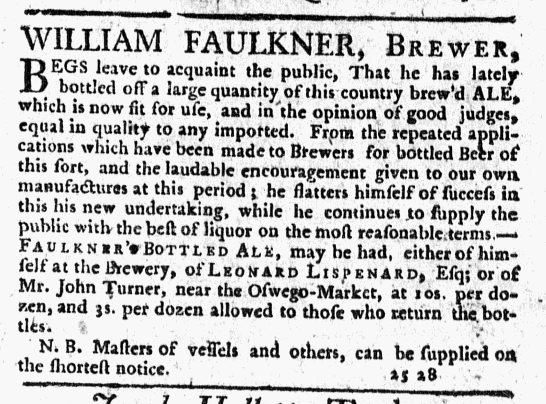
“FAULKNER’S BOTTLED ALE.”

William Faulkner, a brewer, incorporated several marketing strategies into the advertisement he placed in the May 26, 1768, edition of the New-York Journal. Like other colonists who peddled goods and services, he made appeals to price and quality. However, he did not merely resort to the formulaic language that appeared in countless newspaper advertisements. Instead, he offered additional commentary to convince prospective customers to purchase his product.

Faulkner could have simply stated that “he continues to supply the public with the best of liquor on the most reasonable terms.” Such appeals to price and quality, however, were not sufficient for promoting his “country brew’d ALE” that was only recently ready for the marketplace. Not only was his ale “now fit for use,” but “in the opinion of good judges, equal in quality to any imported.” Faulkner did not reveal the identities of these “good judges,” but he did suggest to potential customers that others had indeed endorsed his product. For those still skeptical, he advanced another strategy for encouraging them to take a chance on his “country brew’d ALE.” He stated that the public had already expressed desire “for bottled Beer of this sort” and then invoked “the laudable encouragement given to our own manufactures at this period.” Faulkner did not rehearse the ongoing dispute between Parliament and the colonies. He did not need to do so. Prospective customers were already well aware of the Townshend Act that went into effect six months earlier as well as the calls for increased production and consumption of goods in the colonies as a means of decreasing dependence on imports. With a single turn of phrase, Faulkner imbued purchasing his ale with political meaning.

He also offered a discount of sorts to return customers, pricing his ale at “10s. per dozen” but noting “3s. per dozen allowed to those who return the bottles.” In other words, customers who brought back their empty bottles paid only seven shillings for a dozen full bottles. Faulkner kept his own production costs down through this design. Of the many choices available to them, the brewer encouraged colonists to enjoy “FAULKNER’S BOTTLED ALE” over any alternatives, especially imported ales. He offered assurances about quality in addition to providing pricing and political considerations to persuade consumers to choose his ale.

May 19

What was advertised in a colonial American newspaper 250 years ago today?

May 19 - 5:19:1768 Pennsylvania Gazette
Pennsylvania Gazette (May 19, 1768).

“The Cork of each Bottle will be stamped.”

Timothy Matlack promoted his “Philadelphia brewed BOTTLED BEER” in an advertisement in the May 19, 1768, edition of the Pennsylvania Gazette. The brewer encouraged “Masters of Vessels, and others” to purchase his beer, describing it as “remarkably pale, and very good.” His advertisement also revealed that he engaged in a practice that amounted to branding his beer, marking his product in such a way that made it easy for consumers to recognize and associate it with a particular brewer. He informed prospective customers that “[t]he Cork of each Bottle will be stamped” with his name and an abbreviation for Philadelphia.

Matlack had been marking the corks that stoppered bottles containing his beer for quite some time. Two years earlier, in an advertisement in the Pennsylvania Journal, he reported that his beer “will be stamped on the cork with black letters.” (For more biographical information about Matlack, including his famous connection to the Declaration of Independence, see the entry that examined that previous advertisement.) His advertisement in the Pennsylvania Gazette, however, featured an innovation. With increased attention to typography, this advertisement more accurately depicted the likely appearance of the stamp. It arranged the three words that identified the beer on three lines, centering them just as they would appear on the cork:

TIM

MATLACK

PHILAD.

No matter where throughout the Atlantic world “Masters of Vessels” happened to transport Matlack’s beer, those who consumed it would always be able to identify its origins and its brewer. Matack planned ahead in anticipation that those who drank his beer would appreciate its taste or quality, especially after being stored and shipped long distances. He made sure they encountered tangible reminders of where to obtain more the next time they needed to provision their ships or make purchases for other sorts of consumption. While he certainly did not achieve the name recognition associated with modern breweries, Matlack made efforts – in print and on the packaging of his product – to induce customers to associate his name with a beverage that might otherwise have seemed generic.

April 26

Who was the subject of an advertisement in a colonial American newspaper 250 years ago this week?

Apr 26 - 4:23:1767 Massachusetts Gazette
Massachusetts Gazette (April 23, 1767).

“Will also sell … a Negro Man that understands Brewing and Distilling.”

As he prepared to leave Boston for Nova Scotia, Robert Whatley had the eighteenth-century version of a moving sale. He scheduled a “Public Vendue” (or auction) to sell many of his personal belongings, including beds, tables, chairs, and even a “fine large Canoe with Sails.” Whatley, a brewer by trade, also wished to sell his equipment, including “a Copper Boiler with a brass Cock to it, fit for a Coffee-House or Tavern” and his “Brewing Utensils with all Things necessary for that Business.”

In addition to his household furniture and the tools of his trade, Whatley also offered to sell “a Negro Man that understand Brewing and Distilling.” The Adverts 250 Project recently examined an advertisement that included enslaved artisans, including carpenters and coopers, exploited for their expertise and specialized skills in addition to their labor. Whatley’s advertisement further demonstrates the range of occupations and crafts enslaved men and women pursued in the colonial and Revolutionary eras.

Both the copy and the layout of Whatley’s notice suggest that colonists would not have considered it in any way extraordinary that “a Negro Man that understands Brewing and Distilling” played a role in operating the business. Readers who skimmed the advertisements in the Massachusetts Gazette might even have missed the portion of Whatley’s advertisement that mentioned the enslaved brewer; that sentence was nestled in the middle of two dense paragraphs. In some respects, Whatley’s attempt to sell his slave was hidden in plain sight. It was part of his advertisement, but not its main purpose.

As my students and I have pursued the Slavery Adverts 250 Project for the past seven months, the frequency of advertisements like this one has been a striking feature. We expected to encounter advertisements exclusively devoted to slavery, especially those that offered one or more slaves for sale and others concerning runaway slaves. We have been a bit more surprised by how often slaves for sale incidentally appeared in advertisements, listed alongside consumer goods and real estate. The practice of slavery – the presence of slavery in everyday life and commerce – pervaded early American print culture, especially advertising, more subtly and to a much greater extent than we initially expected.