What was advertised in a revolutionary American newspaper 250 years ago today?
“Rendering due praise and honour to the manly and virtuous supporters of the GLORIOUS CAUSE OF AMERICA.”
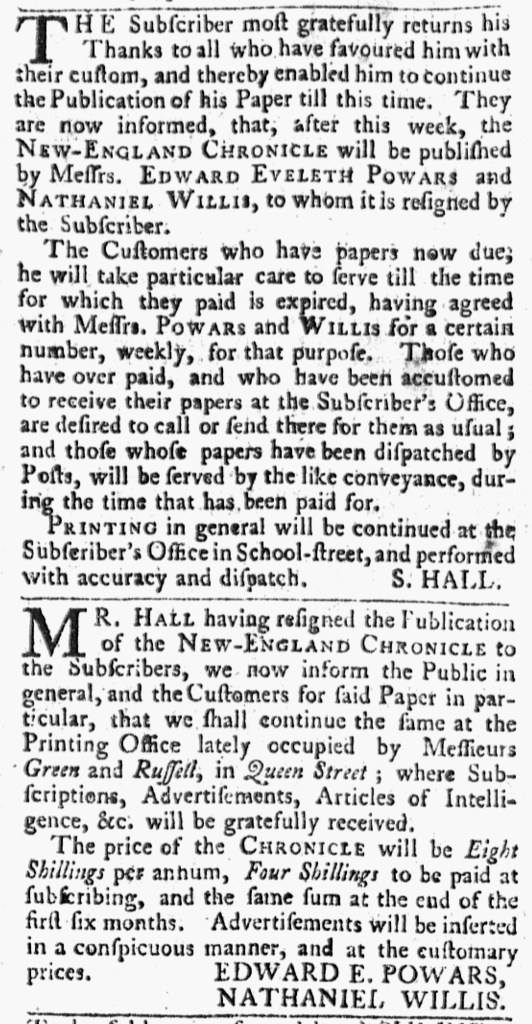
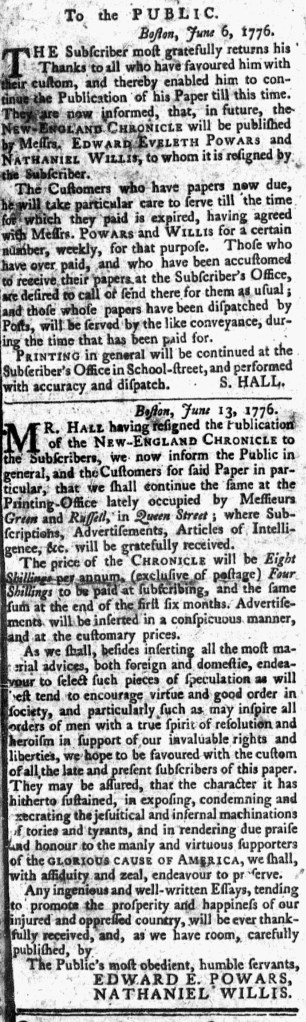
It was the first issue of the New-England Chronicle published by Edward E. Powars and Nathaniel Willis after Samuel Hall transferred the newspaper to them. Their names appeared in the colophon integrated into the masthead at the top of the first page: “BOSTON: Printed by POWARS and WILLIS at their Office opposite the new COURT-HOUSE, Queen-Street.” For the first order of business in the June 13, 1776, edition, the former printer and the new printers reminded readers about the transition in notices that ran in the first column on the first page. They previously made the announcement in separate advertisements in the last issue. Hall’s notice ran again without revisions or additions (except for a salutation, “To the PUBLIC,” and the original date, “Boston, June 6, 1776”) while Powars and Willis took the opportunity to add to their previous advertisement.
In so doing, they vowed to continue the editorial stance practiced by Hall. The public, Powars and Willis promised, “may be assured, that the character [the New-England Chronicle] has hitherto sustained, in exposing, condemning, and execrating the jesuitical and infernal machinations of tories and tyrants, and in rendering due praise and honour to the manly and virtuous supporters of the GLORIOUS CAUSE OF AMERICA, we shall, with assiduity and zeal, endeavour to preserve.” The New-England Chronicle catered to Patriots in Boston less than two months after the siege of that city ended when British troops departed on March 17. Powars and Willis took their responsibilities seriously, stating that they would “select such pieces … as will best tend to encourage virtue and good order in society, and particularly such as may inspire all orders of men with a true spirit of resolution and heroism in support of our invaluable rights and liberties.” With such promises made, they hoped “to be favoured with the custom of all the late and present subscribers of this paper.” In other words, they encouraged readers who previously subscribed to renew their subscriptions and current subscribers to continue receiving the New-England Chronicle. Their previous notice solicited subscribers and advertisers. That portion appeared again, but this time the printers also requested “ingenious and well-written Essays, tending to promote the posterity and happiness of our injured and oppressed country.” Through an eighteenth-century version of crowdsourcing, the public could play a role in maintaining the editorial voice that readers expected from the New-England Chronicle. The publication had new printers, but those new proprietors pledged that the newspaper would remain the same.