December 28

What was advertised in a revolutionary American newspaper 250 years ago today?
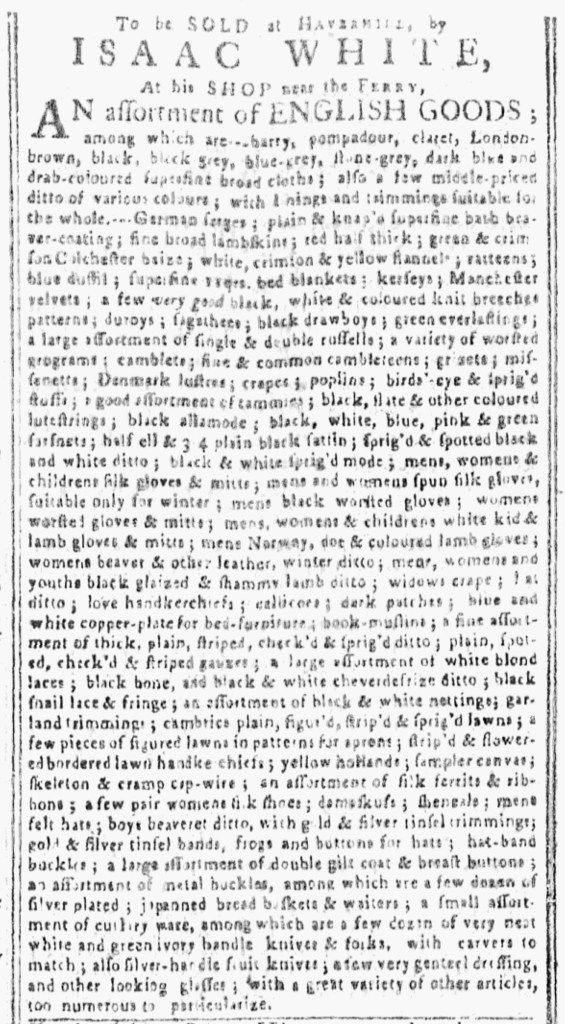
New-England Chronicle (December 28, 1775).

“AN assortment of ENGLISH GOODS … too numerous to particularize.”

Isaac White placed an advertisement for an “assortment of ENGLISH GOODS” available at “his SHOP near the FERRY” in Haverhill, Massachusetts, in the December 28, 1775, edition of the New-England Chronicle.  Despite the outbreak of hostilities at Lexington and Concord eight months earlier and the Continental Association remaining in effect, his advertisement looked much like those that so frequently appeared in American newspapers at times when colonizers did not attempt to use nonimportation agreements as political leverage in their contest with Parliament.  White listed dozens of items, including many varieties and colors of textiles, ribbons, “a large assortment of double gilt coat & breast buttons,” “a few very genteel dressing, and other looking glasses,” and “a small assortment of cutlery ware, among which are a few dozen of very neat white and green ivory handle knives & forks, with carvers to match.”  As if that was not enough, White concluded his catalog with a promise of “a great variety of other articles, too numerous to particularize.”

The shopkeeper did not mention when he acquired his merchandise, whether all those items arrived in the colonies before the Continental Association went into effect, yet he did rely on a familiar marketing strategy by presenting readers with an array of choices and inviting them to imagine themselves visiting his shop, examining his inventory, selecting the goods they desired, and displaying their style and taste to others after they made their purchases.  Consumption certainly had political dimensions during the imperial crisis, but even after the Revolutionary War began habits that had developed (and that advertisers like White had helped in cultivating) did not easily fade.  In the same issue of the New-England Chronicle, Martin Bicker ran an advertisement about a “fresh supply” of “ENGLISH GOODS … just received from New-York and Philadelphia … now selling off at his store in Cambridge.”  Though not as extensive as White’s notice, Bicker’s advertisement listed several kinds of textiles and handkerchiefs.  It concluded with “&c. &c. &c.”  Repeating the common abbreviation for et cetera made the same promise of even more items as White’s assertions about “a great variety of other articles, too numerous to particularize.”  In addition, Bicker declared, “Those that intend to purchase must speedily apply, otherwise they will be disappointed.”  He expected to do brisk business.

That colonizers continued consuming during the Revolutionary War does not necessarily merit attention.  After all, people needed goods.  Then as now, warfare disrupted commerce but did not eliminate it.  Yet the advertisements placed by White and Bicker did not suggest that they served customers who merely sought to purchase necessities.  Instead, they continued to cater to the desires of consumers who continued to shop for many of the reasons they did before the war began.  Some may have had a new purpose, seeking distractions from current events.  How readers responded, these advertisements do not reveal, yet they do indicate that White and Bicker saw opportunities for business as usual.

April 5

What was advertised in a colonial American newspaper 250 years ago today?

Pennsylvania Journal (April 5, 1775).

“JOHN MITCHELL’s WINE, SPIRIT, RUM, and SUGAR STORES.”

John Mitchell operated an alcohol emporium in Philadelphia in the 1770s.  In April 1775, he advertised his “WINE SPIRIT, RUM, and SUGAR STORES” on Front Street, inviting customers in the city and its hinterland to purchase his wares and then retail them at their shops or taverns or enjoy imbibing them at home.  To entice prospective customers, he compiled a lengthy list of his current selection along with a pledge to “keep a constant supply of the above Articles” to avoid disappointments associated with selling out of any favorites.

His inventory included, for instance, “BEST Genuine Madeira Wines,” “Excellent bottled Claret,” “Genuine new and old Port Wine,” “Teneriffe and Fyal Wines,” “Red Lisbon Wine,” “Genuine old French Brandy,” “Shone’s, Ben. Kenton and Parker’s best London bottled Porter,” “Genuine Button and Taunton Ale,” and “West-India and New-England Rum,” along with many other choices.  For many items, Mitchell listed several sizes, indicating that customers could purchase the right amount for their home or business.  He sold Madeira by the gallon or in barrels of various sizes, including “by the pipe, hogshead, [and] quarter-cask.”  The bottled porters came “by the hogshead, hamper or dozen” to meet the budget and the convenience of his customers.

The format of Mitchell’s advertisement highlighted the choices.  Rather than list his wines and spirits in a dense paragraph, as many advertisers did when they sought to demonstrate the selection of goods they offered to consumers, Mitchell devoted one line to each item.  That made it easier for readers to peruse his catalog while also creating visual elements that differentiated his advertisement from news items and other notices that consisted of blocks of text justified on both the left and the right.  The variations in white space that resulted from centering each item on its own line made “Best Genuine Madeira Wines,” “Teneriffe and Fyal Wines,” “Genuine old French Brandy,” and “Spanish Brandy” even more visible within the advertisement.  Both the extensive accounting of wines and spirits and the design of Mitchell’s notice contributed to attracting the attention of prospective customers.

March 21

What was advertised in a colonial American newspaper 250 years ago today?

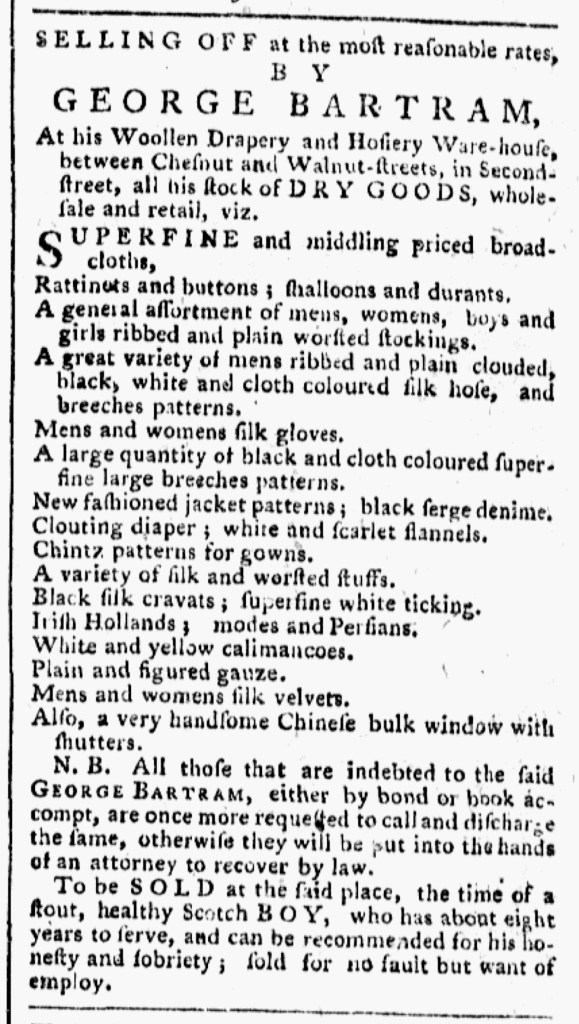
Pennsylvania Evening Post (March 21, 1775).

“Being resolved to decline his Retail Trade … he will sell his Stock of Goods on Hand at the very lowest Rates.”

George Bartram had been in business “At the Sign of the GOLDEN FLEECE’s HEAD” in Philadelphia for several years by the time he placed an advertisement in the March 21, 1775, edition of the Pennsylvania Evening Post.  He sometimes called his establishment the Woollen-Drapery and Hosiery WAREHOUSE and used visual elements to enhance his advertisements.  For instance, a decorative border enclosed the name of his business in some advertisements while others featured a woodcut that depicted that golden fleece’s head.  Earlier in his career, he kept shop “at the Sign of the Naked Boy.”  An even more elaborate woodcut replicated that sign with a naked boy holding a yard of cloth in a cartouche in the center, flanked by rolls of fabric on either side and the proprietor’s name below them.  Bartram was still using the golden fleece’s head woodcut to adorn his advertisements in Dunlap’s Pennsylvania Packet in March 1775, but he did not have a second one to use in the Pennsylvania Evening Post.

Instead, he relied on advertising copy in making his pitch to prospective customers.  As he had often done in previous newspaper notices, Bartram emphasized the array of choices he made available to consumers, promoting a “large and fresh Assortment of MERCHANDIZE.”  To demonstrate that was the case, he inserted a lengthy list of goods, such as “Broadcloaths, of the neatest and most fashionable Colours, with suitable Trimmings,” “beautiful buff and white Hair Shags,” “rich black Paduasoys and Satins,” and “handsome Silk and Worsted Stuff for Womens Gowns.”  His intended for those evocative descriptions to entice readers.  He played to both taste and imagination by making choice a theme throughout his catalog of merchandise: “Handkerchiefs of all Sorts,” “a Variety of Cambricks suitable for Gentlemen’s Ruffles and Stocks,” “a large Assortment of brown and white Russia Sheetings and Hessians,” “an elegant Assortment of the best Moreens,” “a Quantity of the best Rugs,” and “a large Assortment of Hosiery.”

In a final nota bene, Bartram announced that customers could acquire his wares at bargain prices because he was going out of business.  He “resolved to decline his Retail trade” and “assures his Friends and the Public that he will sell his Stock of Goods on Hand at the very lowest Rates.”  He also offered a discount “to those who purchase a Quantity,” hoping that would offer additional encouragement for prospective customers.  Bartram did not indicate why he was closing his business, though the Continental Association, a nonimportation agreement adopted throughout the colonies, may have presented an opportunity to liquidate his merchandise and get rid of items that had lingered on the shelves in his Woollen Drapery and Hosiery Warehouse.  Bartram was “SELLING OFF” his inventory, offering good deals on absolutely everything.

November 12

What was advertised in a colonial American newspaper 250 years ago today?

Providence Gazette (November 12, 1774).

“He pretends not to say that no one can sell so cheap, but believes no one will.”

According to his advertisement in the November 12, 1774, edition of the Providence Gazette, Amos Throop stocked a variety of popular patent medicines, including Hooper’s Pills, Stoughton’s Elixir, Bateman’s Drops, Godfrey’s Cordial, James’s Fever Powder, Turlington’s Balsam of Life, and Hill’s Balsam of Honey “for coughs and consumptions.”  He also sold a variety of medical supplies for both physicians, apothecaries, and home use, such as “pocket cases of surgeons instruments,” “a pretty assortment of bell-metal and glass mortars,” and “beautiful smelling bottles of various figures.”

Throop’s advertisement did not list every item that he recently imported from London.  Like other retailers often did, he promised that prospective customers would discover much more merchandise upon visiting his shop.  “Many more articles might be enumerated,” he proclaimed, “but suffice to say, that a more general assortment never was imported.”  Not only did he offer an array of choices, but the selection was supposedly unrivaled in Providence or anywhere else in the colonies.

In case that was not enough to get the attention of prospective customers, Throop also promoted his prices.  He initially referred to them as “very cheap indeed,” but then elaborated on that point.  Readers would not find more choices elsewhere, “nor can any reasonable objection be made to the prices.  He pretends not to say that no one can sell so cheap, but believes no one will.”  In making that declaration, he invited readers to consider the choices made by purveyors of goods when they set prices for their wares.  Throop claimed that he was not in any sort of special position to offer such bargains.  Anyone else in his line of business could have done the same, but he did not suspect that anyone would.  Throop deliberately chose to sell his merchandise “very cheap indeed.”  Physicians, apothecaries, and other consumers, he suggested, should reward that choice by choosing to buy their patent medicines and medical supplies from him rather than any of his competitors.

February 15

What was advertised in a colonial American newspaper 250 years ago today?

Essex Gazette (February 15, 1774).

“He will sell … at so cheap as Rate as he doubts not will give Satisfaction to every Purchaser.”

George Deblois regularly advertised in the Essex Gazette.  On February 15, 1774, he placed a lengthy notice to promote a “fine Assortment of ENGLISH and HARD-WARE GOODS” that he “just received … from LONDON.”  He asserted that these items were “Suitable for the approaching Season,” encouraging consumers to purchase in advance or at least keep his shop in Salem in mind when they were ready to shop for in the coming weeks and months.  A catalog of his merchandise, divided into two paragraphs, accounted for most of the advertisement.  The first paragraph listed the “ENGLISH” goods, mostly textiles and accessories.  Deblois stocked “Scotch Plaids,” “Devonshire Kersies,” “stampt linen Handkerchiefs,” “a fine assortment of men’s worsted Stockings,” and “Hatter’s Trimmings of all sorts.”  He devoted the other paragraph to housewares and hardware, including the “best of London pewter Dishes,” “hardmetal Tea-Pots,” “steel and iron plate Saws of all sorts and sizes,” and “Brads, Tacks and Nails of all sorts.”

The merchant concluded his advertisement with two common appeals, one about consumer choice and the other about his prices.  The lengthy lists of goods already demonstrated the many choices available to his customers, but he insisted that he also stocked “a great Variety of other Articles, too tedious to enumerate in an Advertisement.”  Readers would have to visit his store to discover what else they might want or need that happened to be on his shelves.  No matter what they selected, his customers could depend on paying low prices.  Deblois declared that “he will sell by Wholesale and Retail … at so cheap a Rate as he doubts not will give Satisfaction to every Purchaser.”  Other advertisers frequently made a nod to low prices.  Elsewhere in the same issue of the Essex Gazette, for instance, John Appleton offered his wares “very cheap.”  Deblois embellished his appeal about prices, hoping to draw the attention of prospective customers and convince them that he offered the best deals.  They would depart his store not only pleased with the goods they acquired but also with a sense of “Satisfaction” about how much they paid.  Deblois encouraged consumers to visit his shop by setting favorable expectations for their shopping experiences.

February 12

What was advertised in a colonial American newspaper 250 years ago today?

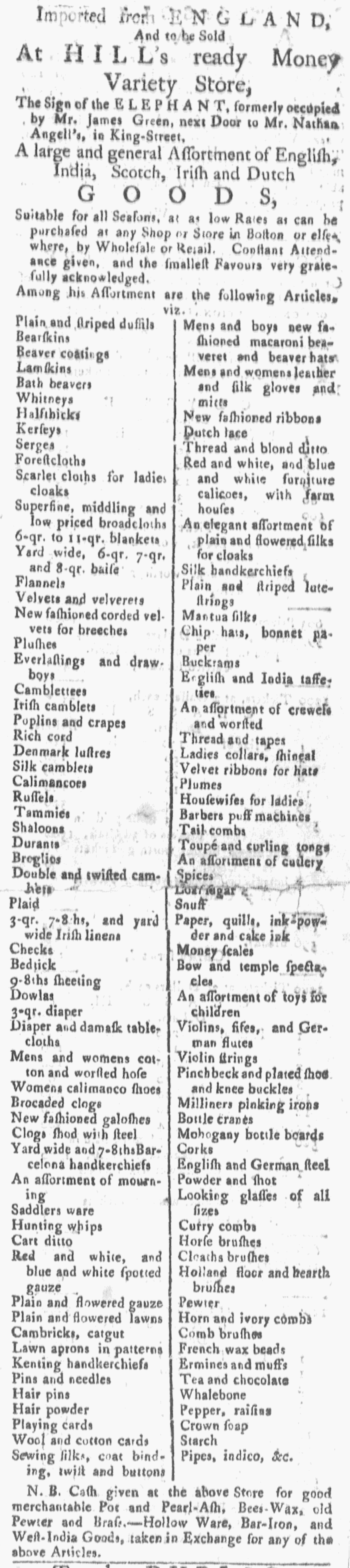
Providence Gazette (February 12, 1774).

“As low Rates as can be purchased at any Shop or Store in Boston or elsewhere.”

When the proprietor of “HILL’s Variety Store” took to the pages of the Providence Gazette near the end of January 1774, his advertisement promoted a “compleat Assortment of English, Scotch and India Goods,” listed about a dozen items, and promised “every other Article usually imported, too many to be enumerated in this Week’s Paper.”  That final note suggested that either the printer had truncated the advertisement due to space constraints or the advertiser had not yet compiled a more complete inventory to insert in the public prints.  It may very well have been the latter, considering that three weeks passed before a more extensive advertisement appeared in the Providence Gazette.

And more extensive it certainly was!  That advertisement filled nearly an entire column in the February 12 edition.  The merchant devoted most of that space to a catalog of “English, India, Scotch, Irish and Dutch GOODS,” demonstrating the range of choices available to consumers.  Divided into two columns with only one item per line, making it easier for readers to navigate than the dense paragraphs of text in some advertisements, this notice included many kinds of textiles and accessories, “Womens calamanco shoes,” “Mens and boys new fashioned macaroni beaveret and beaver hats,” “Mens and womens leather and silk gloves and mitts,” “Pinchbeck and plated shoe and knee buckles,” “Violins, fifes, and German flutes,” and even an “assortment of toys for children.”  Prospective customers could expect to discover much more at “HILL’s ready Money and Variety Store.”  (The variation on the name suggested that they would need to pay at the time of sale rather than purchase on credit, but a note at the end of the advertisements indicated “Hollow Ware, Bar-Iron, and West-India Goods, taken in Exchange for any of the above Articles.”)  The list of goods began with a clarification that “Among his Assortment are the following Articles,” while the catalog concluded with “&c.” (an abbreviation for et cetera) to signal that even more was available at the store.

Yet such appeals to consumer choice were not the only marketing strategies deployed by the merchant.  A preamble to his inventory reported that he sold his goods both wholesale and retail “at as low Rates as can be purchased at any Shop or Store in Boston or elsewhere.”  He realized that he did not compete solely with local merchants and shopkeepers but also with their counterparts in Boston, Newport, New York, and other towns.  He did not want shopkeepers in the countryside turning to importers in other ports to supply their inventory.  Such wholesale purchases could amount to significant revenue.  At the same time, he did not ignore consumers interested in retail purchases.  The merchant stated that “the smallest Favours” or purchases would be “gratefully acknowledged.”  Between the selection and the prices, he hoped prospective customers would come to the “Sign of the ELEPHANT” in King Street to acquire goods they needed to supplement inventories at their own shops or that they wanted for their own use.

December 31

What was advertised in a colonial American newspaper 250 years ago today?

Connecticut Gazette (December 31, 1773).

“Clocks and Watches repaired … as well and cheap as in New-York or Boston.”

John Champlin, a goldsmith and jeweler, ran a shop in New London in the early 1770s.  He occasionally placed advertisements in the Connecticut Gazette to promote the goods and services that he provided.  For instance, as 1773 came to a close, he advised the public that he stocked a “good Assortment of cypher’d and brilliant Ear-ring & Button Stones, Locket Stones, Ring Stones of all Kinds,” “Wires of all Kinds, a neat Assortment of Files,” “Materials for repairing Clocks and Watches,” “best plated Shoe and Knee Buckles,” and “many other Articles.”  Like others advertisers, he intended that a list demonstrating the many choices he offered would entice consumers to visit his shop.

Champlin deployed other marketing strategies as well.  He made an appeal to price, asserting that he sold “All Sorts of Gold-smith, Silver-smith, and Jeweller’s Work as cheap” as anywhere else in the colony.  In so doing, he acknowledged that he operated within a regional rather than a local marketplace.  Prospective customers in New London and nearby towns had the option to send away to smiths and jewelers in New Haven, Hartford, and other towns if they thought they might get better deals, but Champlin assured them that was not necessary.  The market also extended beyond the colony.  Champlin declared that his customers “may have Clocks and Watches repaired at his Shop … as well and cheap as in New-York or Boston.”  In recent months, Thomas Hilldrup, a watchmaker in Hartford, advertised widely in newspapers in Hartford, New Haven, and New London, encouraging colonizers to send their watches to him via post riders.  Champlin may have deliberately avoided alluding to Hartford, not wishing to amplify Hillrup’s marketing efforts, and instead focused on low prices often associated with major ports.  All the same, the message was clear that customers should bring or send their clocks and watches to him rather than sending them for repairs in any other city or town.

The goldsmith and jeweler advanced and adapted some of the most common marketing appeals that appeared in eighteenth-century newspaper advertisements.  He emphasized consumer choice, low prices, and quality.  In so doing, he sought to make himself competitive not only in the town where he kept his shop but anywhere in the colony and throughout New England where readers perused the Connecticut Gazette.

December 25

What was advertised in a colonial American newspaper 250 years ago today?

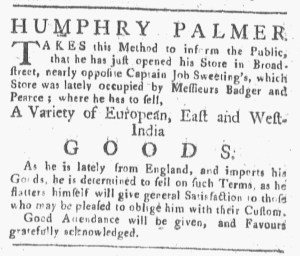
Providence Gazette (December 25, 1773).

“Good Attendance will be given, and Favours gratefully acknowledged.”

Unlike modern marketing, the advertisements disseminated during December in the eighteenth century did not take note of Christmas or associate consumerism with the holiday.  In the December 25, 1773, edition of the Providence Gazette, John Carter, the printer, did insert “A CHRISTMAS CAROL,” consisting of four stanzas, in the upper left corner of the final page of the newspaper.  In several other colonial newspapers, the “Poet’s Corner,” a weekly feature, occupied that space, a verse for that week’s issue appearing alongside the advertisements that filled the rest of the page.  Carter’s carol appeared in proximity to advertisements for consumer goods and services, but also apart.  Marketers did not yet widely depict Christmas as an occasion for making purchases.

That being the case, Humphry Palmer’s advertisement for a “Variety of European, East and West-India GOODS” did not make any special appeals that would not have appeared in the notice had he published it at some other time of the year.  Instead, he tended to some of the mechanics of shopping, describing the location of his store for prospective customers, and attempted to incite demand with promises of a broad selection and good prices.  He confided that he recently arrived in Providence, noting that worked to the advantage of his customers.  “As he is lately from England, and imports his goods,” Palmer declared, “he is determined to sell on such Terms, as he flatters himself will give general Satisfaction to those who may be pleased to oblige him with their Custom.”  His connections in England may have helped him acquire his inventory at low costs.  Perhaps more importantly, his status as a newcomer in town made him realize that the first impression that he made on consumers would become a lasting impression in the community.  He wanted the public to think of good bargains rather than unreasonably high prices when considered shopping at his store.  Palmer also noted that “Good Attendance will be given,” emphasizing customer service.  None of those appeals concerned Christmas or shopping and giving gifts as a holiday pastime.  None of the other advertisements published in the Providence Gazette on Christmas Day or the weeks leading up to it did so either.

February 7

What was advertised in a colonial American newspaper 250 years ago this week?

South-Carolina Gazette (February 4, 1773).

“As complete Assortment as any ever imported into this Province.”

Consumers would not find a larger selection of merchandise anywhere else in the colony.  That was the promise made by Edwards, Fisher, and Company in an advertisement in the February 4, 1773, edition of the South-Carolina Gazette.  The partners reported that they “just imported” a variety of wares in the Fair American from Liverpool as well as “the late Vessels from LONDON,” achieving “as complete [an] Assortment as any ever imported into this Province.”  To demonstrate the point, Edwards, Fisher, and Company deployed dual deadlines, each in larger font than the rest of the advertisement, declaring that they stocked “A VERY LARGE AND COMPLETE ASSORTMENT of GOODS, Suitable for the present Season” and “A LARGE ASSORTMENT OF Ironmongery, Cutlery, Tin-Ware, &c.”  That abbreviation for et cetera alerted readers to even more items.

Lists of goods, short catalogs, followed each of the headlines.  Among the merchandise “Suitable for the present Season,” the merchants carried a “large Quantity of Ladies Calamanco Shoes and Pumps,” “Fashionable Beaver Hatts,” “Mens, Womens, Boys, and Girls Worsted Hose,” “Fashionable Broad Cloths,” a “large Quantity of exceeding good white Plains,” and a variety of other textiles in many different colors and patterns.  Their selection of ironmongery, cutlery, and housewares included everything from “Very neat Parrot Cages” to “Complete Setts of Table China” to “long and short Pipes.”  In some instances, the merchants referred to the packaging materials to suggest the volume of dishes and other ceramics they imported, such as “Crates of yellow Ware” and “Hogsheads [or large barrels] of assorted Delf Ware.”  They offered a tantalizing description of a “large Quantity of Queens Ware,” proclaiming that it included “one Sett of Desert, exceeding elegant, and is the First of the Kind ever imported into this Province.”  Their merchandise was not merely more of the same kinds of items that shoppers could find in other stores and warehouses in Charleston.

Edwards, Fisher, and Company did not publish the longest advertisement for imported consumer goods in that edition of the South-Carolina Gazette.  Others, including John Wilson and a merchant who went by Wakefield, inserted announcements as long or longer.  Wakefield divided his notice into even more categories, while Wilson listed hundreds of items available at his store.  Yet Edwards, Fisher, and Company made a bid for offering the largest selection in their efforts to draw prospective customers to their shop to browse and buy.

November 17

What was advertised in a colonial American newspaper 250 years ago today?

South-Carolina Gazette and Country Journal (November 17, 1772).

“A large and valuable Assortment of Goods.”

Samuel Gordon promoted the “large and valuable Assortment of Goods” he sold at the “IRISH LINEN WARE-HOUSE” in an advertisement in the November 17, 1772, edition of the South-Carolina Gazette and Country Journal.  Contrary to the name of his store, Gordon’s inventory extended far beyond textiles.  To aid prospective customers in perusing his notice, he identified more than two dozen categories of merchandise, including “MILLINARY,” “SHOES,” “HOSIERY,” “CHINA,” “GLASS,” “LOOKING-GLASSES,” “STATIONARY,” and “PEWTER.”  Each of those categories appeared in capitals, indented to form a new paragraph, and followed by a short description or list of goods.  The format likely made Gordon’s advertisement easier for readers to navigate than others that featured dense blocks of text.  Alexander Gillon’s advertisement, for instance, occupied a similar amount of space and included a similar number of items, but nothing about the format differentiated any of the goods from others.

In contrast, Gordon deployed short passages that invited prospective customers to engage with the various kinds of merchandise he stocked.  For “HATS,” he had a “choice of mens fine fashionable hats, felt ditto, ladies riding ditto.”  He did not go into greater detail, but instead encouraged readers to imagine the choices and then visit his store to see for themselves.  The “STATIONARY” items included a “great choice of pocket-books, quills, wax, wafer, paper of different qualities, and a complete set of large books, viz. ledger, journal, and waste-book.”  Gordon composed a longer blurb for “CUTLERY,” mentioning a “great choice of knives and forks, ditto in cases, razors, ditto in cases, … carving-knives, pen-knives,” and related items.  He repeatedly used the word “choice” to signal to prospective customers that they ultimately made decisions according to their own taste and budget rather than settling for whatever happened to be on the shelves.  Similarly, he used variations that included “large assortment,” “different sorts,” “large quantity,” and “variety.”  Many blurbs concluded with “&c.” (an abbreviation for et cetera), suggesting that far more choices awaited those who entered Gordon’s store.

Gordon did not rely on choice alone in marketing his wares.  He also offered a discount to “Merchants who may want any of the above articles.”  He extended credit, while promising a “discount of Ten per cent” to merchants who paid their accounts in January.  Gordon likely intended that the carefully formatted list of wares would spark interest and then the discount in the nota bene would seem like too good of a bargain for merchants to ignore.  The design of the advertisement suggests that Gordon carefully considered his marketing strategy rather than simply publishing an announcement that he had imported goods for sale.