
What was advertised in a revolutionary American newspaper 250 years ago today?
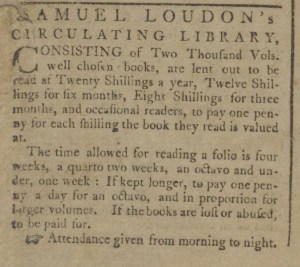
“SAMUEL LOUDON’s CIRCULATING LIBRARY.”
Like other early American printers, Samuel Loudon cultivated multiple revenue streams. He sold subscription to the New York Packet and collected fees for the advertisements in that newspaper. In addition, he sold a variety of books, pamphlets, and almanacs, only some of them produced in his printing office, as well as stationery and writing supplies. Loudon also operated a circulating library, a venture that only a few printers and booksellers incorporated into their portfolios. Clubs or corporations formed for the purpose of operating libraries oversaw most of those institutions established before and during the era of the American Revolution.
Loudon promoted his circulating library “CONSISTING of Two Thousand Vols. [of] well chosen books” in the August 15, 1776, edition of the New York Packet. Unlike modern public libraries that allow access to books and other materials for free, circulating libraries charged subscription fees to readers. Loudon offered discounts for those who subscribed for longer periods. A three-month subscription cost eight shillings while a six-month subscription cost twelve shillings. Subscribers gained access for an entire year for twenty shillings, a significant savings over purchasing consecutive subscriptions for shorter periods. Rather than completely exclude readers who did not purchase subscriptions, Loudon allowed “occasional readers” to borrow books upon paying a fee of “one penny for each shilling the book they read is valued at.” Readers interested in a particular title could peruse it for a lower price without having to make a larger investment in a subscription.
Loudon established some interesting guidelines for how long subscribers could borrow books, making the determination based on the sizes of the sheets (not to be confused with the length of the book). “The time allowed for reading a folio,” he explained, “is four weeks,” but only two weeks for a quarto and just one week for “an octavo and under.” Subscribers (and occasional readers) who kept their books longer had “to pay one penny a day for an octavo, and in proportion for larger volumes.” Whatever the quirks of this system, it meant that readers could not hoard titles and make them unavailable to other subscriber, at least not without paying penalties for doing so. In addition, borrowers had to pay for books that were “lost or abused.”
“SAMUEL LOUDON’s CIRCULATING LIBRARY” gave residents of New York access to thousands of books without having to purchase them, making them more accessible to many readers. Loudon operated the library as a public service while simultaneously generating revenue to supplement his other ventures as a printer and bookseller.