January 9

What was advertised in a colonial American newspaper 250 years ago this week?
Maryland Gazette (January 6, 1774).

“They have had many years experience in the most eminent and approved of shops in London.”

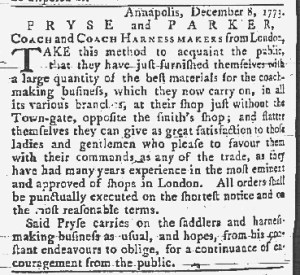
The partnership of Pryse and Parker constructed coaches and other sorts of carriages as well as harnesses at their shop in Annapolis.  In December 1773, they placed an advertisement in the Maryland Gazette to inform prospective customers that they “just furnished themselves with a large quantity of the best materials for the coach-making business.”  They introduced themselves as “from London,” though that did not necessarily mean that they were recent arrivals in Annapolis.  After all, some artisans continued to burnish their London credentials for years after they set up shop in colonies.  Pryse and Parker’s advertisement did not indicate how long they had pursued their trade in town, though a brief note at the end advised that Pryse “carries on the saddlers and harness-making business as usual, and hopes … for a continuance of encouragement from the public.”  That suggested that Pryse had been in Annapolis long enough to gain some familiarity, even if the partnership with Parker was relatively new.  Just over a year earlier, Pryse did indeed advertise on his own.

No matter how long they had been making carriages in Annapolis, Pryse and Parker considered it helpful to their marketing efforts to tout their connections to the most cosmopolitan city in the empire.  In addition to identifying themselves as “from London,” they trumpeted that “they have had many years experience in the most eminent and approved of shops in London.”  Although they stated that they “flatter themselves they can give as great satisfaction to those ladies and gentlemen who please to favour them with their commands, as any of the trade,” Pryse and Parker thought that the time they labored in those “most eminent and approved of shops in London” should distinguish them from their competitors.  They expected that the local gentry who could afford to purchase and maintain coaches and carriages would place a premium on acquiring those items from artisans with the kind of background they boasted.  Even as colonizers protested against the Tea Act and other measures enacted by Parliament, many of them continued to consider links to London a selling point when engaging the services of artisans.

August 2

What was advertised in a colonial American newspaper 250 years ago today?

New-York Gazette and Weekly Mercury (August 2, 1773).

“He makes all sorts of coaches … equal to any imported from England.”

William Deane made appeals to price and quality in an advertisement for the coaches he constructed at his shop “in Broad-street” in the August 2, 1773, edition of the New-York Gazette and Weekly Mercury.  Compared to most other advertisers, however, he devised much more elaborate marketing strategies to convince prospective customers of the price and quality he offered.

Deane started by describing the various services in his shop.  He made several different kinds of carriages as well as “all sorts of harness and saddlers work.”  In addition, he also did “painting, gilding and Japanning, in the neatest and most elegant manner.”  Deane emphasized that he achieved a high level of quality while offering the lowest possible prices because he did not outsource any of those jobs to artisans.  Instead, he “finishes all carriages whatever in his own shop, without applying to any other.”  Accordingly, he was “determined to make them as good, sell them as cheap, and be as expeditious as there is a possibility.”

The carriagemaker realized that he needed “to convince the public of the truth of what he asserts.”  To that end, he vowed that he “will make any piece of work that is required, equal to any imported from England, and will sell it at the prime cost of that imported.”  His customers did not have to sacrifice either price or quality, one for the other, when they supported domestic manufacture by purchasing carriages made in his shop in New York.  Furthermore, they benefitted from additional bargains since they “will save the freight, insurance, and the expences naturally attending to putting the carriages to rights after they arrive.”  In so many ways, purchasing a carriage from Deane was so much easier than importing one made in England.  In addition, he “has now a considerable stock of the best of all materials fit for making carriages,” so he was ready to serve customers who placed orders.

Deane offered a “further inducement,” a one-year guarantee on the carriages made in his shop.  He had been providing guarantees in newspaper advertisements for at least six years (including in an advertisement with nearly identical copy in the New-York Journal more than a year earlier).  The carriagemaker declared that he “will engage his work for a year after it is delivered, that is, if any part gives way, or fails by fair usage, he will make it good at his own expence.”   To make the choice even more clear, he underscored that prospective customers would not have access to that kind of customer service in maintaining their carriages if they opted for ones made in England.  “Those advantages,” Deane intoned, “cannot be obtained on carriages imported.”

The carriagemaker’s advertisement revolved around price and quality.  He did more than make casual reference to them, developing a sophisticated marketing strategy that touted the advantages of purchasing carriages made in his shop.  He used only the best materials and oversaw every aspect of the construction to produce carriages that rivaled in craftsmanship those imported from England.  He also offered competitive prices, especially since his customers saved on shipping and insurance, and a one-year guarantee on any parts that might require repairs.  Deane sought to convince prospective customers that all of this made his carriages the best choice.

April 7

What was advertised in a colonial American newspaper 250 years ago this week?

Pennsylvania Journal (April 4, 1771).

“Spencer has already given convincing proofs of his abilities.”

In the spring of 1771, Brent Spencer, a “Coach & Coach Harness MAKER,” opened a new shop on Lombard Street in Philadelphia.  In an advertisement in the April 4 edition of the Pennsylvania Gazette, he noted that he drew on his experience “in all the branches of Coach, Chariot, Phaeton, and Chaise making” gained in London and Dublin.  Like many other artisans who migrated across the Atlantic, he intended that prospective customers would associate his time in those cities with superior skill and training.

That was one way of attempting to establish a reputation in a new place, but Spencer did not ask consumers merely to take his word.  Instead, he declared that he already had work on display in the local marketplace.  Spencer asserted that he had “already given convincing proofs of his abilities, in executing some of the principal Carriages now running in this city and province.”  He did not name his clients, but he did suggest that some of the most prominent residents of Philadelphia and its environs previously hired him.  Anyone who had admired or otherwise taken note of carriages already traversing the streets of the busy port city, Spencer suggested, had likely seen some that he constructed.

Given that he already cultivated a clientele among the better sorts, Spencer gave their peers and those who aspired to their ranks an opportunity to acquire one of his carriages.  Immediately following his comment about making “some of the principal Carriages” in the city, he noted that he “has now for sale a coach body and a waggon body, both of new construction.”  Prospective customers did not need to settle for secondhand carriages that may have previously belonged to friends or acquaintances, not when Spencer could outfit them with carriages that observers would recognize as new.

Spencer concluded his advertisement with assurances about customer service and low prices, two more reasons for consumers to purchase coaches from him.  In a short advertisement, he established his experience working in two of the largest cities in the empire, suggested that readers already glimpsed his carriages on the streets of Philadelphia, and promoted new carriages available at his shop.  Even for the most affluent colonists, purchasing a carriage was a major investment.  Spencer offered many reasons to choose his workshop over others in the city or imported alternatives.

June 13

What was advertised in a colonial American newspaper 250 years ago this week?

Jun 13 - 6:11:170 Boston Evening-Post
Boston Evening-Post (June 11, 1770).

“The Coach-Making Business in all its Branches is carried on as usual.”

Adino Paddock, a coachmaker in Boston, regularly placed newspaper advertisements in the late 1760s and early 1770s.  He often promoted secondhand coaches, chaises, and other sorts of carriages as an alternative to purchasing new ones, anticipating marketing strategies that became standard in the automobile industry two centuries later.  He also provided maintenance and carried accessories and equipment, such as reins and whips, realizing that ancillary services and smaller sales supplemented the revenues he earned from carriages.

As part of his marketing efforts, Paddock inserted his advertisements in multiple newspapers published in Boston.  While this increased his expenses, it also placed his notice before greater numbers of potential customers.  During the week of June 11, 1770, for instance, Paddock placed the same advertisement in three of the five newspapers printed in Boston at the time.  It appeared in the Boston Evening-Post, the Boston-Gazette, and the Massachusetts Gazette and Boston Post-Boy on the same day at the beginning of the week.  It did not, however, appear in the issue of the Boston Chroniclepublished that same day or the subsequent issue distributed later in the week, but Paddock may not have considered running it there worth the investment.  Relatively few advertisements ran in the Chronicle, perhaps due to the newspaper’s outspoken Tory sympathies.  (Less than two weeks later that newspaper permanently ceased publication, though Paddock would not have known that the end was near for the Chronicle when he submitted his advertisements to the various printing offices in town.)  Paddock also declined to place his notice in the Massachusetts Gazette and Boston Weekly News-Letter.  Perhaps running notices in the other three newspapers exhausted his budget.

Whatever his reasons for choosing some newspapers over others, Paddock did submit identical copy to the Evening-Post, Gazette, and Post-Boy, multiplying the number of readers who would encounter his advertisements.  For readers who perused more than one publication, his advertisement likely became more memorable due to its familiarity.  Paddock was not alone in adopting this strategy.  Artisans, merchants, and shopkeepers in cities with multiple newspapers often sought to increase their visibility by placing identical notices in more than one publication.

March 25

What was advertised in a colonial American newspaper 250 years ago this week?

Mar 25 - 3:23:1770 Massachusaetts Gazette Extraordinary
Massachusetts-Gazette Extraordinary (March 23, 1770).

“A second-hand Coach, a Variety of second-hand Chaises.”

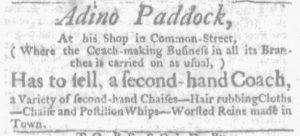
Adino Paddock, a coachmaker, occasionally advertised in Boston’s newspapers in the late 1760s and early 1770s.  He took to the pages of the public prints to promote his business with an advertisement in an extraordinary issue of the Massachusetts Gazette and Boston Weekly News-Letter on March 23, 1770.  In it, he proclaimed that “the Coach-making Business in all its Branches is carried on as usual” at his shop “in Common-Street.”

Paddock also extended one of his “usual” appeals to potential customers, informing them that he offered for a sale “a second-hand Coach” and “a Variety of second-hand Chaises.”  He incorporated used carriages of all sorts into most of his marketing, presenting consumers a less expensive alternative to purchasing new coaches and chaises.  As many of his other advertisements made clear, he acquired secondhand carriages by accepting them as partial payment when customers placed orders.  Paddock deployed what would later become familiar marketing and financing strategies in the automobile industry in the twentieth and twenty-first centuries.  He did so in the early modern era, more than a century before cars were mass produced and sold to consumers.  He anticipated some now-standard strategies for selling transportation to individual customers.

Paddock also made a “Buy American” appeal, though much less explicitly.  The elite who could afford carriages did not have to purchase coaches and chaises imported from England when they could instead acquire the same items made at his shop in Boston.  Furthermore, he sold ancillary goods, including “Worsted Reins,” made locally rather than imported.  Paddock did not name his supplier, but he assured prospective customers that the reins he sold were “made in Town.”  While he did little to underscore the point, it likely would have reverberated all the same considering how much attention residents of Boston and beyond devoted to the nonimportation agreements then in effect to protest duties on imported paper, glass, lead, paint, and tea.  Coverage extended across news items, editorials, and even advertisements.

Consisting solely of text without images, Paddock’s advertisement for carriages is not nowhere near as flashy as print advertisements for automobiles from the twentieth and twenty-first centuries nor, especially, modern television and internet advertisements.  Comparatively humble in appearance, Paddock’s advertisement did, however, pioneer some of the marketing techniques that later became standard practices in the automobile industry.

June 8

What was advertised in a colonial American newspaper 250 years ago today?

Jun 8 - 6:8:1769 Boston Weekly News-Letter
Boston Weekly News-Letter (June 8, 1769).

“He will take second-hand Chaises in Pay for new.”

Adino Paddock offered several methods for consumers to acquire carriages of very sorts when he advertised in the Boston Weekly News-Letter in June 1769. In an advertisement that ran along the outer margin of the second page of the June 8 edition, the coachmaker proclaimed that he “has to sell a second-hand Post-Chaise, a very light Phaeton, and a Variety of Chaises, some of them genteel, and very little wore.” To facilitate purchases, he suggested that he “will take second-hand Chaises in part pay for new.” He also noted that he carried “Wilton Carpeting for Chaises.” In a rather brief advertisement, this eighteenth-century coachmaker invoked several marketing strategies that became common practices for the automobile industry in the twentieth and twenty-first centuries.

First, Paddock offered several models to meet the diverse needs, tastes, and budgets of prospective customers: a post-chaise, a phaeton, and a “variety” of chaises. He also realized that some buyers might not have the means to afford a new carriage but would be willing to purchase a used one, provided that it was in good condition. The “second-hand Post-Chaise” was the eighteenth-century equivalent of a used car. Yet “second-hand” did not have to mean inferior. Paddock stressed that his used carriages “were very little wore,” their quality and durability hardly reduced by having been driven by previous owners. In addition, they some of them were quite fashionable or “genteel.” To aid buyers who aimed to purchase new carriages, Paddock encouraged trade-ins, not unlike the modern automobile industry. In response to his offer to “take second-hand Chaises in part Pay for new,” prospective customers could expect to negotiate for the value of their used carriages that would be applied to the purchase price of new ones. Finally, Paddock acknowledged the benefits of a comfortable and luxurious interior, stressing that he installed “Wilton Carpeting for Chaises.” A carriage was not merely a means of transportation but also a status symbol that incorporated various accessories that contributed to both appearances and comfort.

More than a century before anyone even conceived of producing and selling automobiles, coachmaker Adino Paddock deployed marketing strategies for selling carriages that eventually became staples of the modern automobile industry. An array of models, used carriages, trade-ins, and accessories all played a role in selling vehicles for personal transportation in the eighteenth century, just as they would continue to do when invention and technology made more advanced products available to consumers in subsequent centuries.

May 22

What was advertised in a colonial American newspaper 250 years ago this week?

May 22 - 5:19:1768 Massachusetts Gazette
Massachusetts Gazette (May 19, 1768).

“Said Paddock will take second hand Chaises in part Pay for new.”

In the late 1760s Adino Paddock operated a workshop “Where the Coach and Chaisemaking Business is carried on in every Branch.” In other words, Paddock made, repaired, and sold all sorts of carriages to the residents of Boston and its hinterlands. He frequently promoted his enterprise by inserting advertisements in multiple newspapers published in the city. In addition to some of the usual appeals made by other artisans, especially appeals to price and quality, Paddock deployed additional marketing strategies that seem strikingly modern.

For instance, in the May 19, 1768, edition of the Massachusetts Gazette Paddock provided a brief overview of some of his inventory. Among the various carriages available, he had “A very good second-hand Coach, Curricle, and several Chaises, some almost new.” He anticipated a common practice in the modern automobile industry. Then, as now, not all consumers could afford or wished to invest in a new vehicle, so Paddock provided an alternate means for acquiring carriages. His “second-hand Coach” was the eighteenth-century equivalent of today’s used car. Also like modern dealerships, Paddock realized that prospective customers balanced the price of a “second-hand” carriage against its condition. What kind of wear and tear took place before it landed in the resale market? To address such concerns, he described “several Chaises” as “almost new.” He offered the best of both worlds to his customers: lower prices for slightly used vehicles still in excellent condition. Paddock also incorporated another innovative marketing strategy into his advertisements: the trade-in. He advised readers that he “will take second hand Chaises in part Pay for new.” He simultaneously made his carriages more affordable and replenished his inventory.

Used vehicles and trade-ins are very familiar to modern consumers who buy vehicles, but these practices did not originate with the automobile industry. Instead, they were already in use in the colonial period, long before automobiles had even been invented. Automobile manufacturers and dealerships eventually adopted marketing strategies that their precursor industry had developed much earlier.

September 17

What was advertised in a colonial American newspaper 250 years ago today?

Sep 17 - 9:17:1767 New-York Journal
New-York Journal (September 17, 1767).

“The Coach-making Trade is carried on in all its different Branches.”

Elkanah and William Deane incorporated multiple marketing appeals into their advertisement for carriages slated for sale at auction the following week. Just as modern car dealerships do today, the coachmakers stocked several models so potential customers could choose the one that best fit their needs, tastes, and budgets. They may have also offered choices between new and used carriages. Other coachmakers, including Adino Paddock in Boston, advertised used carriages in the 1760s. The Deanes explicitly described both their “Post-Chariot, and Harness” and “one Horse-Chaise, with Steel-Springs and Iron Axeltree neatly finished with Harness complete” as “new,” but not their “Curricle and Harness.” That they instead described as “good.” If the curricle did indeed have a previous owner, it made sense to focus on its condition to reassure skeptical customers.

The Deanes also proclaimed that they pursued their trade “in all its different Branches” to the same standards as in London and Dublin. They had previously advertised that they “made and finished” coaches, harnesses, saddles and accessories “in the genteelest taste” and that employees in their workshop had been “regularly brought up to the different Branches of Trade.” Establishing connections to London and Dublin elaborated on that appeal. Consumers did not need to import carriages from workshops across the Atlantic. Instead, local artisans possessed the same skills and expertise and followed the same styles as in the most cosmopolitan cities in Britain and Ireland. Their coaches rivaled any built elsewhere in the empire.

Finally, the Deanes inserted a nota bene that informed prospective customers that they “warrant their Work for Twelve Months.” The coachmakers regularly included this guarantee in their advertisements, having previously stated in an earlier notice that the items they sold were “warranted for Twelve Months. They did not offer false promises about the craftsmanship of their carriages; instead, they were so confident that they backed up their appeals to quality with guarantees valid for an entire year after purchase.

Buying a carriage was a major purchase for any customer, even the most affluent. Some colonists spared no expense when they imported carriages from workshops in London, yet local coachmakers sought their own place in the market. Elkanah and William Deane underscored the virtues associated with the carriages they made and sold, promising customers the same cachet as well as services, including repair work during the first year, that faraway competitors could not provide.

May 28

What was advertised in a colonial American newspaper 250 years ago today?

May 28 - 5:28:1767 New-York Journal
New-York Journal (May 28, 1767).

“Have their Work done by Men who have been regularly brought up to the different Branches of Trade.”

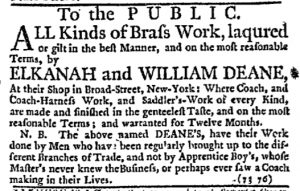
Elkanah and William Deane made coaches “At their Shop in Broad-Street, New-York.” At the same location they also did “Coach-Harness Work, and Saddler’s-Work of every Kind.” The Deanes apparently were not impressed with many of their competitors, issuing sharp words about the quality of work customers could expect from other shops. In a nota bene they asserted, “The above named DEANE’S, have their Work done by Men who have been regularly brought up to different Branches of Trade, and not be Apprentice Boy’s, whose Master’s never knew the Business, or perhaps ever saw a Coach making in their Lives.”

The quality promised by the Deanes resulted from specialized training by qualified artisans. They accused competitors of hiring workers who had supposedly been through apprenticeships, but they cast doubt on the caliber of expertise and experience possessed by some of the supposed masters who trained the next generation of coachmakers and artisans in related occupations, such as harnessmakers and saddlers. The Deanes warned that prospective customers needed to heed not only the credentials of the coachmaker who ran a shop but also those of anyone employed in that shop. After all, the owner of a shop did not undertake all the work but instead distributed it and oversaw the labor of others. The Deanes took responsibility for the work done by every employee in their shop, pledging that they only hired experienced “Men who have been regularly brought up to the different Branches of Trade.”

Assuring potential customers of the quality of the work produced in their shop was so important to the Deanes that they offered a one-year guarantee. Whether repairs to coaches or new harnesses or saddles, everything that came out of their shop was “warranted for Twelve Months.” By providing a guarantee, the Deanes underscored that their scathing comments about training and expertise were not merely idle boasts. They could afford to guarantee their work because they were so confident in their own skills and experience as well as those of everyone who worked in their shop.

June 24

What was advertised in a colonial newspaper 250 years ago this week?

Jun 24 - 6:23:1766 Boston Post-Boy
Boston Post-Boy (June 23, 1766).

“Said PADDOCK has always a Number of second-hand Chaises to dispose of.”

Coachmaker Adino Paddock made a variety of appeals intended to incite demand for his products and services among readers of the Boston Post-Boy. He promoted his own expertise and the care that went into overseeing everything produced in his workshop. He emphasized his prices (“cheaper than in any other Province on the Continent”) and the fine customer service he provided (“those who employ him may depend upon being served in the best Manner”).

In a separate paragraph, Paddock included two final offers that likely look very familiar to modern consumers, especially anyone who has ever purchased a car. Not unlike today, owning a means of transportation in the eighteenth century was expensive. Paddock, like modern car dealers, offered means for potential customers to purchase his wares while reducing the costs, thus making owning carriage a more achievable goal for a greater number of colonists. While Paddock still addressed a relatively small market, only a portion of colonial Bostonians, he did what he could to bring in as many customers as possible.

Paddock underscored that he “has always a Number of second-hand Chaises to dispose of, very cheap.” Today many consumers purchase used cars because they are a less expensive alternative to new cars. In selling “second-hand Chaises,” Paddock became the eighteenth-century equivalent of a used car dealer.

He also indicated that he “will take old Chaises as part of Pay for new.” Trading in a car to offset the price of a new one has long been a standard practice, but this advertisement suggests that it was not especially innovative in the twentieth century. For significant investments in vehicles for personal transportation, coachmakers like Adino Paddock already devised a trade in system more than a century before automobiles were invented.