August 16

What was advertised in a revolutionary American newspaper 250 years ago today?
Massachusetts Spy (August 16, 1775).

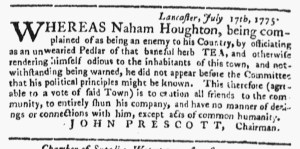
“An unwearied Pedlar of that baneful herb TEA.”

Naham Houghton of Lancaster, Massachusetts, went too far and there had to be consequences.  An advertisement in the August 16, 1775, edition of the Massachusetts Spy gave an abbreviated account of what occurred.  According to John Prescott, chairman of the local Committee of Inspection, there had been complaints that Houghton behaved as “enemy to his Country, by officiating as an unwearied Pedlar of that baneful herb TEA, and otherwise rendering himself odious to the inhabitants of this town.”  Prescott did not elaborate on the other infractions.  Selling tea was enough to get Houghton into hot water.

That violated the Continental Association, a nonimportation agreement devised by the First Continental Congress in response to the Coercive Acts imposed by Parliament in retribution for the Boston Tea Party.  The eleventh article outlined an enforcement mechanism, stating that a “Committee be chosen in every County, City, and Town” to monitor compliance with the pact.  When a majority determined that someone committed a violation, they would “cause the truth of the case to be published in the Gazette, to the End that all such foes to the rights of British America may be publickly known and universally condemned as Enemies.”  In turn, the rest of the community would “break off all Dealings with him, or her.”

The committee in Lancaster apparently sought to work with Houghton in seeking an explanation for his actions, but to no avail.  Prescott reported that Houghton refused to “appear before the Committee that his political principles might be known” even though he had been warned.  Neither the committee nor the town tolerated such defiance.  The town voted “to caution all friends to the community, to entirely shun his company,” as the Continental Association instructed, “and have no manner of dealings or connections with him, except acts of common humanity.”  Selling tea continued to resonate as a political act, yet it was only one of many offenses that made Houghton “odious” to his neighbors.  At the same time that others suspected of Tory sympathies confessed their errors and used newspaper advertisements to rehabilitate their reputations, Houghton steadfastly refused to bow to such pressure exerted by the Committee of Inspection.  He instead became the subject of an advertisement that made clear, far and wide, that he was not in good standing in his community.
April 27

What was advertised in a revolutionary American newspaper 250 years ago today?

Norwich Packet (April 27, 1775).

I am sorry that I have drank any Tea.”

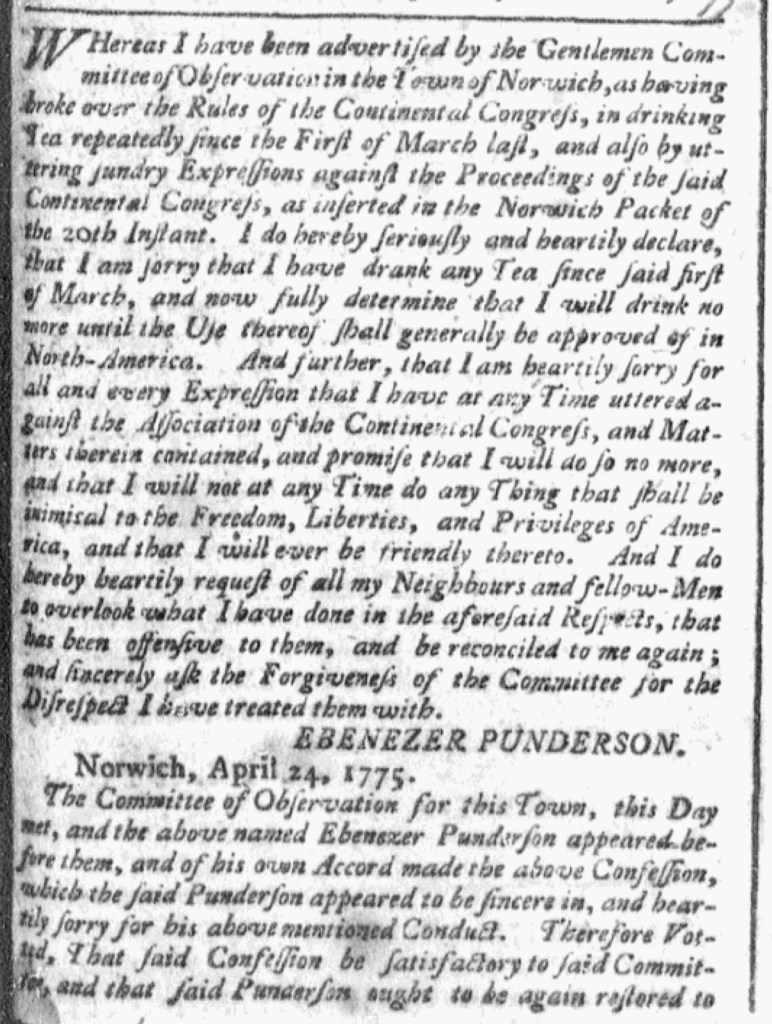
Ebenezer Punderson had the misfortune of appearing in an advertisement placed in the Norwich Packet by the local Committee of Inspection in the issue that carried the first newspaper coverage of the battles of Lexington and Concord.  The committee accused him of drinking tea in violation of the Continental Association, disparaging the First Continental Congress, and refusing to meet with the committee to discuss his conduct.  In turn, the committee advised the public not to carry on any “Trade, Commerce, Dealings or Intercourse” with Punderson.

Perhaps Punderson would have weathered that sort of public shaming under other circumstances, but news of events at Lexington and Concord made his politics even more unpalatable and his situation more dire.  From what ran in the newspaper, it did not take him long to change his tune, meet with the committee, and publish an apology for his behavior.  In a missive dated four days after the committee’s advertisement, Punderson reiterated the charges against him and “seriously and heartily” declared the he was “sorry I have drank any Tea since the first of March” and “will drink no more until the Use thereof shall generally be approved in North-America.”  In addition, he apologized for “all and every Expression that I have at any Time uttered against the Association of the Continental Congress.”  Furthermore, Punderson pledged that he “will not at any Time do any Thing that shall be inimical to the Freedom, Liberties, and Privileges of America, and that I will ever be friendly thereto.”  He requested that his “Neighbours and fellow-Men to overlook” his transgression and “sincerely ask[ed] the Forgiveness of the Committee for the Disrespect I have treated them with.”

Norwich Packet (April 27, 1775).

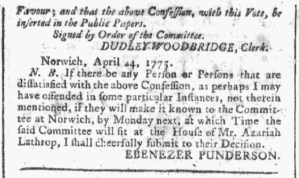
Punderson apparently convinced the committee to give him another chance.  Dudley Woodbridge, the clerk, reported that Punderson “appeared before them, and of his own Accord made the above Confession” and seemed “heartily sorry for his … conduct.”  In turn, the committee voted to find Punderson’s confession “satisfactory” and recommended that he “be again restored to Favour” in the community.  The committee also determined that “the above Confession, with this Vote, be inserted in the Public Papers,” perhaps less concerned with restoring Punderson’s good name than the example his recantation set for other Tories.  When the notice appeared in the Norwich Packet, Punderson inserted an additional note that extended an offer to meet with anyone “dissatisfied with the above Confession” and asserted that he would “cheerfully submit” to any further decisions the Committee of Inspection made in response.

Yet what appeared in the Norwich Packet did not tell the whole story.  According to Steve Fithian, Punderson “attempted to flee to New York but was captured and returned to Norwich where he spent eight days in jail and only released after signing a confession admitting to his loyalist sympathies.”  He did not stay in Norwich long after that.  “Several weeks later he fled to Newport, Rhode Island and boarded a ship which took him to England where he remained for the entire Revolutionary War.”  Apparently, he convincly feigned the sincerity he expressed, well enough that the committee accepted it.  While imprisoned, Punderson wrote a letter to his wife about his ordeal.  After arriving in England, he published an account with a subtitle that summarized what he had endured: The Narrative of Mr. Ebenezer Punderson, Merchant; Who Was Drove Away by the Rebels in America from His Family and a Very Considerable Fortune in Norwich, in Connecticut.  Just as the Committee of Inspection used print to advance a version of events that privileged the patriot cause, Punderson disseminated his own rendering once he arrived in a place where he could safely do so.

**********

The Committee of Inspection’s notice appeared with the advertisements in the April 20, 1775, edition of the Norwich Packet.  Punderson’s confession, however, ran interspersed with news items in the April 27 edition.  It may or may not have been a paid notice, but it was certainly an “advertisement” in the eighteenth-century meaning of the word.  At the time, according to the Oxford English Dictionary, an advertisement was a “(written) statement calling attention to anything” and “an act of informing or notifying.”  Advertisements often delivered local news in early American newspapers.  Punderson definitely made news as the imperial crisis became a war.

April 20

What was advertised in colonial American newspaper 250 years ago today?

Norwich Packet (April 20, 1775).

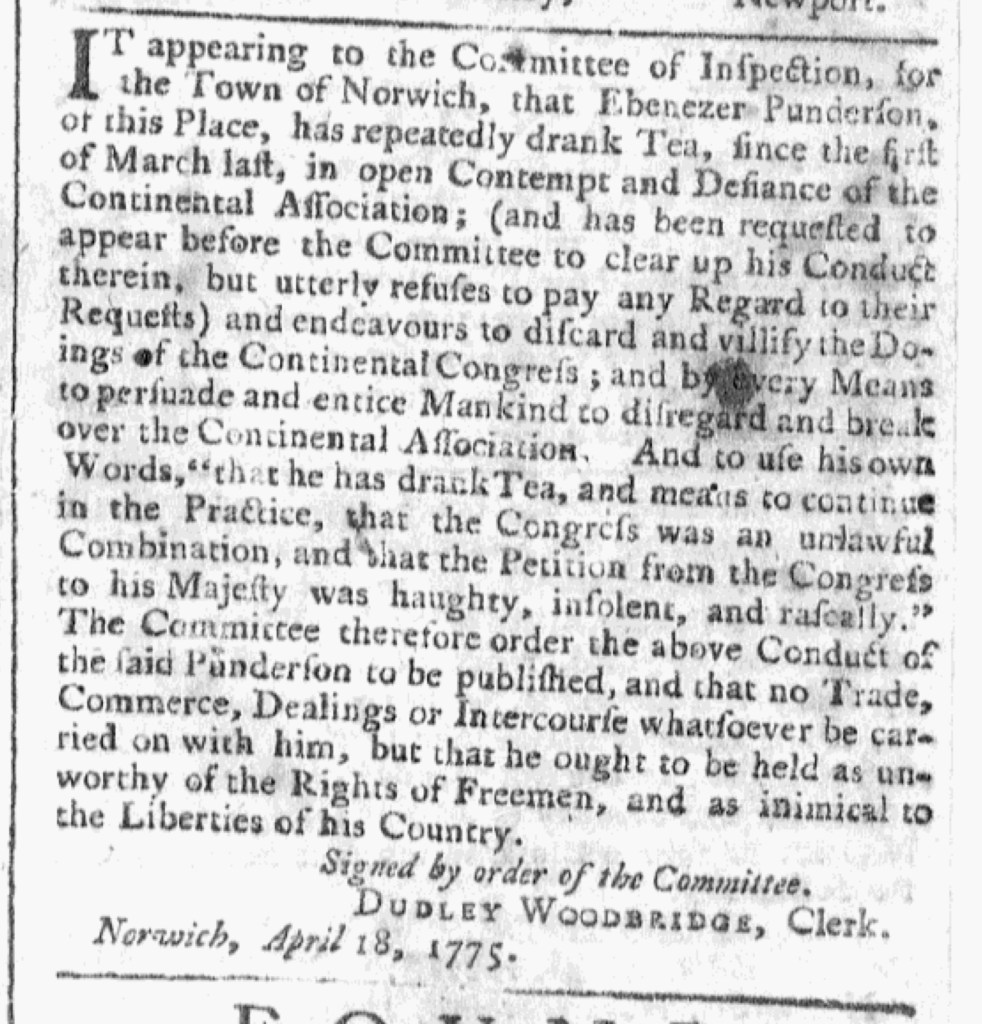
“Ebenezer Punderson … has repeatedly drank Tea … in open Contempt and Defiance of the Continental Association.”

Ebenezer Punderson went too far and now it was time for consequences.  He brazenly and repeatedly violated the Continental Association, the nonimportation and nonconsumption agreement enacted by the Continental Congress in response to the Coercive Acts.  As a result of his actions, the Committee of Inspection in Norwich, Connecticut, placed an advertisement in the April 20, 1775, edition of the Norwich Packet to document his behavior and advise the community to shun Punderson.

The committee reported that Punderson “has repeatedly drank Tea … in open Contempt and Defiance of the Continental Association.”  When the committee sought to investigate the matter, he “utterly refuse[d] to pay any Regard to their Requests” to appear before it.  Even worse, he “endeavours to discard and vilify the Doings of the Continental Congress; and by every Means to persuade and entice Mankind to disregard and break over the Continental Association.”  His refusal to abide by the Continental Association damaged the movement and had the potential to do even more harm by inspiring others to ignore it as well.  In addition, he stridently declared that he had no intention of adhering to the agreement, insulting the Continental Congress in the process:  “to use his own words, ‘that he has drank Tea, and means to continue in that Practice, that the Congress was an unlawful Combination, and that the Petition from the Congress to his Majesty was haughty, insolent, and rascally.’”

The Committee of Inspection, in turn, determined that it was Punderson who was haughty, insolent, and rascally.  It ordered that the “Conduct of the said Punderson be published, and that no Trade, Commerce, Dealings or Intercourse whatsoever be carried on with him.”  Furthermore, the committee declared that “he ought to be held as unworthy of the Rights of Freemen, and as inimical to the Liberties of his Country.”  Punderson acted in opposition to the patriot cause.  The Committee of Inspection intended to see him pay for his transgressions.

Norwich Packet (April 20, 1775).

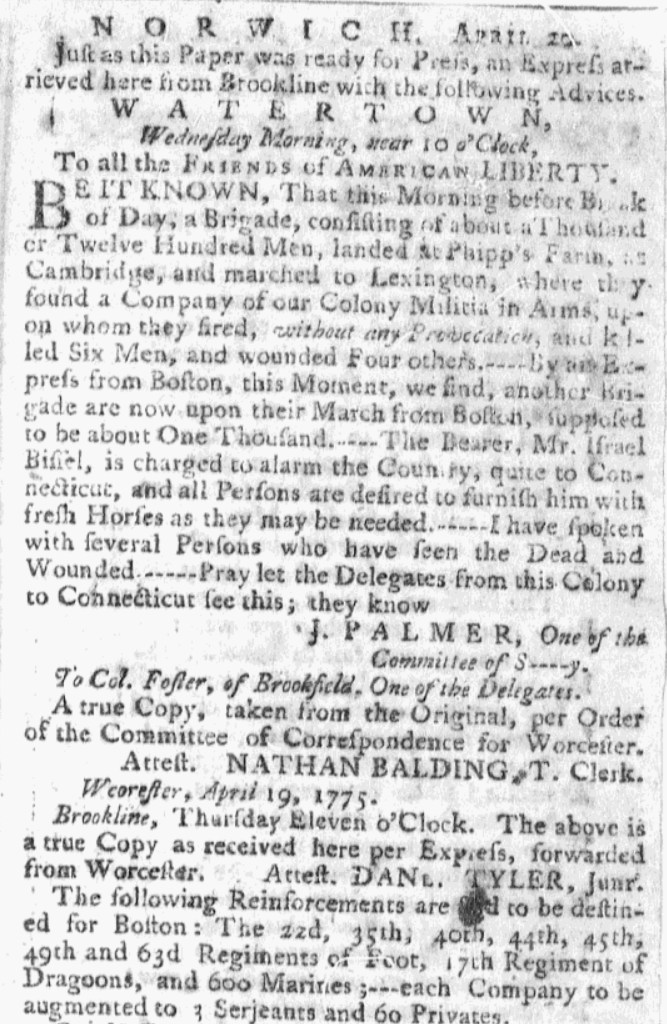
Punderson chose the wrong time to draw attention to himself.  Some of the first coverage of the battle at Lexington to appear in American newspapers ran at the top of the column that featured the advertisement about his offenses.  “Just as this Paper was ready for Press,” the printers declared, “an Express arrived here from Brookline with the following Advices” from J. Palmer, “One of the Committee of S[afet]y,” and dispatched to “Col. Foster, of Brookfield.”  The missive reported that before dawn on the morning of April 19 “a Brigade [of British troops] … marched to Lexington, where they found a Company of our Colony Militia in Arms, upon whom they fired, without any Provocation, and killed Six Men, and wounded Four others.”  Palmer stated that he had “spoken with several Persons who have seen the Dead and Wounded.”  He also relayed news that another Brigade “are now on their March from Boston.”  Israel Bissell carried the message, “charged to alarm the Country” in western Massachusetts all the way to Connecticut.  The printers published this account from a “true Copy, taken from the Original, per Order of the Committee of Correspondence for Worcester.”  The details were sparse, yet the “FRIENDS of AMERICAN LIBERTY” reading the Norwich Packet now knew that fighting had commenced near Boston.  That news quite likely had an impact on their attitude when they read about Punderson’s offenses further down the column.

January 21

What was advertised in a colonial American newspaper 250 years ago today?

Providence Gazette (January 21, 1775).

“TO be Sold, by Order of the Committee of Inspection … sundry Merchandize.”

In December 1774 and January 1775, newspaper advertisements became records of compliance with the provisions of the Continental Association, a nonimportation, nonconsumption, and nonexportation agreement adopted by the First Continental Congress when it met in Philadelphia in September and October 1774.  The tenth article of the Continental Association made provisions for goods that arrived during the months December 1774 and January 1775, items that likely had been shipped before American merchants and shopkeepers could cancel orders previously dispatched across the Atlantic.  The importers could return those goods, turn them over to the local Committee of Inspection to store until the boycott ended, or have the committee sell them, reimburse the importer for costs, and designate any profits for relief of residents of Boston.  For the sake of both transparency and compliance, the tenth article also specified that “a particular Account [be] inserted in the publick Papers.”

Such was the case when James Angell, “Clerk of the Committee,” inserted an advertisement in the January 21, 1775, edition of the Providence Gazette.  That notice announced the upcoming sale of “sundry Merchandize, imported from Great Britain, via New-York.”  That included “6 Tierces [large barrels], 3 Barrels, 5 Bales, 2 Boxes, 1 Hamper, [and] 24 Crates” of unspecified goods as well as “1 Bundle, containing 2 Dozen of Frying Pans” and “8 Bundles, containing 4 Dozen of Iron Shovels.”  As was the case in similar advertisements in other newspapers, the Committee of Inspection did not provide the same extensive catalog of merchandise that merchants and shopkeepers often did to attract the attention of prospective customers when they composed their own newspaper notices.  The committee merely made clear that a notable quantity of items would go up for sale.  The goods “were shipped at Liverpool on board the Ship Daniel, Capt. Casey, the 15th of September, and arrived at New-York since the first Day of December last.”  That accounting made clear that the items had been ordered and shipped before the First Continental Congress agreed on the details of the Continental Association, yet since they arrived after that pact went into effect they fell under its jurisdiction.  On behalf of the Committee of Inspection, Angell decreed that the sale would occur “agreeable to the Association of the Continental Congress.”

January 20

What was advertised in a colonial American newspaper 250 years ago today?

Connecticut Gazette (January 20, 1775).

“To be sold … agreeable to the tenth Article of the Association … Apothecaries Drugs.”

On January 12, 1775, the Committee of Inspection for Norwich, Connecticut, placed an advertisement for an upcoming sale of “three Chests and six Casks of Apothecary’s Drugs” that would be held on January 20 in the Norwich Packet.  They ran the notice again a week later, this time stating that the sale would take place on January 24.  That allowed four more days for word of the sale to circulate and attract prospective customers.  It also made possible advertising in the January 20 edition of the Connecticut Gazette, published in New London.

The advertisement specified that the local Committee of Inspection would oversee that sale “at the Town-House in Norwich … agreeable to the tenth Article of the Association of the American Continental Congress.”  That nonimportation, nonconsumption, and nonexportation agreement had been disseminated far wide in the months since the meetings of the First Continental Congress in Philadelphia concluded at the end of October 1774.  The tenth article made provisions for imported goods that arrived in the colonies between December 1, 1774, and February 1, 1775.  The importers had three options.  They could either return the goods, surrender them to the local Committee of Inspection to store until the boycott ended, or entrust them to the committee to sell.  After the sale, the committee reimbursed the importer what they paid for the goods, but applied any profits to relief of Boston where the harbor had been closed to commerce since the Boston Port Act went into effect on June 1, 1774.

The tenth article of the Continental Association also called for “a particular Account [to be] inserted in the publick Papers.”  When the Committee of Inspection for Norwich advertised the sale of “Apothecaries Drugs, Imported in the ship Lady Gage, from London, via New-York, since the first of December last” in both the Norwich Packet and the Connecticut Gazette, they did more than address prospective customers.  They also kept the public throughout the region that the two newspapers circulated updated on compliance with the Continental Association, encouraging others to abide by it as well.

January 14

What was advertised in a colonial American newspaper 250 years ago today?

Virginia Gazette [Dixon and Hunter] (January 14, 1775).

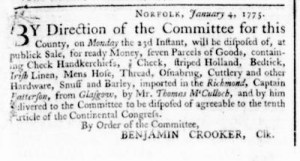
“Seven Parcels of Goods … delivered to the Committee to be disposed of agreeable to the tenth Article of the Continental Congress.”

As an advertisement in the January 14, 1775, edition of Dixon and Hunter’s Virginia Gazette made clear, Thomas McCulloch of Norfolk abided by the Continental Association.  The First Continental Congress adopted that nonimportation, nonconsumption, and nonexportation agreement when it met in Philadelphia in September and October 1774, intending to use economic leverage to convince Parliament to repeal the Coercive Acts passed in retaliation for the destruction of tea during the Boston Tea Party.

“BY Direction of the Committee for this County,” the advertisement informed readers, “on Monday the 23d Instant, will be disposed of, at publick Sale, for ready Money, seven Parcels of Goods … imported in the Richmond, Captain Patterson, from Glasgow, by Mr. Thomas McCulloch.”  The “Committee for this County” referred to the local Committee of Inspection, empowered to oversee the sale of imported goods that arrived between December 1, 1774, and February 1, 1775.  According to the tenth article of the Continental Association, importers had several options for dealing with such items.  They could return the goods, surrender them to the committee to store until the nonimportation agreement concluded, or entrust them to the committee to sell.  McCulloch “delivered [his goods” to the Committee to be disposed of agreeable to the tenth Article of the Continental Congress.”  In that case, the committee would reimburse him what he paid but apply any profit to the relief of Boston where the harbor had been closed since the Boston Port Act went into effect on June 1, 1774.

Another advertisement in the same issue of Dixon and Hunter’s Virginia Gazette advised the public of the sale of “SUNDRY Parcels of Goods lately imported from Great Britain” for sale “Under the Direction of the Committee for the County of CHARLES CITY.”  In this instance, the committee divided the merchandise into “Lots not over ten Pounds Value” to encourage sales.  These local Committees of Inspection joined their counterparts in Massachusetts, New York, and other colonies in advertising imported goods sold according to the tenth article of the Continental Association and, in the process, demonstrating compliance with that measure.

January 8

What was advertised in a colonial American newspaper 250 years ago this week?

Rivington’s New-York Gazetteer (January 5, 1775).

“We being heartily disposed to comply with the association entered into by the late continental congress …”

After it went into effect on December 1, 1774, the Continental Association had an impact on some advertisements that appeared in colonial newspapers.  The tenth article of this nonimportation, nonexportation, and nonconsumption agreement enacted by the First Continental Congress allowed for the sale of goods that arrived between December 1, 1774, and February 1, 1775, but specified that local Committees of Inspection would oversee such transactions, not the importers.  In turn, the importers would be reimbursed for the cost of the goods, but any profits would be earmarked for the relief of Boston while its harbor remained closed because of the Boston Port Act.  The tenth article asserted that “a particular Account” of those goods would be “inserted in the publick Papers.”

That was the case for sales in Plymouth, Massachusetts, near the end of December.  In early January, Thomas Ellison, Jr., Henry Remsen, and several other importers in New York published their own account of goods they ordered the previous spring and summer and the upcoming sale overseen by Joseph Haller, Nicholas Hoffman, and other members of the Committee of Inspection.  Ellison, Remsen, and the others provided an inventory of the imported items.  They also carefully documented when they placed the orders for each item to demonstrate that they had submitted them before the First Continental Congress commenced its meetings in Philadelphia in September and certainly before delegates issued the Continental Association near the end of October.  Still, even though the ship that carried their orders left New York in July, it had returned on January 2, 1775.

The importers recognized their obligation: “we being heartily disposed to comply with the association entered into by the late continental congress, give this public notice, that the said goods will be sold at the Merchants Coffee-house.”  They listed the time and date of the sale and named the members of the Committee of Inspection.  They also provided a succinct inventory, such as “1 case checks, buttons, &c.” and “6 cases Manchester goods,” but did not compose the elaborate descriptions that appeared in many other advertisements before the Continental Association went into effect.  In that regard, their advertisement resembled those for the sales in Plymouth.  Importers who surrendered their goods to Committees of Inspection did not incorporate the marketing strategies commonly used under other circumstances.

December 27

What was advertised in a colonial American newspaper 250 years ago today?

Essex Gazette (December 27, 1774).

“THE Committee of Inspection for the Town of PLYMOUTH, hereby give Notice.”

Once the Continental Association went into effect on December 1, 1774, a new sort of advertisement began appearing in the Essex Gazette and other newspapers.  Rather than advertising and selling their own merchandise, importers surrendered those roles to local Committees of Inspection, “agreeable to the Tenth Article of the Association of the American Continental Congress.”  The First Continental Congress had devised the nonimportation agreement during its meetings in Philadelphia in September and October 1774 and then disseminated it throughout the colonies.

The tenth article of the Continental Association made provisions for goods imported between December 1, 1774, and February 1, 1775.  The importers could choose to return the merchandise or turn it over to the local Committee of Inspection.  If they chose the latter, they could opt for the committee to store the wares until the nonimportation agreement ended or sell them on behalf of the importer, in which case the importer recovered the cost of the items, but profits were designated for relief of Boston since it faced so much hardship once the Boston Port Bill closed and blockaded the harbor.  The tenth article also specified that “a particular Account of all goods so returned, stored, or sold, [was] to be inserted in the publick Papers.”

Such was the case in two advertisements that John Torrey, chairman of the Committee of Inspection in Plymouth, first placed in the Essex Gazette on December 20, 1774, and again in subsequent issues.  Those advertisements indicated which vessels transported the goods, but did not name the importers.  They gave straightforward lists of the merchandise offered for sale without incorporating any of the common appeals to price, quality, fashion, or consumer choice.  No marketing strategy nor turn of phrase (such as “very cheap” or “large Assortment”) sought to distinguish the merchandise in these advertisements from other goods available for sale.  With political principles as the primary focus, John Torrey and the Committee of Inspection had little motivation to craft the sort of lively advertisements that the importers might have placed on their own behalf under other circumstances.

September 4

What was advertised in a colonial American newspaper 250 years ago today?

Sep 4 - 9:4:1770 Essex Gazette
Essex Gazette (September 4, 1770).

“A Person acting in direct Opposition to the general Sense of the Town.”

When Parliament repealed the duties on most imported goods that had been imposed in the Townshend Acts, New York quickly abandoned its nonimportation agreement and resumed trade with British merchants.  Boston and Philadelphia, however, maintained their nonimportation pacts for several month because duties on tea yet remained.  Merchants and traders had specified that they would not import goods from Britain until Parliament eliminated all of the duties.  All the repeal of most of the duties was a victory, it was a partial victory.  For months, colonists in Boston and Philadelphia debated whether they should relent.

Yet this discourse was not confined to the largest port cities.  Similar discussions took place in other towns as well.  In Salem, Massachusetts, for instance, the Committee of Inspection determined in late August 1770 that John Hendy was “a Person acting in direct Opposition to the general Sense of the Town” because he “persist[ed] in his Refusal to sign the Agreement against selling Tea.”  Even worse, he also continued to sell tea.  In an advertisement that ran in the September 3 edition of the Essex Gazette, the Committee of Inspection instructed the public “to withdraw their Connections from the said Hendy” for refusing to support the patriotic principles put into action in the “Agreement against selling Tea.”  The committee further described Hendy as “preferring a little private Interest to the public Good, and thus favouring the Designs of the Enemies to American Liberty.”  Other merchants and shopkeepers made sacrifices to support and maintain the nonimportation agreement, understanding that the stakes were much larger than their own businesses.  By selling tea, the committee argued, Hendy became a collaborator and thus should suffer the consequences.  The advertisement was a public shaming intended meant to have an impact on both Hendy’s business and his reputation.  It also served as an additional mechanism for possibly bringing Hendy into line with “the general Sense of the Town” if enough readers did indeed cease doing business of any sort with him or refused to socialize with him.  Hendy had not been swayed so far, but the Committee of Inspection hoped that the advertisement might help turn the tide and bring him into compliance.  At a time when some entrepreneurs used advertisements to proclaim their patriotic principles as part of their marketing strategies, newspaper notices also informed the public about violators to avoid.