February 14

What was advertised in a revolutionary American newspaper 250 years ago today?
Constitutional Gazette (February 14, 1776).

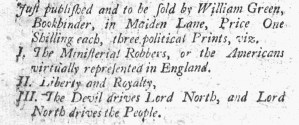
The Devil drives Lord North, and Lord North drives the People.”

In the February 14, 1776, edition of the Constitutional Gazette, William Green, a bookbinder, advertised “three political Prints” for sale for one shilling each at his shop in Maiden Lane in New York.  He listed the titles, but he did not describe them to prospective customers.  Perhaps he did not wish to pay for the additional space in the newspaper.  Perhaps he thought the titles provided sufficient description.  Perhaps he considered the titles evocative enough to spark curiosity among readers, prompting them to visit his shop to discover for themselves what exactly each print depicted.  After all, titles like “The Ministerial Robbers, or the Americans virtually represented in England” and “The Devil drives Lord North, and Lord North drives the People” simultaneously told a story and expressed support for the American cause.  Notably, the purveyor of these “political Prints” was the first person to advertise Thomas Paine’s Common Sense outside of Philadelphia, doing so just eleven days after Robert Bell, the publisher of the first edition, announced its publication.

Readers may have been familiar with some of the political cartoons that Green advertised.  In the fall of 1775, William Woodhouse, John Norman, and Robert Bell placed an advertisement in the Pennsylvania Journal to promote “The MINISTERIAL ROBBERS; or AMERICANS VIRTUALLY Represented in ENGLAND,” a “SATYRICAL PRINT” that “LATELY ARRIVED FROM LONDON.”  Green may have sold copies from London or an American edition of the print.

Another of those political cartoons, “The Devil drives Lord North, and Lord North drives the People,” originated in London as “The State Hackney Coach,” a plate that adorned the London Magazine for December 1772.  The print depicted a coach pulled by eight men rather than horses with Lord North, the prime minister, driving them.  Most of those men did not have distinguishing features; they represented any of the members of Parliament and other officials who allowed the prime minister to dominate them.  The first figure had a face that looked more like a rat than a man, additional commentary on the character of those members of Parliament.  Henry Fox, one of North’s proteges, and Jeremiah Dyson, Lord of the Treasury, were recognizable.  Although North drove the men with a whip, a devil perched on the back of the coach had his own whip that he used to steer North’s course.  A caption above the image declared, “They go fast whom the Devil drives.”  Inside the carriage, George III slept, apparently oblivious to any problems.

Green almost certainly displayed these political cartoons in his shop.  Customers who came to purchase Common Sensewould have seen images that worked in tandem with Paine’s attitudes toward monarchy and calls to declare independence.  They may even have decided to purchase both a print and a pamphlet, expressing their own political principles through the choices they made in the marketplace.
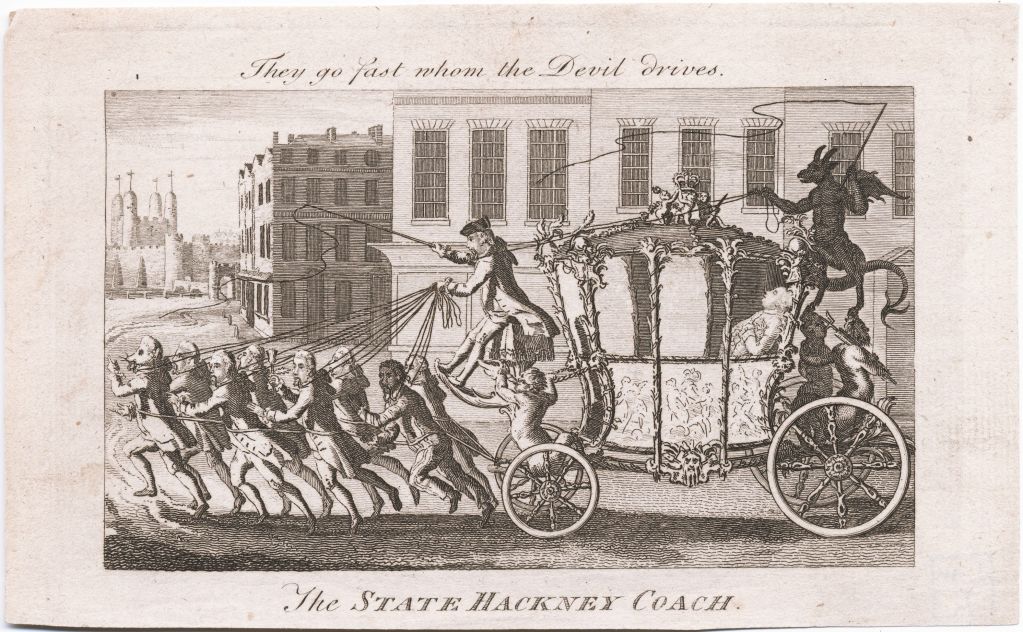
“The State Hackney Coach,” a print that adorned the London Magazine (December 1772). Courtesy Lewis Walpole Library, Yale University.

February 7

What was advertised in a revolutionary American newspaper 250 years ago today?

Constitutional Gazette (February 7, 1776).

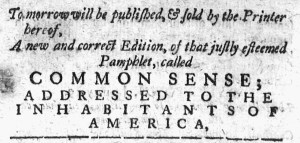
A new and correct Edition, of that justly esteemed Pamphlet, called COMMON SENSE.”

As Robert Bell, the publisher of the first edition of Thomas Paine’s Common Sense, hawked an unauthorized second edition and William Bradford and Thomas Bradford, the printers who collaborated with Paine to publish a new edition with additional content prepared that edition for press, an advertisement for the first edition of Common Sense published beyond Philadelphia appeared in the February 7, 1776, issue of the Constitutional Gazette in New York.  John Anderson, the printer of the Constitutional Gazette, ran a notice announcing, “Tomorrow will be published, & sold by the Printer hereof, A new and correct Edition, of that justly esteemed Pamphlet, called COMMON SENSE; ADDRESSED TO THE INHABITANTS OF AMERICA.”  His advertisement did not go into greater detail about the contents.  Anderson knew very well that other advertisements in the Constitutional Gazette and other newspapers published in New York provided an overview of the sections in Bell’s first edition.  The “justly esteemed Pamphlet” required no further introduction.

Only four weeks passed between Bell’s advertisement promoting the publication of Common Sense in the January 9, 1776, edition of the Pennsylvania Evening Post and Anderson informing readers in New York that they could purchase a local edition.  His newspaper carried the first advertisement for Common Sense in New York, listing William Green, a bookseller, as Bell’s local agent for distributing the pamphlet.  Anderson likely acquired a copy from Green, either purchasing it or accepting it in lieu of payment for the advertisement.  His advertisement for his “new and correct Edition” did not mention the dispute and controversy around the publication of Bell’s unauthorized edition that unfolded in Philadelphia in newspaper advertisements there, though he had likely seen some of those notices.  After all, printers carefully perused newspapers printed in other cities to select content to reprint in their own newspapers.  Anderson focused solely on giving the public greater access to Common Sense (and generating revenue in his printing office).  His local edition met with sufficient success that he eventually published a second edition.

January 31

What was advertised in a revolutionary American newspaper 250 years ago today?

Constitutional Gazette (January 31, 1776).

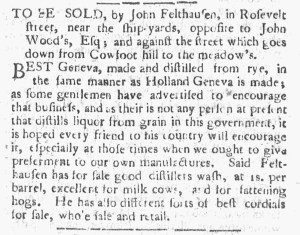
“BEST Geneva, made and distilled from rye.”

Advertisements for consumer goods and services crowded the pages of early American newspaper.  Did they work?  Unfortunately, that question is difficult to answer.  The advertisements reveal what kinds of marketing appeals merchants, shopkeepers, artisans, and other entrepreneurs thought would resonate with consumers and influence them to make purchases, but they rarely indicated how readers responded.

That so many entrepreneurs advertised and that they invested in advertising regularly suggests that they believed that they received a sufficient return on their investment to make the expense worth it.  Consider John Felthausen and his advertisement for “BEST Geneva [or Jenever, a type of gin], made and distilled from rye,” in the January 31, 1776, edition of the Constitutional Gazette.  That was not the first time that Felthausen placed that advertisement.  Three months earlier, he ran an advertisement with nearly identical copy in the New-York Gazette and Weekly Mercury.  If Felthausen believed that previous advertisement had not yielded results, would he have run it again in another newspaper a few months later?

That new advertisement had nearly identical copy, though the compositor for the Constitutional Gazette made very different decisions about the format than the compositor for the New-York Gazette and Weekly Mercury.  Felthausen may have even clipped the advertisement from one newspaper and delivered it to the printing office for the other, making marks on it to indicate copy he wished to update.  Those revisions amounted to adding a sentence at the end: “He has also different sorts of best cordials for sale, wholesale and retail.”  He retained his appeal to “every friend to this country” to “encourage” or support his business, “especially at those times when we ought to give preferment to our own manufactures.”  The distiller apparently believed that his previous advertisement met with sufficient success to merit repeating it to hawk both his “BEST Geneva” and additional products not previously included.

January 20

What was advertised in a revolutionary American newspaper 250 years ago today?

Constitutional Gazette (January 20, 1776).

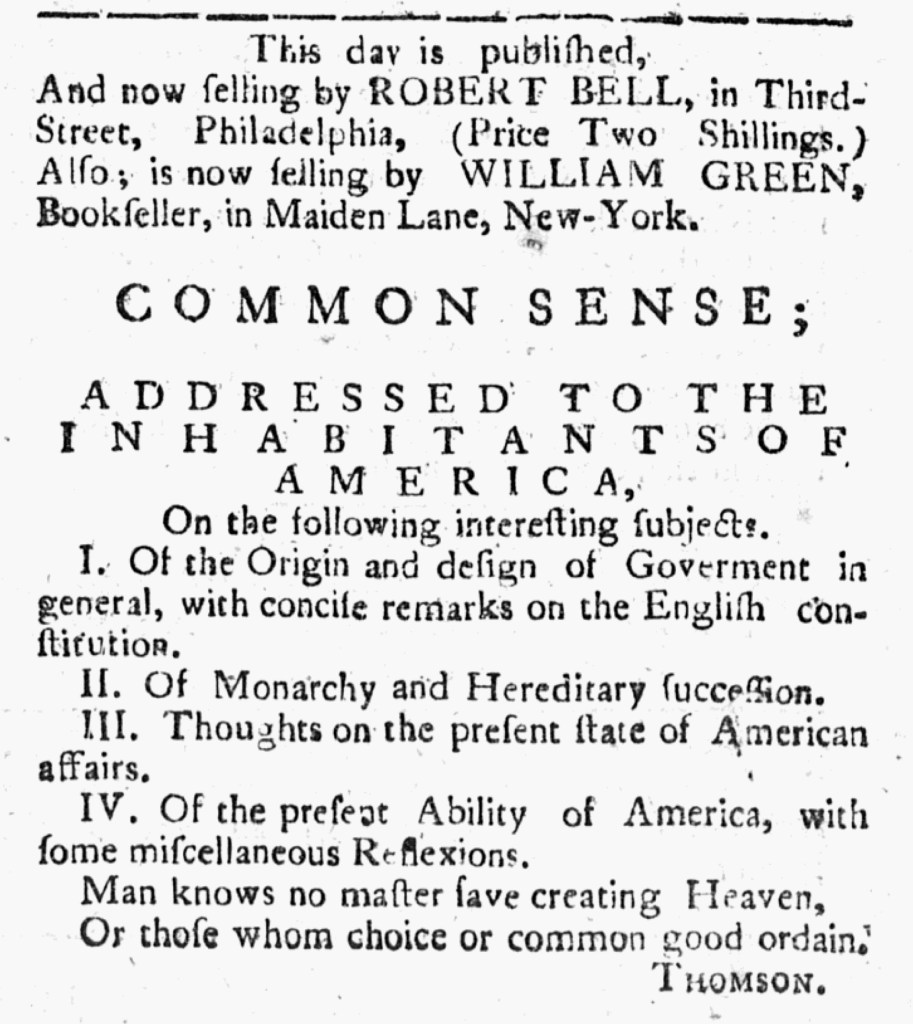
“Now selling by WILLIAM GREEN, Bookseller, in Maiden Lane, New-York.  COMMON SENSE.”

Just eleven days after the first newspaper advertisement for Thomas Paine’s Common Sense appeared in the January 9, 1776, edition of the Pennsylvania Evening Post, the first advertisement for the inflammatory political pamphlet ran in a newspaper outside of Philadelphia.  Within a week, Robert Bell, the publisher of the first edition, inserted advertisements in all six newspapers printed in Philadelphia, including Henrich Millers Pennsylvanischer Staatsbote.  One of the most savvy and influential American printers and booksellers of the eighteenth century, Bell quickly dispatched copies of the pamphlet to New York.  On January 20, the Constitutional Gazette carried an advertisement that nearly replicated those in Philadelphia’s newspapers.

That notice announced the publication of the pamphlet and stated that it was “now selling by ROBERT BELL, in Third-Street, Philadelphia” for two shillings per copy.  Yet prospective customers did not need to send to Philadelphia to acquire copies because the pamphlet was “now selling by WILLIAM GREEN, Bookseller, in Maiden Lane, New-York.”  Like the other advertisements, the notice in the Constitutional Gazette did not identify Paine as the author.  It gave the title of the work, “COMMON SENSE; ADDRESSED TO THE INHABITANTS OF AMERICA,” and listed the various headings for the sections of the pamphlet.  Readers may have already heard about a new pamphlet that took Philadelphia by storm and some of the arguments for declaring independence that it contained, yet such an outline likely told them more than they already knew and whetted their appetites for more.  What did the pamphlet say about “Monarchy and Hereditary succession”?  What kinds of “Thoughts on the present state of American affairs” did it contain?  What did the author think of “the present Ability of America” in its contest against Great Britain?  Even before they saw anything in print, most residents of New York probably first learned about Common Sense via word of mouth.  The advertisement in the Constitutional Gazette offered readers an opportunity to move beyond excited conversations about what they heard the pamphlet said about monarchy, government, and the prospects for declaring independence to obtaining their own copies and reading the treatise for themselves.  It did not take long for advertisements for Common Sense to move beyond Philadelphia’s newspapers to the Constitutional Gazette in New York and other newspapers in other cities and towns.

January 17

What was advertised in a revolutionary American newspaper 250 years ago today?

Constitutional Gazette (January 17, 1776).

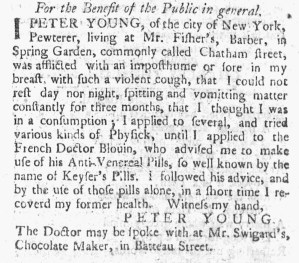
“I applied to the French Doctor Blouin, who advised me to make use of his Anti-Venereal Pills.”

Peter Young, a pewterer in New York, went through quite an ordeal.  According to the advertisement he placed in the January 17, 1776, edition of the Constitutional Gazette, he “was afflicted with an imposthume or sore in my breast, with such a violent cough, that I could not rest day or night.”  In addition, he was “spitting and vomitting matter constantly for three months,” so much so that he thought he “was in a consumption.”  Young sought out medical assistance from several providers and “tried various kinds of Physick,” but none of them could alleviate the disorder that he suffered … at least not until he “applied to the French Doctor Blouin.”  That doctor advised Young “to make use of his Anti-Venereal Pills, so well known by the name of Keyser’s Pills.”  The pewterer followed Blouin’s advice and “by the use of those pills alone, in a short time [he] recovered [his] former health.”

According to the advertisement’s header, Young inserted his testimonial in the Constitutional GazetteFor the Benefit of the Public in general.”  Beneath his signature, a note advised, “The Doctor may be spoke with at Mr. Swigard’s, Chocolate Maker, in Batteau Street.”  The advertisement gave no indication about who added that note.  It could have been Young or it could have been John Anderson, the printer of the Constitutional Gazette, out of his own desire to assist the public.  Most likely, Blouin added that detail and engineered publishing the testimonial while seeking to make it appear that Young published it independently.  After all, if Young pursued that course on his own, solely “For the Benefit of the Public in general,” that made the recommendation even more noteworthy for readers who hoped for relief from similar symptoms.  Blouin previously placed advertisements in the Constitutional Gazette, introducing himself and his pills “TO THE PUBLIC.”  Young’s testimonial supplemented his previous marketing efforts.

November 15

What was advertised in a revolutionary American newspaper 250 years ago today?

Constitutional Gazette (November 15, 1775).

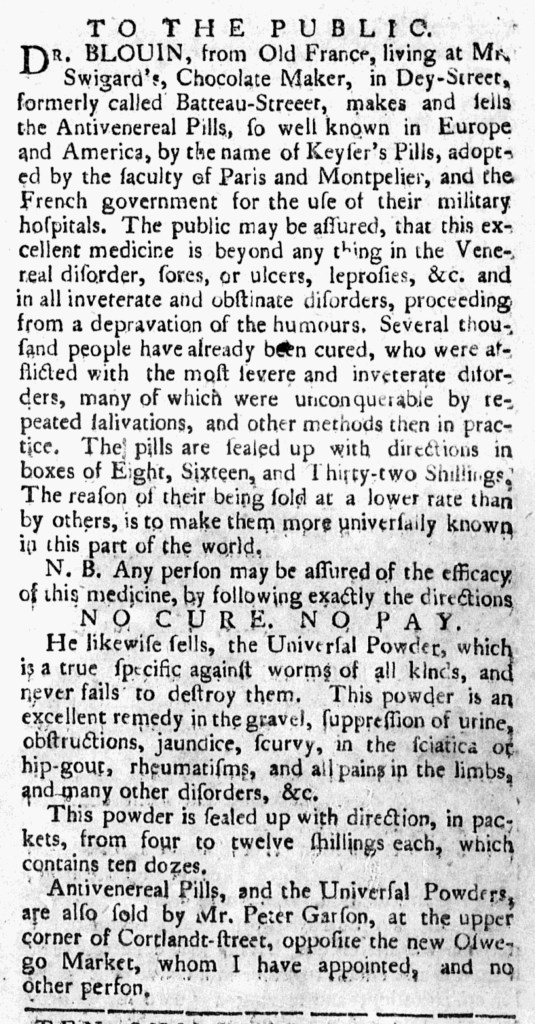
“DR. BLOUIN … makes and sells the Antivenereal Pills, so well known … by the name of Keyser’s Pills.”

It was the eighteenth-century version of offering a generic medication at a lower price than the name brand in hopes of attracting customers.  An entrepreneur who identified himself as “DR. BLOUIN, from Old France,” placed an advertisement in the November 15, 1775, edition of the Constitutional Gazette to inform readers in New York that he makes and sells the Antivenereal Pills, so well known in Europe and America, by the name of Keyser’s Pills.”  Indeed, that medication was popular in the colonies, advertised frequently by apothecaries, shopkeepers, and even printers who sold patent medicines as an alternate revenue stream.  At the same time that Blouin ran his advertisement, James Rivington, the printer of Rivington’s New-York Gazetteer, continued running his notice that proclaimed, “EVERY ONE THEIR OWN PHYSICIAN, By THE USE OF Dr. KEYSER’s PILLS.”  Rivington had been using that familiar refrain in his advertisements for years.

Blouin offered a brief history of the original medication as a means of marketing his generic version, noting that Keyser’s Pills had been “adopted by the faculty of Paris and Montpelier, and the French government for the use of their military hospitals.”  Furthermore, “[s]everal thousand people have already been cured, many of which were unconquerable by … other methods” of treatment.  Prospective customers, Blouin claimed, could not find a more effective remedy: “The public may be assured, that this excellent medicine is beyond any thing in the Venereal disorder, sores, or ulcers, leprosies, &c. and in all inveterate and obstinate disorders, proceeding from a depravation of the humours.”  He was so certain that he offered a guarantee: “NO CURE.  NO PAY.”

Readers interested in purchasing the pills that Blouin made in New York rather than imported ones would receive printed directions and could choose among boxes costing eight, sixteen, and thirty-two shillings.  The efficacy of the cure, he cautioned, depended on “following exactly the directions.”  Rivington sold Keyser’s Pills for ten, twenty, and forty shillings.  Blouin explained that he gave a discount “to make [his generic pills] more universally known in this part of the world.”  For those who wavered in choosing his pills over the name brand version, he hoped that the lower price would help convince them.  Blouin also noted that an associate, Peter Garson, “at the upper corner of Cortlandt-street, opposite the new Oswego Market,” sold the pills, but “no other person.”  Many advertisements for Keyser’s Pills warned prospective customers about counterfeits.  Blouin freely admitted that he “makes and sells” his own version … and advised readers to avoid any attributed to him but not sold by him or his appointed agent.

October 25

Who was the subject of advertisements in a revolutionary American newspaper 250 years ago today?

Constitutional Gazette (October 25, 1775).

“RUN-AWAY … a Negro man, named MINGO.”

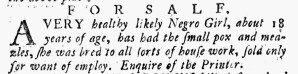
“FOR SALE, A VERY healthy Negro Girl.”

In the fall of 1775, John Anderson joined the ranks of newspaper printers who helped perpetuate slavery by disseminating advertisements about enslaved people in their publications.  In this case, one advertisement concerned “a Negro man, named MINGO,” who liberated himself from Benjamin Hutchinson by escaping from Hutchinson of Southold in Suffolk County on Long Island in early October.  The enslaver described the young man, both his physical features and his clothing, and offered a reward for his capture and return.  Another advertisement offered a “healthy Negro Girl, about 18 years of age,” for sale.  She was capable of “all sorts of house work” and sold “only for want of employ” rather than any deficiency.

Those advertisements first appeared in the October 25 edition of the Constitutional Gazette, a newspaper that commenced publication near the beginning of August.  The new publication initially did not carry advertisements, though Anderson began soliciting them by the end of the month.  Local entrepreneurs who had experience advertising in other newspapers, including goldsmith and jeweller Charles Oliver Bruff and Abraham Delanoy, who pickled lobsters and oysters, soon placed notices in the Constitutional Gazette.  Beyond marketing consumer goods and services, others ran advertisements for a variety of purposes, replicating the kinds of notices found in other newspapers of the period.

Constitutional Gazette (October 25, 1775).

That included advertisements about enslaved people.  Two months after first soliciting advertisements (and less than three months after publishing the inaugural issue), Anderson disseminated Hutchinson’s advertisement about Mingo’s escape from slavery and another notice offering an enslaved young woman for sale.  Like printers from New England to Georgia, he compartmentalized the contents of his newspaper, not devoting much thought to the juxtaposition of news and editorials advocating on behalf of the American cause and advertisements placed for the purpose of perpetuating slavery and the slave trade.

Even as Anderson used his newspaper to advocate for liberty for colonizers who endured the abuses perpetrated by Parliament, he used it to constrain the freedom of Black men, women, and children.  The advertisement about Mingo encouraged readers to engage in surveillance of Black men to determine if any they encountered matched his description.  In addition to publishing advertisements about enslaved people, Anderson also served as a broker.  The advertisement for the young enslaved woman whose name was once known instructed interested parties to “Enquire of the Printer.”  Anderson did more than merely disseminate information.  He actively participated in the sale of the young enslaved woman as one of the services he provided as printer.

October 21

What was advertised in a revolutionary American newspaper 250 years ago today?

Constitutional Gazette (October 21, 1775).

The Public are hereby informed, that the Constitutional Post, goes three times a week between this city and Philadelphia.”

It was yet another advertisement for the Constitutional Post, this time in the October 21, 1775, edition of the Constitutional Gazette, a newspaper printed by John Anderson in New York.  William Goddard, himself a printer, first envisioned the Constitutional Post as an alternative to the imperial postal system in 1773.  The Second Continental Congress adopted a modified version of Goddard’s plan in the summer of 1775 following the outbreak of hostilities at Lexington and Concord.  By then, some local branches of the Constitutional Post had already been established.  Under the direction of Benjamin Franklin, selected as Postmaster General even though Goddard desired the position, the system approved by the Second Continental Congress added new branches and integrated those already in operation to create a network for disseminating information in letters and newspapers from New England to Georgia.

In the fall of 1775, advertisements promoting the Constitutional Post proliferated in American newspapers, especially in those published in the Mid Atlantic.  On October 11, Mary Katharine Goddard, printer of the Maryland Journal in Baltimore, postmaster in that town, and sister of William Goddard, inserted a notice about the schedule for the “CONSTITUTIONAL POST-OFFICE.”  Two days later, Richard Bache, the postmaster in Philadelphia (and son-in-law of Benjamin Franklin), published a more extensive advertisement in Story and Humphreys’s Pennsylvania Mercury.  A little over a week later, Anderson inserted an unsigned notice about the Constitutional Post in the Constitutional Gazette, the newspaper he established in support of the American cause at the beginning of August.   The placement of the notice does not reveal whether Anderson considered it news like the items that appeared immediately above it or an advertisement like his own for “American made DRUMS” immediately below it and the paid notices that appeared on the next page.  For Anderson, that may have been a distinction without a difference.  What mattered was letting the public know that the Constitutional Post dispatched riders to and from Philadelphia three times a week and the system reached “as far as New-Hampshire” in the north and “as far as Savanna, in Georgia,” to the south.

September 2

What was advertised in a revolutionary American newspaper 250 years ago today?

Constitutional Gazette (September 2, 1775).

“A collection of the most elegant swords ever before made in America.”

John Anderson’s call for advertisers to insert notices in the Constitutional Gazette yielded more results.  He touted the circulation of his new newspaper in the August 23, 1775, edition, asserting that the “Public will easily perceive the advantage of advertising in the Constitutional Gazette.”  Three days later, Abraham Delanoy ran an advertisement for pickled lobsters and fried oysters, adorning it with the woodcut depicting a lobster trap and an oyster cage that accompanied his advertisements in other newspapers.  Like printers of other newspapers, Anderson also inserted several advertisements that promoted the goods and services available at his printing office.

For the September 2 edition, other advertisers submitted notices.  Roger Haddock and William Malcolm described the contents of a chest stolen from onboard the Thistle on August 30 and offered a reward for apprehending the thief and returning the missing items.  Peter Garson and Caleb Hall advertised a house and land at “Peek’s-Kill, on the post-road, within three quarters of a mile of a convenient landing” that they considered “suitable for a merchant, trader, or mechanick.”  In collaboration with Mrs. Joyce and other local printers, Anderson once again hawked “JOYCE’s Grand American Balsam,” a patent medicine that alleviated a variety of disorders.  He also continued advertising a pamphlet, “Self defensive WAR lawful.”

In addition, Charles Oliver Bruff, a goldsmith and jeweler with experience advertising in other newspapers, placed an advertisement for “SWORDS.”  Although Delanoy republished copy from his previous advertisements, Bruff generated new copy for his advertisement in the Constitutional Gazette.  “Those Gentlemen who are forming themselves into Companies in Defence of their LIBERTIES,” he proclaimed, “that are not provided with SWORDS, May be suited therewith by applying to Charles Oliver Bruff.”  Such an appeal kept with the tone of Anderson’s Constitutional Gazette.  Bruff presented several options for the pommel, including William Pitt’s head with the motto “Magna Charta and Freedom” and John Wilkes’s head and the motto “Wilkes and Liberty.”  Both men had been vocal advocates of American rights in Britain.  Bruff was not the first advertiser in the colonies to honor Pitt and Wilkes with commemorative items.  The goldsmith and jeweler declared that he stocked “the most elegant swords ever made in America, all manufactured by said BRUFF.”  His advertisement fit the times now that hostilities had commenced in Massachusetts and George Washington took command of the Continental Army laying siege to Boston.  As Anderson sought to expand advertising in the Constitutional Gazette, Bruff’s advertisement for swords addressed to gentlemen defending “their LIBERTIES” complemented his own advertisement for John Carmichael’s sermon, “Self defensive WAR lawful.”

August 26

What was advertised in a revolutionary American newspaper 250 years ago today?

Constitutional Gazette (August 26, 1775).

“He proposes to continue his business of pickling oysters and lobsters.”

John Anderson’s effort to solicit advertisements in the August 23, 1775, edition of the Constitutional Gazette yielded results.  When he published the next issue three days later, the final page carried four advertisements.  The printer was responsible for two of them, one for a pamphlet, “Defensive War in a Just Cause Sinless,” and the other for “All sorts of Blanks used in this Province,” children’s books, and “New Pamphlets.”  Another advertisement hawked “JOYCE’s Grand American Balsam,” a patent medicine sometimes advertised in other newspapers.  Customers could acquire the medicine and directions from “Mrs. Joyce, at Brookland Ferry” and from “Messrs. Anderson, Gaine, and Rivington, Printers in New-York.”  Although Edward Joyce’s widow or the other two printers may have played a role in placing the advertisement, Anderson certainly had a hand in publishing it.

One advertisement, however, had not connection to the printer of the Constitutional Gazette.  Abraham Delanoy placed a notice “to inform his customers, and the public in general, THAT … he proposes to continue his business of pickling oysters and lobsters; and also puts up fired oysters so as to keep a long time even in a hot climate.”  His advertisement featured a woodcut depicting a lobster trap and an oyster cage, accounting for half the space and attracting attention in a newspaper that did not have any other visual images.  That woodcut previously accompanied Delanoy’s advertisement in Rivington’s New-York Gazetteer.  He either retrieved it from another printing office to deliver to Anderson or carefully stored it in anticipation of using it again.  Delanoy also replicated much of the copy from that previous advertisement. The similarities suggest that he either copied directly from it, making minor revisions as he went, or indicated changes directly on a clipping of the advertisement.  Some readers likely recognized Delanoy’s advertisement, but this time it generated revenue for John Anderson and the Constitutional Gazette.  The printer must have been pleased that Delanoy set an example for others to advertise in this new publication.