December 7

What was advertised in a colonial American newspaper 250 years ago today?
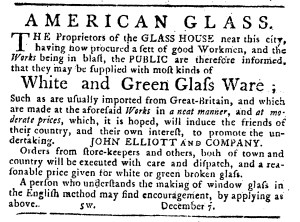
Pennsylvania Journal (December 7, 1774).

“White and Green Glass Ware; Such as are usually imported from Great-Britain.”

A headline in capital letters and a large font proclaimed, “AMERICAN GLASS.”  In a secondary headline composed of font of the same size, John Elliott and Company promoted “White and Green Glass Ware” that they produced ay their “GLASS HOUSE” near Philadelphia.  That advertisement happened to appear in the December 7, 1774, edition of the Pennsylvania Journal, the first issue published since the Continental Association went into effect on December 1.  Throughout the colonies, retailers and consumers adopted that boycott of goods imported from Britain, some enthusiastically and some under pressure.  They hoped that measure would help convince Parliament to repeal the Coercive Acts passed in retaliation for the Boston Tea Party.

Ever since the boycotts inspired by the Stamp Act nearly a decade earlier, supporters of the American cause emphasized the importance of “domestic manufactures” or goods produced in the colonies.  Such products offered an alternative to imported wares while also bolstering local economies and creating jobs.  The Continental Association had the potential to disrupt consumption practice, but it also presented opportunities for American entrepreneurs, including Elliott and Company.

In their advertisement, the proprietors of the Glass House reported that they had “procured a sett of good Workmen” and the glassworks were “in blast.”  That meant that the public “may be supplied with most kinds of White and Green Glass Ware; Such as are usually imported from Great-Britain.”  Prospective customers did not need to worry about the quality or cost of this alternative.  Elliott and Company offered assurances that they produced glassware “in a neat manner, and at moderate prices.”  In their appeal to “the PUBLIC,” Elliott and Company did not address consumers alone.  They also hoped to entice retailers, noting that “Orders from store-keepers and others, both of town and country will be executed with care and dispatch.”  They hoped these various appeals would “induce the friends of their country, and their own interest, to promote the undertaking.”  It was a win-win-win situation for the protest against Parliament, for customers, and for Elliott and Company.
November 17

What was advertised in a colonial American newspaper 250 years ago today?

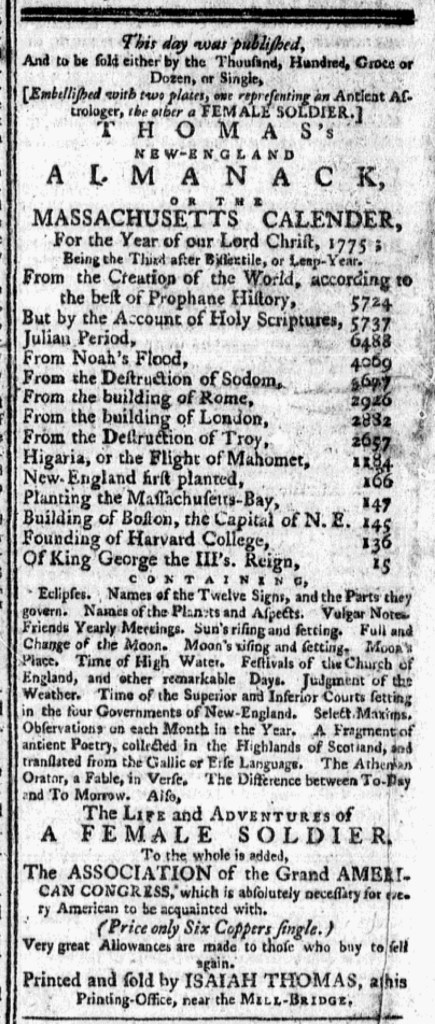
Massachusetts Spy (November 17, 1774).

“To the whole is added, The ASSOCIATION of the Grand AMERICAN CONGRESS.”

Like many colonial printers, Isaiah Thomas generated significant revenue from publishing almanacs.  From the most affluent to the most humble households in port cities and in the countryside, each year colonizers acquired these handy reference manuals that included all kinds of information.  Thomas’s “NEW-ENGLAND ALMANACK, OR THE MASSACHUSETTS CALENDER, For the Year of our Lord Christ, 1775,” for instance, had everything from the tides or “Time of High Water” to a schedule of “the Superior and Inferior Courts setting in the four Governments of New-England” to poetry.  Thomas “Embellished” the almanac with two images, “one representing an Antient Astrologer, the other a FEMALE SOLDIER.”  The latter corresponded to the “LIFE and ADVENTURES of A FEMALE SOLDIER” that the printer promoted among the content of his almanac.  Practically every almanac included the tides and many listed the dates for important meetings in Connecticut, Massachusetts, New Hampshire, and Rhode Island, so Thomas and other printers sought ways to distinguish their almanacs from others, including images and novel stories.

Thomas anticipated doing brisk business with the contents that he selected for his almanac.  He announced that he sold it “by the Thousand, Hundred, Groce or Dozen, or Single,” offering peddlers, booksellers, and shopkeepers the opportunity to purchase in volume for resale.  A single copy cost “Six Coppers,” yet Thomas promised that “Very great Allowances are made to those who buy to sell again.”  In addition to turning a profit on his almanac, this patriot printer also wanted it disseminated widely because of a particular item that he inserted among the contents.  His almanac included “The ASSOCIATION of the Grand AMERICAN CONGRESS.”  He referred to the Continental Association, a nonimportation agreement recently adopted by the First Continental Congress when it met in Philadelphia in September and October 1774.  The inclusion of the Continental Association distinguished Thomas’s almanac from others advertised in the same issue of the Massachusetts Spy, including “BICKERSTAFF’S BOSTON ALMANACK” published by Nathaniel Mills and John Hicks and “LOW’S ALMANACK” published by John Kneeland.  That newspaper also featured advertisements for two different editions of “EXTRACTS from the Votes and Proceedings of the American Continental CONGRESS,” which included the Continental Association.  Whether or not readers happened to purchase that political pamphlet, Thomas provided easy access to what they needed to know about the nonimportation agreement in an almanac that they would consult for a variety of purposes throughout the coming year.  He asserted that the Continental Association “is absolutely necessary for every American to be acquainted with” … and since so many colonizers already planned to purchase an almanac for 1775 they might as well become acquainted with the Continental Association by purchasing Thomas’s almanac, the one that he sought to distribute “by the Thousand, Hundred, Groce or Dozen” to get into as many households as possible.