January 21

What was advertised in a colonial American newspaper 250 years ago today?

Providence Gazette (January 21, 1775).

“TO be Sold, by Order of the Committee of Inspection … sundry Merchandize.”

In December 1774 and January 1775, newspaper advertisements became records of compliance with the provisions of the Continental Association, a nonimportation, nonconsumption, and nonexportation agreement adopted by the First Continental Congress when it met in Philadelphia in September and October 1774.  The tenth article of the Continental Association made provisions for goods that arrived during the months December 1774 and January 1775, items that likely had been shipped before American merchants and shopkeepers could cancel orders previously dispatched across the Atlantic.  The importers could return those goods, turn them over to the local Committee of Inspection to store until the boycott ended, or have the committee sell them, reimburse the importer for costs, and designate any profits for relief of residents of Boston.  For the sake of both transparency and compliance, the tenth article also specified that “a particular Account [be] inserted in the publick Papers.”

Such was the case when James Angell, “Clerk of the Committee,” inserted an advertisement in the January 21, 1775, edition of the Providence Gazette.  That notice announced the upcoming sale of “sundry Merchandize, imported from Great Britain, via New-York.”  That included “6 Tierces [large barrels], 3 Barrels, 5 Bales, 2 Boxes, 1 Hamper, [and] 24 Crates” of unspecified goods as well as “1 Bundle, containing 2 Dozen of Frying Pans” and “8 Bundles, containing 4 Dozen of Iron Shovels.”  As was the case in similar advertisements in other newspapers, the Committee of Inspection did not provide the same extensive catalog of merchandise that merchants and shopkeepers often did to attract the attention of prospective customers when they composed their own newspaper notices.  The committee merely made clear that a notable quantity of items would go up for sale.  The goods “were shipped at Liverpool on board the Ship Daniel, Capt. Casey, the 15th of September, and arrived at New-York since the first Day of December last.”  That accounting made clear that the items had been ordered and shipped before the First Continental Congress agreed on the details of the Continental Association, yet since they arrived after that pact went into effect they fell under its jurisdiction.  On behalf of the Committee of Inspection, Angell decreed that the sale would occur “agreeable to the Association of the Continental Congress.”

January 20

What was advertised in a colonial American newspaper 250 years ago today?

Connecticut Gazette (January 20, 1775).

“To be sold … agreeable to the tenth Article of the Association … Apothecaries Drugs.”

On January 12, 1775, the Committee of Inspection for Norwich, Connecticut, placed an advertisement for an upcoming sale of “three Chests and six Casks of Apothecary’s Drugs” that would be held on January 20 in the Norwich Packet.  They ran the notice again a week later, this time stating that the sale would take place on January 24.  That allowed four more days for word of the sale to circulate and attract prospective customers.  It also made possible advertising in the January 20 edition of the Connecticut Gazette, published in New London.

The advertisement specified that the local Committee of Inspection would oversee that sale “at the Town-House in Norwich … agreeable to the tenth Article of the Association of the American Continental Congress.”  That nonimportation, nonconsumption, and nonexportation agreement had been disseminated far wide in the months since the meetings of the First Continental Congress in Philadelphia concluded at the end of October 1774.  The tenth article made provisions for imported goods that arrived in the colonies between December 1, 1774, and February 1, 1775.  The importers had three options.  They could either return the goods, surrender them to the local Committee of Inspection to store until the boycott ended, or entrust them to the committee to sell.  After the sale, the committee reimbursed the importer what they paid for the goods, but applied any profits to relief of Boston where the harbor had been closed to commerce since the Boston Port Act went into effect on June 1, 1774.

The tenth article of the Continental Association also called for “a particular Account [to be] inserted in the publick Papers.”  When the Committee of Inspection for Norwich advertised the sale of “Apothecaries Drugs, Imported in the ship Lady Gage, from London, via New-York, since the first of December last” in both the Norwich Packet and the Connecticut Gazette, they did more than address prospective customers.  They also kept the public throughout the region that the two newspapers circulated updated on compliance with the Continental Association, encouraging others to abide by it as well.

January 14

What was advertised in a colonial American newspaper 250 years ago today?

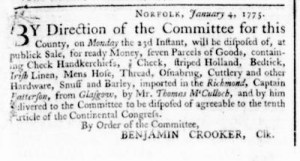
Virginia Gazette [Dixon and Hunter] (January 14, 1775).

“Seven Parcels of Goods … delivered to the Committee to be disposed of agreeable to the tenth Article of the Continental Congress.”

As an advertisement in the January 14, 1775, edition of Dixon and Hunter’s Virginia Gazette made clear, Thomas McCulloch of Norfolk abided by the Continental Association.  The First Continental Congress adopted that nonimportation, nonconsumption, and nonexportation agreement when it met in Philadelphia in September and October 1774, intending to use economic leverage to convince Parliament to repeal the Coercive Acts passed in retaliation for the destruction of tea during the Boston Tea Party.

“BY Direction of the Committee for this County,” the advertisement informed readers, “on Monday the 23d Instant, will be disposed of, at publick Sale, for ready Money, seven Parcels of Goods … imported in the Richmond, Captain Patterson, from Glasgow, by Mr. Thomas McCulloch.”  The “Committee for this County” referred to the local Committee of Inspection, empowered to oversee the sale of imported goods that arrived between December 1, 1774, and February 1, 1775.  According to the tenth article of the Continental Association, importers had several options for dealing with such items.  They could return the goods, surrender them to the committee to store until the nonimportation agreement concluded, or entrust them to the committee to sell.  McCulloch “delivered [his goods” to the Committee to be disposed of agreeable to the tenth Article of the Continental Congress.”  In that case, the committee would reimburse him what he paid but apply any profit to the relief of Boston where the harbor had been closed since the Boston Port Act went into effect on June 1, 1774.

Another advertisement in the same issue of Dixon and Hunter’s Virginia Gazette advised the public of the sale of “SUNDRY Parcels of Goods lately imported from Great Britain” for sale “Under the Direction of the Committee for the County of CHARLES CITY.”  In this instance, the committee divided the merchandise into “Lots not over ten Pounds Value” to encourage sales.  These local Committees of Inspection joined their counterparts in Massachusetts, New York, and other colonies in advertising imported goods sold according to the tenth article of the Continental Association and, in the process, demonstrating compliance with that measure.

January 11

GUEST CURATOR:  Nicholas Arruda

What was advertised in a colonial American newspaper 250 years ago today?

Connecticut Journal (January 11, 1775).

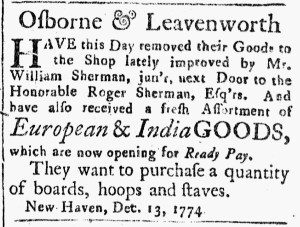
“A fresh Assortment of European & India GOODS.”

Osborne and Leavenworth advertised a “fresh Assortment of European & India GOODS” in the Connecticut Journalon January 11, 1775.  Their advertisement was dated December 13, 1774, very shortly after the implementation of the Continental Association on December 1.  In October 1774, the First Continental Congress organized that nonimportation agreement in response to the oppressive policies of Great Britain, especially the Coercive Acts.  Osborne and Leavenworth may have been undertaking a clearance sale on stock acquired prior to the importation ban.  In The Colonial Merchants and the American Revolution, 1763-1776, Arthur M. Schlesinger observes that merchants had to comply with boycott agreements while they had preexisting inventories to manage.  He observes that “the enforcement of non-importation agreements placed merchants in a precarious position, compelling them to balance between patriotic compliance and economic survival.”[1]  Osborne and Leavenworth probably advertised goods imported before the Continental Association went into effect and colonists refused to import British goods as a sign of unity.

**********

ADDITIONAL COMMENTARY:  Carl Robert Keyes

Osborne and Leavenworth’s advertisement does indeed raise questions about when they received their goods compared to when the Continental Association went into effect.  They placed their notice to advise prospective customers that they had moved to a new location and received a new shipment that they “are now opening.”  They did not specify when that “fresh Assortment” arrived, though they likely hoped that readers would assume they acquired their wares before December 1.  After all, it took time to unpack goods and prepare them for sale, especially when setting up shop in a new location.  Alternately, the goods may have arrived in the colonies, likely New York, prior to December 1 before merchants there dispatched them to Osborne and Leavenworth in New Haven.

The date that appeared in their advertisement made it possible to reach the conclusion that they peddled only wares imported before December 1.  Other merchants and shopkeepers who advertised in the same issue of the Connecticut Journal did not give any indication about when they received merchandise that they promoted as new arrivals.  Jeremiah Atwater, for instance, “just received a fresh Assortment of GOODS.”  Similarly, Anthony Perit “just received a large and general Assortment of English and India GOODS.”  Yet neither of them included any dates nor mentioned the Continental Association.  Josiah Burr proclaimed that he “just receiv’d a large Assortment of GOODS” and gave an extensive list of imported textiles, housewares, and groceries (including tea) in an advertisement dated “Jan. 1775,” well after the Continental Association commenced.  Perhaps each of these local retailers had received new goods from merchants in New York rather than directly from English ports.  After all, five out of six ships that the custom house in New Haven listed as “ENTERED IN” in the January 11 edition of the Connecticut Journal arrived from New York.  In that case, neither advertisers nor readers may have been concerned about breaking the prohibition on buying and selling imported goods.  Six weeks after the Continental Association went into effect, advertisements for consumer goods in the Connecticut Journal looked much the same as they had for years, unlike some advertisements in newspapers published in major ports that announced the sales of imported goods under the direction of local Committees of Inspection.

**********

[1] Arthur M. Schlesinger, The Colonial Merchants and the American Revolution, 1763-1776 (New York: Frederick Ungar Publishing Company, 1957), 240.

January 8

What was advertised in a colonial American newspaper 250 years ago this week?

Rivington’s New-York Gazetteer (January 5, 1775).

“We being heartily disposed to comply with the association entered into by the late continental congress …”

After it went into effect on December 1, 1774, the Continental Association had an impact on some advertisements that appeared in colonial newspapers.  The tenth article of this nonimportation, nonexportation, and nonconsumption agreement enacted by the First Continental Congress allowed for the sale of goods that arrived between December 1, 1774, and February 1, 1775, but specified that local Committees of Inspection would oversee such transactions, not the importers.  In turn, the importers would be reimbursed for the cost of the goods, but any profits would be earmarked for the relief of Boston while its harbor remained closed because of the Boston Port Act.  The tenth article asserted that “a particular Account” of those goods would be “inserted in the publick Papers.”

That was the case for sales in Plymouth, Massachusetts, near the end of December.  In early January, Thomas Ellison, Jr., Henry Remsen, and several other importers in New York published their own account of goods they ordered the previous spring and summer and the upcoming sale overseen by Joseph Haller, Nicholas Hoffman, and other members of the Committee of Inspection.  Ellison, Remsen, and the others provided an inventory of the imported items.  They also carefully documented when they placed the orders for each item to demonstrate that they had submitted them before the First Continental Congress commenced its meetings in Philadelphia in September and certainly before delegates issued the Continental Association near the end of October.  Still, even though the ship that carried their orders left New York in July, it had returned on January 2, 1775.

The importers recognized their obligation: “we being heartily disposed to comply with the association entered into by the late continental congress, give this public notice, that the said goods will be sold at the Merchants Coffee-house.”  They listed the time and date of the sale and named the members of the Committee of Inspection.  They also provided a succinct inventory, such as “1 case checks, buttons, &c.” and “6 cases Manchester goods,” but did not compose the elaborate descriptions that appeared in many other advertisements before the Continental Association went into effect.  In that regard, their advertisement resembled those for the sales in Plymouth.  Importers who surrendered their goods to Committees of Inspection did not incorporate the marketing strategies commonly used under other circumstances.

January 2

What was advertised in a colonial American newspaper 250 years ago today?

Boston-Gazette (January 2, 1775).

The GRAND AMERICAN CONTINENTAL ASSOCIATION … to be pasted up in every Family.”

In the first issue of the Boston-Gazette published in 1775, Benjamin Edes and John Gill, the printers, opened with a notice concerning the Continental Association as the first item in the first column on the first page.  The First Continental Congress had devised that nonimportation, nonconsumption, and nonexportation pact when it met in Philadelphia in September and October 1774, intending for it to go into effect on December 1.  The Continental Association answered the Boston Port Act, the Massachusetts Government Act, and the other Coercive Acts that Parliament had passed in retaliation for the Boston Tea Party, perhaps not expecting a unified response from the colonies.  The First Continental Congress, however, devised a plan that allowed consumers from New England to Georgia to express their political principles through the decisions they made in the marketplace., drawing inspiration from the nonimportation agreements that went into effect to protest the Stamp Act and the duties on imported goods in the Townshend Acts.

Edes and Gill helped to raise awareness of the Continental Association not only through newspaper coverage but also by disseminating copies far and wide.  “ANY Town or District within this Province,” their notice advised, “may be supplied by Edes and Gill, on the shortest Notice, with the GRAND AMERICAN CONTINENTAL ASSOCIATION, printed on one Side of a Sheet of Paper.”  They offered the pact as a broadside “on purpose to be pasted up in every Family.”  The printers wished for local governments to purchase their edition of the Continental Association and distribute them to households for constant reference.  Putting the pact on display demonstrated support for the American cause against Parliament or at least signaled an intention to comply.  Posting it in homes as well as public spaces made it easy to consult, reminding everyone that they had a part to play in the protest.  The Continental Association made decisions about participating in the marketplace inherently political, making it impossible for any individual or household to take a neutral stance.  Edes and Gill recognized that was the case.  Although they stood to generate revenue from selling broadside copies of the Continental Association by the dozen or gross, the political stance they consistently advanced throughout the imperial crisis suggested that increasing awareness of the pact and encouraging compliance with it motivated them as much or even more.

December 28

What was advertised in a colonial American newspaper 250 years ago today?

Pennsylvania Journal (December 28, 1774).

“No advantage of the times taken.”

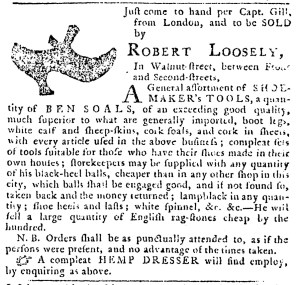
In the early 1770s, Robert Loosely sold “SHOEMAKER’s TOOLS” and materials at his shop on Walnut Street in Philadelphia.  In an advertisement he ran in the Pennsylvania Chronicle in May 1772, he advised the public that he “served his apprenticeship in England, and for some years carried on a considerable trade there.”  During that time, he “became acquainted with the most reputed manufacturers of tools and leather.”  After migrating to Philadelphia, he put his knowledge and connections to good use in importing and selling only the highest quality items connected to that trade.

Loosely did not rehearse that history when he advertised in the Pennsylvania Journal in December 1774.  Perhaps he believed that prospective customers were familiar enough with his reputation that he no longer needed to do so.  He did, however, continue to make appeals to quality and even offered a money-back guarantee for some of his wares.  He described his tools and soles as “exceeding good quality,” even “much superior to what are generally imported.  When it came to “black-heel balls” used to blacken the edges of heels and soles, Loosely told shopkeepers that they “may be supplied with any quantity … cheaper than in any other shop in this city.”  Furthermore, those items “shall be engaged good, and if not found so, taken back and the money returned.”  He trusted that his confidence would entice prospective customers to purchase from him over his competitors.

In a nota bene, Loosely encouraged customers to send orders rather than visiting his shop, declaring that they “shall be as punctually attended to, as if the persons were present.”  In addition, he assured readers, “no advantage of the times taken.”  He referred to the Continental Association, a nonimportation agreement enacted by the First Continental Congress in response to the Coercive Acts.  With imported goods curtailed after December 1, he could have raised prices, yet he abided by the ninth article that asserted, “Venders of Goods or Merchandise will not take Advantage of the Scarcity of Goods that may be occasioned by this Associacion, but will sell the same at the Rates we have been respectively accustomed to do for twelve Months last past.”  Politics and commerce interested in Loosely’s marketing efforts in the final days of 1774.

December 27

What was advertised in a colonial American newspaper 250 years ago today?

Essex Gazette (December 27, 1774).

“THE Committee of Inspection for the Town of PLYMOUTH, hereby give Notice.”

Once the Continental Association went into effect on December 1, 1774, a new sort of advertisement began appearing in the Essex Gazette and other newspapers.  Rather than advertising and selling their own merchandise, importers surrendered those roles to local Committees of Inspection, “agreeable to the Tenth Article of the Association of the American Continental Congress.”  The First Continental Congress had devised the nonimportation agreement during its meetings in Philadelphia in September and October 1774 and then disseminated it throughout the colonies.

The tenth article of the Continental Association made provisions for goods imported between December 1, 1774, and February 1, 1775.  The importers could choose to return the merchandise or turn it over to the local Committee of Inspection.  If they chose the latter, they could opt for the committee to store the wares until the nonimportation agreement ended or sell them on behalf of the importer, in which case the importer recovered the cost of the items, but profits were designated for relief of Boston since it faced so much hardship once the Boston Port Bill closed and blockaded the harbor.  The tenth article also specified that “a particular Account of all goods so returned, stored, or sold, [was] to be inserted in the publick Papers.”

Such was the case in two advertisements that John Torrey, chairman of the Committee of Inspection in Plymouth, first placed in the Essex Gazette on December 20, 1774, and again in subsequent issues.  Those advertisements indicated which vessels transported the goods, but did not name the importers.  They gave straightforward lists of the merchandise offered for sale without incorporating any of the common appeals to price, quality, fashion, or consumer choice.  No marketing strategy nor turn of phrase (such as “very cheap” or “large Assortment”) sought to distinguish the merchandise in these advertisements from other goods available for sale.  With political principles as the primary focus, John Torrey and the Committee of Inspection had little motivation to craft the sort of lively advertisements that the importers might have placed on their own behalf under other circumstances.

December 23

What was advertised in a colonial American newspaper 250 years ago today?

New-Hampshire Gazette (December 23, 1774).

“Fall GOODS, which were imported before the 1st of Dec.”

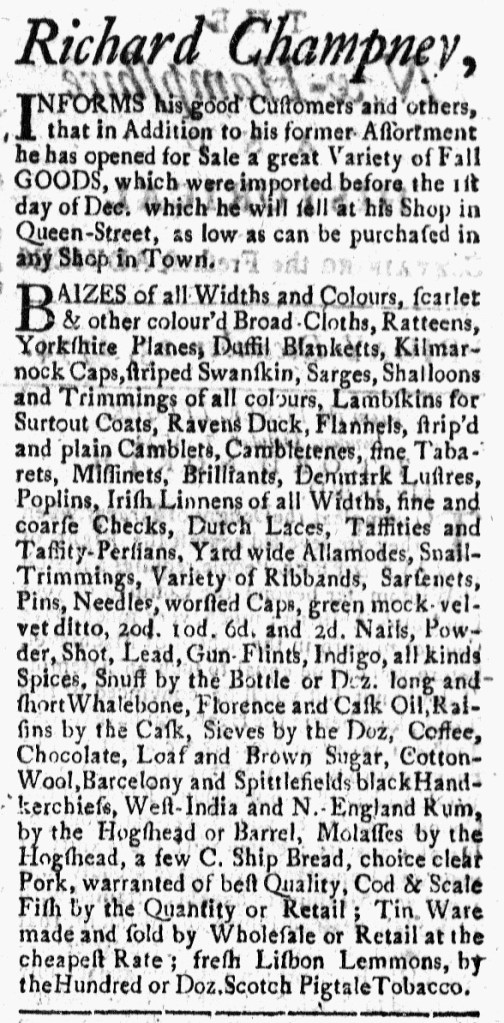
Richard Champney’s advertisement in the December 23, 1774, edition of the New-Hampshire Gazette looked like many others that had appeared in that newspaper and others throughout the colonies for about two decades.  The shopkeeper emphasized that he stocked “a great Variety of Fall GOODS” and promised competitive prices, declaring that consumers could acquire his merchandise “as low as can be purchased in any Shop in Town.”  To demonstrate the array of choices he offered, he devoted most of his advertisement to an extensive list that included “BAIZES of all Widths and Colours,” “Shalloons and Trimmings of all colours,” “strip’d and plain Camblets,” “fine and coarse Checks,” a “Variety of Ribbands,” “worsted Caps,” and “Barcelony and Spittlefields black Handkerchiefs.”  Although many of those textiles and accessories may not be immediately familiar to modern readers, they resonated with readers immersed in the consumer revolution of the eighteenth century.  They fluently spoke the language of consumption.

Despite the similarities with longstanding forms of advertising, Champney’s notice included one detail that distinguished it from what he would have published even a month earlier.  Although he had “opened” a new stock to supplement his “former Assortment,” those new goods “were imported before the 1st day of Dec[ember].”  That clarification was important for the shopkeeper to bring to the attention of prospective customers in Portsmouth and nearby towns and anyone who might read the New-Hampshire Gazette far and wide.  Champney explicitly specified that he observed the Continental Association, a nonimportation agreement adopted by the First Continental Congress that went into effect on December 1.  Since he had received this “great Variety of Fall GOODS” before that date, he could sell them with a clear conscience.  Similarly, consumers could purchase them without worrying whether they aided the shopkeeper in breaking the agreement.  For many years advertisers had noted when they imported their merchandise as a means of assuring prospective customers that they carried new items of the latest styles and taste.  After December 1, 1774, however, when a shipment arrived had political significance and new sorts of ramifications for both advertisers and buyers.

December 22

What was advertised in a colonial American newspaper 250 years ago today?

New-York Journal (December 22, 1774).

“Willing to comply with the association entered into by the late Continental Congress.”

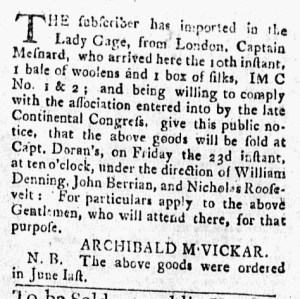
When a shipment of “1 bale of woolens and 1 box of silks” arrived in New York via the Lady Gage on December 10, 1774, Archibald McVickar surrendered the good to the local Committee of Inspection and placed an advertisement to that effect in the New-York Journal.  He declared that he was “willing to comply with the association entered into by the late Continental Congress.”  Accordingly, those goods “will be sold … under the direction of William Denning, John Berrian, and Nicholas Roosevelt.”  Anyone wishing to learn more about the sale should “apply to the above Gentlemen” rather than to the McVickar.

McVickar abided by the Continental Association, a nonimportation agreement enacted by the First Continental Congress in response to the Coercive Acts.  In particular, the tenth article stated, “In Case any Merchant, Trader, or other Persons, shall import any Goods or Merchandise after the first Day of December [1774], and before the first Day of February next, the same ought forthwith, at the Election of the Owner, to be either reshipped or delivered up to the Committee of the County or town wherein they shall be imported, to be stored at the Risk of the Importer, until the Non-importation Agreement shall cease, or be sold under the Direction of the Committee aforesaid.”  In other words, McVickar had three options since his shipment arrived on December 10.  He could return it, turn the goods over to the committee to store until the nonimportation agreement ended, or turn the goods over to the committee to sell.

McVickar chose the final option.  The Continental Association made further provisions that he would be reimbursed for the cost of the goods yet could not earn any profit on them.  Instead, any profit was to be applied to relief efforts for Boston where the harbor had been closed and blockaded since the Boston Port Act went into effect on June 1.  McVickar added a nota bene to clarify that the “goods were ordered in June last.”  At that time, colonizers suspected that a nonimportation agreement might go into effect in the future, but the First Continental Congress had not yet met or composed and disseminated the Continental Association.  McVickar suggested that he had not deliberately attempted to get around that agreement, as he further demonstrated in asserting that he was “willing to comply with the association.”  Whatever he lost in profit, he gained in staying in the good graces of members of the community who supported the Patriot cause.