January 12

What was advertised in a revolutionary American newspaper 250 years ago today?
Connecticut Gazette (January 12, 1776).

(Advertisements omitted will be in our next.)

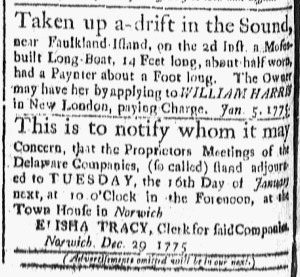
Instead of the usual four pages, the January 12, 1776, edition of the Connecticut Gazette consisted of only two pages.  Most issues of colonial newspapers had four pages, created by printing two pages on each side of a broadsheet and folding it in half.  Timothy Green, the printer of the Connecticut Gazette, had only enough paper that he was forced to condense the contents to a half sheet, one page printed on each side.  He certainly was not the only printer to experience a disruption in his paper supply during the first year of the Revolutionary War.

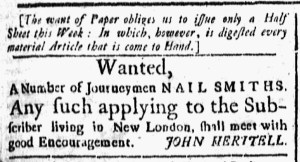
Green acknowledged the situation with a note that appeared at the top of the first column on the first page: “[The want of Paper obliges us to issue only a Half Sheet this Week: In which, however, is digested every material Article that is come to Hand.]”  In other words, subscribers and other readers did not need to worry that they missed important news because Green did not have enough space to print it.  Instead, he carefully undertook his duties as an editor to include everything of importance received in the printing office since the previous week’s issue of the Connecticut Gazette.  The small font for news items, smaller than the font used for advertisements, also allowed Green to squeeze a significant amount of content into just two pages.
Connecticut Gazette (January 12, 1776).

What about the advertisements?  Only three paid notices appeared in that issue, one for “Journeyman NAIL SMITHS” immediately below the printer’s note on the first page and two more at the bottom of the final column on the second page.  The printer concluded the issue with a brief note: “(Advertisements omitted will be in our next.)”  Green assured advertisers, especially those who paid in advance of publication, that the Connecticut Gazette would indeed disseminate their notices.  In this instance, however, he prioritized the needs of subscribers (many of whom did not make timely payments) and other readers (who did not pay the printer at all) over advertisers (who comprised an important revenue stream).  It was a careful balancing act for all colonial printers as they served multiple constituencies simultaneously.  For this issue, Green considered keeping subscribers and the rest of the public informed about “The King’s SPEECH, to both Houses of Parliament, October 26, 1775,” and news from London, Philadelphia, New York, Newport, Worcester, and Watertown (where the Continental Army continued the siege of Boston) more important than publishing many of the advertisements submitted to his printing office.
December 25

What was advertised in a revolutionary American newspaper 250 years ago today?

New-York Gazette and Weekly Mercury (December 25, 1775).

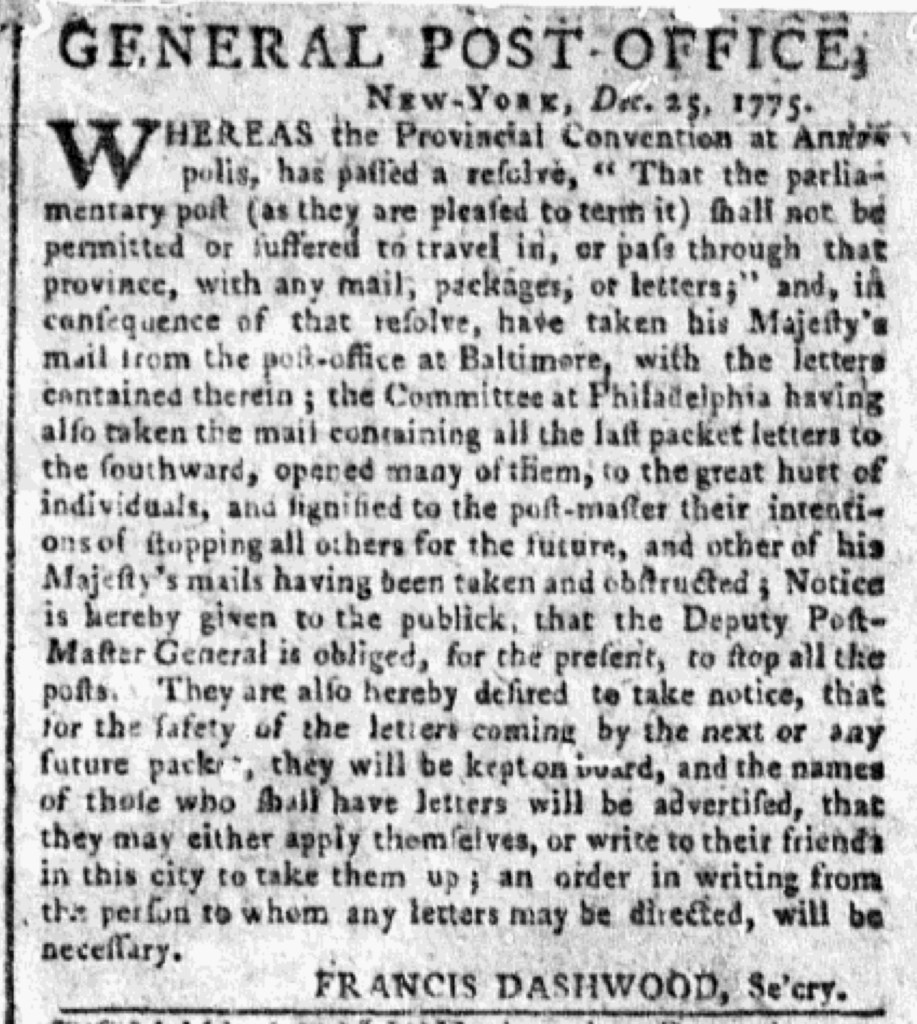
“The Deputy Post-Master General is obliged, for the present, to stop all the posts.”

In the summer and fall of 1775, advertisements for local Constitutional Post Offices, established by the Second Continental Congress as an alternative to the imperial system, appeared in newspapers printed in several colonies.  Postmasters provided schedules.  Post riders offered their services.  As winter arrived, the Deputy Postmaster General of the “parliamentary post (as [supporters of the American cause] are pleased to term it)” published an advertisement announcing that he “is obliged, for the present, to stop all the posts.”  He did not cite competition from the Constitutional Post.  Instead, he blamed the actions of provincial conventions meeting in some of the colonies and abuses by rogues who tampered with private letters.

In Maryland, for instance, one of those conventions passed a resolve that “the parliamentary post … shall not be permitted or suffered to travel in, or pass through, that province, with any mail, packages, or letters.”  In turn, they had confiscated “his Majesty’s mail from the post-office at Baltimore.”  Similarly, a committee in Philadelphia seized “the last packet letters to the southward … and signified to the post-master their intentions of stopping all others for the future.”  That was not all!  That committee also “opened many of [the letters], to the great hurt of individuals,” engaging in some of the same behavior that had caused William Goddard first to envision the Constitutional Post and then advocate that the Second Continental Congress officially endorse it.  The Deputy Postmaster General suggested that it was the Sons of Liberty and their supporters who had infringed on the liberties of others.

Yet this did not end the imperial postal system, though the procedures for delivering letters changed: “for the safety of the letters coming by the next or any future packet,” a ship that carried mail, “they will be kept onboard, and the names of those who shall have letters will be advertised.”  Even if Hugh Gaine, the printer of the New-York Gazette and Weekly Mercury who had recently published a local edition of the Journal of the Proceedings of the Continental Congress, did not care for every British policy, he almost certainly welcomed the advertising revenue for running this notice and the prospects for publishing lists of those who had letters waiting for them aboard packet ships in the harbor.  He was not a staunch patriot like John Holt, printer of the New-York Journal, and John Anderson, printer of the Constitutional Gazette, helping to explain why the advertisement concerning the “GENERAL POST-OFFICE” first appeared in his newspaper.

December 22

What was advertised in a revolutionary American newspaper 250 years ago today?

South-Carolina and American General Gazette (December 22, 1775).

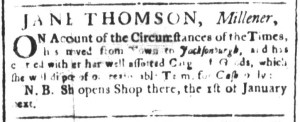
“JANE THOMSON, Millener, ON Account of the Circumstances of the Times, has moved from Town to Jacksonburgh.”

In December 1775, Jane Thomson, a milliner, had been running a shop in Charleston and occasionally placing newspaper advertisements for several years.  She likely followed news from Massachusetts about the hostilities that commenced at Lexington and Concord the previous April as well as updates from the meetings of the Second Continental Congress in Philadelphia.  She probably knew that residents of urban ports beyond New England felt anxious that the British would target their homes next, prompting some to move to the countryside for better security.  She apparently experienced the same anxiety and charted a new course accordingly.  In the December 22 edition of the South-Carolina and American General Gazette, the only newspaper still being published in the colony at the time, she announced that “ON Account of the Circumstances of the Times” she “has moved from Town [or Charleston] to Jacksonburgh,” nearly fifty miles to the west.  Thomson informed readers that she “has carried with her her well assorted [illegible] of Goods, which she will dispose of on reasonable Terms for Cash only.”  She planned to open her shop in her new location on January 1, 1776.

Thomson’s notice will be one of the last advertisements from the South-Carolina and American General Gazette featured on the Adverts 250 Project.  The newspaper continued publication until the end of February 1781, with some suspensions due to the Revolutionary War, and a complete run through December 1779 has been preserved buy the Charleston Library Society.  However, issues for 1776, 1777, 1778, and 1779 have not been digitized for greater accessibility.  In producing the Adverts 250 Project and the Slavery Adverts 250 Project, I have relied on the South Carolina Newspapers collection from Accessible Archives (now part of History Commons), yet that coverage ends with the issue for December 22, 1775.  Readex’s America’s Historical Newspapers has five more issues (September 4, 1776; April 10, 1777; February 19, June 4, and October 1, 1778) that I will incorporate into the project at the appropriate times, but the Adverts 250 Project and the Slavery Adverts 250 Project will not offer the same sustained look at advertising and the intersections of commerce, politics, and everyday life in Charleston during the Revolutionary War as I have attempted to provide for the period of the imperial crisis that ultimately led to that war.  The stories of that important urban port have always been truncated according to which advertisements I selected to feature.  Now they will be absent altogether.

December 11

What was advertised in a revolutionary American newspaper 250 years ago today?

South-Carolina Gazette (December 11, 1775).

“The Times make it uncertain how long he will be able to keep his Store open in Town.”

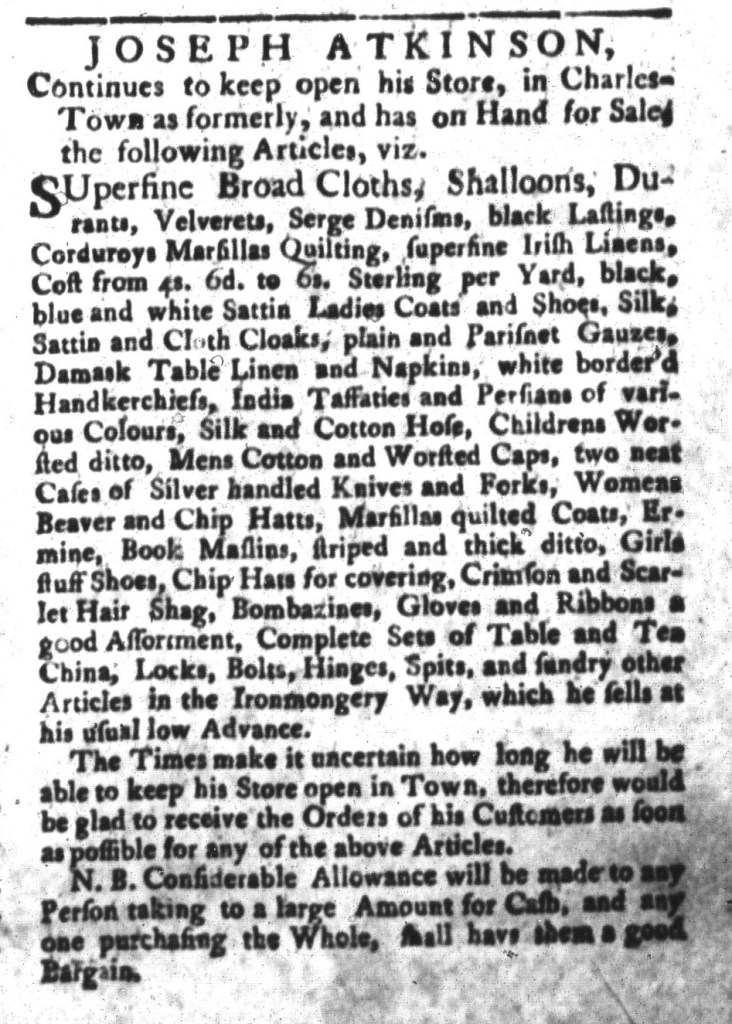
Joseph Atkinson placed an advertisement in the December 11, 1775, edition of the South-Carolina Gazette to advise prospective customers that he “Continues to keep open his Store, in Charles-Town as formerly.”  He listed an array of merchandise, including a variety of textiles, “Mens Cotton and Worsted Caps, two Cases of Silver handled Knives and Forks, Womens Beaver and Chip Hats, … Gloves and Ribbons a good Assortment, Complete Sets of Table and Tea China, … and sundry other Articles in the Ironmongery Way.”  Atkinson sought to liquidate his stock, declaring that “Considerable Allowance will be made to any Person taking to a large Amount for Cash.”  Furthermore, “any one purchasing the Whole, shall have them at a good Bargain.”

The shopkeeper also confessed that the “Times make it uncertain how long he will be able to keep his Store open in Town.”  He declared that he “therefore would be glad to receive the Orders of his Customers as soon as possible.”  To underscore the point about uncertain times, the items on the first page of that issue featured updates from the Second Continental Congress in Philadelphia and the colony’s own congress, including a call for provisions “to supply the REGIMENT of ARTILLERY in the Service of this Colony.”  What Atkinson and readers of the South-Carolina Gazette did not know was that the newspaper would soon cease publication.  The December 11 edition became the last known issue, though Clarence S. Brigham reports it “was followed by one other number, probably Dec[ember] 18.”[1]  Peter Timothy, the printer, revived the newspapers as the Gazette of the State of South-Carolina sixteen months later, on April 9, 1777.  As the title indicates, the colonies declared independence by the time Timothy resumed publishing his newspaper.

The demise of the South-Carolina Gazette meant less news and advertising circulating in that colony and the region.  Four months earlier, the South-Carolina Gazette and Country Journal folded.  Now only the South-Carolina and American General Gazette remained.  For nearly a decade, three competing newspapers served Charleston and the rest of the colony, many issues devoting more space to advertising than news.  Although the South-Carolina and American General Gazette continued publication, with occasional suspensions, until February 28, 1781, issues published after 1775 have not been preserved and digitized for wider access.  That means that advertisements from South Carolina, including the urban port of Charleston, will no longer be part of the Adverts 250 Project and the Slavery Adverts 250 Project.  As the projects continue to tell stories about the era of the American Revolution, they will focus on New England, New York, Pennsylvania, and the Chesapeake, drawing on those newspapers that continued publication (or commenced publication during the Revolutionary War) and that have been preserved and digitized.  So many stories remain to be told, but, for a time, South Carolina will be largely absent from this project’s featured advertisements.

**********

[1] Clarence S. Brigham, History and Bibliography of American Newspapers, 1690-1820 (Worcester: American Antiquarian Society, 1947), 1038.

October 3

What was advertised in a revolutionary American newspaper 250 years ago today?

New-Hampshire Gazette (October 3, 1775).

“Brown Bread with Liberty, will please more, than white with Slavery.”

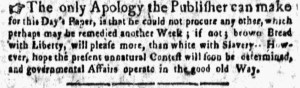
No advertisements appeared in the October 3, 1775, edition of the New-Hampshire Gazette, though the printer, Daniel Fowle, inserted a notice addressing why that was the case.  “The only Apology the Publisher can make for this Day’s Paper,” he stated, is that he could not procure any other.”  He referred to the size of the broadsheet.  The newspaper usually consisted of four pages with three columns on each page, but since hostilities commenced at Lexington and Concord Fowle’s paper supply had been disrupted.  Many issues consisted of only two pages, including the one from the previous week.  Despite having fewer pages, the masthead for the September 26 edition featured an additional note that proudly exclaimed, “This Paper compleats the 19th Year of the New-Hampshire GAZETTE, AND HISTORICAL CHRONICLE.”  The newspaper began its twentieth year with a two-page edition that had only two columns on each page.  Given the limited space, Fowle published news and excluded advertisements.

Fowle hoped that the problem “may be remedied another Week,” but “if not; brown Bread with Liberty, will please more, than white with Slavery.”  Like many other printers, he had been a consistent supporter of the American cause.  Even so, he added his “hope [that] the present unnatural Contest will soon be determine, and governmental Affairs operate in the good old Way.”  In the fall of 1775, most colonizers still sought a redress of grievances from Parliament.  Within a year, however, the Continental Congress would declare independence and the war that started at Lexington and Concord would not end until 1783.  Those “governmental Affairs” would never again “operate in the good old Way.”  Fowle did, however, manage to acquire paper for the next issue of the New-Hampshire Gazette.  The October 10 edition once again had advertisements, including one from Mrs. Hooper, a milliner, and another insertion of John Williams’s invitation to his “House of Entertainment … at the Sign of the SALUTATION.”  It was not the last time, however, that Fowle would experience a disruption in his paper supply during the war.

July 22

What was advertised in a revolutionary American newspaper 250 years ago today?

Essex Journal (July 22, 1775).

THE extreme Difficulty of the Times having rendered it very difficult to procure a sufficiency of Paper.”

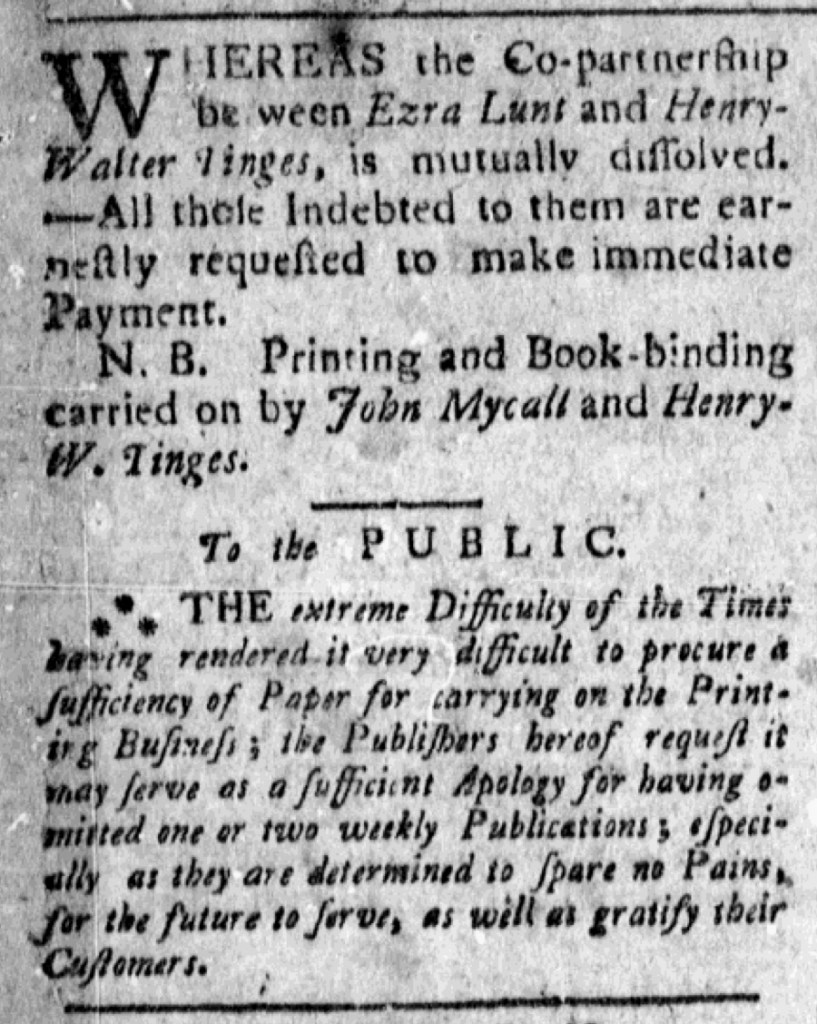
A notice on the first page of the July 22, 1775, edition of the Essex Journal, Or, the Massachusetts and New-Hampshire General Advertiser informed readers that the “Co-partnership between Ezra Lunt and Henry-Walter Tinges,” the publishers of the newspaper, “is mutually dissolved” and called on “those Indebted to them” to settle accounts.  Yet the printing office in Newburyport was not being shuttered.  Instead, a nota bene declared, “Printing and Book-binding carried on by John Mycall and Henry-W. Tinges.”  Mycall became Tinges’s third partner in less than three years.  The young printer first went into business with Isaiah Thomas, the printer of the Massachusetts Spy in the late fall of 1773.  The more experienced printer remained in Boston while his junior partner oversaw the printing office and their new newspaper.  The partnership lasted less than a year.  On August 17, 1774, they notified the public that they “mutually dissolved” their partnership, but the “Printing Business is carried on as usual, by Ezra Lunt and Henry W. Tinges.”

Nearly a year later, Lunt departed and Mycall took his place.  As their first order of business, the new partners addressed some of the challenges the newspaper faced since the battles at Lexington and Concord three months earlier.  “THE extreme Difficulty of the Times having rendered it very difficult to procure a sufficiency of Paper for carrying on the Printing Business,” they lamented, “the Publishers hereof request it may serve as a sufficient Apology for having immitted one or two weekly Publications.”  Indeed, publication had been sporadic during May, immediately after the outbreak of hostilities, returned to a regular schedule in June, and then missed a week in July before announcing the departure of Lunt and arrival of Mycall.  The Essex Journal had missed only two issues, but the publishers did not consistently distribute the newspapers on the same day each week.  That likely added to the impression that they had not supplied all the newspapers that their customers expected.  In addition, the two most recent issues, June 30 and July, and the one that carried the notice about the new partnership consisted of only two pages rather than the usual four.  Mycall and Tinges vowed that “they are determined to spare no Pains, for the future to serve, as well as gratify their Customers.”  Mycall and Tinges kept that promise.  Publication returned to a regular schedule with only minor disruptions.