February 13

What was advertised in a revolutionary American newspaper 250 years ago today?
Dunlap’s Maryland Gazette (February 13, 1776).

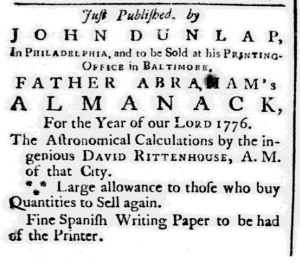
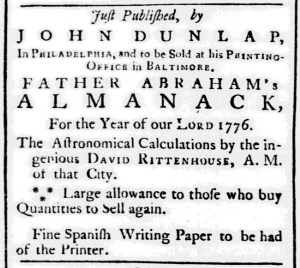
“FATHER ABRAHAM’s ALMANACK, For the Year of our LORD 1776.”

John Dunlap, the printer of Dunlap’s Maryland Gazette, apparently had surplus copies of “FATHER ABRAHAM’s ALMANACK, For the Year of our LORD 1776,” that he hoped to sell in the middle of February of that year.  Although the “Astronomical Calculations by the ingenious DAVID RITTENHOUSE” for the first six weeks of the year were no longer of use to readers, the rest of the contents still had value.  Hoping to move some or all the remaining copies out of his printing office in Baltimore, Dunlap once again placed an advertisement that had first appeared in Dunlap’s Maryland Gazette in October, well before the new year began and readers would refer to the calendars and astronomical calculations in the handy reference manual.  Prospective customers knew that the phrase “Just Published” at the beginning of the advertisement merely meant that copies were available to purchase, not that the almanacs just came off the press.

In addition to operating a printing shop and publishing a newspaper in Baltimore, Dunlap also ran a printing shop in Philadelphia.  It was there, according to his advertisement, that he had printed the almanac and then sent copies to his printing office in Baltimore.  He had also advertised the almanac in the newspaper he published in Philadelphia, Dunlap’s Pennsylvania Packet.  He did not, however, continue running advertisements for the almanac in that newspaper in February 1776.  Perhaps he sold out of copies in Philadelphia.  After all, he established his printing office and newspaper there before his second printing office and newspaper in Baltimore.  Consumers in Philadelphia and its hinterlands had greater familiarity with Dunlap, the printer, and Rittenhouse, the astronomer and mathematician who did the calculations for the almanac.  Alternately, Dunlap may not have continued advertising the almanac in the newspaper published at his printing office in Philadelphia because that location received a heavier volume of advertisements.  The printer may have determined that the revenue generated from advertisements submitted by customers outweighed any potential revenue from advertising the almanac once again.  With limited amount of space in each issue, delivering news also took precedence over yet another advertisement for the almanac.  Dunlap and those who labored in his printing offices may have had other reasons for continuing to advertise the almanac in Baltimore but not in Philadelphia.  Whatever the explanation, the advertisement in Dunlap’s Maryland Gazette became a familiar sight to readers over the course of several months.

December 26

Who was the subject of an advertisement in a revolutionary American newspaper 250 years ago today?

Dunlap’s Maryland Gazette (December 26, 1775).

“N.B. A Negroe woman Cook, healthy honest and sober, 33 years old.”

Alexander Stenhouse apparently wished to discontinue his medical supply business in Baltimore.  In the final week of December 1775, he placed advertisements in both Dunlap’s Maryland Gazette and the Maryland Journal that listed a “general Collection of DRUGS and MEDICINES” available for sale.  He added vials, “Large bottles for Distilled Waters,” “Pill pots of various sizes, labelled and plain,” “Mortars and pestles,” “Surgeons Instruments,” and other medical equipment.  He even included “Shop Furniture,” suggesting that he no longer needed it because he would no longer pursue that trade.  In addition, he declared that the “Drugs and Medicines will not be sold singly, so it is expected those who want will take an assortment.”  To make the offer even more attractive, Stenhouse promised a “considerable discount … to a person who will purchase the whole.”  Perhaps Stenhouse even intended to leave Baltimore.  His inventory concluded with a “Collection of Books, mostly modern publications,” and “Houshold and kitchen furniture, in general almost new.”

Stenhouse offered more than just the contents of his shop and home for sale.  In a nota bene that followed his signature, he described a “Negroe woman Cook, healthy honest and sober, 33 years old.”  The sale of that woman whose name was once known testifies to the widespread use of the early American press to perpetuate slavery and the slave trade.  At a glance, the phrases “TO BE SOLD” and “DRUGS and MEDICINES,” dominated Stenhouse’s advertisement.  The list of items for sale, divided into two columns, unlike any of the other in either newspaper, likely caught readers’ eyes as well.  Those aspects of Stenhouse’s advertisement overshadowed but did not eclipse the portion that offered an enslaved woman for sale.  The format did not indicate that Stenhouse felt any shame or embarrassment about selling a “Negroe woman Cook” and wanted to downplay it; instead, the format demonstrated just how casually enslavers incorporated such transactions into everyday advertising and routine business.  “N.B.” or nota bene, after all, meant “take note.”  Stenhouse wished for readers to “take note” that he wished to sell an enslaved woman as he “disposed of” the contents of his shop and home.

December 19

What was advertised in a revolutionary American newspaper 250 years ago today?

Dunlap’s Maryland Gazette (December 19, 1775).

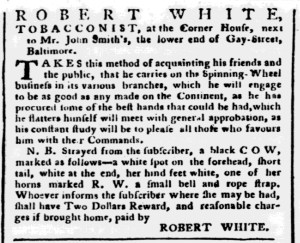
“He carries on the Spinning-Wheel business in its various branches.”

In the final weeks of 1775, Robert White, a tobacconist in Baltimore, diversified his business.  He inserted an advertisement in the December 19 edition of Dunlap’s Maryland Gazette that announced that “he carries on the Spinning-Wheel business in its various branches.”  Why would a tobacconist decide to go into that line of business?  The Continental Association, a nonimportation and nonconsumption agreement devised by the Furst Continental Congress, remained in effect.  It called on colonizers to replace imported goods, including textiles, with alternatives produced in the colonies.  That meant more time spent spinning, a domestic chore that gained political significance.  Women styled Daughters of Liberty in newspaper accounts participated in public spinning bees to demonstrate their patriotism and inspire others to follow their example in their own homes.  To do so, they needed the right equipment.  White saw an expanding market for spinning wheels.

He was not alone in marketing equipment for producing homespun cloth.  His advertisement happened to appear immediately above Fergus McIllroy’s notice promoting “LOOMS made properly, for carrying on the Linen and Woolen Weaving-business.”  McIllroy, a “House Joiner,” also pursued a new line of work, though in his case doing so did not depart nearly as much from his primary occupation.  In addition, he reported that he had previously constructed more than two hundred looms in Ireland before migrating to the colonies.  White, the tobacconist, did not invoke such experience when it came to spinning wheels, yet he confidently proclaimed that he “will engage” his spinning wheels “to be as good as any made on the Continent” because “he has procured some of the best hands that could be had.”  In turn, White “flatters himself” that his workers and the spinning wheels they produced “will meet with general approbation” or approval from customers.  The tobacconist apparently served as a supervisor, an entrepreneur who established a business when he identified need for it during difficult time yet did not participate in making the spinning wheels.  Instead, in overseeing his new business, he pledged that “his constant study will be to please all those who favours him with their Commands.”  With no resolution in sight for the imperial crisis that became a war the previous April, White’s advertisement likely resonated with readers who understand the political implications of a tobacconist deciding to produce spinning wheels.

November 28

What was advertised in a revolutionary American newspaper 250 years ago today?

Dunlap’s Maryland Gazette (November 28, 1775).

“He will engage to make Looms for the weaving of Linen an[d] Woollen.”

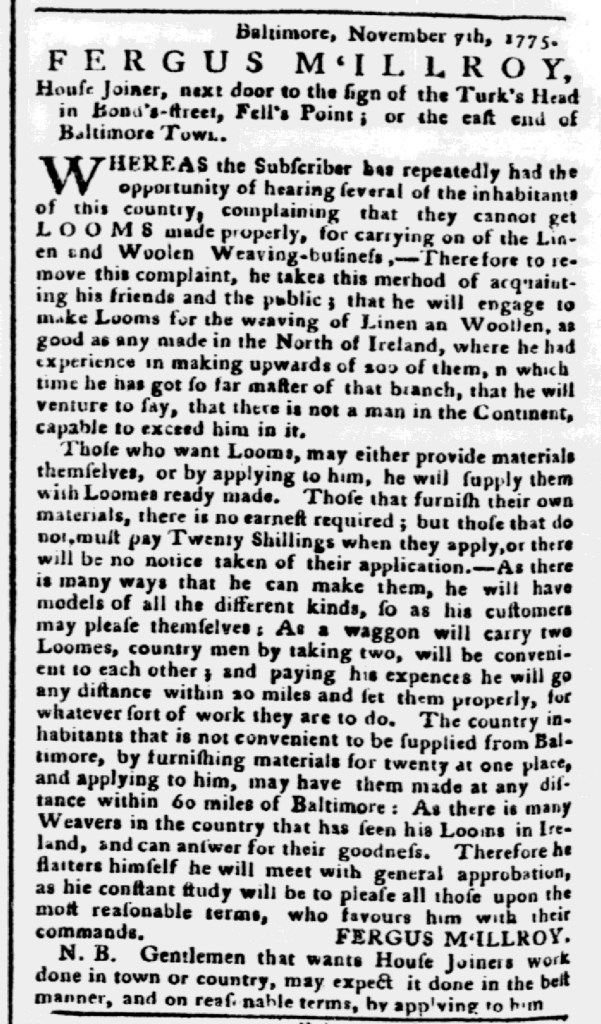
At the same time that David Poe advertised that he “set up … the business of SPINNING WHEEL Making” in Baltimore in November 1775, Fergus McIllroy took to the pages of Dunlap’s Maryland Gazette to inform the public that he “will engage to make Looms for the weaving of Linen an[d] Woolen.”  Both artisans responded to demand for equipment for making textiles that arose in response to the Continental Association, a nonimportation and nonconsumption agreement devised by the First Continental Congress to leverage commerce as a means of achieving political goals.  The text of the pact stated that it would remain in place until Parliament repealed duties on tea and the Coercive Acts that punished Boston for the destruction of tea in what has become known as the Boston Tea Party.  It also issued a call to “encourage Frugality, Economy, and Industry; and promote Agriculture, Arts, and the Manufactures of this Country, especially that of Wool.”

Many colonizers, both men and women, wanted to do their part in producing domestic manufactures as alternatives to imported textiles and other goods, but they needed materials and equipment.  McIllroy reported that he “repeatedly had the opportunity of hearing several of the inhabitants of this country, complaining that they cannot get LOOMS made properly, for carrying on of the Linen and Woolen Weaving-business.”  Although he currently worked as a “House Joiner,” he claimed that he “has experience of making upwards of 200” looms before he migrated to Baltimore.  That being the case, he pledged that his looms were “as good as any made in the North of Ireland.”  Yet prospective customers did not have to take his word for it: “there is many Weavers in the country that has seen his Looms in Ireland, and can answer for their goodness.”  For good measure, he added that he was a “master” when it came to making looms and “there is not a man in the Continent capable to exceed him.”

In addition, McIllroy noted the “many ways that he can make them,” so he had “models of all the different kinds, so as his customers may please themselves.”  Furthermore, they could supply the materials for constructing their looms or leave it to McIllroy to provide the materials.  In the latter instance, customers had to pay a deposit of twenty shillings before McIllroy would make their loom.  He also outlined the conditions for visiting homes to “set them up properly.”  If a town within sixty miles of Baltimore wished to order twenty or more looms, he offered to do the work there to avoid transporting the new looms over long distances.  McIllroy stood ready to contribute to the American cause with his “Industry” that in turn “promote[d] … the Manufactures of this Country,” joining with other artisans who vowed to do the same.

November 14

What was advertised in a revolutionary American newspaper 250 years ago today?

Dunlap’s Maryland Gazette (November 14, 1775).

“He has set up … the business of SPINNING WHEEL Making.”

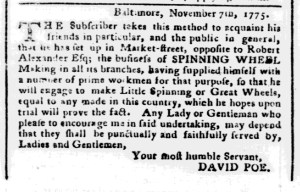
David Poe established a workshop for making spinning wheels in Baltimore in the fall of 1775.  To attract the attention of prospective customers, he placed an advertisement in the November 14 edition of Dunlap’s Maryland Gazette, advising “his friends in particular, and the public in general, that he has set up … the business of SPINNING WHEEL Making in all its branches.”  Rather than make one spinning wheel at a time, he could produce them in quantity, “having supplied himself with a number of prime workmen for that purpose.”  Poe did not specify whether those “prime workmen” were free, indentured, or enslaved.  He instead emphasized that he “will engage to make Little Spinning or Great Wheels, equal to any made in this country.”  Furthermore, he invited readers to see for themselves, stating that he “hopes upon trial” spinning wheels made in his workshop “will prove the fact.”

Poe advertised spinning wheels at a time that they became political symbols.  In response to the Coercive Acts that Parliament passed to punish Boston after the destruction of imported tea during a protest now known as the Boston Tea Party, the First Continental Congress devised the Continental Association, a nonimportation, nonconsumption, and nonexportation pact that called on colonizers to abstain from purchasing goods, including textiles, imported from England.  The agreement also included a call for colonizers to “encourage Frugality, Economy, and Industry; and promote Agriculture, Arts, and the Manufactures of this Country, especially that of Wool.”  Poe heeded that call as homespun cloth produced in the colonies became a fashionable political statement.  Newspapers carried reports of women participating in politics by holding spinning bees in public spaces.  Rather than a useful tool operated in domestic settings, the spinning wheel became a symbol of public commitment to the American cause, a visible demonstration to friends, neighbors, and the rest of the community that industrious women hoped would inspire others to follow their lead.  Poe did his part, aiming to provide “Any Lady or Gentleman” with spinning wheels for their households.  He did not make direct reference to the Continental Association or the events that had unfolded in the seven months since the battles at Lexington and Concord, but he did not need to do so.  Readers certainly understood the connection between spinning wheels and current events.

October 31

What was advertised in a revolutionary American newspaper 250 years ago today?

Dunlap’s Maryland Gazette (October 31, 1775).

“Large allowance to those who buy Quantities to Sell again.”

When John Dunlap published “FATHER ABRAHAM’S ALMANACK, For the Year of our LORD 1776,” in the fall of 1775, he set about advertising the handy reference manual.  He gave the advertisement a privileged place in the September 11, 1775, edition of Dunlap’s Pennsylvania Packet, the newspaper he printed in Philadelphia.  It ran immediately below the lists of ships arriving and departing from the customs house, increasing the chances that readers interested more in news than advertisements would see it.  Unlike other printers who hawked almanacs, Dunlap did not provide an extensive description of the contents to entice prospective customers, though he did indicate that “the ingenious DAVID RITTENHOUSE … of this city” prepared the “Astronomical Calculations.”  The printer believed that the astronomer’s reputation would help sell copies of the almanac.

He also ran advertisements in Dunlap’s Maryland Gazette, the newspaper he printed in Baltimore.  One of those notices appeared in the October 31 edition, again highlighting Rittenhouse’s role in making the “Astronomical Calculations.”  This advertisement did not include additional information about the contents, but it did include an appeal to retails that did not appear in the first iteration of the advertisement in Dunlap’s Pennsylvania Packet on September 11 nor in the most recent insertion on October 30.  Dunlap promised a “Large allowance to those who buy Quantities to Sell again.”  In other words, he offered discounts for purchasing in volume to make the almanac attractive to booksellers, shopkeepers, and peddlers.  Did Dunlap offer the same deal at his printing office in Philadelphia yet not advertise it in the public prints?  Other printers advertised discounts for buying almanacs by the dozen or by the hundred frequently enough to suggest that it was a common practice.  Given that Philadelphia had far more printers than Baltimore, many of them publishing one or more almanacs of their own, Dunlap may have carefully managed the discounts, offering one rate in one city and another rate in the other.  That did not necessarily matter to retailers who saw his advertisement in Dunlap’s Maryland Gazette.  His printing office in Baltimore, opened less than a year earlier, gave them easier access to almanacs than in the past.  The “Large allowance” was a bonus to convince them to take advantage of the convenience rather than order almanacs from other printers in Philadelphia or Annapolis.

October 10

What was advertised in a revolutionary American newspaper 250 years ago today?

Dunlap’s Maryland Gazette (October 10, 1775).

A subscription book for the Military Academy, will be opened immediately.”

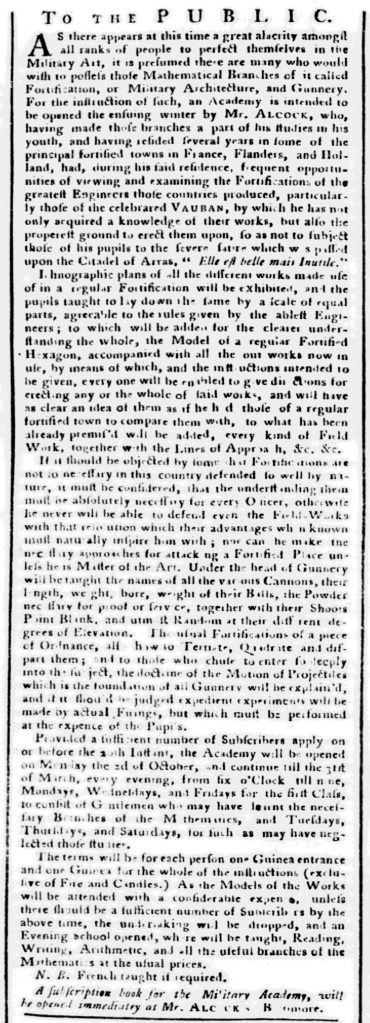
In the fall of 1775, Mr. Alcock advertised an academy with a specialized curriculum.  “AS there appears at this time a great alacrity amongst all ranks of people to perfect themselves in the Military Art,” he declared to readers of the Dunlap’s Maryland Gazette and the Maryland Journal, “it is presumed there are so many who would wish to possess those Mathematical Branches of it called Fortification, or Military Architecture, and Gunnery.”  To that end, Alcock, announced his plans to open a school to teach those subjects.  For his qualifications, he noted that he “made those branches a part of his studies in his youth.”  In addition, he “resided several years in some of the principal fortified towns in France, Flanders, and Holland.”  While there, he took advantage of “frequent opportunities of viewing and examining the Fortifications of the greatest Engineers those countries produced.”  In the first year of the Revolutionary War, Alcock was not the only colonizer to advertise a school of this sort.  In the summer of 1775, John Vinal advertised that he taught “the Doctrine of Projectiles, or Art of GUNNERY,” at his school in Newburyport, Massachusetts.

In advance of opening his academy in Baltimore on October 2, Alcock began advertising in early September.  His lengthy notice appeared in the Maryland Journal on September 6, 13, and 20.  It may have run in Dunlap’s Maryland Gazette as early as September 5, but that issue, if it survives, has not been digitized for wider accessibility.  Alcock’s advertisement did appear in that newspaper for at least five weeks from September 12 through October 10.  With the last two insertions, he likely hoped to pick up stragglers who had not yet enrolled yet had not missed so many classes to join the academy.  From the start, Alcock advised that a “subscription book for the Military Academy, will be opened immediately,” allowing students to commit to enrolling by signing their names.  Prospective students could also peruse the list to see who else in their community planned to attend.  Alcock intended to divide his pupils into two classes, one cohort consisting of “Gentlemen who may have learnt the necessary Branches of the Mathematics” on Mondays, Wednesdays, and Fridays and another series of classes “for such as may have neglected those studies” on Tuesdays, Thursdays, and Saturdays.

Yet Alcock would offer the course on fortifications and gunnery only if “a sufficient number of Subscribers” enrolled.  Those interested in this enterprise needed to encourage their friends and neighbors to sign up or else risk having the classes canceled.  If Alcock did not have enough students, “the undertaking will be dropped and an Evening School opened, where will be taught, Reading, Writing, Arithmetic, and all the useful branches of the Mathematics at the usual prices.”  The schoolmaster did not want to resort to that.  Accordingly, he attempted to convince prospective students of the necessity of his lessons.  “If it should be objected by some that Fortifications are not so necessary in this country defended so well by nature,” he argued, “it must be considered, that the understanding them must be absolutely necessary for every Officer, otherwise he never will be able to defend even the Field-Works with that resolution which their which their advantages when known must naturally inspire him; nor can he make the necessary approaches for attacking a Fortified Place unless he is Master of the Art.”  Prospective students apparently did not find that convincing.  On November 7, Alcock returned to Dunlap’s Maryland Gazette to advertise an evening school “where will be taught Reading, Writing, and Arithmetic” as well as “French, and the most useful branches of the Mathematics, at the usual prices.”  Either he never attracted enough students to open his “Military Academy” or classes fizzled out shortly after they began.

September 12

What was advertised in a revolutionary American newspaper 250 years ago today?

Dunlap’s Maryland Gazette (September 12, 1775).

“Mrs. TAYLOR’s BOARDING SCHOOL … [for] young LADIES.”

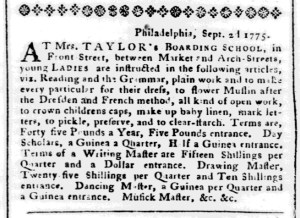
The first advertisement in the September 12, 1775, edition of Dunlap’s Maryland Gazette, published in Baltimore, promoted “Mrs. TAYLOR’s BOARDING SCHOOL” for “young LADIES” on Philadelphia, apparently an elite institution based on the tuition.  The headmistress charged forty-five pounds per year along with an initial entrance fee of five pounds.  Taylor advised the parents and guardians of prospective pupils that they would be taught “Reading and the Grammar, plain work and to make every particular for their dress, to flower Muslin after the Dresden and French method, all kind of open work, to crown childrens caps, make up baby linen, mark letters, to pickle, preserve, and to clear-starch.”  The standard curriculum combined practical skills that prepared young women to run a household with some leisure activities that testified to their status.

Yet that was not the extent of the instruction that took place at Taylor’s boarding school.  For additional fees, her charges could opt for additional lessons taught by tutors that Taylor hired.  Students learned to form their letters from a “Writing Master” for fifteen shillings each quarter.  They learned their steps from a “Dancing Master” for a guinea (or twenty-one shillings) each quarter.  Although Taylor did not say so, those students presumably learned to dance with grace rather than focusing exclusively on the mechanics of minuets and other popular dances.  Lessons from a “Drawing Master” cost twenty-five shillings per quarter.  Taylor also listed a “Musick Mater &c. &c.” but did not note their rates.  Repeating the common abbreviation for et cetera twice suggested that other tutors taught painting, French, and other genteel pursuits in addition to singing and playing instruments.  Taylor operated her boarding school in the largest and most cosmopolitan city in the colonies.  For pupils aspiring to gentility, she could arrange for access to all sorts of instructors, allowing her students and their families to choose which kinds of lessons they needed or desired in addition to the standard curriculum.  For the gentry in Baltimore, a port growing in size and importance on the eve of the American Revolution, Taylor’s boarding school for young ladies may have looked very attractive indeed.

August 29

What was advertised in a revolutionary American newspaper 250 years ago today?

Dunlap’s Maryland Gazette (August 29, 1775).

“The Papers taken out by evil minded persons, who had no manner of right to them.”

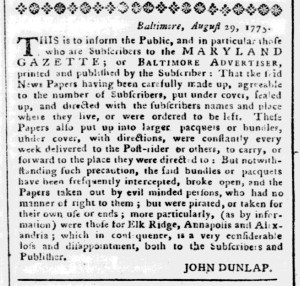
Something went wrong.  John Dunlap, the printer of Dunlap’s Maryland Gazette, had a system for delivering his newspaper to subscribers who lived outside of Baltimore, but “evil minded persons” interfered with it.  In particular, disruptions occurred in Annapolis and Elk Ridge, both in Maryland, and Alexandria, Virginia.  That prompted Dunlap to run a notice in the August 29, 1775, edition, placing it immediately after local news and first among the advertisements to increase the likelihood that readers would see it.

The exasperated printer went into great detail about his delivery infrastructure, hoping to convince “the Public, and in particular those who are Subscribers” that he made every effort to follow through on his obligation to deliver the newspaper.  The correct number of copies had been “carefully made up, agreeable to the number of Subscribers, put under covers, sealed up, and directed with the subscribers names and place where they live, or were ordered to be left.”  Then, those newspapers were “also put up into larger pacquets or bundles, under cover, with directions” and “constantly every week delivered to the Post-rider or other, to carry, or forward to the place they were directed to.”  Despite such careful attention and “notwithstanding such precaution, the said bundles or pacquets have been frequently intercepted, broke open, and the Papers taken out by evil minded persons, who had no manner of right to them.”  Dunlap called this “a very considerable loss and disappointment, both to the Subscribers and Publisher.”  Advertisers may have also been frustrated upon learning that the notices they paid to insert in Dunlap’s Maryland Gazette did not circulate as widely as they expected.  The printer likely realized that could have an impact on revenue as well.

Dunlap declared that the missing newspapers “were pirated, or taken for their own use or ends” by the thieves.  Despite the consequences for subscribers, advertisers, and the printer, the motivation for taking the newspapers may not have been completely nefarious.  In the wake of recent events – the battles at Lexington and Concord, the Battle of Bunker Hill, the Second Continental Congress meeting in Philadelphia, colonial assemblies holding their own meetings, George Washington assuming command of the Continental Army as it besieged Boston – colonizers were eager for news.  Some may have resorted to unsavory means of getting the latest updates, taking newspapers that did not belong to them.  That did not justify what they did, but it does testify to the role of the early American press in disseminating information about the imperial crisis and the Revolutionary War.  Some colonizers became better informed because of the theft, while subscribers to Dunlap’s Maryland Gazette had to seek out other newspapers or rely on conversations and correspondence to learn the latest updates.

August 22

What was advertised in a revolutionary American newspaper 250 years ago today?

Dunlap’s Maryland Gazette (August 22, 1775).

BEST Scotch and Rappee Snuff … warranted good in quality and as well manufactured as any from Great Britain.”

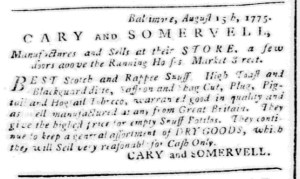
The partnership of Cary and Somervell stocked and sold “a general Assortment of DRY GOODS” at their store in Baltimore in the summer of 1775, but that was not their primary reason for running an advertisement in the August 22 edition of Dunlap’s Maryland Gazette.  Instead, they wished to advise the public that their firm “Manufactures and Sells … BEST Scotch and Rappee Snuff, High Toast and Blackguard [snuff], Saffron and Shag Cut, Plug, Pigtail and Hogtail Tobacco.”  Cary and Somervell offered tobacco users an array of choices of familiar products.  They also paid “the highest price for empty Snuff Bottles,” encouraging prospective customers to offset the cost of their purchases by trading in bottles that they no longer needed.

In promoting the tobacco products that they made in Baltimore, Cary and Somervell published promises about their wares: “warranted good in quality and as well manufactured as any from Great Britain.”  That was a familiar aspect of “Buy American” advertisements prior to the American Revolution, yet it had greater resonance once the Continental Association went into effect on December 1, 1774, and, especially, following the battles at Lexington and Concord on April 19, 1775.  The Continental Association, a nonimportation agreement devised by the First Continental Congress in response to the Coercive Acts, called for “encourag[ing] Frugality, Economy, and Industry; and promot[ing] Agriculture, Arts, and the Manufactures of this Country” as alternatives to imported goods.  Thus, the nonimportation agreement also outlined the responsibilities of both producers and consumers in the colonies.  Such civic duties gained even greater urgency in the wake of battles fought in Massachusetts.

Even without taking current events into consideration, Cary and Somervell issued a familiar challenge when they asserted that their tobacco products were as “good in quality and as well manufactured as any from Great Britain.”  How would consumers know unless they tested Cary and Somervell’s snuff and tobacco for themselves?  The partners used a bold assertion to entice prospective customers to sample their products and become the final arbiters of whether they, the consumers, agreed with the claims made in the newspaper advertisement.