May 30

What was advertised in a colonial American newspaper 250 years ago today?
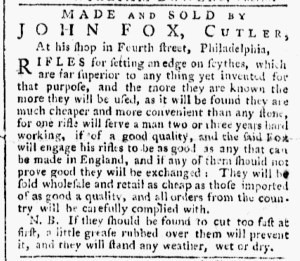
Dunlap’s Pennsylvania Packet (May 30, 1774).

“Fox will engage his rifles to be as good as any that can be made in England.”

John Fox marketed American ingenuity when he advertised scythe rifles, instruments for “setting an edge on scythes,” that he invented.  In the May 30, 1774, edition of Dunlap’s Pennsylvania Packet, the cutler proclaimed that his rifles “are far superior to any thing yet invented for that purpose.”  He was so certain of that assertion that he confidently asserted that “the more [his rifles] are known the more they will be used,” especially since “it will be found they are much cheaper and more convenient than any stone.”  Rifles were made of wood, light enough for farmers to carry with them to sharpen the edges of scythes as they worked in the fields; whetstones were much heavier and, in turn, much less convenient for such purposes.  Continuing his pitch, Fox claimed that “one rifle will serve a man two or three years hard working, if of a good quality,” and he considered “his rifles to be as good as any that can be made in England.”  Furthermore, he pledged to sell his product “wholesale and retail as cheap as those imported of as good a quality.”  If any customers were not satisfied once they gave his rifles a try, the cutler offered to exchange any that “should not prove good.”

During the imperial crisis, colonial entrepreneurs promoted “domestic manufactures” or products made in America rather than imported.  Such appeals appeared in newspaper advertisements with greater frequency when confrontations with Parliament intensified, especially when colonizers enacted nonimportation agreements in response to the Stamp Act and the Townshend Acts.  Fox marketed his scythe rifles as relations between the colonies and Parliament once again deteriorated, this time because of duties on tea, the Boston Tea Party, and the Boston Port Act that closed the harbor until residents made restitution.  Dunlap’s Pennsylvania Packet and other newspapers published in Philadelphia carried extensive coverage of the debates and passage of the Boston Port Act and the responses in other cities and towns.  Fox’s advertisement appeared immediately below resolutions passed at “a meeting of the inhabitants of the city of Annapolis” on May 25, 1774.  They agreed “to put an immediate stop to all exports to Great-Britain” and, upon a date to be determined in coordination with other town in Maryland and “the principal colonies of America,” that “there be no imports from Great-Britain till the said act be repealed.”  Perhaps it was coincidence that Fox’s advertisement happened to follow the resolutions from Annapolis.  No matter where the two items appeared in relation to each other in the newspaper, the political crisis that inspired the resolutions provided support for Fox’s encouragement to purchase the rifle scythes he “MADE AND SOLD … At his shop in Fourth street, Philadelphia,” as an alternative to imported ones.
January 23

What was advertised in a colonial American newspaper 250 years ago this week?

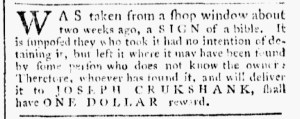
Dunlap’s Pennsylvania Packet (January 17, 1774).

“WAS taken from a shop window … a SIGN of a bible.”

Joseph Crukshank ran a printing office and sold books at the “SIGN of a bible” in Philadelphia … some of the time.  According to an advertisement that he placed in the January 17, 1774, edition of Dunlap’s Pennsylvania Packet, his sign went missing sometime around the beginning of the year.  When he started in the trade, Crukshank did an apprenticeship with Andrew Steuart “at the Bible-in-Heart.”[1]  Perhaps he chose a similar device to mark his location as a means of encouraging an association in the minds of prospective customers familiar with his former master’s work.

“WAS taken from a shop window about two weeks ago,” Crukshank stated, “a SIGN of a bible.”  In that notice, the printer and bookseller provided information that testified to the visual culture of advertising that colonizers encountered when they traversed the streets of Philadelphia.  Although some eighteenth-century trade cards depict shop signs hanging from poles, presumably outside and perhaps perpendicular to the building so pedestrians could see them from a distance, Crukshank apparently positioned his sign in a window, facing into the street.  That gave it less visibility, but likely required less maintenance by protecting it from the weather.  Unfortunately, Crukshank did not indicate the size of the sign, though it must have been small enough for whoever took it to carry away without attracting notice.

The printer and bookseller did not believe that the culprit kept the sign but instead played a trick by abandoning it somewhere.  “It is supposed they who took it had no intention of detaining it,” he declared, “but left it where it may have been found by some person who does not know the owner.”  With that statement, Crukshank confessed the limits of deploying an image to represent his business.  Colonizers who lived in his neighborhood almost certainly recognized the “SIGN of a bible” that identified his shop, as did many others who had resided in the city for some time.  Yet he did not consider the image universally known among the denizens of the busy port.  His advertisement may have aided to establish a connection between Crukshank’s shop and his sign in the minds of those readers, a helpful bit of branding if he managed to recover the sign or replaced it.

**********

[1] Isaiah Thomas, The History of Printing in America: With a Bibliography of Printers and an Account of Newspapers (1810; New York: Weathervane Books, 1970), 386.

January 10

What was advertised in a colonial American newspaper 250 years ago today?

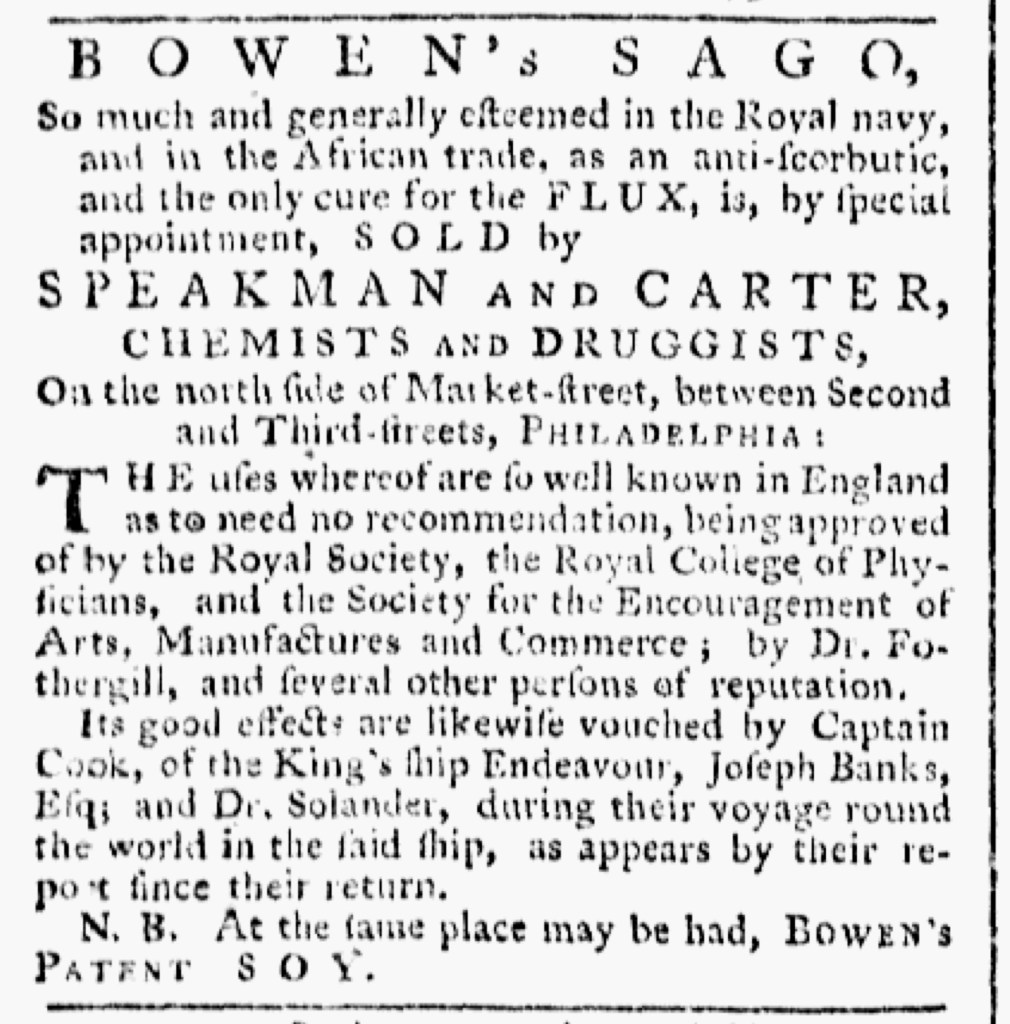
Dunlap’s Pennsylvania Packet (January 10, 1774).

“BOWEN’s SAGO … the only cure for the FLUX.”

Townsend Speakman and Christopher Carter, “CHEMISTS AND DRUGGISTS” in Philadelphia, took to the pages of Dunlap’s Pennsylvania Packet to advertise “BOWEN’s SAGO,” a medicine for preventing and curing scurvy.  The apothecaries did not, however, appear to generate their own copy.  Instead, they seemed to borrow heavily from advertisements that Zepheniah Kingsley placed in the South-Carolina Gazette and Country Journal and other newspapers published in Charleston several months earlier.

The headline differed only slightly, “BOWEN’s patent SAGO” in the original shortened to “BOWEN’s SAGO” in Speakman and Carter’s advertisement.  The introductory remarks remained the same, describing the product as “So much and generally esteemed in the Royal navy, and in the African trade, as an anti-scorbutic, and the only cure for the FLUX.”  In the original, the retailer then announced, “SOLD By Z. KINGSLEY,” and directed customers to his store in Beadon’s Alley.  The apothecaries in Philadelphia altered that portion slightly, declaring that the medicine “is, by special appointment, SOLD by SPEAKMAN AND CARTER, CHEMISTS AND DRUGGISTS,” and then gave directions to their shop.  The main body of both advertisements included an overview of endorsements by “the Royal Society, the Royal College of Physicians, and the Society for the Encouragement of Arts, Manufactures and Commerce.”  Speakman and Carter added additional endorsements: “by Dr. Fothergill, and several other persons of reputation.”  Another paragraph described how Captain James Cook and botanists who sailed with him during the Endeavour’s “voyage round the world” also “vouched” for the “good effects” of Bowen’s Sago in the report they published upon their return.  It appeared almost word-for-word, substituting “Joseph Banks, Esq” for “Mr. BANKES.”  A brief note appeared at the end, “SOLD at same Place, BOWEN’s patent SOY” in the original and “At the same place may be had, BOWEN’S PATENT SOY.”

Speakman and Carter created their advertisement at a time that most people thought little of reprinting what others had written or published, at least in certain contexts.  Colonial printers liberally reprinted content from one newspaper to another, often attributing their sources but sometimes not doing so.  Printers and booksellers who advertised books frequently copied the extensive subtitles or contents that appeared on the title page, treating those as advertising copy. Apothecaries, shopkeepers, and others who sold patent medicines sometimes published newspaper advertisements that drew heavily from the directions or promotional materials provided by the producers.  In this instance, Speakman and Carter may have used Kingsley’s advertisement as a model, revising it slightly for their purposes, or both the apothecaries in Philadelphia and the merchant in Charleston may have adapted handbills, newspaper advertisements, or other marketing materials sent to them by their suppliers.  Whatever the explanation, consumers in two major ports encountered nearly identical marketing for a product sold by local vendors.