March 20

What was advertised in a colonial American newspaper 250 years ago today?
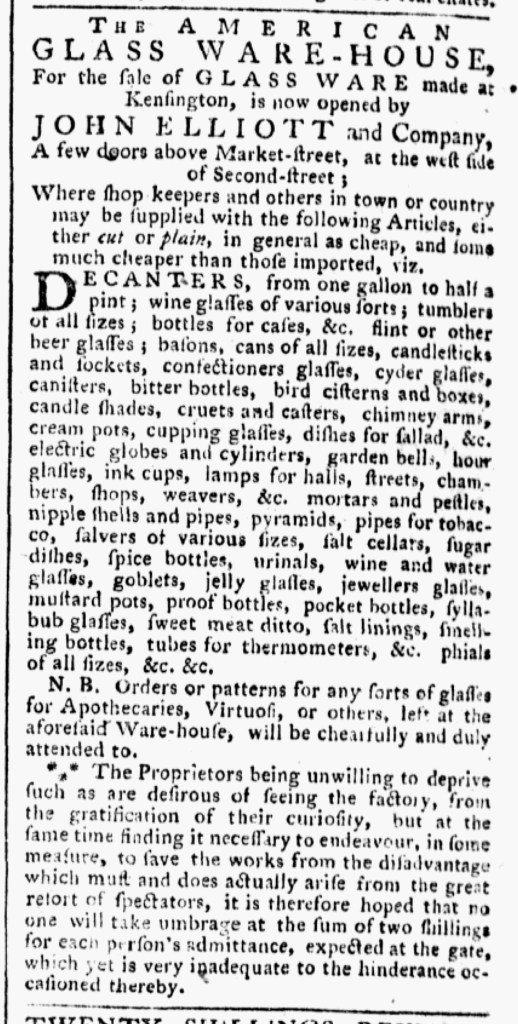
Dunlap’s Pennsylvania Packet (March 20, 1775).

“The Proprietors being unwilling to deprive such as are desirous of seeing the factory, from the gratification of their curiosity.”

John Elliott and Company advertised items made at the “AMERICAN GLASS WARE-HOUSE” in Kensington, Philadelphia, as soon as the Continental Association went into effect in December 1774.  Nearly four months later, the company ran another advertisement that listed a variety of glassware – including “wine glasses of various sorts,” “tumblers of all sizes,” “hour glasses,” “tubes for thermometers,” “mustard pots,” and “lamps for halls, streets, chambers, shops, [and] weavers” – that “shop keepers and others in town or country” could purchase “as cheap [as] those imported.”  Some items were “much cheaper.”  Colonizers who abided by the nonimportation agreement did not have to pay more to acquire glassware made in the colonies; instead, they got a bargain!  Elliott and Company also informed apothecaries and others that they accepted orders and would follow patterns “left at the aforesaid Ware-house.”

Yet this enterprise did more than manufacture glassware.  Elliott and Company’s operation became a destination for the curious who wanted to witness the production of “AMERICAN GLASS” for themselves.  That had the potential to become disruptive, so the proprietors devoted the final paragraph of their advertisement to instructions for visiting.  They explained that they struck a compromise, “being unwilling to deprive such as are desirous of seeing the factory, from the gratification of their curiosity, but at the same time finding it necessary to endeavour, in some measure, to save the works from the disadvantage which must and does actually arise from the great resort of spectators.”  Accordingly, Elliott and Company charged “two shillings for each person’s admittance, expected at the gate.”  Even that fee, they claimed, “is very inadequate to the hinderance occasioned thereby,” yet, once again, the company offered a bargain.  In the process, Elliott and Company monetized visits to their production facility.  Perhaps it had not been as popular a destination as they implied.  Perhaps they exaggerated in hopes of drumming up interest in such a novelty, especially as the imperial crisis intensified and the Continental Association became even more meaningful to many colonizers.  An advertisement with instructions for visiting the factory, no matter how many people had previously been there, gave readers ideas about an outing they could make themselves.  Attracting visitors to see the works, after all, would likely translate into additional sales.

March 13

What was advertised in a colonial American newspaper 250 years ago today?

Dunlap’s Pennsylvania Packet (March 13, 1775).

“LINEN PRINTING … at their Manufactory … on Germantown Road.”

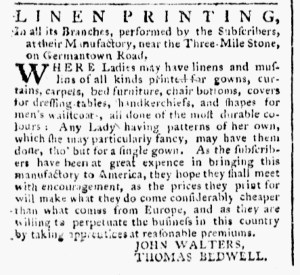
When the Continental Association prohibited importing goods from Great Britain it called on colonizers “in our several Stations, [to] encourage Frugality, Economy, and Industry; and promote Agriculture, Arts, and the Manufactures of this Country.”  John Walters and Thomas Bedwell answered the call to give consumers alternatives to imported textiles.  In an advertisement in the March 13, 1775, edition of Dunlap’s Pennsylvania Packet, those entrepreneurs announced that they undertook “LINEN PRINTING, In all its Branches … at their Manufactory … on Germantown Road.”

Walters and Bedwell targeted “Ladies,” declaring that they “may have linens and muslins of all kinds printed for gowns, curtains, carpets, bed furniture, chair bottoms, covers for dressing-tables, handkerchiefs, and shapes for men’s waistcoats.”  Perhaps the men who would wear those vests were just as interested in how they would maintain appearances while the Continental Association remained in effect, but discourse in the public prints often associated women with consumption even though men participated in the marketplace just as actively.  No job was too small for Walters and Bedwell.  “Any Lady having patterns of her own, which she may particularly fancy” they declared, “may have them done, tho’ but for a single gown.”  They hoped such attention to even the smallest order would gain the approval of prospective customers.

In addition, Walters and Bedwell attempted to leverage their investment in their business to convince consumers that they had a responsibility to support their endeavor.  They “have been at great expence in bringing this manufactory to America” for domestic production as an alternative to importing printed linens.  Accordingly, they “hope they shall meet with encouragement” from customers who considered it their duty to put their political principles into practice in the marketplace.  They also sought to entice “Ladies” (and gentlemen as well) with promises that “the prices they print for will make what they do come considerably cheaper than what comes from Europe.”  Walters and Bedwell did their part for the American cause in establishing their “manufactory.”  Now they needed consumers to rise to the occasion “to perpetuate the business in this country.”  Adhering to the Continental Association created opportunities for both producers and consumers.

February 20

GUEST CURATOR:  Gabriela Vargas

What was advertised in a colonial American newspaper 250 years ago today?

Dunlap’s Pennsylvania Packet (February 20, 1775).

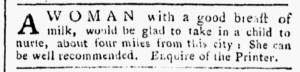
“A WOMAN with a good breast of milk, would be glad to take in a child to nurse.”

On February 20, 1775, an anonymous woman placed an advertisement offering her services as a wet nurse in Dunlap’s Pennsylvania Packet. In colonial and revolutionary America, women advertised their services as wet nurses while families often placed advertisements seeking wet nurses. Mothers who could not supply their own breast milk due to health issues acquired wet nurses. Families who lost mothers during childbirth also needed wet nurses. This was a common practice in the eighteenth century.

According to Janet Golden, some English physicians advised against wet nurses because they might be “sick or ill-tempered.”[1]  William Buchan, for instance, advised looking for a “healthy woman, … one with an abundant supply of milk, healthy children, clean habits and a sound temperament.”[2] Those physicians looked down on women not breastfeeding their own children but doing it for others. In general, wet nursing caused an increase in infant mortality rate. Golden states, “Nearly every European commentator knew that wet nursing increased infant mortality. Wet-nursed infants were more likely to die than were infants suckled by their mothers, and the wet nursing system itself contributed to infant mortality by inducing poor women to abandon their own offspring in order to find employment suckling the children of others.”[3]

For women who were hired as wet nurses in colonial America, their earnings belonged to their husbands by law.[4] Wet nursing was not always a paid arrangement. Instead, neighbors sometimes helped their communities by nursing the babies of mothers who could not breastfeed due to postpartum ailments.[5] Some families felt more comfortable with a neighbor rather than a stranger. Mothers or their families would often look for neighbors or friends to breastfeed their babies, but that was not always possible. That created a market for other women to offer their services, which they would advertise in early American newspapers.

**********

ADDITIONAL COMMENTARY:  Carl Robert Keyes

Even though the prescriptive literature authored by English physicians sometimes cautioned against entrusting infants to wet nurses, colonizers sometimes heeded those concerns and other times developed their own practices embedded in local circumstances in the eighteenth century.  As Gabriela indicates, neighbors participated in communal wet nursing as one way of contributing to their communities.

Some also went against the prescriptive literature that condemned wealthy women for hiring wet nurses instead of fulfilling what the physicians considered their maternal obligations.  Sending infants to foster with wet nurses in the countryside became a popular practice among many affluent families in Boston and other cities.  “Some urban families,” Golden explains,” assumed that the city was an unhealthy environment, rife with both epidemic and endemic diseases.  The countryside, many believed, provided a more salubrious setting, especially in the early months of life.”[6]  Note that the anonymous “WOMAN with a good breast of milk” in the advertisement Gabriela selected emphasized that she resided about four miles from Philadelphia, near the busy port yet removed from the largest city in the colonies.  Other women took a similar approach.  According to Golden, “advertisements placed by women looking for babies to wet nurse reported their distance from the city.”[7]

In four short lines, the woman who placed today’s featured advertisement addressed several common concerns.  She commented on her own health and the nourishment she could provide for an infant, asserting that she had a “good breast of milk.”  Yet she did not ask prospective clients to take her word for it.  Instead, she stated that she “can be well recommended,” presumably both for her character and for her health.  At the same time, she testified to the healthiness of the environment where she provided her services, highlighting that she resided outside the city.  The anonymous woman intended for each of those appeals to resonate with mothers and their families.

**********

[1] Janet Golden, A Social History of Wet Nursing in America: From Breast to Bottle (New York: Cambridge University Press, 1996), 15.

[2] Golden, Social History of Wet Nursing, 16.

[3] Golden, Social History of Wet Nursing, 14.

[4] Golden, Social History of Wet Nursing, 17.

[5] Golden, Social History of Wet Nursing, 20.

[6] Golden, Social History of Wet Nursing, 22.

[7] Golden, Social History of Wet Nursing, 22.

September 19

What was advertised in a colonial American newspaper 250 years ago today?

Dunlap’s Pennsylvania Packet (September 19, 1774).

“The above pamphlet … is quoted in a respectful manner by the Earl of Chatham.”

Two weeks after the First Continental Congress commenced its meetings in Philadelphia, Joseph Crukshank took to the pages of Dunlap’s Pennsylvania Gazette to advertise that he had “Just published … A TRUE STATE of the PROCEEDINGS in the Parliament of Great-Britain, and in the Province of Massachusetts Bay, relative to the giving and granting the Money of the People of that province, and of all America, in the House of Commons, in which they are not represented.”  As was often the case, the extensive title simultaneously provided an overview of the pamphlet’s contents and served as advertising copy.

Yet that was not the only appeal made in this advertisement.  Crukshank, the printer of this American edition of a work originally published in London, sought to entice buyers with additional information.  “The above pamphlet, said to be written by Dr. Franklin,” he informed readers, “is quoted in a respectful manner by the Earl of Chatham, in his speech on the third reading of the bill for quartering troops in America.”  Colonizers had long celebrated William Pitt the Elder for his advocacy on their behalf, doing so once again when he considered the wisdom of the Quartering Act, one of the Coercive Acts that Parliament passed in the wake of the Boston Tea Party.  Historians have determined that Arthur Lee compiled the pamphlet from material furnished by Benjamin Franklin.

The title of the pamphlet, including its reference to the colonies lacking direct representation in Parliament, buttressed the arguments presented in letters and editorials that ran elsewhere in the September 19, 1774, edition of Dunlap’s Pennsylvania Packet.  On its own, the advertisement operated as a miniature editorial among the other content of the newspaper.  Scholars debate the extent that political pamphlets shaped public opinion, some arguing that newspapers reached many more people.  Compared to pamphlets, newspapers were inexpensive, plus they circulated widely.  Yet advertisements for political pamphlets did important work, even if few readers opted to purchase or read those pamphlets.  The advertisements contributed to an impression of the discourse taking place, signaling to readers what others believed about current events and why they should prefer one position over another.  Most readers of Dunlap’s Pennsylvania Packet never purchased Crukshank’s American edition of a political pamphlet originally published in London, yet the advertisement relayed information about the position taken by a popular politician and made an argument about the colonies’ lack of representation in Parliament.  The advertisement became part of the news environment.

September 5

What was advertised in a colonial American newspaper 250 years ago today?

Dunlap’s Pennsylvania Packet (September 5, 1774).

“MR. PIKE, Ten years a teacher in Charlestown, South-Carolina, is arrived.”

When Mr. Pike arrived in Philadelphia near the end of the summer of 1774, he introduced himself to his new neighbors and prospective students with an advertisement in Dunlap’s Pennsylvania Packet.  He devised a headline, “DANCING AND FENCING,” to attract attention and provide a general overview of the services he offered.  As a newcomer with a reputation largely unknown in the bustling urban port, he gave his résumé, declaring that he had been “Ten years a teacher in Charlestown, South-Carolina.”  (The Adverts 250 Project has traced his career there throughout most of his time in that city.)  For quite some time, Pike had been planning to leave Charleston, announcing his intentions in the newspapers there and publishing a farewell message in early May.

According to the dancing master, some of the gentry in Philadelphia already knew how well he had served his students and the community in Charleston.  He chose Philadelphia as his new home, he explained, “Agreeable to an invitation from several respectable families in this city.”  Furthermore, Pike feigned modesty, as many advertisers often did, in declaring that he “flatters himself that his abilities as a master of his profession, may be sufficiently known, as many very respectable gentlemen of the above province are at present in this city.”  He likely referred to Christopher Gadsden, Thomas Lynch, Jr., Henry Middleton, Edward Rutledge, and John Rutledge, South Carolina’s delegates to the First Continental Congress.  They had commenced their meetings in Carpenters’ Hall on the very day that Pike’s advertisement first ran in Dunlap’s Pennsylvania Packet.  Even if Pike had not instructed any of those gentlemen or members of their families, they almost certainly were familiar with his reputation and the balls he hosted so his pupils could demonstrate their grace and proficiency in “cotillions and other fashionable dances.”  The dancing master hoped that casual conversations would include inquiries about him directed to delegates and others from Charleston who happened to be in Philadelphia at the time, resulting in recommendations to supplement and support his advertisement in the public prints.

August 29

What was advertised in a colonial American newspaper 250 years ago today?

Dunlap’s Pennsylvania Packet (August 29, 1774).

“He carries on the Bookbinding and Stationary business in an extensive manner.”

Among the many advertisements that ran in the August 29, 1774, edition of Dunlap’s Pennsylvania Packet, one from William O’Brien offered several goods and services.  He first offered several varieties of alcohol and popular groceries, including “Jamaica spirit, West-India and continent rum, all kinds of wines, tea and sugar of different kinds, coffee, cordials and patent medicines.”  In addition to that inventory, he also stocked “a large collection of the best books, both antient and modern.”  Yet O’Brien also identified himself as a bookbinder and stationer, promoting in particular custom-made account books, ruled or unruled, to any size as bespoke.”  He offered those items to both merchants and retailers who might buy in volume “to sell again.”

Although O’Brien advertised in Dunlap’s Pennsylvania Packet, published in Philadelphia, he lived and worked in Baltimore.  He likely did not expect that his notice would generate much business among readers in Philadelphia; instead, he sought customers in his own town and the surrounding area, realizing that for many years the Pennsylvania Gazette, the Pennsylvania Journal, Dunlap’s Pennsylvania Packet, and other newspapers printed in Philadelphia served as local newspapers for towns in Pennsylvania, Delaware, New Jersey, and Maryland.  O’Brien could have chosen to advertise in the Maryland Journal, Baltimore’s first newspaper, in addition to or instead of one of the newspapers in Philadelphia, though he may have had doubts about the efficacy of doing so.  Commencing publication on August 20, 1773, the Maryland Journal had just marked its first year, yet its appearance had been sporadic during that time rather than sticking to a weekly schedule.  O’Brien turned to a more reliable newspaper, likely familiar with its circulation in Maryland and, as a result, having greater confidence in the money he invested in advertising in Dunlap’s Pennsylvania Packet. William Goddard, the printer of the Maryland Journal, still had work to do to win over prospective advertisers in Baltimore.

May 30

What was advertised in a colonial American newspaper 250 years ago today?

Dunlap’s Pennsylvania Packet (May 30, 1774).

“Fox will engage his rifles to be as good as any that can be made in England.”

John Fox marketed American ingenuity when he advertised scythe rifles, instruments for “setting an edge on scythes,” that he invented.  In the May 30, 1774, edition of Dunlap’s Pennsylvania Packet, the cutler proclaimed that his rifles “are far superior to any thing yet invented for that purpose.”  He was so certain of that assertion that he confidently asserted that “the more [his rifles] are known the more they will be used,” especially since “it will be found they are much cheaper and more convenient than any stone.”  Rifles were made of wood, light enough for farmers to carry with them to sharpen the edges of scythes as they worked in the fields; whetstones were much heavier and, in turn, much less convenient for such purposes.  Continuing his pitch, Fox claimed that “one rifle will serve a man two or three years hard working, if of a good quality,” and he considered “his rifles to be as good as any that can be made in England.”  Furthermore, he pledged to sell his product “wholesale and retail as cheap as those imported of as good a quality.”  If any customers were not satisfied once they gave his rifles a try, the cutler offered to exchange any that “should not prove good.”

During the imperial crisis, colonial entrepreneurs promoted “domestic manufactures” or products made in America rather than imported.  Such appeals appeared in newspaper advertisements with greater frequency when confrontations with Parliament intensified, especially when colonizers enacted nonimportation agreements in response to the Stamp Act and the Townshend Acts.  Fox marketed his scythe rifles as relations between the colonies and Parliament once again deteriorated, this time because of duties on tea, the Boston Tea Party, and the Boston Port Act that closed the harbor until residents made restitution.  Dunlap’s Pennsylvania Packet and other newspapers published in Philadelphia carried extensive coverage of the debates and passage of the Boston Port Act and the responses in other cities and towns.  Fox’s advertisement appeared immediately below resolutions passed at “a meeting of the inhabitants of the city of Annapolis” on May 25, 1774.  They agreed “to put an immediate stop to all exports to Great-Britain” and, upon a date to be determined in coordination with other town in Maryland and “the principal colonies of America,” that “there be no imports from Great-Britain till the said act be repealed.”  Perhaps it was coincidence that Fox’s advertisement happened to follow the resolutions from Annapolis.  No matter where the two items appeared in relation to each other in the newspaper, the political crisis that inspired the resolutions provided support for Fox’s encouragement to purchase the rifle scythes he “MADE AND SOLD … At his shop in Fourth street, Philadelphia,” as an alternative to imported ones.

January 23

What was advertised in a colonial American newspaper 250 years ago this week?

Dunlap’s Pennsylvania Packet (January 17, 1774).

“WAS taken from a shop window … a SIGN of a bible.”

Joseph Crukshank ran a printing office and sold books at the “SIGN of a bible” in Philadelphia … some of the time.  According to an advertisement that he placed in the January 17, 1774, edition of Dunlap’s Pennsylvania Packet, his sign went missing sometime around the beginning of the year.  When he started in the trade, Crukshank did an apprenticeship with Andrew Steuart “at the Bible-in-Heart.”[1]  Perhaps he chose a similar device to mark his location as a means of encouraging an association in the minds of prospective customers familiar with his former master’s work.

“WAS taken from a shop window about two weeks ago,” Crukshank stated, “a SIGN of a bible.”  In that notice, the printer and bookseller provided information that testified to the visual culture of advertising that colonizers encountered when they traversed the streets of Philadelphia.  Although some eighteenth-century trade cards depict shop signs hanging from poles, presumably outside and perhaps perpendicular to the building so pedestrians could see them from a distance, Crukshank apparently positioned his sign in a window, facing into the street.  That gave it less visibility, but likely required less maintenance by protecting it from the weather.  Unfortunately, Crukshank did not indicate the size of the sign, though it must have been small enough for whoever took it to carry away without attracting notice.

The printer and bookseller did not believe that the culprit kept the sign but instead played a trick by abandoning it somewhere.  “It is supposed they who took it had no intention of detaining it,” he declared, “but left it where it may have been found by some person who does not know the owner.”  With that statement, Crukshank confessed the limits of deploying an image to represent his business.  Colonizers who lived in his neighborhood almost certainly recognized the “SIGN of a bible” that identified his shop, as did many others who had resided in the city for some time.  Yet he did not consider the image universally known among the denizens of the busy port.  His advertisement may have aided to establish a connection between Crukshank’s shop and his sign in the minds of those readers, a helpful bit of branding if he managed to recover the sign or replaced it.

**********

[1] Isaiah Thomas, The History of Printing in America: With a Bibliography of Printers and an Account of Newspapers (1810; New York: Weathervane Books, 1970), 386.

January 10

What was advertised in a colonial American newspaper 250 years ago today?

Dunlap’s Pennsylvania Packet (January 10, 1774).

“BOWEN’s SAGO … the only cure for the FLUX.”

Townsend Speakman and Christopher Carter, “CHEMISTS AND DRUGGISTS” in Philadelphia, took to the pages of Dunlap’s Pennsylvania Packet to advertise “BOWEN’s SAGO,” a medicine for preventing and curing scurvy.  The apothecaries did not, however, appear to generate their own copy.  Instead, they seemed to borrow heavily from advertisements that Zepheniah Kingsley placed in the South-Carolina Gazette and Country Journal and other newspapers published in Charleston several months earlier.

The headline differed only slightly, “BOWEN’s patent SAGO” in the original shortened to “BOWEN’s SAGO” in Speakman and Carter’s advertisement.  The introductory remarks remained the same, describing the product as “So much and generally esteemed in the Royal navy, and in the African trade, as an anti-scorbutic, and the only cure for the FLUX.”  In the original, the retailer then announced, “SOLD By Z. KINGSLEY,” and directed customers to his store in Beadon’s Alley.  The apothecaries in Philadelphia altered that portion slightly, declaring that the medicine “is, by special appointment, SOLD by SPEAKMAN AND CARTER, CHEMISTS AND DRUGGISTS,” and then gave directions to their shop.  The main body of both advertisements included an overview of endorsements by “the Royal Society, the Royal College of Physicians, and the Society for the Encouragement of Arts, Manufactures and Commerce.”  Speakman and Carter added additional endorsements: “by Dr. Fothergill, and several other persons of reputation.”  Another paragraph described how Captain James Cook and botanists who sailed with him during the Endeavour’s “voyage round the world” also “vouched” for the “good effects” of Bowen’s Sago in the report they published upon their return.  It appeared almost word-for-word, substituting “Joseph Banks, Esq” for “Mr. BANKES.”  A brief note appeared at the end, “SOLD at same Place, BOWEN’s patent SOY” in the original and “At the same place may be had, BOWEN’S PATENT SOY.”

Speakman and Carter created their advertisement at a time that most people thought little of reprinting what others had written or published, at least in certain contexts.  Colonial printers liberally reprinted content from one newspaper to another, often attributing their sources but sometimes not doing so.  Printers and booksellers who advertised books frequently copied the extensive subtitles or contents that appeared on the title page, treating those as advertising copy. Apothecaries, shopkeepers, and others who sold patent medicines sometimes published newspaper advertisements that drew heavily from the directions or promotional materials provided by the producers.  In this instance, Speakman and Carter may have used Kingsley’s advertisement as a model, revising it slightly for their purposes, or both the apothecaries in Philadelphia and the merchant in Charleston may have adapted handbills, newspaper advertisements, or other marketing materials sent to them by their suppliers.  Whatever the explanation, consumers in two major ports encountered nearly identical marketing for a product sold by local vendors.