March 17

What was advertised in a colonial American newspaper 250 years ago today?

Massachusetts Gazette and Boston Weekly News-Letter (March 17, 1775).

“AN ORATION … to commemorate the bloody Tragedy of March 5th 1770.”

In the spring of 1771, patriots marked the first anniversary of the “BLOODY TRAGEDY” now known as the Boston Massacre with “AN ORATION Delivered … at the Request of the Inhabitants of the Town of Boston … By JAMES LOVELL.”  That started an annual tradition, with Joseph Warren giving the oration in 1772, Benjamin Church in 1773, and John Hancock in 1774.  Gathering for the oration became an annual ritual.  So did publishing and marketing it.

For the fifth anniversary, the “ORATION … to commemorate the bloody Tragedy of March 5th 1770” was once again “delivered by JOSEPH WARREN.”  Less than two weeks later, advertisements in the March 17 edition of the Massachusetts Gazette and Boston Weekly News-Letter informed readers where they could acquire copies.  One indicated that Benjamin Edes and John Gill, the printers of the Boston-Gazette, sold the oration, implying that they also published it.  According to the imprint, Edes and Gill printed the address in partnership with Joseph Greenleaf, the proprietor of the Royal American Magazine.

Another advertisement gave readers another option: “In the MASSACHUSETTS SPY, of this Day is published, the WHOLE of the ORATION, delivered by JOSEPH WARREN, Esq; on March 6th , 1775, to commemorate the bloody Tragedy of March 5th, 1770.”  Isaiah Thomas, the printer of the Massachusetts Spy, did indeed devote three of the four columns of the third page of his newspaper to Warren’s oration.  In an introduction, he reported that it was “this day published, in a pamphlet” and available for sale in addition to appearing in the newspaper.  The printer offered multiple ways for readers to engage with the oration.  He (and Edes and Gill and Greenleaf) also offered consumers an opportunity to purchase a commemorative item.  Readers who previously purchased the orations by Lovell, Warren, Church, and Hancock on previous anniversaries may have been motivated to add to their collections.

The printer of the Massachusetts Gazette and Boston Weekly News-Letter gave the advertisements a privileged place, likely intended to increase the chances that readers took note of them.  They appeared one after the other immediately after the weekly account of local marriages and deaths.  That meant that the advertisements served as a transition between news items and paid notices.  Readers who perused the news yet merely glanced through the advertisements may have been more likely to take note of these first notices as they realized that the remainder of the page featured advertising.  A manicule also helped call attention to them, signaling their importance in a town experiencing the distresses of the Boston Port Act and the other Coercive Acts.

January 2

What was advertised in a colonial American newspaper 250 years ago today?

Boston-Gazette (January 2, 1775).

The GRAND AMERICAN CONTINENTAL ASSOCIATION … to be pasted up in every Family.”

In the first issue of the Boston-Gazette published in 1775, Benjamin Edes and John Gill, the printers, opened with a notice concerning the Continental Association as the first item in the first column on the first page.  The First Continental Congress had devised that nonimportation, nonconsumption, and nonexportation pact when it met in Philadelphia in September and October 1774, intending for it to go into effect on December 1.  The Continental Association answered the Boston Port Act, the Massachusetts Government Act, and the other Coercive Acts that Parliament had passed in retaliation for the Boston Tea Party, perhaps not expecting a unified response from the colonies.  The First Continental Congress, however, devised a plan that allowed consumers from New England to Georgia to express their political principles through the decisions they made in the marketplace., drawing inspiration from the nonimportation agreements that went into effect to protest the Stamp Act and the duties on imported goods in the Townshend Acts.

Edes and Gill helped to raise awareness of the Continental Association not only through newspaper coverage but also by disseminating copies far and wide.  “ANY Town or District within this Province,” their notice advised, “may be supplied by Edes and Gill, on the shortest Notice, with the GRAND AMERICAN CONTINENTAL ASSOCIATION, printed on one Side of a Sheet of Paper.”  They offered the pact as a broadside “on purpose to be pasted up in every Family.”  The printers wished for local governments to purchase their edition of the Continental Association and distribute them to households for constant reference.  Putting the pact on display demonstrated support for the American cause against Parliament or at least signaled an intention to comply.  Posting it in homes as well as public spaces made it easy to consult, reminding everyone that they had a part to play in the protest.  The Continental Association made decisions about participating in the marketplace inherently political, making it impossible for any individual or household to take a neutral stance.  Edes and Gill recognized that was the case.  Although they stood to generate revenue from selling broadside copies of the Continental Association by the dozen or gross, the political stance they consistently advanced throughout the imperial crisis suggested that increasing awareness of the pact and encouraging compliance with it motivated them as much or even more.

August 1

What was advertised in a colonial American newspaper 250 years ago today?

Boston-Gazette (August 1, 1774).

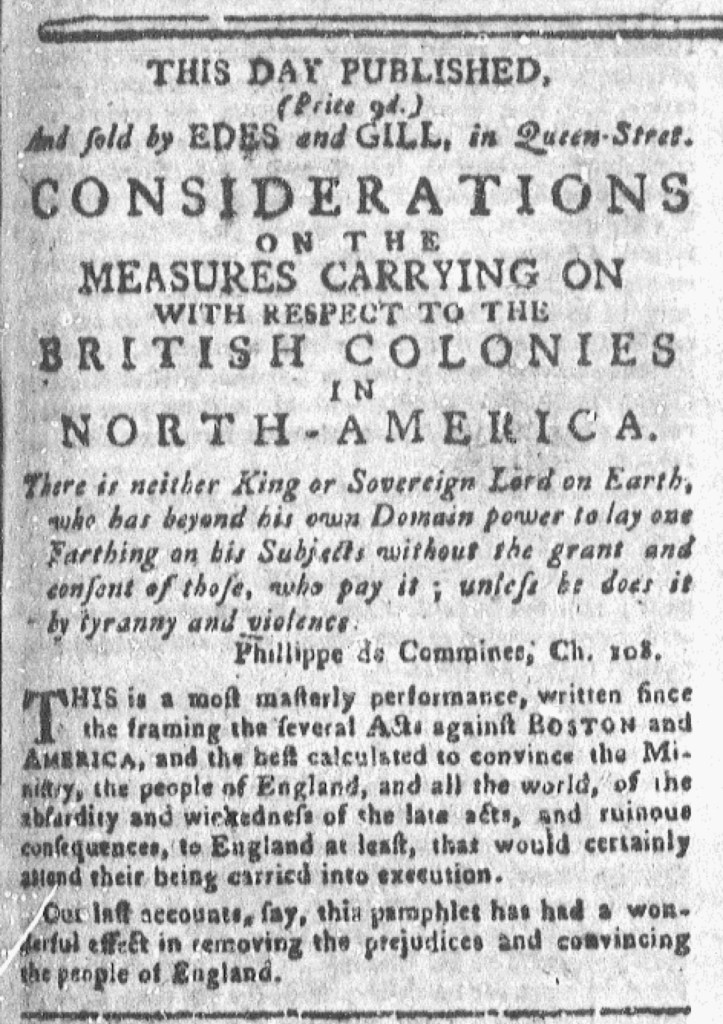
“This pamphlet has had a wonderful effect in removing the prejudices and convincing the people of England.”

Benjamin Edes and John Gill, the printers of the Boston-Gazette, gave an advertisement for their American edition of Considerations on the Measures Carrying On with Respect to the British Colonies in North-America a prominent place in the August 1, 1774, edition of their newspaper.  It appeared as the first item in the first column on the first page, making it difficult for readers to miss.  The printers wished to call attention to the book, originally published in London, not only because they hoped to generate revenue from its sales but also as a means for colonizers to become even better informed about current events and the political challenges they faced as Parliament passed a series of laws, the Coercive Acts, following the Boston Tea Party.  As the imperial crisis intensified, patriot printers like Edes and Gill published newspapers, broadsides, pamphlets, books, and other items that documented the ongoing contest with Parliament, the king, and royal officials in the colonies.

To convince prospective customers of the necessity of purchasing and perusing this pamphlet, Edes and Gill explained that it was the “most masterly performance, written since the framing of the several Acts against BOSTON and AMERICA,” including the Boston Port Act and the Massachusetts Government Act, and “the best calculated to convince the Ministry, the people of England, and all the world, of the absurdity and wickedness of the late acts.”  Colonizers used newspapers and other publications in their efforts to shape opinion in the colonies, yet they were just as concerned with the information environment on the other side of the Atlantic.  In their publications and letters, they hoped to sway both officials and the general public in London and throughout Great Britain.  They also took note of the support they received for their plight.  In their advertisement for Considerations, Edes and Gill reported that their “last accounts” indicated “this pamphlet had had a wonderful effect in removing the prejudices and convincing the people of England” that Parliament had not been just in its treatment of the colonies.  Whether that was accurate or wishful thinking likely varied from person to person, but the printers wanted to believe that it was true.

Edes and Gill applauded how the pamphlet made a case about the “ruinous consequences, to England at least,” not just the colonies, “that would certainly attend” from the Coercive Acts “being carried into execution.”  Printers in Hartford, New York, and Philadelphia shared those sentiments, producing other American editions in each of those towns.  They hoped that the dissemination of the ideas expressed in Considerations would buttress the resolve of colonizers distressed by Parliament’s most recent legislation, especially upon learning how their allies in England made a case on their behalf.

April 11

What was advertised in a colonial American newspaper 250 years ago today?

Boston-Gazette (April 11, 1774).

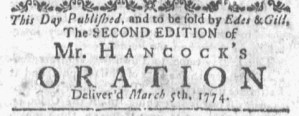
“The SECOND EDITION of Mr. HANCOCK’S ORATION.”

Benjamin Edes and John Gill, printers of the Boston-Gazette, gave their advertisement for the “SECOND EDITION of Mr. HANCOCK’S ORATION Deliver’d March 5th” a privileged place in their newspaper.  Readers did not need further explanation to understand that “March 5th” referred to the date of the Boston Massacre and that Hancock had been selected to give the annual address that memorialized the victims and raised an alarm about the danger of quartering an army in an urban center, like Boston, during times of peace.

Still, Edes and Gill, who printed the “ORATION” as well as the newspaper, did what they could to draw attention to the second edition.  The first time they announced it was “This Day Published,” in the April 4, 1774, edition of the Boston-Gazette, they ran the notice immediately below news and editorials.  Even if readers chose not to peruse other advertisements closely once they realized they had finished the news, they likely took note of the advertisement for the “ORATION” in its place of transition from one kind of content to another.  In the next issue of the weekly newspaper, the notice ran at the bottom of the last column on the first page, the only advertisement on that page.  Once again, the patriot printers increased the likelihood that readers would spot that advertisement and accept an invitation to demonstrate their own commitment to the patriot cause by purchasing copies for themselves.

That Edes and Gill published a “SECOND EDITION” testified to the demand for the first edition.  It sold well enough to justify another printing.  Edes and Gill took it to press just a few months after the Boston Tea Party and just a few weeks after another destruction of tea.  Although that second Boston Tea Party is not nearly as well known today, it was certainly among the current events that would have been on the minds of colonizers as they participated in commemorating the fourth anniversary of the Boston Massacre, discussed the politics of tea, and decried various abuses perpetrated by Parliament.  Purchasing and reading Hancock’s “ORATION” was part of the growing resistance to British rule in the colonies, a means for consumers to practice politics in the marketplace and imbibe the rhetoric of a noted patriot long after the Boston Massacre’s annual commemorative events concluded.

March 21

What was advertised in a colonial American newspaper 250 years ago today?

Boston-Gazette (March 21, 1774).

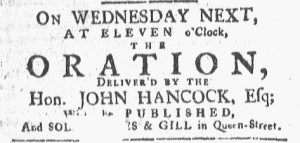
“THE ORATION DELIVER’D BY THE Hon. JOHN HANCOCK, Esq; Will be PUBLISHED.”

Many colonizers commemorated events that were part of the American Revolution before the Revolutionary War began.  For instance, residents of Boston acknowledged the anniversary of the “horrid Massacre on the 5th of March 1770” each year.  That description of the Boston Massacre came from coverage of the fourth anniversary commemorations in the March 7, 1774, edition of the Boston-Gazette.  Benjamin Edes and John Gill, the printers, reported that “the Freeholders and other Inhabitants of this Town met at Faneuil-Hall.”  They selected Samuel Adams as moderator for the meeting.  Adams, in turn, recognized John Hancock to deliver “an ORATION, on the dangerous Tendency of Standing Armies being placed in free and populous Cities” and sought to “perpetuate the Memory of the horrid Massacre … by a Party of Soldiers belonging to the 29th Regiment, commanded by Capt. Thomas Preston.”

According to the printers, a “prodigious Crowd of People attended to hear the Oration, which was received with universal applause.”  In turn, two committees were appointed, one to select a speaker to deliver the oration the following year and the other “to return the Orator the Thanks of the Town for his elegant and spirited Oration, and also to request a Copy of it for the Press.”  Already, the annual commemoration including publishing the oration for further dissemination throughout the city and beyond.  Edes and Gill further reported that the anniversary occurred on Saturday, “the Evening of which is considered by many Persons as the Commencement of the Sabbath,” so the display of the “Exhibition Portraits of the Murderers, and the slaughtered Citizens” was delayed until Monday evening, the same day the printers distributed that issue of the Boston-Gazette.

Two weeks later, on March 21, Edes and Gill ran a notice in their own newspaper to alert readers that “ON WEDNESDAY NEXT … THE ORATION DELIVER’D BY THE Hon. JOHN HANCOCK, Esq; Will be PUBLISHED” at their printing office.  They even specified the time, “ELEVEN o’Clock,” so prospective customers would know exactly when they could obtain their copies.  The printers staged an eighteenth-century precursor to a release party.  In hopes of inciting greater demand and gaining even more attention for Hancock’s arguments about the rights of colonizers, Edes and Gill also ran advertisements in the Boston Evening-Post and the Massachusetts Gazette and Boston Post-Boy on March 21.  The next issue of the Massachusetts Gazette and Boston Weekly News-Letter carried a notice that the oration had been published and was available from “EDES & GILL in Queen-Street.”  Each year, printers published the oration marking the anniversary of the Boston Massacre and advertised it widely.  Commodification of the event went hand in hand with commemoration.

February 14

GUEST CURATOR:  Caroline Branch

What was advertised in a colonial American newspaper 250 years ago today?

Boston-Gazette (February 14, 1774).

“KEYSER’s FAMOUS PILLS … eradicating every Degree of a certain Disease.”

The date of this advertisement for “KEYSER’s FAMOUS PILLS” to treat venereal disease is an ironic one, appearing on Valentine’s Day, but advertisements for these pills ran often. This advertisement displays the fear of venereal diseases throughout Europe and the colonies in the eighteenth century. Doctors agreed that mercury was the way to treat the disease, including Jean Keyser, a French military surgeon. According to Micheline Louis-Courvoisier, many doctors prescribed a mercurial ointment that patients rubbed all over their bodies for about forty days. In contrast, Keyser’s Pills “contain[ed] a combination of mercuric acid and acetic acid.”  The pills were an invention to treat venereal diseases better. In 1761 doctors in Geneva tested the two methods. Louis-Courvoisier states that “following that trial, Keyser pills were considered a good treatment.” They were deemed a success due to the improvement of side effects from previous medications. The pills became a common medication to treat syphilis and other diseases in Europe and the American colonies.

**********

ADDITIONAL COMMENTARY:  Carl Robert Keyes

Keyser’s Pills may very well have been the most popular, or at least the most widely advertised and generally recognized, patent medicine marketed in British mainland North America in the 1760s and 1770s.  Apothecaries stocked the pills, as did shopkeepers and even printers.  The Adverts 250 Project traced the competition among apothecaries and printers in New York and Philadelphia in the fall of 1773.  That competition (or was it a coordinated effort?) continued into the winter of 1774, extending to Boston as well.

Hugh Gaine, the printer of the New-York Gazette and Weekly Mercury, continued advertising Keyser’s Pills in his newspaper in the new year.  To corner as much of the market as he could, he had previously advertised in the Newport Mercury, encouraging prospective customers in Rhode Island to submit orders to “his book store and printing-office, at the bible & crown in Hanover-square” in New York.  When Benjamin Edes and John Gill, printers of the Boston-Gazette, advertised “KEYSER’s FAMOUS PILLS” on February 14, 1774, they lifted the copy for their notice directly from Gaine’s advertisement.  Edes and Gill used the same headline, followed by two paragraphs of identical text (with some variations in capitalization and italics).”  Like Gaine, they declared that declared that the remedy was “So well known all over Europe, and in this and the neighbouring Colonies, for their superior Efficacy and peculiar Mildness,” making note of the less severe side effects that Caroline discusses above.  The format continued to replicate Gaine’s advertisement, with a secondary headline distributed over three lines.  It announced, “THESE PILLS ARE NOW SOLD BY / EDES and GILL, / (In Boxes of 7s6 L.M. each, fresh imported).”  They simply traded out Gaine’s name for their own and converted the price into local currency.  In another paragraph, Edes and Gill claimed that they “have in their Hands a Letter from the Widow KEYSER, and a Certificate from under her own Hand of the Genuineness of the above Pills.”  Apothecaries, shopkeepers, printers, and other purveyors of Keyser’s Pills frequently squabbled over who sold the real remedy and who peddled counterfeits.  Edes and Gill invited “any Person” to have a “Perusal” of the letter and certificate at their printing office, once again replicating and only slightly editing as necessary Gaine’s advertisement.

Printers and others competed to sell Keyser’s Pills, sometimes even appropriating advertising copy devised by their rivals.  Edes and Gill may not have needed to resort to consulting an advertisement from the Newport Mercury published a couple of months earlier when they first ran their own notice on January 31 and again on February 7 and 14.  More recently, Gaine ran the same advertisement in his New-York Gazette and Weekly Mercury, commencing on January 17.  (He resurrected copy that previously appeared in both his own newspaper and the Newport Mercury.)  That allowed enough time for Edes and Gill to receive that issue in Boston.  Perhaps Gaine even franchised out Keyser’s Pills to Edes and Gill to sell in New England, providing them with both pills and copy for their marketing efforts.  Whatever the explanation, readers in New York and New England experienced consistent messaging about a product imported from Europe and sold in several American ports.  That likely contributed to the acclaim the pills earned in the colonies.

January 30

What was advertised in a colonial American newspaper 250 years ago this week?

Boston-Gazette (January 24, 1774).

Our Advertising Customers, are desired for the future to send their Advertisements by Saturday Sunset.”

Benjamin Edes and John Gill, printers of the Boston-Gazette, exercised their prerogative as proprietors of the newspaper to place some notices about its operation at the top of the first column on the first page of the January 24, 1774, edition.  Doing so, they hoped, increased the likelihood that the customers they addressed would see them and take note.  To that end, they enclosed their first notice within a decorative border.  The printers declared, “ALL Persons indebted for this Paper, whose Accounts have been above 12 Months standing, are requested to make immediate Payment.”  Printers often extended credit to subscribers.  Some of them remained delinquent for years.

In another notice, Edes and Gill instructed that “Our Advertising Customers, are desired for the future to send their Advertisements by Saturday Sunset.”  Rather than a decorative border, a manicule and italic font called attention to this notice.  Edes and Gill published the Boston-Gazette on Mondays, but ordinances in colonial Boston prohibited working on Sundays.  Sunset occurred at 4:52 in the afternoon on the day the printers published this announcement.  Though that time has been standardized for modern time zones, it was early enough in the day that those laboring in the printing office could set type and finish printing the newspaper in the evening.  John Adams suggests that Edes and Gill may not have always abided the prohibition on working on Sundays.  On Sunday, September 3, 1769, he wrote in his diary that he attended a “Charity Lecture” and then “Spent the Remainder of the Evening and supped with Mr. Otis, in Company with Mr. Adams, Mr. Wm. Davis, and Mr. Jno. Gill.  The Evening spent in preparing for the Next Days Newspaper – a curios Employment.  Cooking up Paragraphs, Articles, Occurences, &c. – Working the political Engine!”  Things were in motion at Edes and Gill’s printing office on Sundays, at least sometimes!  Yet in the early 1770s some colonizers even complained about work undertaken on Saturday evenings.  Announcing that they accepted advertisements until sunset on Saturdays may have been Edes and Gill’s way of indicating that they completed most of their work by that time while also holding firm that they could labor into the evening if they wished.  Although they would not have used the phrase, it gave them plausible deniability about any intentions of working on Sundays.

In a third notice, the printers teased an item that would appear in the next edition.  They acknowledged that they “receiv’d THE REMEMB’RANCER … intended for this Day’s Paper,” yet chose to delay publication for a week.  The piece “publickly reveals very marvellous Practices of his Excellency, at the last Session of the General Assembly.”  Edes and Gill chose to hold off on embarrassing the governor, Thomas Hutchinson, “till next Week, when the Members of both Houses will be more generally in Town.”  The printers may have hoped that the anticipation would yield more sales for the next issue of the Boston-Gazette, though their primary goal seemed to be that as many people as possible, especially those who served in the assembly, would read the piece when issues circulated the following week.  It appeared as the first item on the first page of the January 31 edition.

Rather than opening the January 24 edition with news, editorials, or advertisements submitted by customers, Edes and Gill instead tended to the business of operating their newspaper first and then published other content.  They called on delinquent subscribers to settle accounts, directed advertisers when to submit their notices, and previewed a juicy letter that would appear in the next issue, giving their own notices a prominent place on the page.

August 23

What was advertised in a colonial American newspaper 250 years ago today?

Boston-Gazette (August 23, 1773).

“It would greatly oblige us, if our advertising Customers would send their Advertisements Saturday Afternoon.”

Colonial printers only occasionally addressed the business of advertising in their newspapers.  Some did solicit advertisements in the colophon at the bottom of the final page, though they did not always specify rates or offer additional instructions.  In the colophon for the Massachusetts Gazette and Boston Post-Boy, for instance, Nathaniel Mills and John Hicks stated that “Subscriptions, Advertisements, and Letters of Intelligence for this Paper are taken in” at their printing office.  John Holt did provide more information in the colophon for the New-York Journal, noting that “Advertisements of no more Length than Breadth are inserted for Five Shillings, four Weeks, and One Shilling for each Week after, and larger Advertisements in the same Proportion.”  A few printers also promoted other forms of advertising.  Isaiah Thomas, for example, informed readers that he printed “Small HAND-BILLS at an Hour’s Notice” in the colophon for the Massachusetts Spy.  The printer of the Wöchentliche Pennsylvanische Staatsbote highlighted a particular service in the masthead of that newspaper: “All ADVERTISEMENTS to be inserted in this Paper, or printed single by HENRY MILLER, Publisher hereof, are by him translated gratis.”

Most printers, in contrast, did not regularly publish information about advertising in their newspapers.  Among those that did, few presented the sorts of specifics that Holt, Thomas, and Miller did in their colophons.  That makes the note that Benjamin Edes and John Gill, printers of the Boston-Gazette, inserted at the bottom of the third page of the August 23, 1773, edition all the more noteworthy.  “It would greatly oblige us,” they pleaded, “if our advertising Customers would send their Advertisements Saturday Afternoon.”  The printers presumably meant “no later than Saturday Afternoon.”  They distributed their weekly newspaper on Mondays.  That meant that production of the first and last pages, printed on the same side of a broadsheet, took place near the end of the week and production of the second and third pages, on the other side of the broadsheet, just prior to distribution.  Edes and Gill and others who worked in their printing office needed time to set type for the latest news and new advertisements, manually operate the press, and hang the newspapers for the ink to dry before folding and delivering them to subscribers.  If advertisers wanted their notices to appear in the Boston-Gazette on Monday then they needed to submit them to the printing office in a timely fashion.  Edes and Gill advised that meant Saturday afternoon.  To increase the likelihood that advertisers would take note of such instructions, they inserted this notice as a single line in the margin at the bottom of the page, a line that ran across all three columns of that page. That notice guided advertisers while also testifying to what the printers considered best practices in the business of advertising in their colonial newspaper.

March 22

What was advertised in a colonial American newspaper 250 years ago today?

Boston-Gazette (March 22, 1773).

An ORATION … to COMMEMORATE the BLOODY TRAGEDY of the FIFTH of MARCH 1770.”

Within a week of Benjamin Edes and John Gill announcing that “Dr. CHURCH’S ORATION will be Published by the Printers hereof as soon as possible,” advertisements for that pamphlet appeared in three of Boston’s newspapers.  Edes and Gill referred to the address that Dr. Benjamin Church delivered “At the Request of the Inhabitants of the Town of BOSTON” on the third anniversary of the Boston Massacre “to COMMEMORATE the BLOODY TRAGEDY.”  Edes and Gill reported on the commemorations in their newspaper, the Boston-Gazette, on March 8, 1773, reporting that Church spoke about “the dangerous Tendency of Standing Armies” to the “universal Applause of his Audience.”  Furthermore, “his Fellow Citizens voted him their Thanks, and unanimously requested a Copy of his Oration for the Press.”  In the next weekly issue of the Boston-Gazette, Edes and Gill advised the public that they would soon publish Church’s Oration.

Boston Evening-Post (March 22, 1773).

Three days later, the Massachusetts Gazette and Boston Weekly News-Letter carried a notice that the “THIRD EDITION, corrected by the AUTHOR” was “Just Publish’d” and sold by Edes and Gill as well as Thomas Fleet and John Fleet, the printers of the Boston Evening-Post.  Apparently, Joseph Greenleaf was the first printer to take Church’s Oration to press, but Edes and Gill produced a superior edition.  In promoting the third edition, the printers gave their advertisement a privileged place in the Boston-Gazette.  It appeared as the first item in the first column on the first page of the March 22 issue, making it difficult for readers to overlook.  The same day, the Fleets ran the same notice in the Boston Evening-Post.  Although not as prominently displayed as in the Boston-Gazette, the placement likely received special attention.  Rather than nestled among the dozens of advertisements on the third and fourth pages, it ran as the sole advertisement on the second page.  As readers moved from “Proceedings of the Town of Westminster” to news from London that arrived in the colonies via New York, they encountered the advertisement for Church’s Oration.  In its own way, that notice served as news, continuing the coverage of current events and shaping how colonizers viewed their place within the empire.

March 18

What was advertised in a colonial American newspaper 250 years ago today?

Massachusetts Gazette and Boston Weekly News-Letter (March 18, 1773).

“An ORATION … to Commemorate the bloody Tragedy of the Fifth of March 1770.”

In their first issues published after the commemorations of the third anniversary of the Boston Massacre, the Boston Evening-Post and the Boston-Gazette reported that Dr. Benjamin Church delivered an oration “on the dangerous Tendency of Standing Armies being placed in free and populous cities.”  According to that coverage, Church’s oration “was received with universal Applause: and his Fellow Citizens unanimously voted him their Thanks, and requested a Copy of his Oration for the Press.”  The previous year, printers in Boston published and advertised the oration that Dr. Joseph Warren delivered on March 5, 1772, to commemorate the second anniversary of the Boston Massacre.  They also hawked copies of the oration that James Lovell delivered following the first anniversary of “the Massacre in Boston.”  Annual commemorations of the Boston Massacre quickly became a tradition, as did producing and promoting memorabilia associated with the commemorations.

Following coverage in the March 8 edition, the Boston-Gazette carried a short notice on March 15 to inform readers that “Dr. CHURCH’S ORATION will be Published by the Printers hereof as soon as possible.”  Three days later, a notice in the Massachusetts Gazette and Boston Weekly News-Letter announced the sale of the Oration by “T. & J. FLEET,” printers of the Boston Evening-Post, and “EDES & GILL,” printers of the Boston-Gazette.  That advertisement indicated that Edes and Gill printed “The THIRD EDITION, corrected by the AUTHOR.”  How did they go from promising to publish the address “as soon as possible” to issuing a corrected third edition three days later?  It appears that Edes and Gill competed with Joseph Greenleaf and the editions that he produced “at the NEW PRINTING-OFFICE, in HANOVER-STREET, near CONCERT HALL.”  Seeking to beat the competition, Greenleaf likely rushed his edition to press.  Apparently, he met sufficient demand to produce a second edition without advertising.  Harbottle Dorr, the merchant now famous for annotating and indexing newspaper coverage of the imperial crisis that resulted in the American Revolution, for instance, purchased a copy of Church’s Oration printed by Greenleaf.

Printers in Boston recognized that demand existed for memorabilia associated with commemorating the Boston Massacre.  They likewise believed that they could incite even more interest through advertising, keeping the events of “the bloody Tragedy of the Fifth of March 1770” in the public discourse long after the anniversary passed.  Publishing and promoting memorabilia, in turn, contributed to shaping perceptions of the relationship between Britain and the colonies.