December 10

What was advertised in a colonial American newspaper 250 years ago today?

Essex Gazette (December 10, 1771).

“Some of the above-mentioned Lawns and Gauzes are perhaps the most genteel of any ever imported into North-America.”

Several merchants and shopkeepers placed advertisements promoting imported goods in the December 10, 1771, edition of the Essex Gazette.  With the exception of the notice from John Cabot and Andrew Cabot with its text running upward diagonally, most of those advertisements looked quite similar at a glance.  The name of the purveyor of the goods, set in a larger font, functioned as a headline, an introduction outlined the origins of the merchandise and the location of the shop or warehouse, and dozens of items appeared in a catalog of current inventory.

Some advertisers, however, attempted to distinguish their notices from others by incorporating additional appeals to prospective customers.  John Andrew, for instance, informed readers that they could expect good bargains at his shop at the Sign of the Gold Cup.  “Those who favour him with their Custom,” he confided, “may depend upon being served with good Pennyworths, as he is determined to be undersold by none.”  Elsewhere on the same page, Samuel Cottman described his prices as “Extremely cheap,” while John Gould and Company declared that they set prices “as low as at any Store in the Province.”  Andrew made it clear that customers could expect competitive prices from him.

Rather than price, John Grozart made an appeal to fashion in the nota bene that enhanced his advertisement.  He drew attention to certain textiles, declaring that “Some of the above-mentioned Lawns and Gauzes are perhaps the most genteel of any ever imported into North-America.”  Those fabrics were not merely fashionable, Grozart suggested, but superlative in their fashionableness.  Customers could not go wrong in purchasing them, especially if they wanted to impress their friends and acquaintances.  Folsom and Hart advertised wigs “made in the present Taste,” but did not make claims nearly as bold as Grozart did about his wares as he attempted to incite curiosity among readers.

Neither Andrew nor Grozart included images in their advertisements.  The copy had to do all the work of enticing prospective customers to visit their stores.  To that end, they each devised an additional appeal to enhance the otherwise standard format of their newspaper notices, trusting that consumers practiced the close reading necessary to detect the differences among the advertisements in the Essex Gazette.
November 27

What was advertised in a colonial American newspaper 250 years ago this week?

New-York Gazette and Weekly Mercury (November 25, 1771).

“Every other article that fashion produces in the millenary business.”

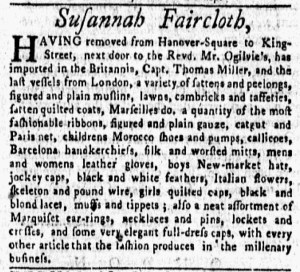
The appropriately named Susannah Faircloth sold a variety of textiles and adornments at her shop in New York in the early 1770s.  In an advertisement in the November 25, 1771, edition of the New-York Gazette and Weekly Mercury, she listed “a variety of sattens and peelongs, figured and plain muslins, lawns, cambricks and taffeties” and “figured and plain gauze,” naming an array of fabrics familiar to discerning eighteenth-century consumers.  She acquired her wares from England, having imported them “in the Britannia, Capt. Thomas Miller, and the last vessels from London.”

Faircloth and other advertisers reported such connections to the cosmopolitan center of the empire as a means of convincing prospective customers that they carried the latest fashions.  Elsewhere in the same issue, for instance, the partnership of Leigh and Price promoted goods “imported by the Britannia, Capt. Miller, and by the late Vessels from London.”  Several artisans who set up shop in New York indicated that they formerly practiced their trades in London, including Bennett and Dixon, “Jewellers, Goldsmiths, and Lapidaries, from LONDON,” James Yeoman, “WATCH and CLOCK-MAKER, from LONDON,” and Thomas Brown, “Marble Cutter, FROM LONDON.”  With so many artisans hailing from London and so many merchants and shopkeepers outfitting customers in garments and goods from London, the advertisements in the New-York Gazette and Weekly Mercury suggested to customers that they had full access to the styles of the fashionable metropolis.

Faircloth also invoked the latest tastes more explicitly.  Among her inventory, she carried “a quantity of the most fashionable ribbons.”  She concluded her advertisement with a proclamation that she also sold “every other article that the fashion produces in the millenary business.”  Prospective customers could depend on her to offer more than just goods shipped from London.  She also provided knowledge of the latest trends, a valuable resource for consumers.

September 9

What was advertised in a colonial American newspaper 250 years ago today?

Boston Evening-Post (September 9, 1771).

“He has invented an HAIR-ROLL upon an entire new Construction.”

In the 1770s, fashionable women preferred a towering hairstyle known as the high roll.  Their high hair testified that they had the leisure time to maintain the style and the means to hire hairdressers or maids to assist in achieving the style.  While some women with high rolls wore wigs, most arranged their own hair around pads and rollers, sometimes embellished with plumes, ribbons, hats, or other adornments.  Women wore high rolls to assert status, but they also became targets of critics who condemned luxury and the corrupting influences sometimes associated with consumer culture in the eighteenth century.

William Warden, a wigmaker who kept shop on King Street in Boston, attempted to catch the attention of prospective customers with an advertisement “To the LADIES” in the September 9, 1771, edition of the Boston Evening-Post.  He promoted a product that he invented to aid women in achieving the style while also making high hair more comfortable to wear.  Warden proclaimed that he “invented an HAIR-ROLL upon an entire new Construction,” one that weighed significantly less than those made and sold by his competitors.  The wigmaker estimated that most “Rolls in common use weigh from Seven to Ten Ounces, whereas those he makes do not exceed Three.”  Warden did not believe that he needed to provide further recommendation for his product.  “The Advantages of a light Roll over a heavy one,” he declared, “are so obvious that it would be affrontive to the Understanding to point them out.”  Women who wore the style may have been delighted to learn of hair rollers that were easier to balance and put less strain on their necks.

According to Warden, being fashionable did not mean having to be uncomfortable, or at least not as uncomfortable as most hair rolls made the women who wore them.  He invited women to give his new product a try, giving them access to a popular fashion, the high roll, without experiencing some of the disadvantages often associated with it.

June 2

What was advertised in a colonial American newspaper 250 years ago this week?

Maryland Gazette (May 30, 1771).

“The newest and neatest Fashion, either in Europe or America.”

In the spring of 1771, Peter Sinnott, a “TAYLOR, from Dublin,” introduced himself to the residents of Annapolis in an advertisement in the Maryland Gazette.  He advised prospective clients, both “Gentlemen” and “Ladies,” that he “carries on his Trade in all its Branches.”  The tailor also pledged that his customers “may depend on having their Cloaths well made.”  Like many other artisans, Sinnott incorporated the combination of quality, skill, and expertise into his newspaper notices.

He also included an appeal to fashion, another common marketing strategy for tailors, milliners, and others who made garments.  Sinnott proclaimed that he produced clothing “in the newest and neatest Fashion, either in Europe or America.”  In so doing, he demonstrated that he expected anxieties about wearing the latest styles resonated even in smaller ports.  Simultaneously, he attempted to stoke those anxieties.  Annapolis was not nearly as large as Boston, Charleston, New York, or Philadelphia, but that did not mean that consumers there could not be as cosmopolitan in their appearances as their counterparts in those major urban ports.  Yet that was not the extent of the promise that Sinnott made.  His clients in Annapolis could not only keep pace with fashionable gentlemen and ladies throughout the colonies but also with trendsetters on the other side of the Atlantic.

Sinnott realized that it would take time to establish his reputation and cultivate a clientele for his garments.  In order to earn a living while he did so, he also promoted an ancillary service, declaring that he “scours and cleans Cloaths in a superior Manner than has hitherto been done in this Place.”  Furthermore, he had perfected a method for “taking Spots and Stains out of Scarlet Cloth.”  Each time he interacted with clients who hired him to clean their garments, Sinnott had an opportunity to offer his services as a tailor.  One branch of his business supported the other, possibly resulting in new commissions.

In a short advertisement, Sinnott presented “the PUBLICK” with several reasons to him.  He emphasized his skill and the quality of his garments while reassuring prospective clients that he would outfit them in the latest styles.  He also provided additional services for the benefit of his clients.  As Sinnott’s advertisement demonstrates, eighteenth-century newspaper notices did not merely announce the availability of consumer goods and services.  Instead, advertisers constructed appeals intended to incite demand and convince readers to visit their shops.

December 11

What was advertised in a colonial American newspaper 250 years ago today?

Connecticut Courant (December 11, 1770).

“They have been at the expence of bringing workmen from Philadelphia.”

Herman Allen and Levi Allen embarked on a new venture in December 1770.  The Allens ran a store in Salisbury, Connecticut, where they sold a “LARGE and general assortment of European, East, & West India Goods.”  Their notice, along with others for shops in Hartford and other towns in Connecticut that ran in the Connecticut Courant, demonstrated that the consumer revolution extended beyond the major port cities and into the countryside.

The Allens’ new venture also demonstrated that retailers and, likely, customers looked to larger cities for cues about consumption practices while also remaining mindful of local economies.  In addition to the “general assortment” of merchandise available at their store, the Allens also informed consumers that “they have been to the expence of bringing workmen from Philadelphia, for dressing Leather, and making Breeches and Gloves in the neatest Philadelphia fashion.”  They assumed that prospective customers in small towns were familiar with the manner of making breeches and gloves in the largest city in the colonies as well as the appearance of the finished products.  Furthermore, the Allens expected that their customers desired breeches and gloves that resembled those made in Philadelphia.  Even if prospective customers did not, the Allens suggested that they should.

The Allens also declared that their customers could gain access to the fashions of urban ports while still supporting the local economy.  Since the Allens brought the workmen to Connecticut to make breeches and gloves, “the public may be supply’d without sending the money out of this colony.”  Furthermore, customers did not have to pay a premium for that privilege.  Instead, the Allens set prices “as cheap as in New York or Albany or elsewhere.”  In terms of payment, they accepted cash and “all sorts of country produce” and extended “the usual credit.”

Colonists did not need to reside in urban ports where newspapers overflowed with advertisements for consumer goods in order to experience the pleasures of shopping and showing off the clothing and other possessions they acquired.  From stocking an assortment of goods to bringing workmen to the town of Salisbury to make breeches and gloves “in the neatest Philadelphia fashion” to low prices and credit, the Allens sought to make it easy and convenient for residents of Salisbury and other small towns in Connecticut to participate in the consumer revolution.

September 7

What was advertised in a colonial American newspaper 250 years ago today?

Sep 7 - 9:7:1770 New-Hampshire Gazette
New-Hampshire Gazette (September 7, 1770).

“MANTU-MAKER, FROM BOSTON.”

Over the past few days the Adverts 250 Project has examined the manner in which purveyors of goods and services in the colonies incorporated their origins into their advertisements as part of their marketing campaigns.  We began with James Yeoman, a clock- and watchmaker “FROM LONDON,” who sought to convince readers of the New-York Gazette and Weekly Mercury that his skills eclipsed those of competitors who had not trained or worked in the largest city in the empire.  Next we looked at George Lafong, a “French HAIR-DRESSER,” who informed the ladies and gentlemen of Williamsburg, Virginia, that he styled hair “in the cheapest manner, & TOUT A LA MODE” (all in fashion).  Injecting a few words of French into his advertisement in William Rind’s Virginia Gazette underscored the gentility and cachet associated with hiring a hairdresser from France.

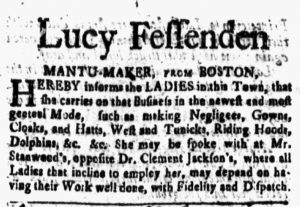
Today we consider the advertisement that Lucy Fessenden inserted into the September 7, 1770, edition of the New-Hampshire Gazette.  She introduced herself as a mantuamaker “FROM BOSTON,” asserting that she pursued her craft “in the newest and most genteel Mode.”  While Yeoman and Lafong’s advertisements testified to migration across the Atlantic, Fessenden’s notice indicated migration within the colonies.  In both instances, advertisers sought to use their origins to their advantage.  Artisans as well as tailors, milliners, and others in the garments trade, including mantuamakers like Fessenden, frequently noted that they formerly lived and worked in some of the largest port cities when they relocated to smaller towns and advertised their services.  Perceptions of skill and associations with gentility seemed to operate on a sliding scale.  Residents of Boston, Charleston, New York, and Philadelphia looked to London and other places on the far side of the Atlantic as models.  Residents of smaller towns did as well, but they also recognized the major ports in the colonies as locations that merited notice.  Unable to make a direct connection to London, Fessenden instead leveraged her time in Boston to suggest her familiarity with “the newest and most genteel Mode” and her ability to deliver on it “with Fidelity and Dispatch.”

September 6

What was advertised in a colonial American newspaper 250 years ago today?

Sep 6 - 9:6:1770 Virginia Gazette Rind
Virginia Gazette [Rind] (September 6, 1770).
TOUT A LA MODE.”

George Lafong introduced himself to the ladies and gentlemen of Williamsburg as a “French HAIR-DRESSER” in an advertisement in the September 6, 1770, edition of William Rind’s Virginia Gazette.  Apparently, he was new in town and had not yet established a clientele; he announced that he “intends carrying on the said business.”  He also made two familiar marketing appeals, though he put a twist on the second one when he proclaimed that he styled hair “in the cheapest manner, & TOUT A LA MODE.”  The hairdresser concluded by inviting “Gentlemen who may please to honour him with their commands” to come to him for shaving.

Extending only eight lines, it was a brief advertisement, but Lafong managed to pack a lot of meaning into it.  Throughout the colonies, newcomers often noted their origins in their advertisements, especially when they thought this signaled greater prestige for their wares or services.  Artisans often described themselves as “from London,” suggesting that they possessed greater skill and had better training.  Apothecaries and others who provided medical treatments and services also emphasized their connections to London and other places on the other side of the Atlantic, often listing their credentials.  For hairdressers, being from London hinted at the cosmopolitanism associated with the thriving metropolis at the center of the empire, but being a “French HAIR-DRESSER” may have been even better since even the genteel denizens of London looked to France for fashion cues.  Hiring a French hairdresser in colonial Virginia could have been an expensive luxury reserved for the elite, but Lafong declared that his prices were not exorbitant.  His clients could have their hair elegantly styled and adorned “in the cheapest manner.”  Hiring a French hairdresser at all alluded to exclusivity, but the newcomer did not seek to become so exclusive that he priced himself out of the market.  He also put his own spin on familiar marketing appeals that emphasized fashion.  Shopkeepers, tailors, milliners, and others who provided consumer goods and services frequently incorporated fashion into their advertisements.  Lafong did so as well, trumpeting that he styled hair “TOUT A LA MODE” or “all in fashion.”  This appeal simultaneously underscored his identity as a French hairdresser and enhanced the aura of exclusivity for prospective clients who learned French to appear more genteel to their friends and neighbors.

Upon arriving in Virginia, Lafong placed a savvy advertisement intended to cultivate a clientele among the “Ladies and Gentlemen” of Williamsburg.  Incorporating several familiar marketing appeals, he also introduced an innovative means of underscoring his origins as a “French HAIR-DRESSER” by making his appeal to fashion in French rather than English.

June 17

What was advertised in a colonial American newspaper 250 years ago this week?

Jun 17 - 6:14:1770 Pennsylvania Gazette
Pennsylvania Gazette (June 14, 1770).

“Proposes to return as soon as the Importation is opened.”

Although many colonists promoted “domestic manufactures” as alternative to imported goods in the late 1760s and early 1770s, many consumers and purveyors of goods embraced those products only temporarily.  Items produced in the colonies gained popularity when nonimportation agreements were in effect as a means of economic resistance to Parliament imposing duties on certain imported goods, but many colonists anticipated repeal of such odious legislation and looked forward to resuming business as usual.  For some, domestic manufactures represented a temporary measure; merchants and shopkeepers intended to import goods from England once again when the political situation calmed, just as consumers intended to purchase those items as soon as they became available once again.

In the summer of 1770, Anne Pearson, a milliner in Philadelphia, was among those purveyors of goods who expressed enthusiasm about acquiring and selling imported merchandise once again.  She placed an advertisement in the June 14, 1770, edition of the Pennsylvania Gazette to announce that she sought to liquidate her current inventory before traveling to London in the fall.  She offered a “LARGE and general Assortment of Millinery and Linen-drapery Goods” at low prices.  Yet Pearson did not plan to relocate to London; instead, she would stay for only a short time and then “return as soon as the Importation is opened” in the wake of the repeal of the duties on imported paper, glass, paint, and lead that had been established in the Townshend Acts.  Some colonists continued to argue for the importance of domestic manufactures even after Parliament capitulated, but they did not sway purveyors or consumers to continue to abstain completely from imported goods.  Recognizing the demand for such goods, Pearson attempted to put herself in the best position to serve customers in Philadelphia.  Not only would she “return as soon as the Importation is opened,” she would bring with her “a fresh Assortment of the very best and most fashionable Goods.”  In journeying to London to select those goods herself, Pearson seized an advantage over competitors who relied on English merchants and correspondents to supply them with goods.  Pearson would not have to rely on the judgment of others, judgment that might be compromised by their desire to rid themselves of wares unlikely to sell in England.  Instead, she could inspect the merchandise before placing her order and observe the current trends in London in order to make her case to prospective customers that she did indeed stock “the very best and most fashionable Goods” upon her return to Philadelphia.

June 16

What was advertised in a colonial American newspaper 250 years ago today?

Jun 16 - 6:16:1770 Providence Gazette
Providence Gazette (June 16, 1770).

They may depend on having their Commands executed after the newest and most genteel Fashions.”

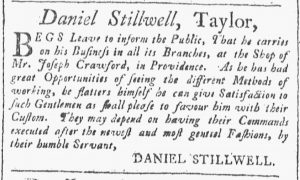
When Daniel Stillwell, a tailor, placed an advertisement in the June 16, 1770, edition of the Providence Gazette, he made one of the most common and important appeals deployed by colonists who followed his trade.  He pledged that clients “may depend on having their Commands executed after the newest and most genteel Fashions.”  Tailors and others in the garment trades often made appeals to price, quality, and fashion in their advertisements.  Stillwell, like other tailors, believed that price and quality might not have mattered much to those who wished for their clothing to communicate their gentility if their garments, trimmings, and accessories did not actually achieve the desired purpose.  Reasonable prices and good quality were no substitute for making the right impression.  Stillwell’s work as a tailor required a special kind of expertise beyond measuring, cutting, and sewing.  He had to be a keen observer of changing tastes and trends so he could deliver “the newest and most genteel Fashions” to his clients.

To that end, Stillwell informed prospective customers that he “has had great Opportunities of seeing the different Methods of working.”  Although he did not elaborate on those experiences, this statement suggested to readers that Stillwell refused to become stagnant in his trade.  Rather than learning one method or technique and then relying on it exclusively, he consulted with other tailors and then incorporated new and different techniques, further enhancing his skill.  In so doing, he joined the many artisans who asserted that their skill and experience prepared them to “give Satisfaction” to those who employed them or purchased the wares they produced.  Stillwell was no novice; instead, he “carries on his Business in all its Branches,” proficiently doing so because of the care he had taken in “seeing the different Methods of working.” Simply observing current fashions was not sufficient for someone in his trade who was unable to replicate them.  Stillwell sought to assure prospective clients that he possessed two kinds of knowledge necessary for serving them, a discerning knowledge of the latest styles and a thorough knowledge of the methods of his trade that would allow him to outfit customers accordingly.

February 25

What was advertised in a colonial American newspaper 250 years ago this week?

Feb 25 - 2:22:1770 New-York Journal
New-York Journal (February 22, 1770).

“The Best accounts of fashions have been sent over by every packet.”

Thomas Charles Willett listed “A Great Variety” of garments, textiles, adornments, and accoutrements in the advertisement he placed in the New-York Journal in February 1770.  He stocked everything from “scarlet cloth cloaks” to “Striped Lutestrings” to “French pearl, garnet and jet necklaces and ear rings” to “Italian hair powder.”  He concluded his catalog of merchandise with “Bonnets and other fashionable goods.”  In his line of business, fashion mattered, especially his ability to convince prospective customers that he was familiar with the latest fashions and would offer appropriate guidance as they made their selections.

To that end, Willett made a special appeal at the conclusion of his advertisement.  He informed potential clients that “the best accounts of fashions have been sent over by every packet.”  In other words, the vessels that sailed from London and other English ports to New York delivered news of the latest fashions to Willett.  He may have maintained correspondence with friend and business associates in London, the cosmopolitan center of the empire, or received magazines with descriptions of the latest tastes.  Regardless of his source, Willett had his eye on the other side of the Atlantic … and he expected that prospective customers did as well.

This stood in stark contrast to the political ideology of the period that called for boycotting goods imported from England.  In protest of the duties leveled on imported paper, glass, lead, paint, and tea in the Townshend Acts, merchants, shopkeepers, and other signed nonimportation agreements.  They pledged not to do business with their counterparts in England until Parliament repealed the duties, just as the Stamp Act had been repealed.  That did not prevent Willett and other retailers from selling goods ordered or delivered before the nonimportation pact went into effect, not did it prevent consumers from looking to England when they wished to display their own gentility and cosmopolitanism.  Willett stocked a variety of textiles and adornments.  How were they to be transformed into garments and combined together to make a statement?  As the answer to that question changed, Willett offered assistance from “the best accounts of fashions” he continued to receive.  He imported information for his customers to consume even when they collectively declined to import or purchase goods.