May 20

What was advertised in a revolutionary American newspaper 250 years ago today?
Pennsylvania Ledger (May 20, 1775).

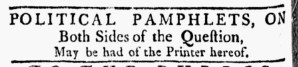
“POLITICAL PAMPHLETS, ON Both Sides of the Question.”

When he launched the Pennsylvania Ledger in the winter of 1775, James Humphreys, Jr., distributed proposals declaring that it would be a “Free and Impartial News Paper, open to All, and Influenced by None.”  With high hopes for operating an impartial press as the imperial crisis intensified, he soon advertised “POLITICAL PAMPHLETS … on Both Sides of the Question” in February 1775.  Several months later, he ran a notice advising that “POLITICAL PAMPHLETS, ON Both Sides of the Question, May be had of the Printer hereof” in the May 20 edition.  Doing so required both courage and commitment, especially considering recent events.

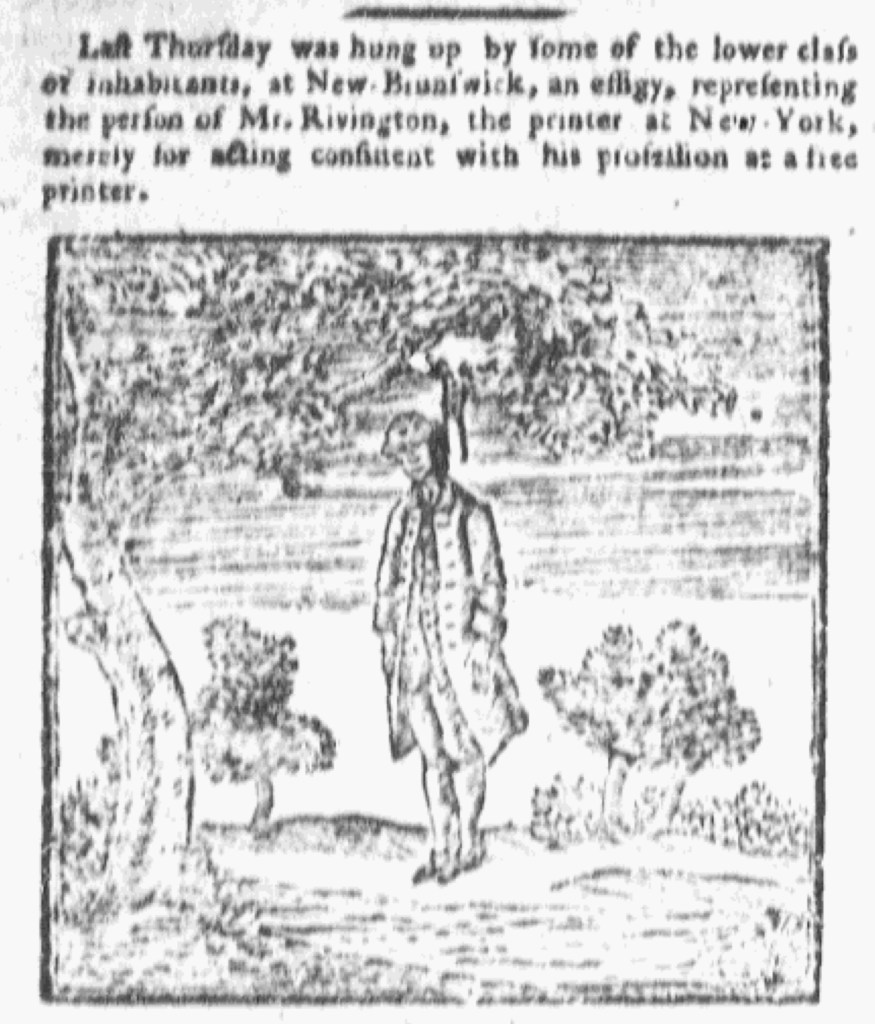
Humphreys published that advertisement a month after the battles at Lexington and Concord.  The siege of Boston continued, yet he did not allow news of the battles or the siege to dissuade him from hawking pamphlets on “Both Sides of the Question.”  Perhaps more significantly, James Rivington, the printer who also published pamphlets “on both sides, in the unhappy dispute with Great-Britain” at his “OPEN and UNINFLUENCED PRESS” in New York, had been hung in effigy in New Brunswick, New Jersey, by colonizers dissatisfied with what they considered his Loyalist sympathies.  Rivington covered that event in his newspaper, Rivington’s New-York Gazetteer, even including a woodcut depicting the scene.  Given that printers exchanged newspapers with their counterparts in other cities and towns, Humphreys likely read about the effigy; even if he did not, he almost certainly heard about it.  Even more recently, Rivington published a notice in which he acknowledged that “many Publications have appeared from my Press which have given great Offence … to many of my Fellow Citizens,” asserted that “Nothing which I have ever done, has proceeded from any Sentiments in the least unfriendly to the Liberties of this Continent,” and pledged “to conduct my Press upon such Principles as shall not give Offence to the Inhabitants of the Colonies.”  Despite his effort to clarify that he had not pursued a political agenda but instead followed his “duty as a Printer” to encourage “the Liberty of the Press,” the Sons of Liberty attacked his home and office on May 10.  Rivington took refuge on a British naval vessel.  Assistants continued publishing the newspaper, inserting his notice about his true intentions twice more.  Rivington had already discontinued advertising political pamphlets representing both sides of what he had previously called “The American Controversy” and “THE AMERICAN CONTEST.”

Although Humphreys advertised political pamphlets from “Both Sides” on May 20, word of what happened to Rivington may have prompted him to reconsider his courage in the weeks and months that followed.  He discontinued that advertisement.  In the next issue, he marketed only one pamphlet for sale at his printing office, The Group, a satire by Mercy Otis Warren that depicted a “SCENE AT BOSTON.”  That publication unabashedly supported the American cause.  A week later, that advertisement appeared on the first page of the Pennsylvania Ledger (as it had in the May 20 edition that carried the advertisement for political pamphlets on the final page), next to an advertisement for a multi-volume set of Political Disquisitions recommended for “all the friends of Constitutional Liberty, whether Britons or Americans.”  Still, the editorial perspective of the Pennsylvania Ledger, according to Isaiah Thomas, “was under the influence of the British government” and Humphreys eventually “refused to bear arms in favor of his country, and against the government of England.”[1]  He experienced sufficient difficulty that he suspended the newspaper at the end of November 1776.  In May 1775, a year and a half earlier, he grappled with what kinds of publications he would promote among the advertisements in his newspaper, first forging ahead with notices for pamphlets representing multiple perspectives and then emphasizing those that supported the American cause, perhaps doing so in hopes of avoiding the treatment that Rivington received.

**********

[1] Isaiah Thomas, The History of Printing in America: With a Biography of Printers and an Account of Newspapers (1810; New York: Weathervane Books, 1970), 398.
May 11

What was advertised in a revolutionary American newspaper 250 years ago today?

Rivington’s New-York Gazetteer (May 11, 1775).

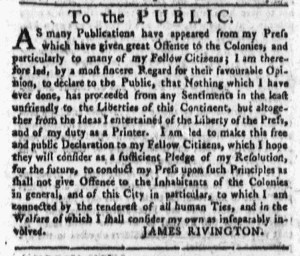
“Many Publications have appeared from my Press which have given great Offence to the Colonies.”

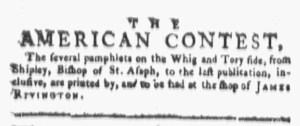
James Rivington seemed to change his tune about what he printed and sold at his printing office on Hanover Square in New York.  On April 20, the day after the battles at Lexington and Concord, the printer of Rivington’s New-York Gazetteer once again advertised “several pamphlets on the Whig and Tory side” of “THE AMERICAN CONTEST.”  Word of what had occurred in Massachusetts the previous day had not yet arrived in New York, but Rivington had other news concerning the imperial crisis to report.  That included residents of New Brunswick, New Jersey, hanging “an effigy, representing the person of Mr. Rivington … merely for acting consistent with his profession as a free printer.”  A rare woodcut depicting the scene accompanied the combination article and editorial about his “OPEN and UNINFLUENCED PRESS.”

A week later, Rivington’s New-York Gazetteer carried news of Lexington and Concord.  The printer chose not to insert his advertisement hawking pamphlets representing both Whig and Tory perspectives in that issue.  In the next issue, two weeks after the battles in Massachusetts, Rivington ran a new advertisement, one that took a different tone than his coverage of the effigy.  “AS many Publications have appeared from Press which have given great Offence to the Colonies, and particularly to many of my Fellow Citizens,” the printer declared, “I am therefore led, be a most sincere Regard for their favourable Opinion, to declare to the Public, that Nothing which I have ever done, has proceeded from any Sentiments in the least unfriendly to the Liberties of this Continent, but altogether from the Ideas I entertained of the Liberty of the Press, and of my duty as a Printer.”  That being the case, “I am led to make this free and public Declaration to my Fellow Citizens, which I hope they will consider as a sufficient Pledge of my Resolution, for the future, to conduct my Press upon such Principles as shall not give Offence to the Inhabitants of the Colonies in general, and of this City in particular, to which I am connected by the tenderest of all human Ties, and in the Welfare of which I shall consider my own as inseparably involved.”  Rivington stopped short of offering an apology or stating that he regretted printing and selling newspapers and pamphlets that advanced Tory views, but he did take a less defiant tone in his effort to explain his editorial decisions.  He suggested that he would adopt a new approach, though he did not go into detail about that.  Perhaps he hoped that critics would notice that he did not advertise the problematic pamphlets.  Even if they did not, Rivington refrained from publishing an advertisement that ran counter to the message he delivered in his notice clarifying his prior actions.

That notice appeared in three consecutive issues of Rivington’s New-York Gazetteer, none of which carried advertisements for political pamphlets.  The events unfolding in Massachusetts may have encouraged the printer to take greater caution, though the masthead of his newspaper continued to proclaim that he operated an “OPEN and UNINFLUENCED PRESS.”  As far as the Sons of Liberty were concerned, however, the printer could not redeem himself.  On May 10, a week after Rivington first published his notice assuring the public that he would “conduct [his] Press upon such Principles as shall not give Offence to the Inhabitants of the Colonies,” the Sons of Liberty attacked his home and printing office.  Rivington fled to a British ship in the harbor.  Assistants maintained uninterrupted publication of the newspaper, continuing to run Rivington’s notice, while the printer petitioned the Second Continental Congress for pardon.  As Todd Andrlik documents, Rivington explained that “however wrong and mistaken he may have been in his opinions, he has always meant honestly and openly to do his duty.”  The Continental Congress forwarded the petition to the New York Provincial Congress.  Rivington received his pardon, but his reformation was not so complete as to avoid further notice from the Sons of Liberty.  In November 1775, Sons of Liberty from New Haven destroyed his press and reportedly melted down his types to make shot, bringing an end to Rivington’s New-York Gazetteer.

April 23

What was advertised in a revolutionary American newspaper 250 years ago this week?

Rivington’s New-York Gazetteer (April 20, 1775).

“Several pamphlets on the Whig and Tory side.”

Many Patriots did not care for the editorial stance that James Rivington took in his newspaper.  They considered him a Loyalist even though he declared in the masthead that he operated an “OPEN and UNINFLUENCED PRESS” that represented all views.  Similarly, he printed, advertised, and sold political pamphlets about “THE AMERICAN CONTEST … on the Whig and Tory side.”  Rivington aimed to keep colonizers informed and intended to generate revenue while doing so, believing that controversy could be good for business during the imperial crisis.

Late in 1774 and throughout the first months of 1775, Rivington regularly ran advertisements that listed the variety of political pamphlets available at his printing office.  He inserted an abbreviated version in the April 20, 1775, edition.  Colonizers in New York had not yet received word of the events at Lexington and Concord the previous morning.  Rivington instead published other news, including a recent instance of “some of the lower class of inhabitants, at New-Brunswick” hanging “an effigy, representing the person of Mr. Rivington … merely for acting consistent with his profession as a free printer.”  He not only covered that story but also illustrated it with a woodcut depicting the effigy hanging from a tree.

Rivington’s New-York Gazetteer (April 20, 1775).

The image almost certainly attracted attention, in part because news items in eighteenth-century newspapers so rarely featured illustrations of any sort.  Elsewhere in the same issue, readers encountered only five other images.  The masthead contained the coat of arms of Great Britain, as usual, and the drop cap for a letter to the editor appeared within a smaller version of the coat of arms.  A stock image of a ship adorned an announcement that the Earl of Dunmore would soon sail for London.  Similarly, a stock image of a horse being led by a man helped promote the stud services of Lath, Match ‘Em, Pilgrim, and Bashaw.  Abraham Delanoy’s woodcut depicting lobster traps was the only other image created to match the content of an advertisement or a news item.

The scarcity of images made the scene of the effigy even more conspicuous.  Rivington wrote a sarcastic description of the event and then affirmed “that his press has been open to publications from ALL PARTIES.”  He challenged “his enemies to produce an instance to the contrary,” noting that he treated his role as printer like “a public office” and reasoned that “every man has a right to have recourse” via his press.  “But the moment he ventured to publish sentiments which were opposed to the dangerous views and designs of certain demagogues,” Rivington asserted, “he found himself held up as an enemy to his country.”  His support for “LIBERTY OF THE PRESS” made him a target for “a most cruel tyranny,” as demonstrated by “very recent transactions” that included the effigy in New Brunswick.  His description of how some Patriots comported themselves along with his insistence on continuing to sell political pamphlets “on the Whig and Tory side” did not endear Rivington to “his enemies.”  Within in a month, a mob of Sons of Liberty would attack his printing office and destroy his press.  Rivington escaped, seeking refuge on a British naval ship in the harbor.

October 29

What was advertised in a colonial American newspaper 250 years ago today?

Maryland Gazette (October 29, 1772).

“I now propose to publish, by Subscription, … a Weekly News-Paper.”

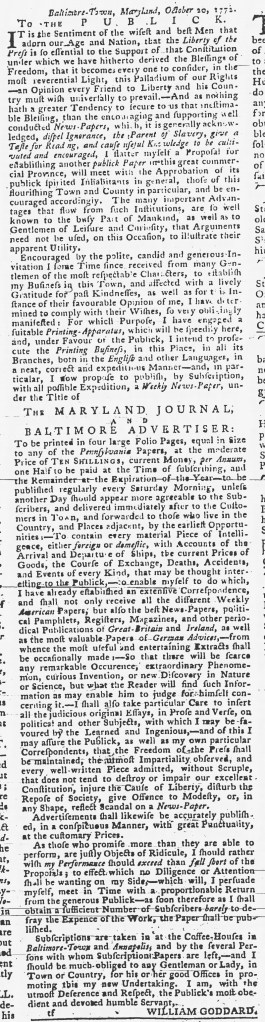
Maryland had only one newspaper in 1772.  William Goddard aimed to change that.  To aid his efforts, he inserted a proposal in the October 29 edition of the Maryland Gazette, the publication that would be his competitor if he managed to launch “THE MARYLAND JOURNAL, AND BALTIMORE ADVERTISER.”  Printed in Annapolis, the Maryland Gazette served the entire colony, but Goddard believed that a market existed, or would exist after some savvy advertising, to support two newspapers in the colony.  In addition, he underscored the political utility of newspapers to prospective subscribers.  “IT is the Sentiment of the wisest and best Men that adorn our Age and Nation,” Goddard declared in the first sentence of his proposal, “that the Liberty of the Press is so essential to the Support of that Constitution under which we have hitherto derived the Blessings of Freedom, that it becomes every one to consider, in the most reverential Light, this Palladium of our Rights.”  The printer further explained that “well conducted News-Papersdispel Ignorance, the Parent of Slavery, give a Taste for Reading, and cause useful Knowledge to be cultivated and encouraged.”  Accordingly, he called on “every Friend to Liberty and his Country” to support his proposed project.

Goddard’s proposal filled nearly an entire column in the Maryland Gazette.  In addition to expounding on the philosophy that prompted him to consider publishing a newspaper in Baltimore, he advised potential subscribers that he was indeed prepared to launch the venture “as soon … as I shall obtain a sufficient Number of Subscribers barely to defray the Expence of the Work.”  Already in correspondence with “many Gentlemen of the most respectable Characters” in Baltimore, Goddard had “engaged a suitable Printing-Apparatus, which will be speedily here.”  In addition, as printer of the Pennsylvania Chronicle he had already “established an extensive Correspondence, and shall not only receive all the different Weekly American Papers, but also the best News-Papers, political Pamphlets, Registers, Magazines, and other periodical Publications of Great-Britain and Ireland.”  In addition to printer and publisher, Goddard assumed the responsibilities of editor, drawing the news from the letters, newspapers, and periodicals sent to him.  Every American newspaper printer-editor reprinted extensively from other publications. Goddard even acquired “the most valuable Papers of German Advices” in order to provide news of interest to the growing German population in the backcountry.

The proposal also outlined the particulars of the publication and how to subscribe.  The newspaper would be “printed in four large Folio Pages, equal in Size to any of the Pennsylvania Papers” that, along with the Maryland Gazette, operated as local newspapers for Baltimore and the region.  Goddard intended to print and distribute the newspaper “regularly every Saturday Morning, unless another Day should appear more agreeable to the Subscribers.” Subscriptions cost ten shillings per year, with half to be paid immediately and the other half at the end of the year. Goddard briefly mentioned advertisements, noting they would be “accurately published, in a conspicuous Manner, with great Punctuality, at the customary Prices.”  He did not list those prices.  Colonizers interested in subscribing could leave their names “at the Coffee-Houses in Baltimore-Town and Annapolis” or with “several Persons with whom Subscription Papers are left.”  Like other printers attempting to launch new projects, Goddard relied on a network of local agents who assisted in recruiting subscribers.

Beyond the particulars, Goddard emphasized that he pursued a higher purpose than merely generating revenues or turning a profit on the publication.  He promised to publish news about every “remarkable Occurence, extraordinary Phenomemon, curious Invention, or New Discovery in Nature or Science” as well as “judicious original Essays … on political and other Subjects.”  In selecting material to include in the Maryland Journal, Goddard pledged that “the Freedom of the Press shall be maintained, the utmost Impartiality observed, and every well written Piece admitted, without Scruple, that does not tend to destroy or impair our excellent Constitution, injure the Cause of Liberty, disturb the Repose of Society, give Offence to Modesty, or, in any Shape, reflect Scandal on a News-Paper.”  In an era of upheaval as Parliament turned unwanted attention to the colonies, Goddard framed publishing a newspaper as a civic duty that served the commercial and political interests of the community.

Did the subscription proposal help Goddard to obtain that “sufficient Number of Subscribers barely to defray the Expence” and commence publication?  Perhaps, but it took some time.  The first issue appeared on August 20, 1773, ten months after Goddard initially proposed publishing the Maryland Journal and Baltimore Advertiser.  The newspaper continued publication, under the guidance of various printers and proprietors, throughout the American Revolution and into the 1790s, transitioning from weekly to semi-weekly to tri-weekly to daily as newspaper publishing expanded throughout the new nation.

March 26

Who was the subject of an advertisement in a colonial American newspaper 250 years ago today?

Mar 26 - 3:26:1768 New-York Journal Supplement
Supplement to the New-York Journal (March 26, 1768).

“TO BE SOLD, A Likely young Negro Girl.”

John Holt published the New-York Journal on Thursdays in 1768. According to schedule, he distributed a standard four-page issue on Thursday, March 24. A two-page supplement filled mostly with news and a limited number of advertisements accompanied that issue. Two days later, Holt distributed an additional two-page supplement on Saturday, March 26. He explained that it contained “Articles left out of last for Want of Room,” apparently items that either could not wait for inclusion the following week or that would crowd out more recent news if held that long. The March 26 supplement consisted almost entirely of news items. One advertisement appeared at the bottom of the final column on the second page.

That advertisement offered a “Likely young Negro Girl about 13 Years of Age” for sale. It stood in stark juxtaposition to the remainder of the content of the supplement. Holt devoted four of the six columns to news from Boston, including several editorial pieces reprinted from the Boston-Gazette. One reprinted letter, signed “A TRUE PATRIOT,” warned that the colonists “soon will find themselves in chains” if they did not “support their own RIGHTS, and the Liberty of the PRESS” in the face of abuses by Parliament. Another correspondent, “POPULUS,” underscored that there was “nothing so justly TERRIBLE to tyrants, and their tools and abettors, as FREE PRESS.” The press played such an important role that “it is ever watched by those who are forming plans for the destruction of the people’s liberties, with an envious and malignant eye.”

In addition to these editorials, Holt inserted a circular letter “written by the hon. the House of Representatives” in Massachusetts “in the last Session of the General Assembly and sent to the respective Assemblies on the Continent.” In it, that body expressed “their humble opinion, which they express with the greatest deference to the wisdom of the parliament; that the acts made there, imposing duties on the people of this province, with the sole and express purpose of raising a revenue, are infringements on their natural and constitutional rights; because, as they are not represented in the British parliament, his Majesty’s commons in Britain, by those acts, grant their property without their consent.” In other words, colonists in Massachusetts objected to taxation without representation. Holt amplified their sentiments by reprinting their letter for readers in New York and its hinterlands.

All of this discussion of freedom of the press and theories of constitutional liberty took place alongside an advertisement for a “young Negro Girl.” The revenues generated from that advertisement contributed to the dissemination of the arguments voiced by “A TRUE PATRIOT,” “POPULUS,” and the assembly of the “Province of MASSACHUSETTS-BAY.” As white colonists fretted about their liberties, they also perpetuated a system that enslaved a “young Negro Girl” and countless others, holding their bodies in bondage even as they lamented potential challenges to their own speech. Resistance led to revolution as the imperial crisis intensified over the course of a decade, but many colonists were inconsistent in their conceptions of liberty and applying them to all who resided in the colonies. Even as they challenged Parliament to recognize their “natural constitutional right” colonists continued to purchase and peddle slaves from New England to George. The evidence for each appeared side-by-side in the pages of their newspapers.