Who was the subject of an advertisement in a colonial American newspaper 250 years ago today?
Georgia Gazette (June 24, 1767).
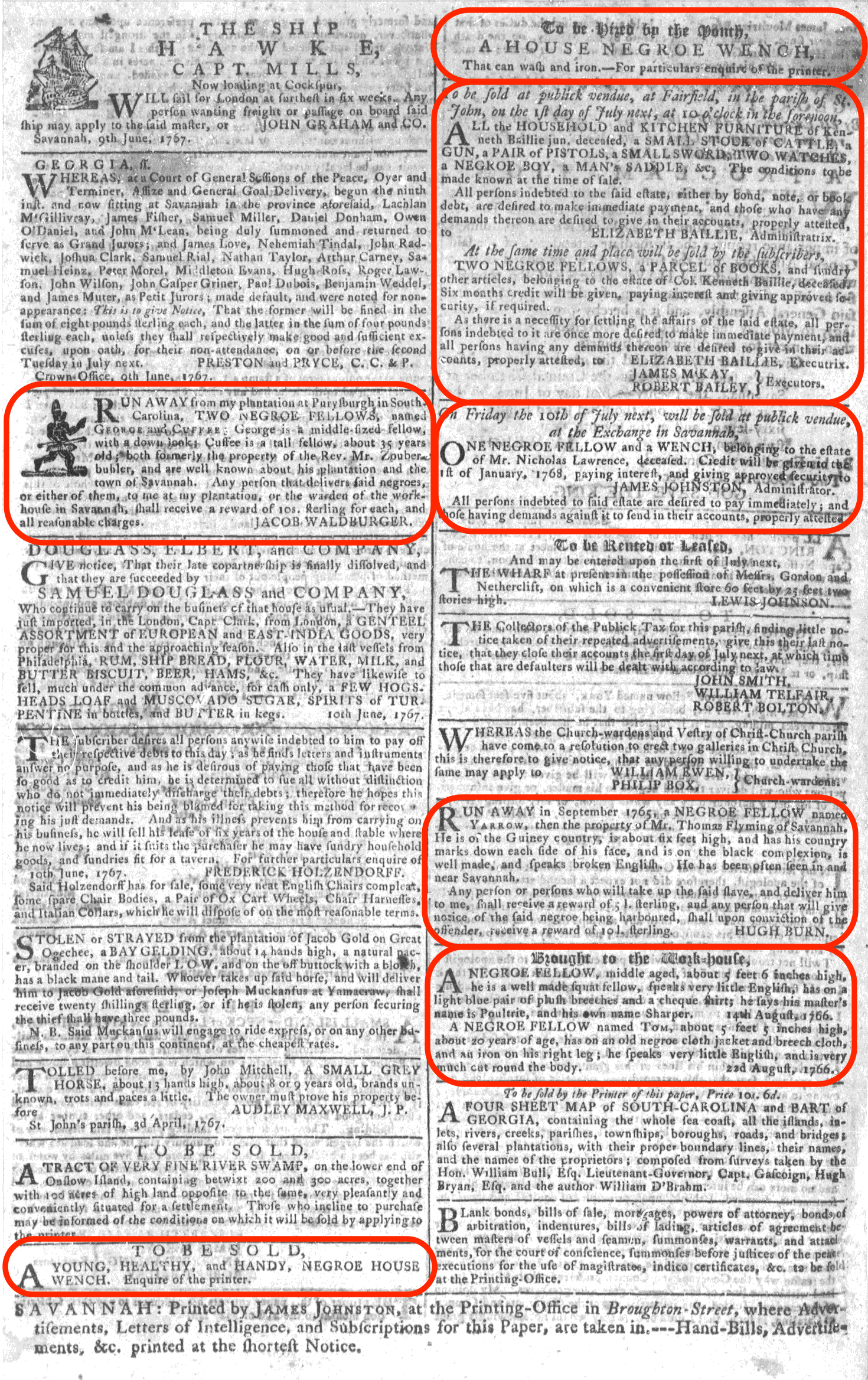
“TO BE SOLD, A YOUNG, HEALTHY, and HANDY, NEGROE WENCH.”
Nine advertisements about enslaved men and women appeared in the June 24, 1767, edition of the Georgia Gazette. Four of them offered slaves for sale. Another sought not to sell an enslaved woman outright but instead to hire her out by the month. Readers could rent her services – washing and ironing – for less than purchasing a slave. The slaveholder continued to generate a return on an investment in human property. Three other advertisements warned against runaways and offered rewards for their capture and return. The final advertisement identified two runaways that had been captured and “Brought to the Work-house, ” where they were being held until their masters collected them.
As the image above demonstrates, seven of those advertisements ran on the final page of the issue. They accounted for approximately half of the content printed on the page. The other two notices similarly accounted for half of the space allotted to advertising elsewhere in the issue. This underscores that advertisements concerning slaves provided a firm foundation for other sorts of advertising in the Georgia Gazette. Revenues from these advertisements contributed to the continuation of the newspaper.
Most of these advertisements focused exclusively on slaves, especially those for runaways and captured fugitives. On the other hand, some that advertised slaves for sale did so in the midst of attempting to make other sales as well. For instance, one notice for an estate sale listed “HOUSEHOLD and KITCHEN FURNITURE” and “a SMALL STOCK of CATTLE, a GUN, a PAIR of PISTOLS, a SMALLSWORD, TWO WATCHES, a NEGROE BOY, a MAN’s SADDLE, &c.” The same advertisement also listed “TWO NEGROE FELLOWS, a PARCEL of BOOKS, and sundry other articles.” Undifferentiated from other possessions, the presence of slaves among an estate inventory soon to be auctioned further demonstrates that eighteenth-century consumer culture (and the print culture that bolstered it) operated firmly within a system that relied on the productive labor of enslaved men, women, and children and the ability to buy and sell them as easily as any other commodities.
What was advertised in a colonial American newspaper 250 years ago today?
Georgia Gazette (June 17, 1767).
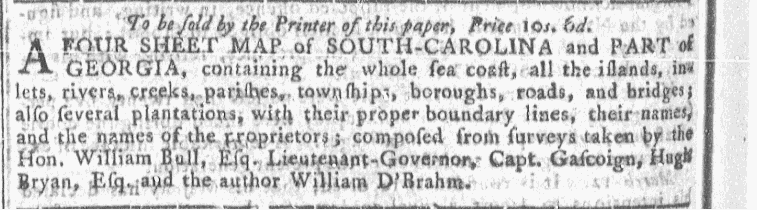
“To be sold by the Printer of this paper …”
James Johnston’s advertisement for a “FOUR SHEET MAP of SOUTH-CAROLINA and PART of GEORGIA” would have looked very familiar to readers of the Georgia Gazette. It had been inserted frequently in that newspaper for quite some time, often on the final page alongside most other advertisements but other times on the second or third pages with news items. Although Johnston, the printer of the Georgia Gazette, certainly wished to sell copies of this map to interested customers, he also used this advertisement as filler to complete the page when he did not have sufficient news items and other commercial notices to do so. Subscribers and regular readers would have recognized it at a glance. The same was true of the notice immediately below it, an announcement that colonists could purchase all sorts of printed blanks at Johnston’s printing office. Again, the advertisement served dual purposes: attracting customers and filling the page. The latter was particularly efficient since type had already been set long ago for both advertisements. The printer resorted to the eighteenth-century version of cut-and-paste when laying out the pages of the Georgia Gazette each week.
For more information about the map (and to examine the map itself), see the previous entry that featured an earlier insertion of this advertisement in the August 27, 1766, edition of the Georgia Gazette. The methodology of the Adverts 250 Project usually precludes examining any advertisement more than once but allows for exceptions when doing so illuminates some aspect of eighteenth-century practices or consumer culture. In this case, an advertisement that practically became a permanent feature of the Georgia Gazette merited attention. Its frequency should not be misconstrued to suggest that Johnston was desperate to sell surplus copies of the map (though that might have also been the case). Instead, when read alongside the notice hawking printed blanks, this advertisement might better be interpreted as a device for completing the page or the issue when lacking other content.
What was advertised in a colonial American newspaper 250 years ago today?
Georgia Gazette (June 10, 1767).
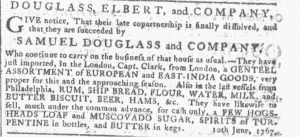
“Just imported … from London … Also in the last vessels from Philadelphia.”
This advertisement by Samuel Douglass and Company (formerly Douglass, Elbert, and Company) in the Georgia Gazette depicted the colonial crossroads of trade in the eighteenth century. While many shopkeepers placed notices that promoted imported goods from particular places (most notably the lengthy list advertisements of manufactured wares from England), these merchants outlined the many networks of exchange that crisscrossed the Atlantic and beyond.
Douglass and Company’s inventory came from diverse places. They stocked a “GENTEEL ASSORTMENT of EUROPEAN and EAST-INDIA GOODS,” an array of dry goods, housewares, and hardware. Various textiles made in the East Indies had been first transported to London before continuing on to the colonies. Other goods had been manufactured in the English provinces and then made their way to faraway markets.
Other products did not cross the Atlantic. Instead, they were part of the coastal trade that connected the colonies (and their economies) to each other. Farmers in the Middle Atlantic colonies, for instance, produced surpluses of wheat, butter, and meat that became important supplies for other English colonies in North America and, especially, the plantation economies of the West Indies. Douglass and Company received their dry goods via London, but ship bread, flour, hams, and other foodstuffs and agricultural products arrived “in the last vessels from Philadelphia.”
Finally, Douglass and Company sold other grocery items, particularly sugar, produced in the West Indies and shipped to the mainland colonies in exchange for agricultural goods. Enslaved Africans toiling on plantations had produced the sugar. Their labor was not mentioned in this advertisement, making Douglass and Company’s sketch of trading networks incomplete. The transatlantic slave trade was a major component of a vast system of exchange in the eighteenth century, one that made the others represented in Douglass and Company’s advertisement both possible and profitable. Douglass and Company may not have sold enslaved Africans themselves, but their venture depended on that endeavor. The map of commerce and exchange conjured in their advertisement was both extensive and incomplete.
What was advertised in a colonial American newspaper 250 years ago today?
Georgia Gazette (June 3, 1767).
“MRS. STEDMAN takes this method of returning her sincere thanks.”
Mrs. Stedman tells an interesting story (or, at least, parts of it) in her advertisement in the Georgia Gazette, but that story has been obscured by at least two factors. First, Stedman did not provide all of the details herself. Second, the quality of the original printing and subsequent photography and digitization makes the advertisement (and much of the rest of the issue) difficult to read. This second factor has ramifications when using digital surrogates to conduct research.
With some effort, the human eye can identify all the words in Stedman’s advertisement. Modern technologies, especially OCR (optical character recognition), often do not do as well when searching through digitized documents. I located Stedman’s advertisement because I read through the entire June 3, 1767, edition of the Georgia Gazette. I wondered, however, whether keyword searches would yield this advertisement. I’ve been frustrated in the past when I’ve had copies of advertisements from eighteenth-century newspapers that came from a particular database yet keyword searches to determine how many times those advertisements appeared did not even produce the originals although I knew very well that they did indeed exist.
I conducted an experiment with Stedman’s advertisement and the database in which I first encountered it, Readex’s America’s Historical Newspapers. What would happen if I did a keyword search for “Stedman,” limiting the date range to 1767 and considering only advertisements? This yielded only two results, both for “ALEX. STEDMAN” in the Pennsylvania Chronicle. The keyword search did not turn up an item that I knew very well had been printed in the Georgia Gazette and was part of the database!
I also recognized, however, that the problem may not have been the OCR but instead could have been a metadata error. What would happen in a keyword search for “Stedman” with the date range limited to 1767 but not specifying that advertisements were the only article types under consideration? That search yielded three results, two for “ALEX. STEDMAN” as above and one for “MRS. STEDMAN.” In this case, the problem was not the OCR but rather a human error made in coding the data. The advertisement had been mistakenly marked as a news item.
Still, I questioned the effectiveness of keyword searches for this particular advertisement because I have learned from experience that OCR often has difficulty with eighteenth-century print. I decided to try a search with an alternate keyword, one that might have been much more likely depending on the interests of the researcher: “tuition.” With the date range limited to 1767 and no specifications for particular article types, a keyword search for “tuition” yielded forty-seven results. It did not, however, uncover Stedman’s advertisement. A similar keyword search for “Stewart,” the woman Stedman recommended as her replacement, similarly did not pick up this particular advertisement among its 203 results.
This experiment demonstrated two types of problems to keep in mind when using digitized sources. OCR is not infallible. Human coding of data can also be flawed. Despite these shortcomings, digitized sources have revolutionized the way historians conduct research, the types of questions they ask, and the answers they find. As with any research tool or methodology, historians and others need to aware of both advantages and potential deficiencies.
What was advertised in a colonial American newspaper 250 years ago today?
Georgia Gazette (May 27, 1767).
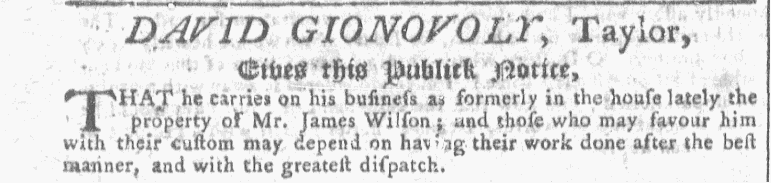
“DAVID GIONOVOLY, Taylor.”
David Gionovoly’s advertisement may have been short, but it was visually stimulating, especially compared to the other commercial notices that appeared on the same page of the Georgia Gazette. Amid a series of advertisements that consisted of dense blocks of text, the format of Gionovoly’s advertisement likely drew the attention of prospective clients. The visual aspects of the advertisement eclipsed the contents.
Georgia Gazette (May 27, 1767).
Most of the evidence suggests that advertisers submitted copy to printers who then determined the format, though negotiations took place and special requests were sometimes honored (perhaps for an additional fee). Gionovoly may have worked closely with James Johnston, the printer of the Georgia Gazette, to create an advertisement with distinctive visual appeal. Alternately, he may have made a general request but offered no specifics. On the other hand, the format of the tailor’s advertisement may have been entirely due to the printer’s own initiative.
Regardless of who was responsible for each visual element of the advertisement, it effectively deployed varied fonts and sizes. It also included just enough white space to accentuate those variations. The headline of the advertisement – “DAVID GIONOVOLY, Taylor” – was set in the largest font used on that page (or anywhere else in the issue, with the exception of the masthead). Both capitals and italics further emphasized the tailor’s name, giving him an appropriate sense of style that anyone in the garment trades would have wanted to communicate to potential customers. The ornate font for the next line – “Gives this Publick Notice” – also appeared in other advertisements, but not so many that it did not seem novel in Gionovoly’s notice. The remainder of the advertisement had a standard format and incorporated the usual sorts of appeals – “work done after the best manner, and with the greatest dispatch” – but the lack of innovation in the copy may not have mattered as much as making sure that readers noticed the advertisement at all.
Who was the subject of an advertisement in a colonial American newspaper 250 years ago today?
Georgia Gazette (May 20, 1767).
“RUN AWAY … a MUSTEE WENCH.”
Jenny, an enslaved woman, made her escape, prompting Archibald Bulloch to place an advertisement in the Georgia Gazette. He offered a reward to “Whoever apprehends and delivers the said wench to me in Savannah.” To help readers identify Jenny, Bulloch described her as a “MUSTEE WENCH,” mobilizing one of the many categories for describing both the physical appearance and heritage of mixed race men, women, and children in the early modern Atlantic world.
Mustee, now chiefly an historical term according to the Oxford English Dictionary, specifically means “a person with one white-skinned parent and the other one-quarter black.” In other words, Jenny may have been one-eighth black, presumably fairly light-skinned, as the result of having one African great-grandparent. However, the OED also indicates that mustee sometimes also referred to “a person of mixed European and African descent” and, even more generally, “a person of mixed racial descent” (including indigenous Americans as well as Africans). Mustee was likely a shortened form of mestizo arising from non-standardized spellings. That being the case, Bulloch may not have intended to be any more descriptive than simply indicating that Jenny had a mixed racial heritage.
Whatever the case, Bulloch mobilized print culture to put black bodies on display. By advertising Jenny and describing her as a “MUSTEE WENCH,” he encouraged readers to engage in surveillance of all black women they encountered, to carefully examine their physical characteristics to assess whether they might be the runaway. This advertisement called attention not only to Jenny; it cast suspicion on all black women, the reward offering added incentive to take note of their bodies.
South Carolina Gazette (November 4, 1732).
Research note: I consulted the Oxford English Dictionary for an authoritative definition and etymology of mustee. Among its historical sources, the OED included a runaway slave advertisement published in the South Carolina Gazette in 1732.
What was advertised in a colonial American newspaper 250 years ago today?
Georgia Gazette (May 6, 1767).
“A GENERAL ASSORTMENT OF MEDICINES.”
Lewis Johnson operated an apothecary shop in colonial Savannah, though his advertisement did not indicate if he compounded remedies onsite in addition to selling “A GENERAL ASSORTMENT OF MEDICINES” that included ingredients and readymade elixirs. For the latter category, he depended on customers’ familiarity with established brands, listing several popular patent medicines recently imported from London. These included “Daffy’s elixir, … Squire’s elixir, Bateman’s drops, Stoughton’s ditto, Godrey’s cordial, Turlington’s balsam, James’s powders strong and mild, and Anderson’s pills.” Johnson expected that patients were already familiar with the symptoms each of these medicines purported to relieve. Few products had so firmly established brand identities in the eighteenth century. In terms of name recognition and, sometimes, packaging materials, creators of patent medicines led the way in developing branding as an effective marketing strategy.
In addition to the half dozen or so pills and potions already noted, Johnson also carried the “Family Medicines of Dr. Hill’s,” several different elixirs associated with the same physician, each intended for specific indications. For instance, patients suffering from gout and rheumatism could purchase Hill’s “Elixir of bardana,” but those with colds, coughs, and even consumption should instead choose the “Balsam of honey.” Johnson listed nearly as many tinctures and elixirs from Hill’s “Family Medicines” as the other sorts of patent medicines combined. In this regard, Hill had worked out an effective system for increasing sales. Many competitors either marketed their medicines as cure-alls or specified an astonishing array of symptoms they relieved. Hill, on the other hand, associated particular medical problems with specific medicines formulated with unique ingredients considered especially efficacious for the circumstances. In so doing, he multiplied the number of potential sales possible for each customer.
The assorted remedies Lewis Johnson stocked in his apothecary shop would certainly look strange to modern consumers, but the experience of shopping there would not have been that much different than visiting a twenty-first-century retail pharmacy. Customers recognize certain brands. When feeling ill, they find comfort in selecting familiar remedies, often expressing preferences for one over another even when the competing brands combat the same symptoms.
What was advertised in a colonial American newspaper 250 years ago today?
Georgia Gazette (April 29, 1767).
“Hand-Bills, Advertisements, &c. printed at the shortest Notice.”
In the colophon for each edition of the Georgia Gazette, James Johnston informed readers that they could submit “Advertisements, Letters of Intelligence, and Subscriptions for this Paper” at his “Printing-Office in Broughton-Street” in Savannah. In effect, Johnston used the colophon to advertise advertisements. To some extent, it seemed to work. Advertising filled three out of eight columns of the April 29, 1767, issue, making the balance of news items and paid notices comparable to what appeared in many other newspapers throughout the colonies in the 1760s (at least those that did not distribute supplements devoted primarily to advertising). The nature of the advertising, however, differed significantly from the notices printed in newspapers in cities like Boston, Charleston, New York, and Philadelphia. Advertisements for consumer goods placed by merchants, shopkeepers, and artisans accounted for a significant portion of all paid notices in those places. The Georgia Gazette, on the other hand, did not attract many advertisers promoting the assortment of goods featured so prominently in newspapers from other places.
Did this matter to Johnston? Did the printer care which sorts of advertisements he published as long he had enough to fill the pages of each issue and generate additional revenue to supplement the subscription fees? Perhaps not, but when he received newspapers from other colonies he almost certainly realized that he was missing out on a potentially lucrative opportunity. Many of his counterparts operated businesses that benefited from purveyors of consumer goods and providers of services competing with each other for potential customers in the public prints, placing new advertisements week after week.
Why did so few shopkeepers and merchants advertise in the Georgia Gazette? Certainly Savannah was a smaller town than most others with newspapers, but the shipping news did indicate the arrival of two vessels since the previous issue. The brigantine Ann had sailed from London, presumably carrying a similar assortment of consumer goods as those advertised regularly throughout the rest of the colonies. Did the relatively small size of the town alone account for the absence of any advertisements at least announcing the arrival of new merchandise? Merchants and shopkeepers in Savannah probably did not face the same level of competition as in bustling port cities, yet it was still in their own best interests to attempt to incite demand in their wares.
Many newspapers published in the quarter century before the Revolution contained a vibrant array of advertisements for consumer goods and services, testifying to a consumer revolution experienced in both Britain and the colonies. As they read their local newspaper, residents of Savannah (and New London and, to a lesser extent, Providence and Portsmouth) experienced a very different textual landscape of advertising for consumer goods compared to the multitude of advertisements for consumer goods that filled the pages of newspapers in larger cities and sometimes even flowed over into advertising supplements. Consumer culture was widespread throughout the colonies, but advertising was uneven.
What was advertised in a colonial American newspaper 250 years ago today?
Georgia Gazette (April 22, 1767).
“HAVING OPENED A SCHOOL … TEACHING READING, WRITING, and ARITHMETICK.”
I chose this advertisement because I plan on being an educator – a teacher, professor, or a public historian – so this advertisement is quite close to heart. It is important to note that this advertisement comes from a newspaper printed in the southern colonies, the Georgia Gazette. This education offered in this advertisement differs from the schooling some children in the region received. “The sons of a planter typically would be taught the basics at home,” state the curators at Stratford Hall. Discussions in “Schools in American Society,” an Education course taught by Professor Casey Handfield at Assumption College, confirmed that this was typical in southern colonies. On the other hand, in Learning to Read and Write in Colonial America, E. Jennifer Monaghan argues the northern colonies had significantly more extensive schooling, including pubic schooling in New England, due to the religious focus on education dating back to the seventeenth century.
Also it should not be overlooked that the advertisement included the subjects to be taught. Due to the nature of these subjects it appears as though the school was for younger children who needed the basics but not a “genteel” education. When it came to children of the elite, according to historians at Stratford Hall, “The boys studied higher math, Greek, Latin, science, celestial navigation (navigatin[g] ships by the stars), geography, history, fencing, social etiquette, and plantation management.” In addition, “The school days for girls were somewhat different. Girls learned enough reading, writing, and arithmetic to read their Bibles and be able to record household expenses.” This distinction is important because it separates the typical roles that men and women would play in life from an early start. This is important because it gives modern historians a view of gender roles in colonial society.
**********
ADDITIONAL COMMENTARY: Carl Robert Keyes
As Jonathan notes, John Francklin taught the basics: reading, writing, and arithmetic. James Whitefield, a competitor who also advertised in the Georgia Gazette, offered only a slightly more extensive curriculum. He listed Latin among the subjects taught at his school. Neither schoolmaster advertised additional subjects often promoted as “genteel education” in newspapers printed in other cities, the sorts of subjects Jonathan already listed.
In addition to the north-south divide that distinguished educational opportunities in the different colonial regions, urban culture also played a role in determining which subjects were offered (or, at least, advertised) to potential students. Schoolmasters and schoolmistresses in both Philadelphia and Charleston, both large and bustling port cities, advertised day and boarding schools where students learned a variety of advanced academic subjects as well as ancillary skills (like dancing and personal comportment) in addition to reading, writing, and arithmetic.
In colonial America’s larger cities, some instructors advertised independently of any affiliation with schoolmasters and schoolmistresses whose curriculum focused on general education. For instance, French language tutors frequently advertised their services, often offering one-on-one instruction with their pupils. Dancing masters also advertised regularly in newspapers printed in larger cities. In addition to one-on-one instruction, many also ran their own academies where they tended to teach female students during one portion of the day and male students at alternate times. Some dancing masters doubled as fencing instructors, further enhancing the genteel arts their charges developed. Although some French tutors and dancing and fencing masters were itinerants, many tended to remain in the larger colonial cities for several years, presumably because they cultivated a clientele that kept them employed.
Surveying advertisements for education in newspapers printed throughout the colonies in the decade before the Revolution reveals certain disparities. From New Hampshire to Georgia, colonists used consumer culture to assert their status and identity, anxious lest their counterparts in England think they lived in provincial backwaters. While advertisements for goods demonstrate standardization of products available to purchase during this period, advertisements for services – especially education – suggest uneven opportunities. Schoolmasters and schoolmistresses everywhere taught the basics, but, not surprisingly, instructors with specialized skills most often promoted their services to potential pupils in larger cities. They relied not only on larger populations but also elites conscious of demonstrating their status and middling sorts with aspirations for social mobility. Readers of the Pennsylvania Gazette and the South-Carolina Gazette regularly encountered advertisements for education that looked much different than today’s advertisement from the Georgia Gazette.
What was advertised in a colonial American newspaper 250 years ago today?
Georgia Gazette (April 8, 1767).
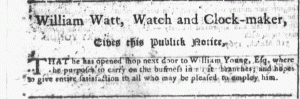
“William Watt, Watch and Clock-maker.”
I chose this advertisement because it addressed a unique occupation: clockmaking. Despite my time guest curating the Adverts 250 Project for two weeks, this advertisement surprised me. I had not seen many advertisements for clocks or clockmakers. However, I learned that timekeeping objects have had a long held place in society. Having impressive timepieces has meant something throughout most of American history. Think of society today. If someone has a Rolex or Movado, it is often thought of as symbol of wealth and sophistication. Similarly, if someone in the seventeenth or eighteenth century had an ornate freestanding clock, it was also seen as a status symbol. When I initially discovered this advertisement, I assumed that only the wealthiest colonists would be able to afford clocks, but Cathryn J. McElroy discusses the range of citizens who owned clocks in one eighteenth-century city, describing them as coming from “a wide range of economic and social status.”[1] Watches and clocks were owned by elite colonists, but also by those from the middling ranks. This made me reconsider which items consistently indicated status in colonial America and which did not.
[1]Cathryn J. McElroy, “Furniture in Philadelphia: The First Fifty Years,” Winterthur Portfolio 13 (1979): 78.