September 2

What was advertised in a colonial American newspaper 250 years ago today?

Sep 2 - 9:2:1767 Georgia Gazette
Georgia Gazette (September 2, 1767).

“EXCEEDING GOOD OLD BARBADOS RUM, by the hogshead, quarter-cask, or small quantity.”

Horton and Moore placed a fairly simple advertisement in the September 2, 1767, issue of the Georgia Gazette. In it, they announced that they sold a small number of items: rum, sugar, vinegar, and Delftware (a popular blue and white pottery made in the Netherlands and exported to locales throughout the Atlantic world). Compared to the list-style advertisements that crowded the pages of many eighteenth-century newspapers, their notice was relatively short. Yet the simplicity and the length did not mean that Horton and Moore neglected to advance marketing messages in their advertisement. For each item, they offered some sort of commentary intended to entice potential customers to visit Horton and Moore’s wharf to make their purchases.

The partners resorted to some of the most common appeals made to consumers throughout the eighteenth century. They emphasized quality, explicitly and implicitly, to promote both rum and sugar. They described the former as “EXCEEDING GOOD” and the latter as “of an extraordinary good quality.” In noting the places of origin – “BARBADOS RUM” and “JAMAICA SUGAR” – they further testified to quality since those locations were widely recognized for producing the finest examples of their respective commodities.

When it mattered, Horton and Moore made an appeal to consumer choice: they carried a ‘COMPLETE ASSORTMENT” of Delftware. This implied a variety of (fashionable) patterns as well as an array of items, from plates and bowls to canisters and sugar dishes to tiles and tureens for household use and decoration. Horton and Moore invited customers to examine all the possibilities, promising that they would not be forced to choose from a tiny selection. A “COMPLETE ASSORTMENT” meant the freedom to express themselves by identifying their favorites and choosing items that distinguished them from their friends and relations.

Horton and Moore also marketed convenience when they offered to sell their commodities in various quantities. Customers could purchase rum “by the hogshead, quarter-cask, or small quantity,” sugar “by the hogshead, barrel, or small quantity,” and vinegar “in any quantity.” Presumably shoppers were also welcome to select as many or as few pieces of Delftware as they desired.

Finally, the partners made an appeal to price, stating they sold all of their merchandise “on the most reasonable terms.” Combined with the other appeals, this made their wares even more attractive to prospective customers.

Horton and Moore’s advertisement demonstrates that commercial notices aimed at consumers did not need to be elaborate or lengthy to incorporate marketing appeals. In the space of half a dozen lines, the merchants deployed messages about quality, choice, convenience, and price as they attempted to incite demand among customers in Savannah and its hinterland.
August 26

What was advertised in a colonial American newspaper 250 years ago today?

Aug 26 - 8:26:1767 Photo Georgia Gazette
Georgia Gazette (August 26, 1767).

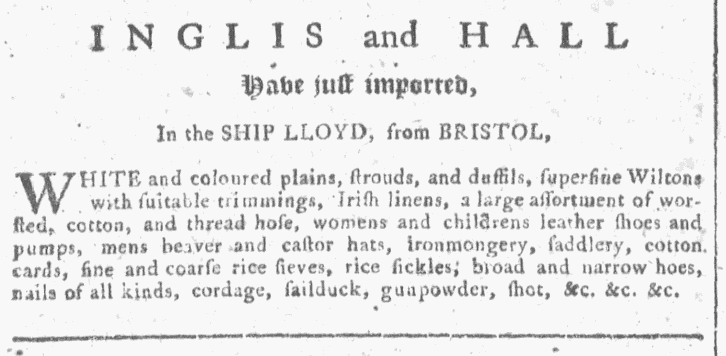
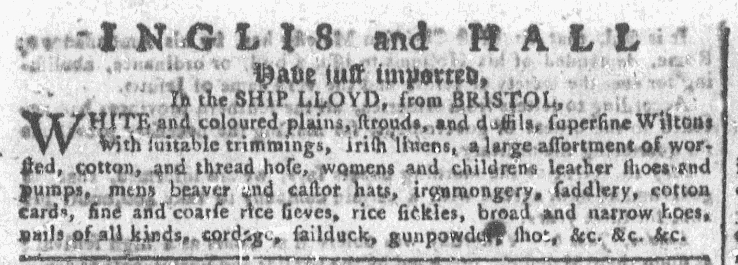
“INGLIS and HALL have just imported …”

Inglis and Hall were among the most frequent advertisers of consumer goods in the Georgia Gazette in 1767. Their multiple advertisements, however, remain hidden when relying on certain technologies, especially keyword searches in online databases, to uncover them.

Readex’s America’s Historical Newspapers database makes the Adverts 250 Project and the Slavery Adverts 250 Project possible. In many ways, it is an invaluable resource, but no database is perfect. Current technologies, as cutting edge as they may be compared to previous methods of conducting historical research, sometimes constrain or skew the process. In some instances, for example, keyword searches of newspapers uncover far fewer results than examining individual issues page by page, column by column, in chronological order. Inglis and Hall’s advertisement makes for an interesting case study.

As part of the research process for the Adverts 250 Project and the Slavery Adverts 250 Project, I download a copy of every American newspaper published 250 years ago that day. This already requires a clarification: I only download those that have been digitized. Some are not yet available in digital format for online consultation; others have not survived into the twenty-first century and will never be available for consultation, neither original copies nor digital surrogates.

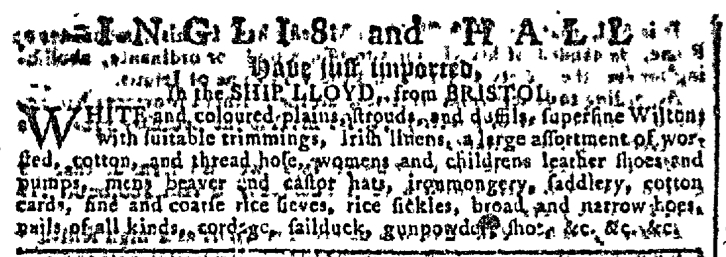
The most efficient way to download this material from America’s Historical Newspapers involves downloading an entire issue all at once. This process results in a multipage PDF of the newspaper. It transforms the digital photo seen in the online database into a format that can sometimes be more difficult to read. Note how the photo of Inglis and Hall’s advertisement above differs from the PDF rendering below. It is possible to download photos of individual pages. Given that most newspapers were four pages, but many were six when they included an advertising supplement, this method would take at least four times as long. For the purposes of this project, it is not practical to download photos rather than PDFs of the newspapers.

Aug 26 - 8:26:1767 PDF Georgia Gazette
Georgia Gazette (August 26, 1767).

Next I print hard copies of every page of every newspaper so I can mark on them and more easily consult them than if they remained strictly in digital format. Despite the comparatively poor visual quality of the PDF version, once I have printed hard copies I can work back and forth between the PDF and the more clear (but not always crisp) photos in the database when necessary.

In the case of Inglis and Hall’s advertisement, I can make out what it says in the PDF version, but I consider the photo easier to read (and more attractive and accessible for readers of the Adverts 250 Project). Still, I have to work at decoding the advertisement. Given that this takes me some effort, imagine how confusing it must be for OCR software. In fact, OCR cannot accurately read Inglis and Hall’s advertisement, not even the slightly clearer photo.

I assumed that would be the case. To test my suspicions I ran a keyword search for Inglis and Hall, limiting the year to 1767. The database turned up only two instances of Inglis and Hall advertising in the Georgia Gazette in 1767. One appeared in the January 21 issue. The database also flagged an earlier iteration of today’s advertisement in the August 19 issue, one that was much easier to read. The keyword search did not, however, identify the August 26 advertisement, yet I knew it existed because I had a hard copy originally drawn from the database sitting next to my computer. I also knew from experience reading the Georgia Gazette that Inglis and Hall advertised more than twice in 1767.

Aug 26 - 8:19:1767 Georgia Gazette
Georgia Gazette (August 19, 1767).

This means that there are certain questions that keyword searches cannot address given current technological constraints. For instance: How frequently did Inglis and Hall advertise in the 1760s? Determining the answer to that question requires an older method of research, examining the newspaper page by page. The online database certainly facilitates that process, eliminating the need to consult original copies of the Georgia Gazette in archives, yet the keyword search does not always eliminate portions of the research process it was intended to streamline. Researchers cannot depend on keyword searches to be exhaustive.

As an historian, I regularly consult original copies of newspapers at the American Antiquarian Society and other archives, microfilms of newspapers, digital surrogates in databases like Readex’s America’s Historical Newspapers, and hard copies that I have generated from my own photos and the materials available via databases. Each of these formats is unique and has its virtues, as well as its shortcomings. None of them replaces the others. Instead, historians must recognize the limitations and devise strategies for effectively and efficiently utilizing the various resources available to them.

August 19

What was advertised in a colonial American newspaper 250 years ago today?

Aug 19 - 8:19:1767 Georgia Gazette
Georgia Gazette (August 19, 1767).

“I will not pay any debts of her contracting.”

Four short lines on the final page of advertisements in the August 19, 1767, issue of the Georgia Gazette alerted residents of Savannah to discord in the Frentz household. John Frentz placed a notice “to forewarn all persons from purchasing effects of any kind from my wife, Margaret Frentz, or crediting her on my account.” He added that he would not “pay any debts of her contracting” after August 4, 1767.

By August 19, regular readers of the Georgia Gazette would have been aware of Frentz’s prohibition already. The notice first appeared two weeks earlier in the August 5 edition and again on August 12. Like many advertisements published during the colonial era, it ran for three weeks before disappearing from the pages of the public prints. The discord between John and Margaret Frentz, however, most likely did not evaporate quite so quickly, not if it had been so substantial as to warrant airing in public in the local newspaper.

Frentz’s advertisement was the only one of its kind in the Georgia Gazette throughout the month of August 1767, but it was not a sort unfamiliar to colonists. In larger ports, weekly newspapers often carried as many as half a dozen such warnings published by husbands targeting absent or recalcitrant wives. Any given issue published in New York or Philadelphia was as likely as not to contain at least one such notice.

Frentz’s notice, however, did differ from most others in one significant way. He did not indicate that Margaret had departed from his household. Similar announcements have collectively become known as “runaway wife” advertisements; they usually included some sort of variation on the wife “eloping” away from husband and home, thus justifying the aggrieved husband no longer assuming responsibility for any debts contracted by an absent and insubordinate wife.

Margaret may not have departed at the time John composed his advertisement, but he still worried about what sorts of mischief she might do to his disadvantage. He attempted to eliminate, or at least curtail, her ability to participate in the marketplace, disavowing any debts she initiated. He also sought to prevent her from selling any sorts of goods, presumably including his own belongings, which may have been a strategy for preventing her from eventually “eloping” once she had accumulated enough cash to have a fair chance of making her escape.

Runaway wife advertisements are often interpreted as evidence of women asserting agency in eighteenth-century America, removing themselves from unhappy marriages and households. That was certainly the case, but they also demonstrate that husbands continued to possess the upper hand, even after wives departed. Women had less access to cash and credit as well as fewer opportunities to participate in the marketplace. In this advertisement, John Frentz used buying and selling goods as a means of curbing the agency of his disobedient wife.

August 12

What was advertised in a colonial American newspaper 250 years ago today?

Aug 12 - 8:12:1767 Georgia Gazette
Georgia Gazette (August 12, 1767).

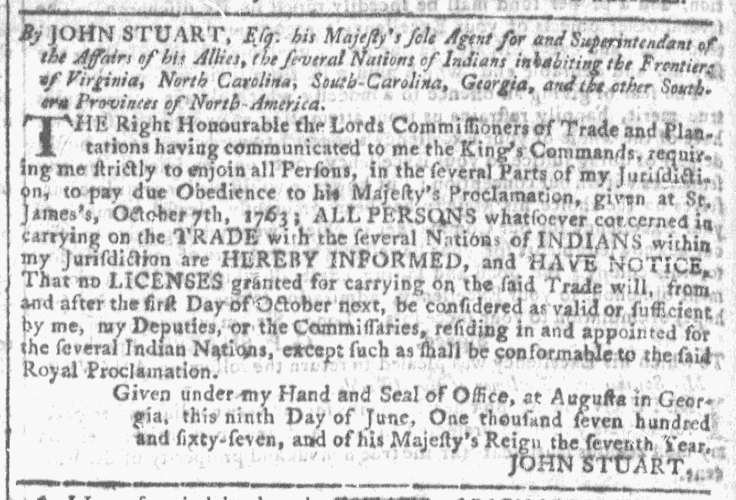
“All Persons … pay due Obedience to his Majesty’s Proclamation.”

John Stuart served as the Superintendent of Indian Affairs for Britain’s southern colonies from 1761 to 1779. Based in South Carolina, the Scottish-born official was counterpart to William Johnson in the northern colonies. Stuart and Johnson were charged with overseeing relations between indigenous Americans and Great Britain and the colonies. In the wake of British victory in the Seven Years War, the superintendents exercised diplomacy in their efforts to prevent violence and other conflict between settlers and Indians residing in the frontier lands newly acquired by the empire.

In this advertisement, Stuart pursued his duties. He informed “ALL PERSONS … carrying on the TRADE with … INDIANS … That no LICENSES granted for carrying on the said Trade will … be considered valid … except such as shall be conformable to the said Royal Proclamation.” Here he invoked what has become known as the Royal Proclamation of 1763, issued on October 7 of that year by George III.

That document provided a framework for managing Britain’s new territories ceded by the French at the conclusion of the Seven Years War. In addition to establishing four new colonies with military governments (Quebec, East Florida, West Florida, and Granada) and enumerating a scheme for distributing land to war veterans, the Royal Proclamation also addressed relations with indigenous Americans to the west of the Appalachians by creating the Proclamation Line. Settlers were forbidden to move into territory reserved for Indians, an attempt to prevent hostile encounters and pan-Indian uprisings like Pontiac’s War. The king and his advisors believed this would establish stability and order within the empire, but colonists felt betrayed. They had just fought and made sacrifices for Great Britain in a long war, but now the Royal Proclamation denied them the spoils they expected by prohibiting westward expansion. To add insult to injury, the proclamation seemed to protect Indians who recently fought against Britain at the expense of loyal subjects. Even before the Stamp Act crisis and other legislation that led to cries of “no taxation without representation,” the Royal Proclamation of 1763 angered colonists and alienated them from Britain.

In today’s advertisement, superintendent John Stuart invoked provisions of “his Majesty’s Proclamation, given at St. James’s, October 7th, 1763” to regulate trade between colonists and Indians. While other portions of the newspaper included news from London about “a plan for taxing America … now under consideration,” Stuart’s notice reminded colonists of other ways that a faraway government meddled in local affairs.

August 5

What was advertised in a colonial American newspaper 250 years ago today?

Aug 5 - 8:5:1767 Georgia Gazette
Georgia Gazette (August 5, 1767).

“THE subscriber intends opening a COFFEE ROOM.”

Mary Hepburn placed an advertisement in the Georgia Gazette in the summer of 1767 to announce that she had entered the service and hospitality industry. She operated two related enterprises from her house, a coffee room and an ordinary. For each, she offered comparisons to similar establishments in larger cities – London and Charleston, respectively – to give readers and potential clients a frame of reference, yet also imbue her business with cosmopolitan flair.

The Oxford English Dictionary suggests that an eighteenth-century coffee room had a slightly different function than the more familiar coffeehouse. It describes a coffee room as “a public room where coffee and similar refreshments are served; now, generally, the name of the public dining-room in a hotel.” On the other hand, a coffeehouse was “a house of entertainment where coffee and other refreshments are supplied. (Much frequented in 17th and 18th c. for the purpose of political and literary conversation, circulation of news, etc.)” The OED adds an additional note that “[t]he places now so called have lost this character, and are simply refreshment-houses.” Coffeehouses had distinctive cultural functions in the early modern Atlantic world, but it does not appear that Hepburn attempted to operate that sort of establishment, at least not initially. Perhaps once she successfully established her coffee room she hoped to expand its offerings. At its initial launch, however, she limited it to breakfast alone. She did not advertise a gathering place for merchants and others to meet at all times throughout the day.

The OED also sheds light on what Hepburn and potential customers imagined when they thought of an ordinary: “an inn, public house, tavern, etc., where meals are provided at a fixed price; the room in such a building where this type of meal is provided.” (This meaning is now considered historical and archaic.) Hepburn did not, however, extend an open invitation to residents and visitors to Savannah to visit her ordinary to purchase meals. She restricted it to “eight Gentlemen” who would also board at her house for an extended period. She planned to open her coffee room immediately, but the ordinary was delayed until “the number of her boarders is compleated.”

Hepburn sold food and drink and provided lodging, yet she did not operate a tavern, an inn, or a coffeehouse. She sought to establish a different, yet related, kind of service in Savannah for select clientele, “the first attempt of this kind” in the city. If her efforts met with success, perhaps she considered expanding the scope of her enterprise, but she started on a smaller scale while she established her footing in the local marketplace.

July 29

What was advertised in a colonial American newspaper 250 years ago today?

Jul 29 - 7:29:1767 Georgia Gazette
Georgia Gazette (July 29, 1767).

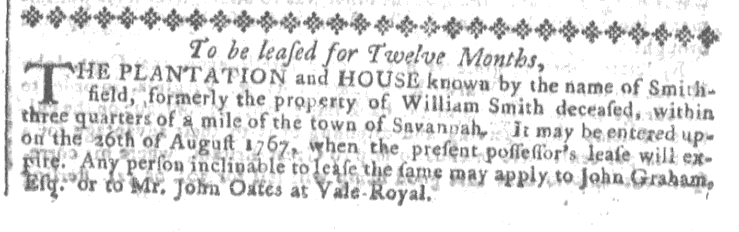
“To be leased for Twelve Months, THE PLANTATION and HOUSE.”

John Graham and John Oates offered a lease on Smithfield, the plantation and house of the deceased William Smith. James Johnston, the printer of the Georgia Gazette, gave their notice space in his newspaper, but he also used it to serve his own needs (beyond collecting the advertising fees). Johnston needed to fill out the first page of the July 29, 1767, edition of the Georgia Gazette; this advertisement was just the right length to do so (though several others in the same issue would have fit the bill and could have been inserted interchangeably in the same spot).

Unlike many colonial newspapers that clustered advertising on one or two pages, paid advertisements appeared on every page of this issue of the Georgia Gazette. The notice concerning Smithfield was the sole advertisement on the first page, filling the small space left by a satirical political essay on what was “RIGHT, WRONG, and REASONABLE, with regard to America” from the British perspective, a sarcastic list of lamentations that anticipated many of the grievances against George III eventually included in the Declaration of Independence. The second page included a letter reprinted from the London Chronicle as well as extensive news from New York and shorter updates from Newport, Rhode Island; Charleston, South Carolina; and several Caribbean colonies. Two advertisements – one concerning stray horses and the other seeking “a QUANTITY of GOOD BEES-WAX” – completed the page. Local news occupied the third page. Given that advertisements appeared at the top of the first column, the printer likely left space in anticipation of including additional news from across the Atlantic and from other colonies, continuing from the previous page, but ran out of content. An extended legal notice took up one of the two columns on the final page; advertisements, including two final advertisements placed by the printer, accounted for the remainder.

Printers and compositors valued advertising not only because of the additional revenue generated. Advertising yielded content of varying lengths that could be manipulated to complete the pages of a newspaper when news items were not available. To that end, the Georgia Gazette incorporated advertising throughout the July 29 issue, even inserting two notices from the printer in order to fill the space.

July 22

What was advertised in a colonial American newspaper 250 years ago today?

Jul 22 - 7:22:1767 Georgia Gazette
Georgia Gazette (July 22, 1767).

“SUGAR … RUM … NEGROES … NEGROE SHOES.”

Cowper and Telfairs’ business, at least the aspects promoted in this advertisement, revolved around the enslavement of African men, women, and children. Near the end of July 1767, they announced to readers of the Georgia Gazette that they sold “A FEW NEGROES, consisting of men, women, boys, and girls.” They did not, however, elaborate on the origins of these slaves, whether they had just arrived in the colony directly from Africa or if they had been transshipped through other colonial ports or if they had been born in Georgia. Nor did they add other information that acknowledged the humanity of the men, women, and children they sold. The “NEGROES” were merely commodities to be exchanged, not unlike the goods listed before and after them in the advertisement.

Colonists who had acquired slaves also needed to outfit them. Cowper and Telfairs pursued this market as well, selling “NEGROE SHOES at 36s. per dozen.” The price structure indicates that the partners expected to deal with slaveholders who wished to purchase in volume. The Georgia Gazette and the several newspapers published in Charleston, South Carolina, frequently inserted advertisements for “NEGROE SHOES,” though none provided much detail about the shoes. As the price suggests, they would have been constructed of inferior materials, especially stiff fabrics, and not particularly comfortable. Presumably readers were already so familiar with this commodity that “NEGROE SHOES” usually merited no additional comment. Cowper and Telfairs, however, did offer various sizes. They promised, “Any person who chuses to deliver measure[ment]s may be supplied in proper time for their negroes.”

Finally, Cowper and Telfairs advertised commodities produced with enslaved labor: sugar and rum. Slaves certainly participated directly in the cultivation and processing of sugar. The advertisers did not reveal the origins of the rum they sold. Slaves may have played a significant role in distilling it. At the very least, rum, whether made from molasses or sugarcane juice, was a byproduct of sugar production, a commodity that circulated throughout the Atlantic world in great quantities as a consequence of enslaved labor on sugar plantations.

Cowper and Telfairs advertised several “commodities” – slaves, shoes, sugar, rum – that might seem like a haphazard combination at first glance. However, the system of enslavement that formed the foundation of economic exchange in the early modern Atlantic world linked all of these “commodities” in ways that would have been apparent to eighteenth-century readers and consumers.

July 15

Who was the subject of an advertisement in a colonial American newspaper 250 years ago today?

Jul 15 - 7:15:1767 Georgia Gazette
Georgia Gazette (July 15, 1767).

“RUN AWAY … NEGROE FELLOW named Joe.”

Joe, “a LIKELY NEW NEGROE FELLOW,” made a run for it in the summer of 1767. At the end of June, he took a canoe and attempted to make his escape from John Witherspoon. The slaveholder stated that the fugitive “was seen going towards Savannah,” perhaps heading for Savannah from Sunbury, perhaps heading toward the largest settlement in the area in hopes of attracting less attention among larger numbers of people. It may have been hard for Joe to avoid detection, however, because he “speaks very little English.”

Among enslaved men and women in Georgia, Joe was not alone in desiring his freedom. In another advertisement, David Cutler Braddock reported that his slaves had “TAKEN UP … a CANOE with TWO RUNAWAY NEGROES, a man and a woman.” Braddock advertised that he would hold the canoe until its owner came to collect it. “The negroes,” on the other hand, “were sent to the work-house” (where they joined Sharper and Tom, two captured runaways listed in the final advertisement in the July 15 issue of the Georgia Gazette).

These brief advertisements told intriguing yet incomplete stories about enslaved men and women. In addition to noting that he spoke little English, Witherspoon described Joe as “NEW.” How long had he been in Georgia? Had he recently survived the Middle Passage from Africa to the Americas? Given that he was headed toward Savannah, how familiar was he with the local geography? Did he hope to reunite with friends or relatives there? Or was he on his own? What was the source of the “large scar or cut on his left shoulder”? Was it the result of some sort of punishment that may have strengthened his resolve to make an escape?

How about the runaways in the canoe? What was their relationship? Husband and wife? Brother and sister? Friends or acquaintances connected by little more than their bondage and mutual agreement to seized an opportunity to take a canoe and depart when no one was looking? What role did Braddock’s slaves play in capturing them? What was their motivation for the part they played? Did they participate willingly? Did they turn in the runaways because they expected some sort of reward? Did they turn over the fugitives and their canoe to the slaveholder reluctantly only to avoid trouble because others observed them?

Advertisements for runaway slaves have been called the first slave narratives. They certainly tell important stories about the agency exercised by enslaved men and women, but since slaveholders composed them they lack some of the perspective and insight that likely would have been present in first-person narratives. These advertisements tell rich stories, but the questions they raise can sometimes be as revealing about the experiences of enslaved people in colonial America.

July 8

What was advertised in a colonial American newspaper 250 years ago today?

Jul 8 - 7:8:1767 Georgia Gazette
Georgia Gazette (July 8, 1767).

“INGLIS and HALL have just imported, In the ship Friendship, Capt. Fitzherbert, from Bristol.”

Inglis and Hall advertised a “NEAT ASSORTMENT” of merchandise “just imported, In the ship Friendship, Capt. Fitzherbert, from Bristol, and the last vessels from London.” Throughout the colonies, merchants, shopkeepers, and others who sold imported goods frequently indicated which ship transported their wares across the Atlantic. This was not superfluous information for eighteenth-century consumers. Instead, it allowed readers who might be potential customers to determine how recently sellers obtained their inventory. They could test the accuracy of what “just imported,” a formulaic phrase regularly inserted in advertisements, actually meant.

Inglis and Hall had the good fortune that their advertisement appeared immediately below the shipping news in the July 8, 1767, edition of the Georgia Gazette. Upon reading that their merchandise arrived “In the ship Friendship, Capt. Fitzherbert, from Bristol,” readers could glance up the column to see of they spotted the vessel and its captain in the list of those that had “ENTERED INWARDS at the CUSTOM-HOUSE” since the last issue. The Friendship was listed first, having arrived from South Carolina five days earlier. Apparently Fitzherbert did not sail directly from Bristol to Savannah but instead made port in the much larger Charleston before continuing to Georgia. Still, by consulting the shipping new readers could determine that at least some of the merchandise Inglis and Hall promoted as “just imported” had indeed been just imported.

Not every advertisement that indicated which ship and captain transported goods now available for sale happened to be positioned so conveniently on the page in relation to the shipping news. (Most likely, the proximity in this case was a happy coincidence for Inglis and Hall, rather than a deliberate effort.) Yet colonial newspapers were relatively short by today’s standards, only four pages or perhaps six or eight if they happened to include a supplement that week. In addition, most printers inserted the shipping news immediately before the advertisements, making that information fairly easy to locate. If readers were not already aware of which ships had recently been in port, they could efficiently consult the shipping news when they encountered the names of vessels in commercial notices. Eighteenth-century advertisers expected potential customers participated in this sort of active engagement with news items printed elsewhere in newspapers as they contemplated future purchases.

July 1

What was advertised in a colonial American newspaper 250 years ago today?

Jul 1 - 7:1:1767 Georgia Gazette
Georgia Gazette (July 1, 1767).

“The printer of this paper entreats his customers to pay their subscription monies.”

In the period before the American Revolution, printers regularly inserted notices asking newspaper subscribers to “pay their subscription monies,” as James Johnston did in the July 1, 1767, issue of the Georgia Gazette. His notice was particularly short; others went into greater detail in their attempts to get customers to settle their account, some suggesting that many subscribers were in arrears not for weeks or months or rather for years. If colonial readers did not make timely payments for their newspapers, that helps to explain why advertising was considered such an important means of generating revenues for newspapers.

This raises a question about printers and their business practices. Did advertisers pay for their notices before they were inserted in the newspaper? Or, did printers extend credit to advertisers as well as subscribers?

Printers certainly encouraged newspaper advertising. The colophon of the Georgia Gazette indicated that it was “Printed by JAMES JOHNSTON, at the Printing-Office in Broughton-Street, where Advertisements, Letters of Intelligence, and Subscriptions for this Paper, are taken in.” This was fairly standard for publications that included colophons that ran across all the columns at the bottom of the final page. That same week, several printers included similar language in their colophon, including Sarah Goddard and Company (Providence Gazette), William Goddard (Pennsylvania Chronicle), John Holt (New-York Journal), James Parker (New-York Gazette: Or, the Weekly Post-Boy), Alexander Purdie and John Dixon (Virginia Gazette), and Robert Wells (South-Carolina Gazette and Country Journal). Two of them, Holt and Purdie and Dixon, even indicated the costs of advertising, but neither indicated that they needed to be paid in advance.

Although printers frequently advertised that subscribers needed to settle accounts, they did not make similar requests of advertisers. There are at least two possibilities to explain this. Possibly advertisements had to be paid in advance. Alternately, printers may have considered advertising valuable content that helped to attract readers who would (eventually, hopefully) pay for their subscriptions. They may have been more lenient with advertisers who fell behind with their accounts as a result. This is a question that I would like to pursue in greater detail the next time I have a chance to consult printers’ records.