October 7

What was advertised in a revolutionary American newspaper 250 years ago today?
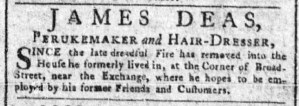
New-York Gazette and Weekly Mercury [New York] (October 7, 1776).
“JAMES DEAS … SINCE the late dreadful Fire has removed into the House he formerly lived in.”

In the weeks after the British took possession of New York in September 1776, Hugh Gaine removed to Newark, New Jersey, and printed the New-York Gazette and Weekly Mercury there.  Without a newspaper in the city they just captured, the British tasked Ambrose Serle with publishing another New-York Gazette and Weekly Mercury in New York.  The first issue featured Gaine’s name in the imprint, but it disappeared from subsequent issues until Gaine returned to the city and resumed publication there in November.  The October 7 edition was the first with a masthead that stated, “PRINTED AT THE BIBLE AND CROWN, IN HANOVER SQUARE,” without naming a printer.  The masthead continued to proclaim that the newspaper “Contain[ed] the freshest Advices Foreign and Domestick.”

In addition to news articles and letters, advertisements accounted for those “freshest Advices.”  James Deas, a “PERUKEMAKER and HAIR-DRESSER,” placed a short advertisement to inform the public of his new location.  “SINCE the late dreadful Fire,” he announced, he “has removed into the House he formerly lived in, at the Corner of Broad-Street, near the Exchange.”  He hoped that “his former Friends and Customers” would avail themselves of his services at his new (but familiar) location.  Deas referred to the fire that destroyed more than one-fifth of the city on the night of September 20 and into the morning of September 21, just as the British arrived.  Gaine provided the first coverage of the fire in his New-York Gazette and Weekly Mercury printed in Newark on September 21, part of his promise to publish “the freshest Advices Foreign and Domestick” in that newspaper.  For his part, Deas did not comment on the fire beyond describing it as “dreadful.”  Instead, he focused on maintaining his clientele and rebuilding his business.  His advertisement did not reveal his politics, a savvy strategy considering recent events, but the fire raised lots of questions and speculation about whether the retreating American forces set it deliberately.  The fire may very well have been a topic of lively conversation between Deas and his clients as he dressed their hair or took their measurements at his new shop.
September 21

What was advertised in a revolutionary American newspaper 250 years ago today?

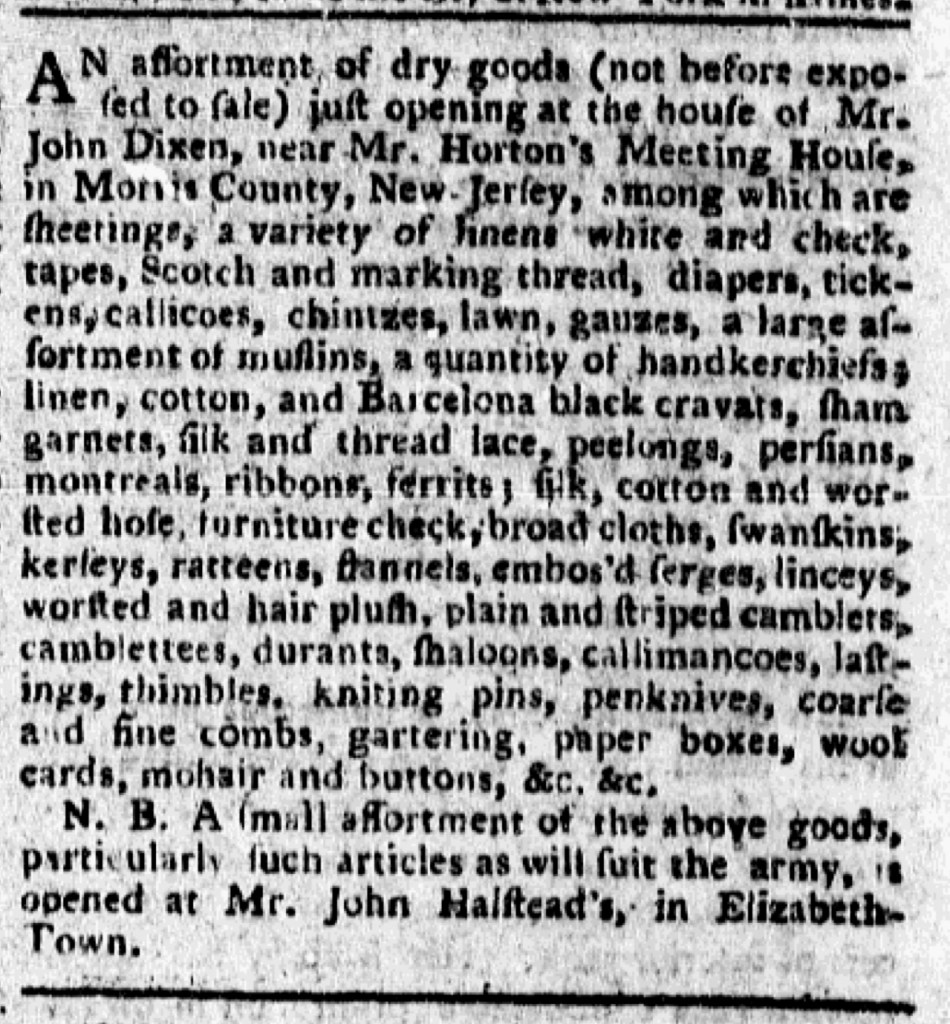
New-York Gazette and Weekly Mercury [Newark] (September 21, 1776).

“AN assortment of dry goods … at the house of Mr. John Dixen, near Mr. Horton’s Meeting House, in Morris County, New-Jersey.”

When Samuel Loudon discontinued publication of the New York Packet, his advertisement in the New-York Gazette and Weekly Mercury explained that the “City of New-York, is now invaded by a powerful Fleet and army” so the “Inhabitants are obliged to seek a Retreat in the Country.”  Hugh Gaine, the printer of the New-York Gazette and Weekly Mercury, was one of those inhabitants who decided to leave New York at the beginning of the British occupation.  The September 21, 1776, edition featured a new location in the colophon: “Newark, in East-New-Jersey.”  That issue consisted of only two pages instead of the usual four, perhaps the result of paper shortages, perhaps because Gaine did not have time to publish a full issue, or perhaps due to other circumstances related to getting out of the New York.  He printed only seven issues in Newark before returning to New York.

The masthead proclaimed that newspaper “Contain[ed] the freshest Advices Foreign and Domestic.”  In the three most recent news updates, Gaine reported that “Yesterday Morning a very heavy firing was hear on York Island from Bergen Town,” “We hear there are no more than one thousand of the King’s troops now in New-York, and those principally Englishmen,” and “About 3 o’clock this morning, a most dreadful fire was discovered from the heights back of this town, which upon the appearance of day light was supposed to be the city of New York in flames.”  That was the first newspaper coverage of the burning of New York City.

The first Newark edition of the New-York Gazette and Weekly Mercury had half a dozen advertisements placed by customers as well as one for bibles, writing supplies, and patent medicines that Gaine sold ay his new printing office.  The news and advertisements, as Clarence S. Brigham notes, “were expressly intended for New Jersey.”[1]  The advertisement that appeared immediately below news about the conflagration in New York City promoted an “assortment of dry goods (not before exposed to sale) just opening at the house of Mr. John Dixen, near Mr. Horton’s Meeting House, in Morris County, New-Jersey.”  It listed dozens of items to entice prospective customers.  The advertisement concluded with a nota bene drawing attention to a “small assortment of the above goods, particularly such articles as will suit the army, … opened at Mr. John Halstead’s, in Elizabeth-Town.”

**********

[1] Clarence S. Brigham, History and Bibliography of American Newspapers, 1690-1820 (Worcester: American Antiquarian Society, 1947), 513.