November 15

What was advertised in a revolutionary American newspaper 250 years ago today?
Constitutional Gazette (November 15, 1775).

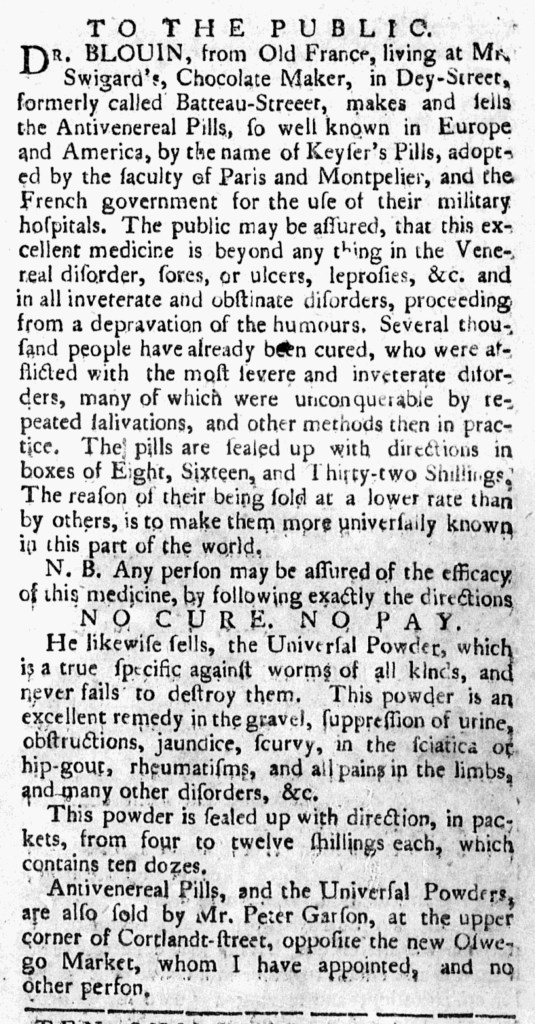
“DR. BLOUIN … makes and sells the Antivenereal Pills, so well known … by the name of Keyser’s Pills.”

It was the eighteenth-century version of offering a generic medication at a lower price than the name brand in hopes of attracting customers.  An entrepreneur who identified himself as “DR. BLOUIN, from Old France,” placed an advertisement in the November 15, 1775, edition of the Constitutional Gazette to inform readers in New York that he makes and sells the Antivenereal Pills, so well known in Europe and America, by the name of Keyser’s Pills.”  Indeed, that medication was popular in the colonies, advertised frequently by apothecaries, shopkeepers, and even printers who sold patent medicines as an alternate revenue stream.  At the same time that Blouin ran his advertisement, James Rivington, the printer of Rivington’s New-York Gazetteer, continued running his notice that proclaimed, “EVERY ONE THEIR OWN PHYSICIAN, By THE USE OF Dr. KEYSER’s PILLS.”  Rivington had been using that familiar refrain in his advertisements for years.

Blouin offered a brief history of the original medication as a means of marketing his generic version, noting that Keyser’s Pills had been “adopted by the faculty of Paris and Montpelier, and the French government for the use of their military hospitals.”  Furthermore, “[s]everal thousand people have already been cured, many of which were unconquerable by … other methods” of treatment.  Prospective customers, Blouin claimed, could not find a more effective remedy: “The public may be assured, that this excellent medicine is beyond any thing in the Venereal disorder, sores, or ulcers, leprosies, &c. and in all inveterate and obstinate disorders, proceeding from a depravation of the humours.”  He was so certain that he offered a guarantee: “NO CURE.  NO PAY.”

Readers interested in purchasing the pills that Blouin made in New York rather than imported ones would receive printed directions and could choose among boxes costing eight, sixteen, and thirty-two shillings.  The efficacy of the cure, he cautioned, depended on “following exactly the directions.”  Rivington sold Keyser’s Pills for ten, twenty, and forty shillings.  Blouin explained that he gave a discount “to make [his generic pills] more universally known in this part of the world.”  For those who wavered in choosing his pills over the name brand version, he hoped that the lower price would help convince them.  Blouin also noted that an associate, Peter Garson, “at the upper corner of Cortlandt-street, opposite the new Oswego Market,” sold the pills, but “no other person.”  Many advertisements for Keyser’s Pills warned prospective customers about counterfeits.  Blouin freely admitted that he “makes and sells” his own version … and advised readers to avoid any attributed to him but not sold by him or his appointed agent.
December 6

What was advertised in a colonial American newspaper 250 years ago today?

South-Carolina Gazette and Country Journal (December 6, 1774).

“WATCH-MAKER … proposes the fair Terms, No Cure, No Pay.”

When he moved to Charleston, one of the largest port cities in the colonies, M. Shepherd, a watchmaker, took to the pages of the South-Carolina Gazette and Country Journal to introduce himself to his prospective customers.  Like many artisans who crossed the Atlantic, he emphasized his connections to London, suggesting the level of skill he obtained while employed there.  In addition to stating that he “Just arrived from LONDON,” Shepherd also asserted that he “REPAIRS and CLEANS all Sorts of plain, horizontal and repeating WATCHES, in as compleat a Manner as possibly can be done in London.”  That was possible, in part, because he had “Materials of the best Kind for that Purpose.”  Shepherd’s competitors could make claims about doing work that rivaled that of their counterparts in London, but he was in a much better position to deliver on those promises.

The watchmaker also seized an opportunity to critique what he believed was a shortcoming in the services offered in the local market.  He suggested that “Silversmiths and other undertaking that Branch of Business,” rather than trained and experienced watchmakers, attempted to repair and clean watches, resulting in “very frequent” complaints about shoddy work.  In that regard, he echoed the critiques so often launched by John Simnet, another watchmaker from London who had migrated to the colonies.  Simnet regularly asserted that his competitors who attempted to fix watches did more damage, making it necessary for him to undertake even greater repairs.  Shepherd was so confident of his abilities that he offered a guarantee that he framed as “fair Terms.”  Invoking language more often deployed by physicians and apothecaries, the watchmaker promised, “No Cure, No Pay.”  In other words, if he could not fix a watch then he did not charge the customer for the time or materials that he invested in the effort.  As a newcomer in Charleston, he aimed to make his services attractive to prospective clients, highlighting both his skill and his no-risk guarantee.

November 9

What was advertised in a colonial American newspaper 250 years ago today?

Connecticut Courant (November 9, 1773).

“Shall have their Money return’d if the Work he does shall not be found upon Tryal to answer their End.”

In the fall of 1773, Enos Doolittle, a silversmith, took to the pages of the Connecticut Courant to advise prospective clients that he also offered services as a “CLOCK and WATCH-MAKER.”  To that end, he “lately furnished himself with a universal Assortment of WATCH FURNITURE” or parts, including springs, glasses, dial plates, keys, and seals.  Doolittle assured “Any Gentlemen that please to Favour him with their Custom” that he possessed the skills necessary both to repair damaged clocks and watches or make new ones.

To entice prospective customers, Doolittle presented a return policy.  He pledged that customers “shall have their Money return’d if the Work he does shall not be found upon Tryal to answer their End.”  That put him in company with other watchmakers who issued similar guarantees.  For instance, Thomas Hilldrup, a “WATCH MAKER from LONDON” who advertised extensively in newspapers published in Connecticut during the previous year, asserted that he “restored [watches] to their pristine vigour, and warranted [them] to perform well, free of any expence for one year.”  Similarly, Issac Heron in New York noted, “As usual, he warrants their performance – not for ever, but one year,” while Thomas Morgan in Baltimore “proposes to engage his performance for one year, provided the owners do not abuse the same, nor apply to unskilful hands, where many good watches are greatly abused for want of experience.”  Watchmakers set some conditions along with their guarantees.

Doolittle paired his warranty with a promise of low prices that matched those set by his competitors.  He may have been making a jab at the “WATCH MAKER from LONDON” who so often advertised his own shop in Hartford when he declared that “his Motives are barely to obtain such a Support as one of his Profession has a right to expect.”  Accordingly, Doolittle “is determined to Work as Cheap as any one in the Colony.”  Eschewing the pretensions that played such a significant role in advertisements placed by some of his competitors, Doolittle promised quality work for reasonable prices.  In contrast to watchmakers who sought acclaim for themselves and their work, Doolittle suggested that he labored industriously on behalf of his clients and focused on customer satisfaction.

August 2

What was advertised in a colonial American newspaper 250 years ago today?

New-York Gazette and Weekly Mercury (August 2, 1773).

“He makes all sorts of coaches … equal to any imported from England.”

William Deane made appeals to price and quality in an advertisement for the coaches he constructed at his shop “in Broad-street” in the August 2, 1773, edition of the New-York Gazette and Weekly Mercury.  Compared to most other advertisers, however, he devised much more elaborate marketing strategies to convince prospective customers of the price and quality he offered.

Deane started by describing the various services in his shop.  He made several different kinds of carriages as well as “all sorts of harness and saddlers work.”  In addition, he also did “painting, gilding and Japanning, in the neatest and most elegant manner.”  Deane emphasized that he achieved a high level of quality while offering the lowest possible prices because he did not outsource any of those jobs to artisans.  Instead, he “finishes all carriages whatever in his own shop, without applying to any other.”  Accordingly, he was “determined to make them as good, sell them as cheap, and be as expeditious as there is a possibility.”

The carriagemaker realized that he needed “to convince the public of the truth of what he asserts.”  To that end, he vowed that he “will make any piece of work that is required, equal to any imported from England, and will sell it at the prime cost of that imported.”  His customers did not have to sacrifice either price or quality, one for the other, when they supported domestic manufacture by purchasing carriages made in his shop in New York.  Furthermore, they benefitted from additional bargains since they “will save the freight, insurance, and the expences naturally attending to putting the carriages to rights after they arrive.”  In so many ways, purchasing a carriage from Deane was so much easier than importing one made in England.  In addition, he “has now a considerable stock of the best of all materials fit for making carriages,” so he was ready to serve customers who placed orders.

Deane offered a “further inducement,” a one-year guarantee on the carriages made in his shop.  He had been providing guarantees in newspaper advertisements for at least six years (including in an advertisement with nearly identical copy in the New-York Journal more than a year earlier).  The carriagemaker declared that he “will engage his work for a year after it is delivered, that is, if any part gives way, or fails by fair usage, he will make it good at his own expence.”   To make the choice even more clear, he underscored that prospective customers would not have access to that kind of customer service in maintaining their carriages if they opted for ones made in England.  “Those advantages,” Deane intoned, “cannot be obtained on carriages imported.”

The carriagemaker’s advertisement revolved around price and quality.  He did more than make casual reference to them, developing a sophisticated marketing strategy that touted the advantages of purchasing carriages made in his shop.  He used only the best materials and oversaw every aspect of the construction to produce carriages that rivaled in craftsmanship those imported from England.  He also offered competitive prices, especially since his customers saved on shipping and insurance, and a one-year guarantee on any parts that might require repairs.  Deane sought to convince prospective customers that all of this made his carriages the best choice.

July 23

What was advertised in a colonial American newspaper 250 years ago today?

Connecticut Journal and New-Haven Post-Boy (July 23, 1773).

WATCHES are restored to their pristine vigour, and warranted to perform well, free of any expence for one year.”

Though dated “Hartford, July 20, 1773,” Thomas Hilldrup’s advertisement in the July 23 edition of the Connecticut Journal and New-Haven Post-Boy had been composed much earlier.  The same copy first ran in Connecticut Courant, published in Hartford, on May 25.  It appeared in each issue of that newspaper since then, though Hilldrup dropped a short nota bene carried over from his previous advertisement after two insertions.  In this latest advertisement, Hilldrup, a “WATCH MAKER from LONDON,” declared that he had already met with so much success during his brief time in Connecticut, that he had been so “IMbolden’d by the encouragement receiv’d from the indulgent public,” that he “remov’d his shop” to a new location.  Prospective customers could find him at “the sign of the Dial” in the shop formerly occupied by Dr. Neil McLean near the courthouse in Hartford, “where Repeating, Horizontal and plain WATCHES are restored to their pristine vigour, and warranted to perform well, free of any expence for one year.”

After publishing this promotion in the Connecticut Courant for two months, Hilldrup extended that guarantee to readers of the Connecticut Journal.  It was not the first time, however, that the watchmaker took to the pages of a newspaper printed in another town in his efforts to build a large enough clientele to allow him to settle permanently in Hartford.  His advertising campaign commenced in the Connecticut Courant in the fall of 1772, but eventually expanded to the Connecticut Journal and New-Haven Post-Boy and the New-London Gazette during the winter months.  The newcomer ran advertisements in every newspaper published in the colony at the time, making it clear that local watchmakers who already established their reputations among prospective customers faced some new competition.  Placing an advertisement in the Connecticut Journal and New-Haven Post-Boy the first time may have been an experiment for a watchmaker who recently arrived in Hartford.  Opting to place another advertisement in that newspaper six months later, however, indicated that he believed the first one had been effective in generating business beyond clients served primarily by Hartford’s Connecticut Courant.  Even then, he did not consider merely announcing his presence in Hartford sufficient to draw clients to his shop.  Instead, he offered a one-year guarantee on repairs to convince prospective customers to give him a chance over his competitors.

December 27

What was advertised in a colonial American newspaper 250 years ago this week?

New-York Journal (December 24, 1772).

“Sprigs, which more beauteous makes the fair; / And lockets, various, for the hair.”

Isaac Heron, a watchmaker, operated a shop at the Sign of the Arched Dial in New York in the 1760s and 1770s.  When he decided to promote his services in the public prints in the early 1770s, he published a lively advertisement, one that interspersed commentary and poetry, in the December 24, 1772, edition of the New-York Journal.  Heron may have taken note of the notices placed by his competitors, especially John Simnet and James Yeoman, over the past six months or so.  Often creative beyond the standard appeals that appeared in many other advertisements and sometimes descending into rancorous feuds with each other, Simnet and Yeoman made their newspaper notices memorable for readers.  After observing how those rival watchmakers described their services and characterized their competitors, Heron likely determined that he needed to write copy that did not pale in comparison.  He composed more innovative copy than appeared in one of his earlier advertisements.

For instance, he offered low prices and a guarantee when it came to repairing watches.  Heron declared that he “charges as low … as his neighbors,” other watchmakers, by setting his rates “as near the London prices as possible.”  In what might have been a rebuke to Simnet and Yeoman, Heron stated, “To say more, would neither be prudent nor honest.”  In terms of a guarantee, he pledged that “As usual, he warrants their performance” for a year.  Like other watchmakers who offered similar guarantees, he clarified “accidents and mismanagement of [watches he repaired] excepted.”  Unlike other watchmakers, he elaborated in verse: “Should the all-sustaining hand, him drop, / His movements all, springs, wheels, hands must stop! / Then, like the tale of ‘a bear and fiddle,’ / This bargain—‘breaks off in the middle.’”

In addition to selling and repairing watches, Heron also sold jewelry.  He inserted a rhyming couplet to conclude the list of merchandise he lighted to prospective customers.  A paragraph that included “Ladies elegant steel watch-chains, mens [chains,] seals, trinkets, glasses, strings, and keys by the dozen, … Elegant broach-jewels for their honest breasts; sword-knots, sundries, &c.” concluded with “Sprigs, which more beauteous makes the fair; / And lockets, various, for the hair.”  Neither Simnet nor Yeoman advertised these additional items.  They focused exclusively on their skill and experience as watchmakers.  In terms of both goods and presentation, Heron devised an advertisement that distinguished his services from his competitors.

June 21

What was advertised in a colonial American newspaper 250 years ago this week?

New-York Journal (June 18, 1772).

Those advantages cannot be obtained on carriages imported.”

Advertisers began encouraging consumers to “Buy American” before the American Revolution.  Such was the case in an advertisement that coachmaker William Deane placed in the New-York Journal for several weeks in May and June 1772.  He advised “the public in general and his customers in particular” that he made all sorts of carriages and did all of the painting, gilding, and japanning.  With an attention to detail, Deane “finishes all carriages whatever in his own shop without applying to any other,” utilizing his “considerable stock of the best of all materials fit for making carriages.”  Furthermore, the coachmaker declared his determination “to make them as good, sell them as cheap, and be as expeditious as there is a possibility.”

Deane competed with coachmakers in England.  Many colonizers preferred to purchase carriages from artisans on the other side of the Atlantic, but Deane asserted that imported carriages were merely more expensive but not superior in quality or craftsmanship to those he constructed in New York.  He proclaimed that he could “make any piece of work that is required equal to any imported from England, and will sell it at the prime cost of that imported.”  That accrued various benefits to his customers.  Deane explained that they “will save the freight, insurance, and the expences naturally attending in putting the carriages to right after they arrive.”  Why incur those addition expenses and risk purchasing carriages that needed repairs after shipping when Deane made and sold carriages of the same quality in New York?

In addition, Deane offered a guarantee, stating he “will engage his work for a year after it is delivered.”  That meant that “if any part gives way or fails by fair usage, he will make it good at his own expence.”  What did prospective customers have to lose by purchasing one of Deane’s carriages?  They paid less for the same quality, plus they had easy access to the maker for repairs, including repairs undertaken for free if the result of some defect.  “Those advantages cannot be obtained on carriages imported,” Deane trumpeted as he concluded making his case that consumers in the market for carriages should “Buy American” by choosing his carriages over any that they would import from England.  Two centuries later, car manufacturers deployed “Buy American” marketing campaigns as they competed in an increasingly globalized economy, but that strategy did not emerge from developments in the twentieth and twenty-first century.  Coachmakers like William Deane encouraged consumers to “Buy American” long before the creation of the modern automotive industry.

March 22

What was advertised in a colonial American newspaper 250 years ago this week?

Massachusetts Spy (March 19, 1772).

“To prevent deception, the paper which contains the Hooks is marked ABRAHAM CORNISH.”

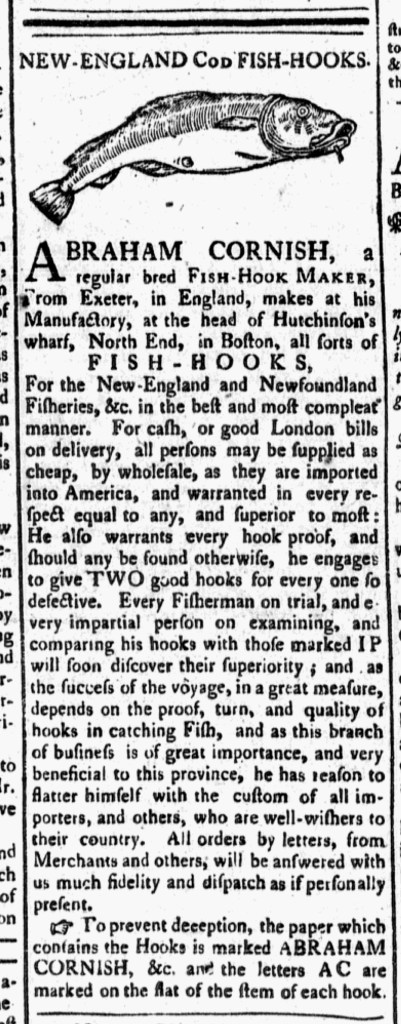
Abraham Cornish deployed a variety of marketing strategies for the “NEW ENGLAND COD FISH-HOOKS” that he made in the North End of Boston.  In an advertisement that appeared in the March 19, 1772, edition of the Massachusetts Spy, he described himself as “a regular bred FISH-HOOK MAKER, From Exeter, in England,” who produced “all sorts of FISH-HOOKS … warranted in every respect equal to any, and superior to most,” whether imported or made in the colonies.  Cornish was so certain of the quality of his hooks that offered a guarantee, stating that he “warrants every hook proof, and should any be found otherwise, he engages to give TWO good hooks for every one so defective.”  That two-for-one replacement policy testified to his confidence in the quality of his product.

Cornish also challenged prospective customers to compare his hooks to those of a competitor who marked hooks with the initials “IP.”  He asserted that “Every Fisherman” who did such a “trial” as well as “every impartial person” who performed a similar examination “would soon discover” the “superiority” of his hooks.  The success of voyages to New England and Newfoundland fisheries depended in part on the “quality of hooks in catching Fish,” so “Every Fisherman” should outfit themselves with hooks that Cornish made “in the best and most compleat manner.”

Cornish also cautioned buyers to be cautious about counterfeits, especially if they acquired hooks from retailers rather than directly from him.  “To prevent deception,” he instructed, “the paper which contains the Hooks is marked ABRAHAM CORNISH, &c. and the letters AC are marked on the flat of the stem of each hook.”  Both the hooks and the packaging attributed the hooks to Cornish.  Marking each hook with “AC” served as an enduring advertisement for his work, even after buyers separated the hooks from their package.  Cornish used “&c.” (an abbreviation for et cetera) in describing the packaging.  What else did it include?  His newspaper advertisement featured a woodcut depicting a fish.  Did the packaging also have a visual image to make it distinctive and memorable?  Did the packaging include Cornish’s location?  Did it include the guarantee that he promoted in the newspaper?  Whatever might have appeared on the packaging, Cornish used it as an additional means of marketing his product.

March 16

What was advertised in a colonial American newspaper 250 years ago today?

Pennsylvania Packet (March 16, 1772).

“Proposes to engage his performance for one year, provided the owners do not abuse the same.”

When Thomas Morgan, a watch- and clockmaker, relocated from Philadelphia to a shop on Gay Street in Baltimore in the early 1770s, he placed an advertisement in the Pennsylvania Packet, published in Philadelphia.  Why did he advertise in a newspaper published in the town he left rather than one published in his new town?  Baltimore did not yet have its own newspaper.  Colonizers in Baltimore and the surrounding area depended on the Maryland Gazette, published in Annapolis, and several newspapers published in Philadelphia, including the Pennsylvania Packet, as regional newspapers.  When he placed an advertisement in the Pennsylvania Packet, Morgan anticipated that prospective customers in Baltimore would see it.

In addition, he deployed other marketing strategies.  He marked his new location in Baltimore with “THE SIGN OF THE ARCH DIAL,” a visual statement to all passersby about what kind of business he operated.  He also offered a guarantee for repairing and cleaning watches and clocks, stating that he would “engage his performance for one year, provided the owners do not abuse the same.”  In other words, the guarantee remained in effect only if customers treated their clocks and watches well.  That included not subjecting their timepieces to “unskilful hands” who did more harm than good.  Morgan lamented that “many good watches are greatly abused for want of experience” by artisans who purported to possess skills that they did not.  In so doing, Morgan made appeals similar to those that John Simnet, a watchmaker in New York, included in his newspaper advertisements.  He also offered guarantees of his work, contingent on how customers treated their clocks and watches, and warned against trusting inexperienced watch- and clockmakers who damaged the timepieces entrusted to them.

Morgan invited “Any Gentleman” to visit his new location in Baltimore, promising that they may “have new Watches and Clocks made after the neat and best construction.”  To encourage those previously unfamiliar with his work, he indicated that he already attracted new clients and “most gratefully acknowledges the many favours received from the Public, and hopes for the continuance of them.”  Morgan hoped that advertising in the Pennsylvania Packet would further ease the transition after setting up shop in a new town.

November 14

What was advertised in a colonial American newspaper 250 years ago today?

Pennsylvania Journal (November 14, 1771).

“WATCHES made in Philadelphia.”

When Parliament imposed duties on certain imported goods – glass, lead, paint, paper, and tea – in the Townshend Acts in 1767, colonists responded by adopting nonimportation agreements.  In so doing, they resumed a strategy that helped win repeal of the Stamp Act, using economic leverage in the service of political goals.  At the same time that merchants vowed not to import and sell a wide assortment of items, many colonists also advocated that consumers support “domestic manufactures” by purchasing goods produced in the colonies as alternatives to their imported counterparts.  When Parliament eventually relented and repealed all of the duties except the one on tea, colonial merchants and others resumed trade with Britain.  Imported goods flooded American markets.

Even as consumers eagerly embraced imported goods once again, some American entrepreneurs continued to promote domestic manufactures.  John Sprogell, Jr., for instance, marketed “WATCHES made in Philadelphia” in an advertisement in the November 14, 1771, edition of the Pennsylvania Journal.  Like others who advertised goods made in the colonies, Sprogrell promised prospective customers that they would not sacrifice quality.  To that end, he declared that he had “employed journeymen from London” so his shop would produce “the best of WATCHES.”  He offered a guarantee, proclaiming that he would “insure [the watches] for one, two, or three years.”  They would not need any maintenance that would incur “expense to the purchaser,” with the exception of routine cleaning.

As the proprietor of the shop, Sprogell understood that his reputation was on the line.  “The public may be assured,” he asserted, “that he will use his utmost endeavour to give general satisfaction” because “the character of the maker lays at stake.”  Even though the journeymen who labored in the shop did much or all of the work, ultimately the watches were Sprogell’s products.  Inferior work would have an effect on his standing in the marketplace, so even as he arranged a means of providing the same quality as found in London he provided additional security for customers who chose his “WATCHES made in Philadelphia” in hopes that his various pledges and promises would entice them into his shop.