
What was advertised in a revolutionary American newspaper 250 years ago today?
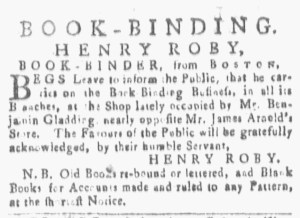
“Books for Accounts made and ruled to any Pattern.”
In the fall of 1776, Henry Roby, a “BOOK-BINDER, from BOSTON,” took to the pages of the Providence Gazette “to inform the Public, that he carries on the Book-Binding Business, in all its Branches, at the Shop lately occupied by Mr. Benjamin Gladding, nearly opposite Mr. James Arnold’s Store.” Roby did not indicate how recently he had arrived in Providence from Boston. He might have just taken up residence after leaving a city that had experienced significant hardships when the Boston Port Act shut down the harbor in the summer of 1774 and during the siege of the city following the outbreak of hostilities at Lexington and Concord in April 1775 or he might have departed Boston at some point in the past several years. Artisans from that urban port sometimes continued to describe themselves as “from Boston” for years after they set up shop in another town. Whatever the case, Roby recently moved into a shop where he had not previously conducted business. He gave extensive directions to help prospective customers find it.
He also provided an overview of his services. He suggested that he possessed both skill and experience when he stated that he “carries on the Book-Binding Business, in all its Branches.” There was no aspect of that trade that he could not perform on his own. He also chose to highlight certain services in a nota bene at the end of his advertisement. Customers could have “Old Books re-bound or lettered” with the titles on the spine or cover. In addition, merchants, brokers, or anyone keeping business or household accounts could have “Blank Books for Accounts made and ruled to any Pattern.” Roby may have had some account books in stock, but he could also custom-make books to suit the needs of his customers. They could send orders, though Roby likely preferred those who came to his shop for a consultation. That allowed him to get the details right and perhaps even upsell them on other features or services. Whatever customers ordered, Roby promised to complete the work “at the shortest Notice.” The bookbinder apparently considered the advertisement worth the investment. He inserted it in the Providence Gazette for seven consecutive weeks.