July 25

What was advertised in a colonial American newspaper 250 years ago this week?

Rivington’s New-York Gazetteer (July 22, 1773).

“HORSEMANSHIP.”

“MR. BATES PROPOSES to perform on Tuesday next, and on Friday the 30th instant, and no more, before he leaves this City.”  That brief advertisement in the July 22 edition of Rivington’s New-York Gazetteer put readers on notice that only limited opportunities remained to see Bates’s show.  From both his frequent advertisements in New York’s newspapers and the reputation that he cultivated in the city, most readers probably knew that Bates performed feats of horsemanship for the entertainment of his audiences.

New-York Journal (July 22, 1773).

A much longer advertisement in the New-York Journal on the same day deployed the usual headline, “HORSEMANSHIP,” and described him as “The ORIGINAL PERFORMER.”  Bates offered a spectacle of the “MANLY ARTS” that he previously performed for dignitaries that included “the Emperor of Germany, the Empress of Russia, the King of Great-Britain, the French King, the Kings of Prussia, Portugal, Sweden, Denmark, and Poland, and the Prince of Orange.”  Bates confided that he “received the greatest applause” for those performances, “as can be made manifest by the CERTIFICATES from the several courts now in his possession.”  Readers did not have to take his word for it that he presented his feats of horsemanship to monarchs and aristocrats.  For a mere four shillings, colonizers in New York could gain access to the same exhibition enjoyed by royals and nobles, but they had to purchase tickets in advance because “No money will be taken at the Doors, nor Admittance without Tickets.”  Bates welcomed “Ladies and Gentlemen” and provided “proper” seating for their comfort, but requested that “Gentlemen will not suffer any dogs to come with them” for fear of scaring or distracting the horses.

A manicule drew attention to the same appeal that appeared in the other newspaper, though stated differently.  “Mr. Bates proposes, but twice more, before he leaves this City, to exhibit his Performances in Horsemanship,” the equestrian daredevil stated.  That being the case, he intended to sell “the Boards, Scantling, &c. at his riding Inclosure, together with the Benches, Rails, &c.”  Dismantling the venue underscored that audiences had only a limited time to witness Bates performing “on one, two, three and four Horses, at the Bulls-Head, in Bowery-Lane.”  They risked missing a performance that would “excel any Horseman that ever attempted any thing of the kind” if they hesitated and did not buy their tickets as soon as possible.
October 21

What was advertised in a colonial American newspaper 250 years ago today?

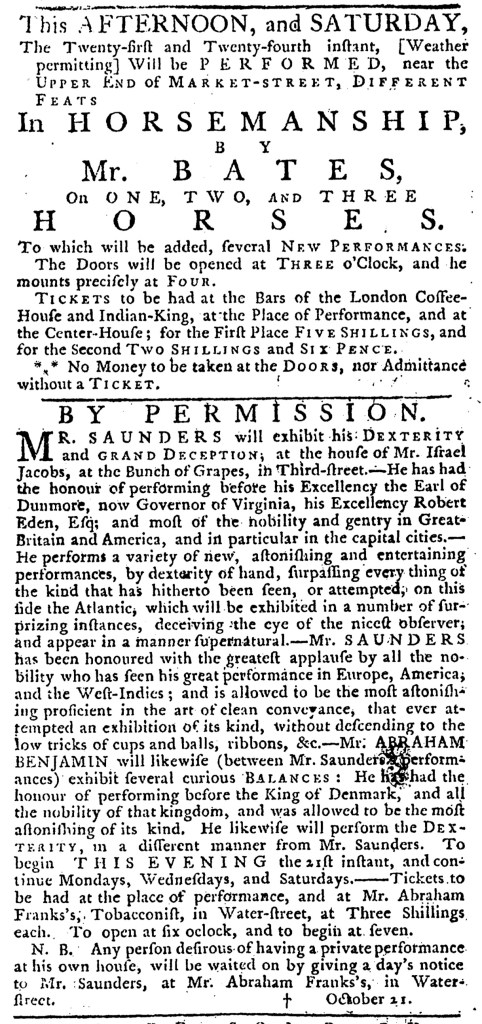
Pennsylvania Journal (October 21, 1772).

“MR. SAUNDERS will exhibit his DEXTERITY and GRAND DECEPTION.”

Newspaper advertisements help in revealing some of the entertainments enjoyed by colonizers in the eighteenth century.  For instance, two advertisements in the October 21, 1772, edition of the Pennsylvania Journal promoted upcoming performances and encouraged residents of Philadelphia to purchase tickets.  The first offered feats of “HORSEMANSHIP, BY Mr. BATES,” promising that he did tricks “On ONE, TWO, AND THREE HORSES.”  Bates and his act would have been familiar to regular readers at the time this advertisement appeared, so to entice anyone who had already seen the show to come again he proclaimed that he added “several NEW PERFORMANCES.”  Patrons needed to purchase tickets in advance since “No Money [would] be taken at the DOORS, nor Admittance without a TICKET,” yet they also received a discount for purchasing more than one.  The first ticket cost five shillings and the second only two shillings and six pence.  In other words, Bates advertised a “buy one, get one half off” promotion.

The other advertisement announced that “MR. SAUNDERS will exhibit his DEXTERITY and GRAND DECEPTION … at the Bunch of Grapes.”  Most likely, Hyman Saunders, the illusionist and itinerant performer who previously advertised in newspapers in both New York and Philadelphia, placed this notice.  He boasted that he “had the honour of performing before his Excellency the Earl of Dunmore, now Governor of Virginia … and most of the nobility and gentry in Great-Britain and America, and in particular in the capital cities.”  Saunders described his act as “dexterity by hand, surpassing everything of the kind that has hitherto been seen, or attempted, on this side of the Atlantic,” intending that such hyperbole would motivate readers to come to the show.  As a bonus, they would also see “Mr. ABRAHAM BENJAMIN … exhibit several curious BALANCES,” feats of “DEXTERITY, in a different manner from Mr. Saunders.”  Benjamin previously “had the honour of performing before the King of Denmark, and all the nobility of that kingdom.”  The pedigrees of both performers likely resonated with residents of Philadelphia who aspired to be as cosmopolitan as their counterparts in European cities.  Patrons could purchase tickets in advance at the Bunch of Grapes or “at Mr. Abraham Franks’s, Tobacconist.”  Saunders advised that performances would “continue [on] Mondays, Wednesdays, and Saturdays.”  Colonizers could also hire him for private performances in their own homes, entertaining themselves and guests fortunate enough to receive invitations.

Performers used newspaper advertisements to drum up interest in their performances in early America.  They likely resorted to handbills and broadsides as well, though those kinds of advertisements were more ephemeral.  Itinerant performers depended on publicity to draw audiences to their shows.  Even those who spent some time in town had to resort to promoting their acts to keep audiences coming or coming back for more.

June 25

What was advertised in a colonial American newspaper 250 years ago today?

Jun 25 - 6:25:1768 Providence Gazette
Providence Gazette (June 25, 1768).

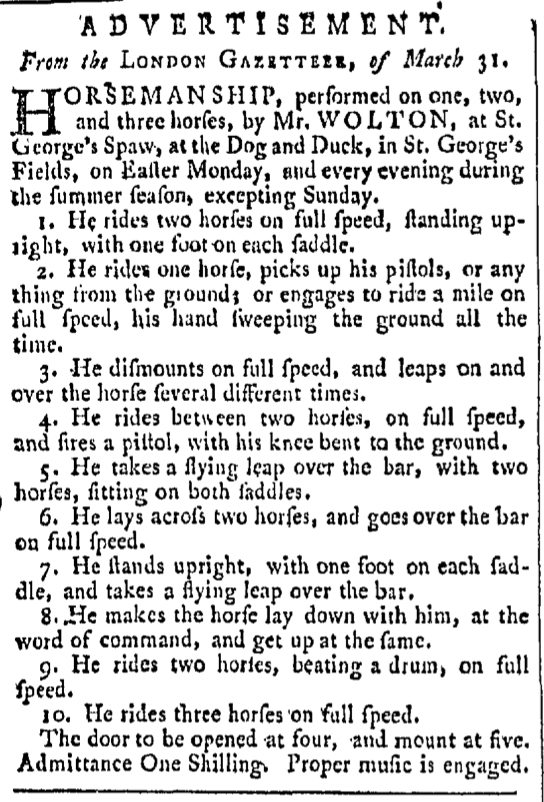
“ADVERTISEMENT. From the LONDON GAZETTEER, of March 31.”

On June 4, 1768, the supplement to the New-York Journal carried an advertisement reprinted from the March 31 edition of the London Gazetteer. John Holt included an editorial note that it was “inserted as a Curiosity.” The advertisement promoted “HORSEMANSHIP, performed on one, two, and three horses, by Mr. WOLTON, at St. George’s Spaw, at the Dog and Duck in St. George’s Field Southwark,” starting on Easter Monday and continuing “every evening during the summer season” with the exception of Sundays.

Apparently Sarah Goddard and John Carter, printers of the Providence Gazette, also considered this a “Curiosity” that would entertain their readers. Three weeks later they reprinted the same advertisement in their newspaper. Although printers regularly generated content by reprinting news items and editorials from one newspaper to another throughout the eighteenth century, the attribution practices make it difficult to determine if Goddard and Carter reprinted this curious advertisement after encountering it in the New-York Journal or if they saw the same item in a copy of the London Gazetteer they had obtained and independently chose to reprint the advertisement for the amusement of their readers.

Both the New-York Journal and the Providence Gazette noted that the advertisement originally appeared in the London Gazetteer. In the same supplement, Holt inserted a poem “On JOHN WILKES, Esq; offering himself a Candidate for the County of Middlesex” for readers in New York. He did not indicate the source of the poem, though it did appear with news from London as well as short excerpts from the Public Advertiser and the Public Ledger as well as the London Gazetteer. Holt also reprinted a couplet from the Public Advertiser: “THE Reign of HUMOUR, WIT and SENSE is o’er! / When did it end?—When YORICK was no more.”

Goddard and Carter reprinted both of those items along with two other poems under a heading dated “LONDON, March 29” that further indicated “The following was this morning posted up at the Sun Fire Office, in Cornhill.” This general heading does not make clear whether it applied only to “BRITANNIA to JOHN WILKES, Esq.” or all four poems. A brief explanation accompanied the couplet that also appeared in the New-York Journal. It had been composed “On the Death of Reverend Mr. STERNE, Author of Tristram Shandy, &c.” The novelist had only recently died on March 18, 1768.

Considering that Goddard and Carter published both additional material and information that differed from some of the attributions in Holt’s newspaper, they very well could have made the decision to reprint an interesting advertisement from the London Gazetteer without being influenced by a fellow printer elsewhere in the colonies. Even if Holt’s inclusion of the advertisement in the New-York Journal had inspired them, the further dissemination of it in the Providence Gazette demonstrates that colonists sometimes turned to advertisements for entertainment or amusement. In that manner, advertisements enhanced other content in newspapers by serving purposes other than selling tickets or other goods and services. Either Wolton or the proprietors of St. George’s Spa had paid to insert an advertisement in the London Gazetteer with the intention of attracting audiences. In the end, they entertained readers on the other side of the Atlantic who had no chance of attending the performances. Neither colonial printers nor colonial readers paid anything to Wolton or St. George’s Spa for their entertainment.

June 4

What was advertised in a colonial American newspaper 250 years ago today?

Jun 4 - 6:4:1768 New-York Journal
Supplement to the New-York Journal (June 4, 1768).

The following Advertisement from the London Gazetteer … is inserted as a Curiosity.”

Colonial printers generated content for their newspapers by liberally reprinting items that previously appeared in other newspapers. Much of the news came from newspapers printed in other colonies, but some it also came directly from newspapers printed in London. In making their editorial decisions, printers sometimes chose items intended to inform or to educate, but other times selected items intended solely to entertain. The latter included anecdotes, poems, and even advertisements.

For instance, John Holt reprinted news from London in the Supplement to the New-York Journal distributed on June 4, 1768. He complemented the news from the Public Advertiser and Public Ledger with items intended to edify and to amuse, namely a poem “On JOHN WILKES, Esq; offering himself a Candidate for the County of Middlesex” and an “Advertisement from the London Gazetteer of the 31st of March last.” Holt explained that the advertisement “is inserted as a Curiosity” for his readers.

The advertisement offered colonists a glimpse of popular culture and entertainments available in England. It announced a spectacle that occurred every night (except Sundays) throughout the summer: “HORSEMANSHIP, performed on one, two, and three horses, by Mr. WOLTON, at St. George’s Spaw, at the Dog and Duck in St. George’s Fields Southwark.” The notice listed ten tricks performed by Wolton, including riding “two horses on full speed, standing upright with one foot on each saddle” and making “a flying leap over the bar with two horses, sitting on both saddles.” For added interest, Wolton beat a drum during some of his tricks and fired a pistol during others. To make the event even more spectacular, the proprietors supplied “Proper musick” to set the tone throughout the series of stunts.

Unless they planned a trip across the Atlantic, the readers of the New-York Journal did not have opportunities to witness Wolton’s show of horsemanship during the summer of 1768, but Holt suspected that the advertisement on its own provided some of level of entertainment. Its inclusion in the New-York Journal demonstrates how carefully the printer scoured other newspapers for content he imagined his readers would enjoy. Some colonists likely paid similar attention to the advertisements in their local newspapers, not because they were responsible for filling out the pages but instead because they sought entertainment, either by attending events like fireworks shows and musical performances or simply by reading advertisements that included curious or amusing content.