November 21

What was advertised in a revolutionary American newspaper 250 years ago today?
New-Hampshire Gazette (November 21, 1775).

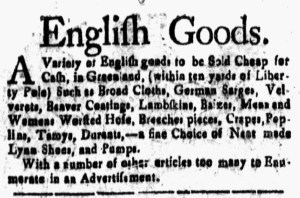
“English Goods … within ten yards of Liberty Pole.”

An anonymous advertiser hawked “A Variety of English goods” in the November 21, 1775, edition of the New-Hampshire Gazette.  The notice included a short list of imported items, mostly textiles, such as “Broad Cloths, … Velverets, … Poplins, Tamys, [and] Durants,” as well as “Mens and Womens Worsted Hose [and] Breeches pieces.”  That list apparently did not cover everything available for sale; the advertisement concluded with a note about “a number of other articles too many to Enumerate in an Advertisement.”

That may have been the advertiser’s choice since some merchants and shopkeepers did occasionally resort to similar language, though it may have been a decision influenced by the printer, Daniel Fowle.  That issue of the New-Hampshire Gazette consisted of only two pages instead of the usual four.  It was the first issue of the New-Hampshire Gazette since November 8.  The printer did not produce and circulate an issue the previous week.  The Adverts 250 Project has tracked apparent disruptions in the supply of paper that had an impact on the New-Hampshire Gazette, yet that was not the only difficulty the printer faced.  In the monumental History and Bibliography of American Newspapers, 1690-1820, Clarence S. Brigham notes that Fowle announced that he printed the November 2 edition “‘with great difficulty’ because of the threatened British attack on Portsmouth” and that the printer “stated that the press ‘is removed to Greenland, about six miles from Portsmouth.”[1]  Those circumstances may have played a role in the decision to publish an abbreviated advertisement that promised a greater selection of goods than appeared in print.

The advertisement presents other questions about consumer culture during the era of the American Revolution.  The Continental Association, a nonimportation and nonconsumption agreement devised by the First Continental Congress, was in effect, yet the unnamed advertiser boldly marketed imported goods.  The headline, “English Goods,” appeared in a larger font than anything else in that issue except for the title of the newspaper in the masthead.  The advertiser conveniently did not mention when the goods had arrived in the colonies, whether they had been transported and delivered before the boycott went into effect.  Yet the advertiser did acknowledge current events when giving the location to purchase the imported goods: “within ten yards of [the] Liberty Pole” in Greenland.  In his recent book on the consumption and politics of tea during the era of the American Revolution, James R. Fichter argues that many tea retailers did not face repercussions while tea importers certainly did.  He further contends that advertisements revealed the reality of local commerce compared to the propaganda that appeared in news articles and editorials about tea.[2]  Perhaps something similar occurred with these “English Goods” in Greenland in the late fall of 1775.

**********

[1] Clarence S. Brigham, History and Bibliography of American Newspapers, 1690-1820 (American Antiquarian Society, 1947), 471.

[2] James Fichter, “Truth in Advertising,” in Tea: Consumption, Politics, and Revolution, 1773-1776 (Cornell University Press, 2023), 132-157.
February 22

What was advertised in a colonial American newspaper 250 years ago today?

Pennsylvania Gazette (February 22, 1775).

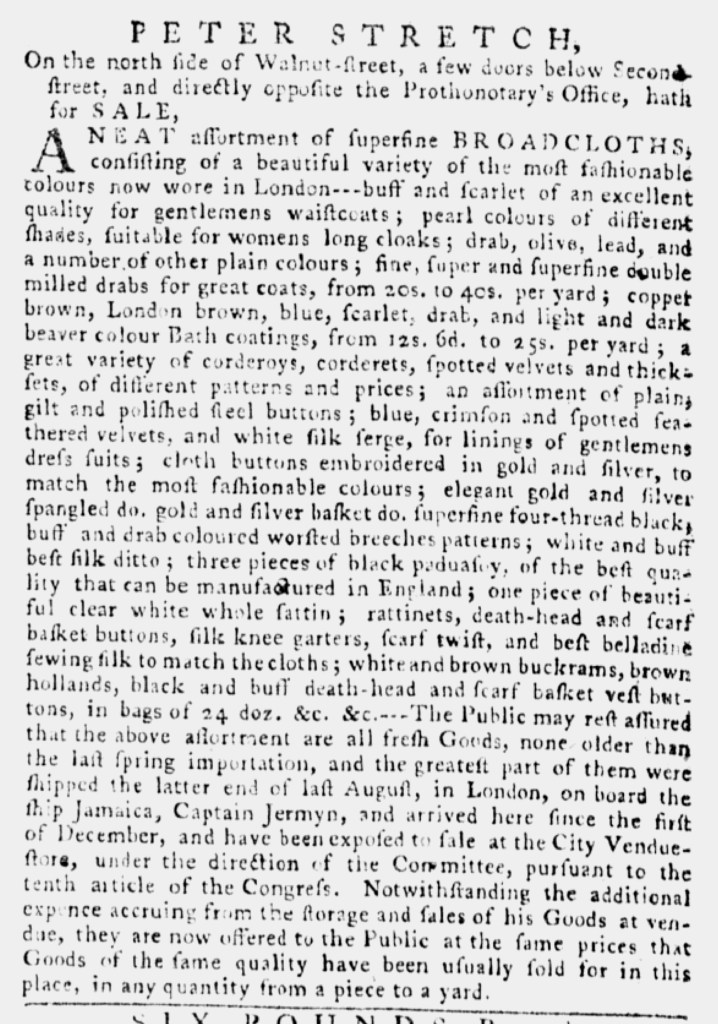
“Goods … have been exposed to sale … under the direction of the Committee, pursuant to the tenth article of the Congress.”

Even as the imperial crisis intensified in February 1775, Peter Stretch expected that consumers in and near Philadelphia would respond to marketing appeals that connected the textiles and accessories that he imported and sold to current fashions in London.  Such had been the case for quite some time before the political situation became so troubled.  A transatlantic consumer revolution bound together England and the colonies in the eighteenth century, helping to fuel a process of Anglicization among subjects of the empire in British mainland North America.  When it came to advertising, it made sense to Stretch to open his notice in the February 22 edition of the Pennsylvania Gazette with a “NEAT assortment of superfine BROADCLOTHS, consisting of a beautiful variety of the most fashionable colours now wore in London.”

He anticipated such an appeal would resonate with prospective customers even with the Continental Association in effect.  The First Continental Congress enacted that nonimportation agreement in response to the Coercive Acts.  Yet Stretch acknowledged those circumstances as well.  He wanted consumers to know that he sold new merchandise rather than items that had lingered on the shelves or in the warehouse for years, so he assured readers that “the above assortment are all fresh Goods, one older than the last spring importation.”  He went into more detail, explaining that “the greatest part of them were shipped the latter end of last August, in London, on board the ship Jamaica, Captain Jermyn.”  That meant that his wares had been ordered and shipped before the First Continental Congress began its meetings in September and October 1774 and certainly before delegates devised the Continental Association.

However, the Jamaica “arrived here since the first of December,” the day the nonimportation agreement went into effect.  The tenth article made provisions for imports that arrived in December 1774 and January 1775, allowing merchants to refuse and return the goods, turn them over to a local committee to store while the pact remained in force, or entrust them to the committee to sell with the original costs returned to the importer and any profits designated to the relief of Boston where the harbor had been closed and blockaded since June 1774.  Stretch reported that he adhered to the Continental Association.  His wares “have been exposed to sale at the City Vendue-store, under the direction of the Committee, pursuant to the tenth article of the Congress.”  Having done its due diligence, the committee apparently returned items not sold at auction to Stretch, provided that he also observe the ninth article that prohibited price gouging or “tak[ing] Advantage of the Scarcity of Goods that may be occasioned by this Association.”  Stretch pledged that he offered his merchandise “at the same prices that Goods of the same quality have been usually sold for in this place.”  The merchant demonstrated to consumers that they could still acquire textiles “of the most fashionable colours now wore in London” without violating the Continental Association.

October 12

What was advertised in a colonial American newspaper 250 years ago today?

Pennsylvania Journal (October 12, 1774).

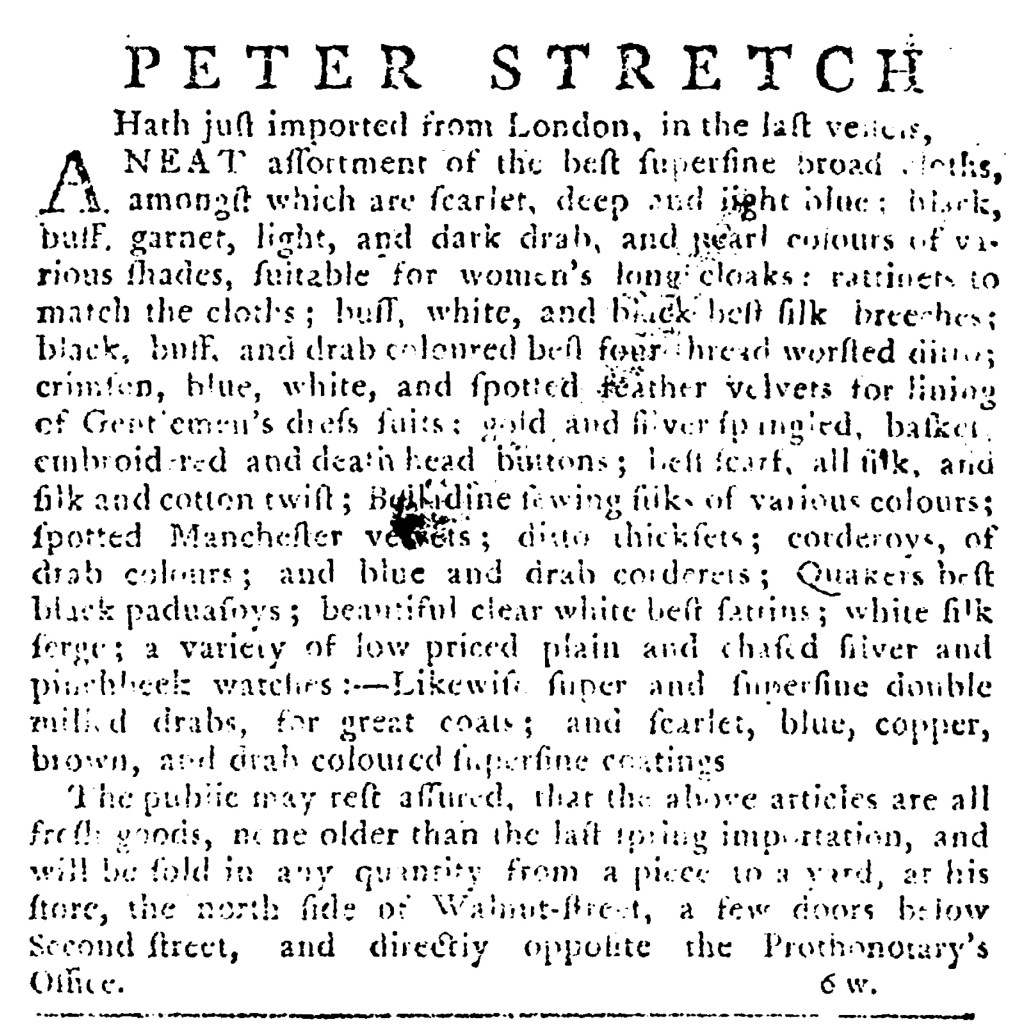
“The above articles are all fresh goods, none older than the last spring importation.”

In the fall of 1774, Peter Stretch advertised a “NEAT assortment” of textiles and accessories that he “Hath just imported from London, in the last vessels.”  In an advertisement in the October 12 edition of the Pennsylvania Journal, he listed many of those items, including “the best superfine broad cloths, amongst which are scarlet, deep and light blue, black, buff, garnet, light, and dark drab and pearl colours of various shades, suitable for women’s long cloaks,” “crimson, blue, white, and spotted feather velvets for lining of Gentlemen’s dress suits,” and “gold and silver spangled, basket, embroidered and death head buttons.”

In stating that he had recently imported his wares “in the last vessels,” Stretch deployed language commonly used by merchants and shopkeepers in their marketing efforts.  Elsewhere on the same page, for instance, Barclay and Mitchell declared that they stocked merchandise “Imported in the last vessels from England.”  Yet Stretch decided to provide further details about when he received his inventory at the end of his advertisement.  “The public may rest assured,” he confided, “that the above articles are all fresh goods, none older than the last spring importation.”  Stretch was in a bit of an awkward position.  He wanted the public to think of his goods as new rather than as leftovers that had been lingering on the shelves or in the storeroom, yet not too new.  As the First Continental Congress continued to meet in Philadelphia, just a short distance from Stretch’s store, the colonies prepared to adopt a nonimportation agreement in protest of the Coercive Acts imposed by Parliament following the Boston Tea Party.  Stretch seemingly did not want the public to get the impression that he had imported surplus goods with the intention of sidestepping any nonimportation agreement when it went into effect.  That would have meant allegations that he technically lived up to the letter of the pact but not the spirit.  Rather than hoarding goods in recent months to sell once a nonimportation made imported wares scarce, Stretch “assured” the public that he acquired much of his inventory during “the last spring importation” before the colonies knew about the Boston Port Act, the Massachusetts Government Act, and other legislation passed by Parliament.  He hoped that made it acceptable for patriots to make purchases at his store even as they became wary of the goods carried by his competitors.

September 27

What was advertised in a colonial American newspaper 250 years ago today?

Supplement to the South-Carolina Gazette and Country Journal (September 27, 1774).

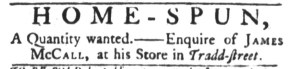
“HOME-SPUN, A Quantity wanted.”

In so many ways, James McCall’s advertisement appeared as a stark contrast compared to others in the September 27, 1774, edition of the South-Carolina Gazette and Country Journal.  In just three lines, it proclaimed, “HOME-SPUN, A Quantity wanted. – Enquire of JAMES McCALL, at his Store in Tradd-street.”  The word “HOME-SPUN” in all capitals in a significantly larger font occupied a line on its own, calling attention to the commodity that McCall sought.  He referred to linen and wool textiles produced in the colonies as an alternative to imported fabrics.  Spinning, a domestic chore undertaken by women, took on political significance when colonizers enacted nonimportation agreements in response to the duties imposed in the Townshend Acts in the late 1760s.  The homespun cloth that resulted from their efforts became a visible symbol of support for the Patriot cause.  McCall did not need to elaborate on the political principles associated with homespun when he placed his advertisement seeking a quantity of it.  In other advertisements, he had previously demonstrated that how well he understood consumer politics.

Elsewhere in the same issue of the South-Carolina Gazette and Country Journal, merchants who imported “fashionable” textiles from London and other English ports ran lengthy advertisements that listed and described their merchandise.  Edwards, Fisher, and Company, for instance, ran their notice about receiving “PART of their FALL GOODS.”  Mansell and Corbett inserted an even more lengthy advertisement that featured imported fabrics, emphasizing “the most fashionable colours” and “an entire new pattern,” as well as housewares.  Other advertisers were a bit more restrained in terms of length, but not their exuberance for imported textiles.  In addition to leading his list of merchandise with a “LARGE Assortment of printed Muslins, Linens, and Calicoes,” Z. Kingsley concluded with a nota bene that explained, “The printed Muslins and Linens, are all the newest Patterns.”  These merchants considered it necessary to offer assurances to prospective customers that their wares did indeed follow the latest styles, simultaneously emphasizing all the choices available to them.  Homespun cloth, on the other hand, turned fashion on its head.  What was the newest and the most sophisticated did not matter as much as the simple political message that producing, purchasing, and wearing homespun communicated during the imperial crisis.

September 23

What was advertised in a colonial American newspaper 250 years ago today?

South-Carolina and American General Gazette (September 23, 1774).

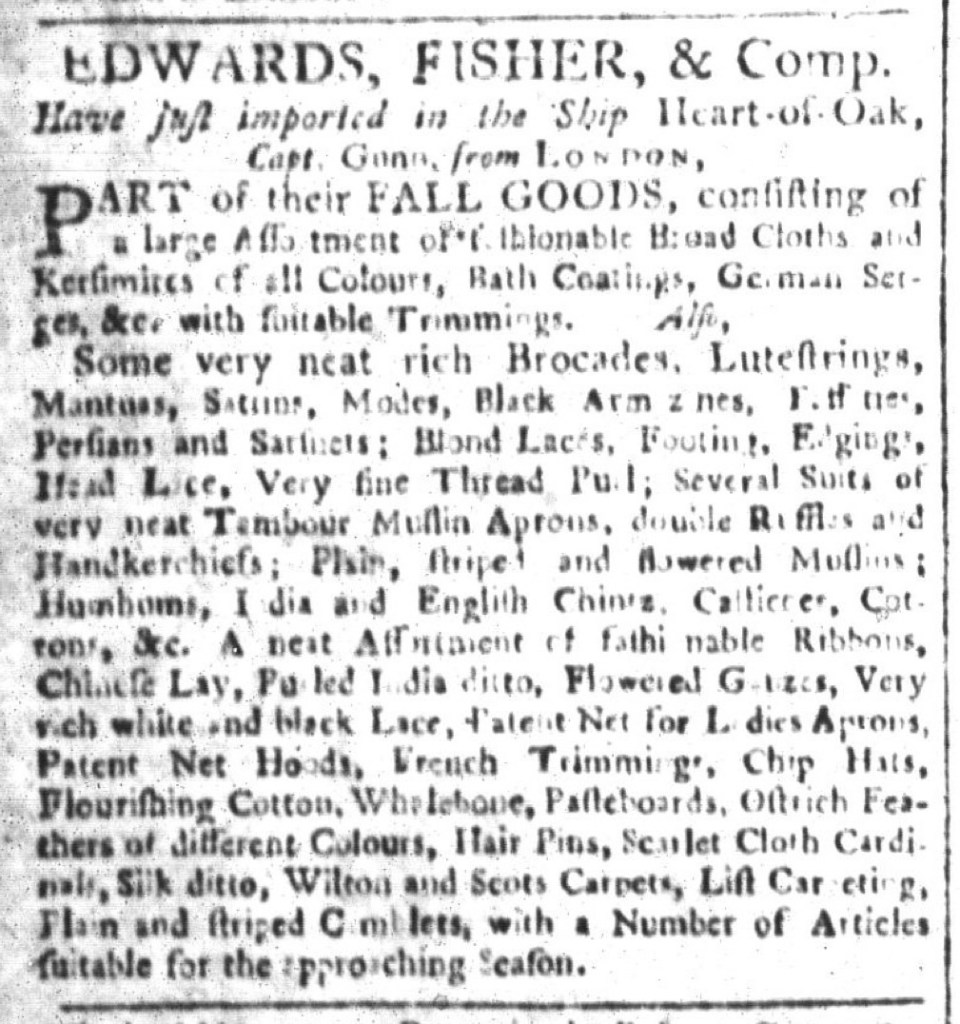
“Just imported … from LONDON, PART of their FALL GOODS.”

Like many other merchants and shopkeepers, Edwards, Fisher, and Company in Charleston updated their merchandise with the changing of the seasons.  With the arrival of fall in 1774, they ran advertisements in the South-Carolina and American General Gazette, the South-Carolina Gazette, and the South-Carolina Gazette and Country Journal to announce that they had “just imported” a “large Assortment” of textiles and other items.  This new inventory accounted for “PART of their FALL GOODS,” suggesting that they would continue to supplement their wares as ships arrived from London.

Edwards, Fisher, and Company may have believed that they had a narrow window of opportunity to import and sell these goods.  Earlier in the month, a competitor acknowledged that “a Non-importation Agreement will undoubtedly soon take Place here,” encouraging consumers (“Ladies” in particular) to shop while they had the chance.  The First Continental Congress had recently convened in Philadelphia to discuss coordinated measures in response to the Coercive Acts.  Their deliberations would result in the Continental Association, a nonimportation, nonconsumption, and nonexportation agreement set to go into effect on December 1.  In late September, merchants, shopkeepers, and consumers in Charleston and other American cities and towns did not yet know exactly which measures the First Continental Congress would adopt, but they reasonably anticipated that importing and purchasing goods would be constrained in the coming months.

That gave Edwards, Fisher, and Company an opportunity to sell the “Number of Articles suitable for the approaching Season” that had already arrived as “PART of their FALL GOODS.”  They probably kept their fingers crossed that other shipments would arrive from London before news of a nonimportation agreement arrived from Philadelphia.  They sought to entice prospective customers with an extensive list of their wares, describing them as “fashionable” more than once.  What consumers would consider fashionable, however, evolved when nonimportation agreements went into effect.  Homespun textiles produced in the colonies rather than “very neat rich Brocades” and other imported fabrics became fashionable because of the political principles they communicated.  Edwards, Fisher, and Company would have to content with that another day; for the moment, they could continue following familiar strategies for marketing imported textiles and other goods.

June 29

What was advertised in a colonial American newspaper 250 years ago today?

Essex Journal (June 29, 1774).

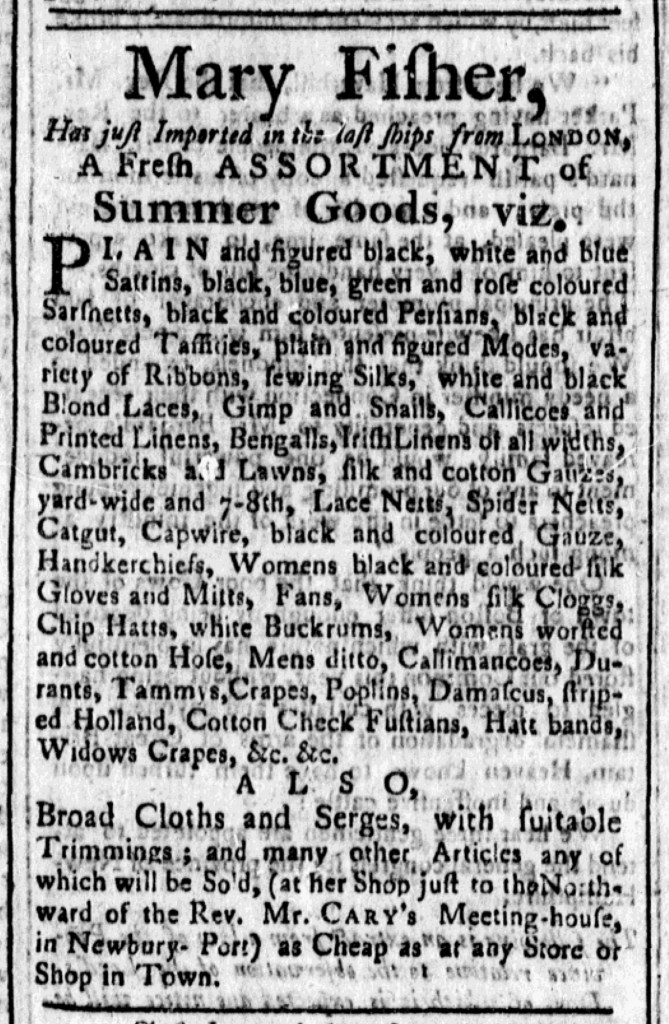
Imported in the last ships from LONDON, A Fresh ASSORTMENT of Summer Goods.”

As June 1774 came to a close, the final issue of the Essex Journal for that month carried news that arrived from Salem, Boston, New London, New York, Philadelphia, Williamsburg, and Charleston.  The editor also selected a short address “To the Farmers in America” from “FREEDOM” to reprint from the most recent edition of the Massachusetts Spy.  It advised, “INCREASE your SHEEP and raise WOOL as far as possible, that you from this time wear LIBERTY CLOTH.”  Although framed as advice to farmers, the suggestion to wear homespun cloth applied to all consumers who wished to protest various abuses by Parliament, especially the Boston Port Act that went into effect at the beginning of the month.  Colonizers discussed their prospects for using commercial means to achieve political ends, recognizing that any boycott of imported goods should be accompanied by encouraging “domestic manufactures” as alternative products.  That included clothing made of homespun fabrics to substitute for textiles imported from London.

Even as “FREEDOM” promoted “LIBERTY CLOTH” as a symbol of patriotism, merchants and shopkeepers hawked imported goods elsewhere in the newspaper.  No nonimportation or nonconsumption agreement had yet been adopted.  George Searle, for instance, “Just Imported from LONDON … an assortment of Painters Oils and Colours.”  Similarly, John Stickney and Son, announced that they “imported from London, a large assortment of English, India and hard ware GOODS.”  Those goods certainly included garments and fabrics.  Mary Fisher provided more detail, advertising that she “just Imported in the last ships from LONDON, A Fresh ASSORTMENT of Summer Goods.”  She then listed dozens of items, including an array of textiles that ranged from “PLAIN and figured black, white and blue Sattins” to “black, blue green and rose coloured Sarsnetts [sarcenets]” to “Callicoes and Printed Linens.”  Even as such items fell out of favor in some circles, Fisher offered an opportunity for consumers who desired imported textiles, even those who supported the patriot cause, and realized that they should buy what they could before discussions about boycotts became actual boycotts.  Fisher offered her wares “as Cheap as at any Store or Shop in Town,” making it possible for consumers to stockpile items they purchased from her.  Her imported textiles did not have the appearance of homespun “LIBERTY CLOTH,” but, for the moment, customers could at least equivocate that they had not bought those fabrics while a nonconsumption agreement was in effect.  Memories of boycotts in response to the Stamp Act and the duties on certain goods in the Townshend Acts guided consumers in preparing for a new round of protests.

May 16

What was advertised in a colonial American newspaper 250 years ago today?

Newport Mercury (May 16, 1774).

“Fresh Imported … direct from LONDON … English & India GOODS.”

The crisis over tea hit the boiling point as Christopher Champlin inserted a new advertisement in the May 16, 1774, edition of the Newport Mercury.  Relying on standard language that appeared in notices placed by merchants and shopkeepers, he informed readers in Rhode Island that he stocked a “general assortment of English & India GOODS, Suitable for the Season, Which he continues to sell, by WHOLESALE and RETAIL.”  His merchandise was “Fresh Imported” on two ships “direct from LONDON.”  In a final appeal, Champlin asserted that he sold his wares “As low, for cash, as at any store or shop in the colony.”  Considering the news that ran immediately to the left of his advertisement, Champlin’s marketing strategy may not have been resonated differently than he originally intended.

Word of the Boston Port Act had arrived in Newport.  A news update with a headline that proclaimed, “JOIN or DIE!!” described the “act of parliament for blockading the harbour of Boston, in order to reduce its spirited inhabitants to the most servile and mean compliance ever attempted to be imposed on a free people” as leading to a fate “worse than death—SLAVERY.”  The editor had the news from “a gentleman” who recently arrived in Newport from Boston.”  That source stated that “a number of the first merchants in London had wrote the manufacturers in inland towns of England, not to send them any more goods, and had wrote to the merchants in Boston, that the surest way to settle the present difference, between the two countries, is to stop all trade immediately, and advised a strict union between all the colonies in this measure.”  Whether merchants in London had actually done any of that or it was wishful thinking on the part of patriots who sought allies on the other side of the Atlantic, colonizers had experience with nonimportant agreements (or boycotts) as political leverage in response to the Stamp Act and the Townshend Acts.  The update reminded readers “that hydra the Stamp Act … was destroyed by our firmness and union.”

By the end of October, the First Continental Congress adopted the Continental Association, a trade boycott intended to pressure Parliament into repealing the Boston Port Act and the rest of the Coercive Acts passed in retaliation for the Boston Tea Party as well as address other grievances.  For the moment, however, no boycott was in place when Champlin published his advertisement promoting his “Fresh Imported” goods.  The news that accompanied that notice perhaps caused some consumers to reconsider what they might purchase, but it might also have served to encourage sales among colonizers who suspected that it was only a matter of time before another boycott went into effect.  They could buy what they wished with a clear conscience and without others censuring them for doing so.  Whatever they chose to do in May 1774, consumers in Rhode Island made decisions in the context of news arriving from Boston, London, and other places.

November 9

What was advertised in a colonial American newspaper 250 years ago today?

Nov 9 - Massachusetts Gazette and Boston Weekly News-Letter
Massachusetts Gazette and Boston Weekly News-Letter (November 9, 1769).

“The Whole of which were imported by himself before the Non-Importation Agreement took Place.”

William Greenleaf’s advertisement in the November 9, 1769, edition of the Massachusetts Gazette and Boston Weekly News-Letter looked much like others that promoted consumer goods. Extending half a column, it listed a vast assortment of items available at his shop, everything from “Silk & worsted Sagathies” to “Ivory, Bone, & Ebony Fans” to “Necklaces and Earings of various sorts” to Persia Carpets three yards square.” In addition to its celebration of consumer culture and encouragement for colonists to acquire more goods, Greenleaf’s advertisement also addressed the politics of the day. The shopkeeper assured the entire community that his entire inventory had been “imported by himself before the Non-Importation Agreement took Place.” In so doing, he protected his reputation and signaled to prospective customers that they could buy his wares without compromising their political principles.

When it came to advertising textiles and accessories, the bulk of Greenleaf’s merchandise, most merchants and shopkeepers emphasized how recently their goods had arrived in the colonies. “Just Imported” implied that these items represented the latest fashions from London and other English cities. In 1769, however, this popular appeal no longer possessed its usual power to entice prospective customers. New merchandise was politically problematic merchandise. The merchants and traders of Boston and other towns in Massachusetts adopted nonimportation agreements to protest the duties Parliament imposed on imported paper, glass, lead, paint, and tea. If Parliament intended to tax those items, then colonists resolved not to import an even greater array of goods from Britain. The goods that merchants and shopkeepers stocked and sold possessed political significance based on when those items arrived in the colonies.

In the late 1760s and early 1770s, colonists observed the commercial practices of their friends, neighbors, and other members of their communities. Greenleaf realized that all merchants and shopkeepers were under scrutiny to detect if they violated the nonimportation agreement. Committees investigated suspected violations and published names and accounts of their actions in newspapers, alerting consumers not to do business with them and warning others to abide by the agreement. In such an environment, Greenleaf considered it imperative to assert that he sold merchandise that did not breach the nonimportation agreement. In his business practices, he expressed a commitment to the patriot cause.

January 11

What was advertised in a colonial American newspaper 250 years ago today?

Georgia Gazette (January 11, 1769).

“Just imported … and to be sold by JOHN HIGGIN.”

In January 1769, John Higgin advertised a variety of goods “Just imported, from Liverpool and Corke, and to be sold … At Mr. Moore’s Store opposite the Exchange.” Unlike Inglis and Hall, whose advertisement from the previous week appeared in the Georgia Gazette once again, Higgin did not regularly insert advertisements for consumer goods in the colony’s only newspaper. The shipping news suggests that may have been because Higgin was not a resident of Savannah but instead a ship captain who sometimes did some trading on his own.

According to the shipping news in the January 4 edition of the Georgia Gazette, the “Snow Ann,” captained by John Higgins “ENTERED INWARDS at the CUSTOM-HOUSE” from Montserrat and St. Martin’s that very day. A week later, Higgin published an advertisement for “IRISH linens,” “Cheque, silk, and muslin handkerchiefs,” “Tin saucepans,” and an assortment of other textiles, garments, and housewares. Like many other advertisements, it ran in three consecutive issues (January 11, 18, and 25) before being discontinued. Higgin, however, did not disappear from the pages of the Georgia Gazette. The following week, the “Snow Anne, John Higgin,” headed for Montserrat was listed among the vessels “ENTERED OUTWARDS” at the customhouse. Preparations for departure took some time. Higgin and his vessel remained on that list for nearly two months. In the March 29 edition, the shipping news reported that the “Snow Anne, John Higgin” had “CLEARED” on March 23.

While it is possible that the John Higgin who commanded the Anne and the John Higgin who sold imported goods were two different people, the evidence in the Georgia Gazette suggests otherwise. That the advertisement stated Higgin’s goods came from Liverpool and Cork likely indicated their origins rather than suggesting that they had been transported directly from the British Isles to Georgia. Higgin would have had plenty of opportunities to pursue side ventures on his own while sailing the Anne in the Caribbean. When competing against other purveyors of imported goods in Savannah, he would have been at a disadvantage if he reported that his merchandise from Liverpool and Cork made a detour to the sugar islands first. After all, colonial consumers demanded the newest fashions when it came to clothing and housewares. Selling his wares “At Mr. Moore’s Store” rather than a shop of his own would have been appropriate for someone only in Savannah briefly.

Higgin’s advertisement occupied more space than most advertisements for consumer goods and services that ran in the Georgia Gazette. Although this suggested the array of choices available to prospective customers, Higgin likely envisioned an additional strategy when he composed the advertisement. Unlike Inglis and Hall and other local merchants and shopkeepers already familiar to residents of the colony, Higgin was unknown and in port for a limited time. Especially if he wished to acquire new wares for further trading before departing, he needed to sell as quickly as possible. An advertisement of such length certainly made his presence known.

October 23

What was advertised in a colonial American newspaper 250 years ago today?

Oct 23 - 10:23:1767 New-Hampshire Gazette
New-Hampshire Gazette (October 23, 1767).

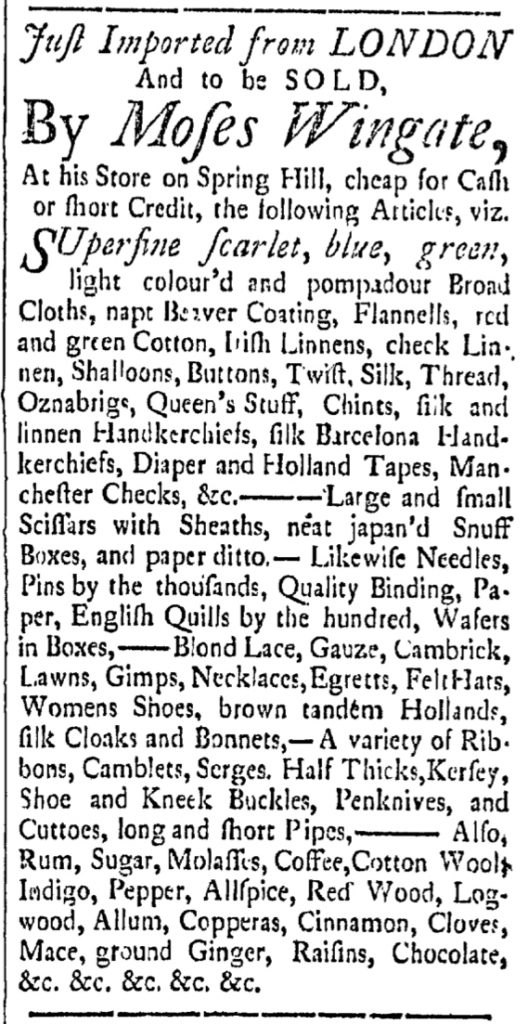
Superfine, scarlet, blue, green, light colour’d and pompadour Broad Cloths …”

In the fall of 1767, Moses Wingate imported and sold a vast assortment of goods “At his Store on Spring Hill” in Portsmouth, New Hampshire. In a newspaper advertisement intended to entice potential customers, he adopted one of the most common marketing strategies of the eighteenth century: listing his merchandise. Very few entrepreneurs, mostly booksellers, distributed catalogs in eighteenth-century America; however, many treated newspaper advertisements as surrogates for publishing separate catalogs. Wingate’s advertisement filled half a column, with most of the space devoted to enumerating his inventory. Other merchants and shopkeepers sometimes published advertisements that occupied an entire column and, on occasion, spilled over into the next. List style advertisements for consumer goods filled the pages of American newspapers in the eighteenth century. These lists implicitly communicated an appeal to consumer choice. Wingate and others informed readers that they did not have to accept whatever happened to be on their shelves. Instead, merchants and shopkeepers stocked such varieties of goods that customers could exercise their own taste and judgment – assert their own independence – by choosing the goods that most appealed to them.

To that end, Wingate named more than seventy-five distinct items readers could expect to find among his inventory. In some cases, these were categories of goods, such as buttons or penknives, suggesting even variety. In one instance, he specified further choices: “A variety of Ribbons.” Like many of his competitors and counterparts, he also deployed “&c.” (the eighteenth-century abbreviation for et cetera), inserting it once in the middle of the advertisement to indicate he sold an even broader array of imported textiles than listed there. He also concluded his advertisement with “&c. &c. &c. &c.” to underscore to potential customers that they would find much, much more when they visited his store. Wingate provided an extensive list of imported goods to encourage potential customers to imagine his inventory, to imagine touching, sorting through, comparing, and selecting from among his wares. He indicated readers could find even more imported goods at his store as a means of further inflaming their curiosity. Wingate could have placed a much shorter advertisement that simply announced that he sold a variety of goods imported from London, but he made an investment in a lengthier list style advertisement because he believed that perusing its contents would incite consumer demand.