May 3

What was advertised in a revolutionary American newspaper 250 years ago today?
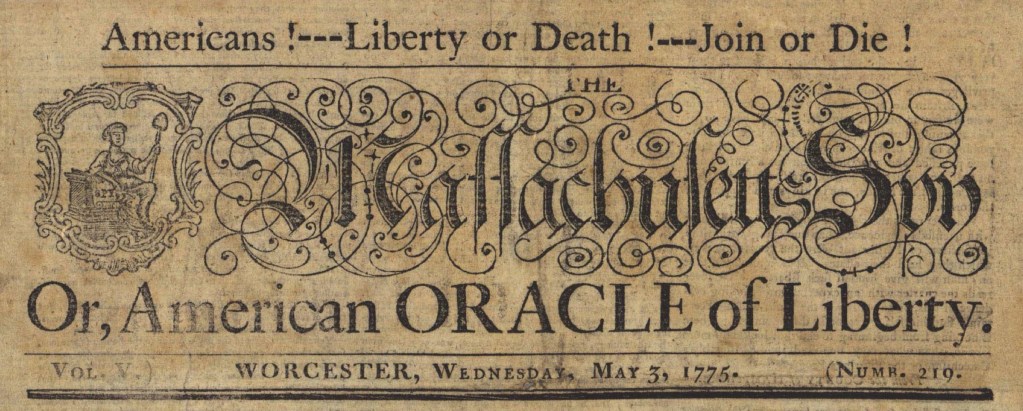
Massachusetts Spy (May 3, 1775). Courtesy American Antiquarian Society.

“I beg the Assistance of all the Friends to our righteous Cause to circulate this Paper.”

When the patriot printer Isaiah Thomas revived the Massachusetts Spy, originally published in Boston, after fleeing to Worcester to evade “friends of the British administration” who “openly threatened him with the effects of their resentment,” the first issue published in that town opened with a notice to the public.[1]  He reminded readers that he had previously entered into an agreement to aid in establishing a press in Worcester, installing a junior partner to manage a printing office there while he oversaw the enterprise from Boston.  He had issued proposals for the newspaper, intending to name it the “WORCESTER GAZETTE, or AMERICAN ORACLE of LIBERTY.”  However, when Thomas determined that it became “highly necessary that I should remove my Printing Materials from Boston to this Place,” he decided to “continue the Publication of the well-known MASSACHUSETTS SPY, or THOMAS’S BOSTON JOURNAL.”  He continued the numbering but gave it a new title, combining elements of the existing one and the proposed one: Massachusetts Spy Or, American Oracle of Liberty.  In addition, the masthead proclaimed, “Americans! — Liberty or Death! — Join or Die!”

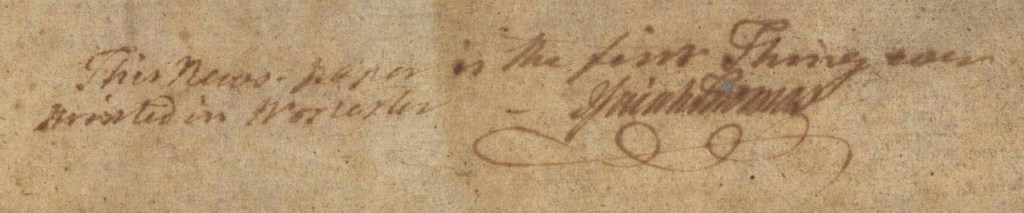
In his notice, Thomas reported that first he sent his “Printing Utensils” to Worcester and then “escaped myself from Boston on the memorable 19th of April, 1775, which will be remembered in the future as the Anniversary of the BATTLE of LEXINGTON!”  Elsewhere that first issue published in Worcester, Thomas provided a chronicle of the battle “collected from those whose veracity is unquestioned.”  That narrative likely incorporated elements drawn from the printer’s own firsthand account.  Several years later, he recorded that at daybreak on April 19 he “crossed from Boston over to Charlestown in a boat with Dr. Joseph Warren, went to Lexington, and joined the provincial militia in opposing the king’s troops.”[2]  The following day, went to Worcester to open the printing office and revive his newspaper.  He was proud of that work and the service he provided, making a note and signing his name in the margin at the bottom of the first page of the first issue published there: “This News-paper is the first Thing ever printed in Worcester – Isaiah Thomas.”

Massachusetts Spy (May 3, 1775). Courtesy American Antiquarian Society.

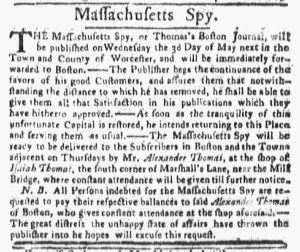
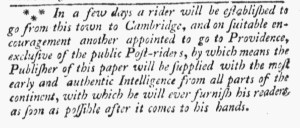
Having installed himself in that town, he made clear his purpose in publishing the Massachusetts Spy as such momentous events occurred.  He pledged to give “the utmost of my poor Endeavours … to maintain those Rights and Priviledges for which we and our Fathers have bled!”  To that end, he would “procure the most interesting and authentic Intelligence” to keep his readers in central Massachusetts and beyond informed of the latest news.  In addition, he called on “all the Friends to our righteous Cause” to aid in circulating the Massachusetts Spy.  Many had already enlisted in that endeavor, serving as local agents who collected the names of subscribers and forwarded them to the printing office.  In revised proposals that ran immediately below Thomas’s notice, he listed associates who accepted subscriptions in nearly three dozen towns in Worcester County and indicated that “many other Gentlemen in several parts of the province” did as well.

Of the five newspapers published in Boston at the beginning of April 1775, the Massachusetts Spy was the first to suspend publication, the decision resulting from Thomas leaving town rather than the outbreak of hostilities at Lexington and Concord.  It was also the first to resume circulating weekly issues on a regular schedule, a result of the printer’s foresight in relocating to Worcester.  Some of the other newspapers folded completely, but the Massachusetts Spy continued throughout the war and well beyond.

Massachusetts Spy (May 3, 1775). Courtesy American Antiquarian Society.

Click here to view the entire May 3, 1775, edition of the Massachusetts Spy, including Thomas’s note on the first page and the account of the Battle of Lexington on the third page.  That copy is in the collections of the American Antiquarian Society, founded by Thomas in 1812.

**********

[1] Isaiah Thomas, The History of Printing in America: With a Biography of Printers and an Account of Newspapers (1810; New York: Weathervane Books, 1970), 168

[2] Thomas, History of Printing, 168-9.

April 17

What was advertised in a colonial American newspaper 250 years ago today?

Boston Evening-Post (April 17, 1775).

“THE Massachusetts Spy … will be published … in the Town and County of Worcester.”

Isaiah Thomas published the last issue of the Massachusetts Spy in Boston on April 6, 1775.  Eleven days later, advertisements in the Boston Evening-Post and the Massachusetts Gazette and Boston Post-Boy informed readers that the “Massachusetts Spy, or Thomas’s Boston Journal, will be published on Wednesday the 3d Day of May next in the Town and County of Worcester, and will be immediately forwarded to Boston.”  Why did Thomas suddenly suspend publishing the Massachusetts Spy, founded in 1770, and relocate to Worcester with plans to revive the newspaper there?

In his History of Printing in America, published in 1810, Thomas declared, “It became at length apparent to all reflecting men that hostilities must soon take place between Great Britain and her American colonies.”  Through the editorial stance he took in the Massachusetts Spy, the patriot printer “had rendered himself very obnoxious to the friends of the British administration; and, in consequence, the tories, and some of the British soldiery in the town, openly threatened him with the effects of their resentment.”  Along with other residents of Boston, Thomas had endured all sorts of “Distresses,” as he called them, following the closure of the harbor in retaliation for the destruction of the tea, but now his own safety was at stake.  “For these and other reasons, he was induced to pack up, privately, a press and types, and to send them in the night over the Charles river to Charlestown, whence they were conveyed to Worcester.”  Thomas was smart with his timing for getting out of Boston: “This was only a few days before the affair at Lexington.”[1]  The printer smuggled a press out of Boston just before the Revolutionary War began with the skirmishes at Lexington and Concord followed by the siege of Boston.

Near the end of February, the Massachusetts Spy carried subscription proposals for a “New Weekly NEWS-PAPER … To be entitled, The WORCESTER GAZETTE.”  Thomas had made arrangements with “a number of gentlemen in the county of Worcester, zealously engaged in the cause of the country … to open a printing house, and to publish a newspaper there, in the course of the ensuing spring.”  It would be the town’s first printing office and first newspaper.  Thomas planned “to send a press, with a suitable person to manage the concerns of it,” having previously gained experience setting up Henry-Walter Tinges as a junior partner who oversaw their printing office in Newburyport and printed the Essex Journal.  “The war commencing sooner than expected,” however, Thomas “was obliged to leave Boston, and came himself to Worcester, opened a printing house, and on the 3d of May, 1775, executed the first printing done in the town.”[2]

As he prepared to open that printing office, his advertisement in newspapers still published in Boston advised the public that the “Publisher [of the Massachusetts Spy] begs the continuance of the favors of his good Customers, and assures then that notwithstanding the distance to which he has removed, he shall be able to give them all that Satisfaction in his publications which they have hitherto approved.”  Furthermore, he planned to return to Boston “[a]s soon as the tranquility of this unfortunate Capital is restored,” not knowing at the time that he would remain in Worcester after the war ended.  For the moment, he designated a local agent, Alexander Thomas, who oversaw his shop in Boston and saw to the delivery of new issues of the Massachusetts Spy on Thursdays, the day after the printer published them in Worcester.  He also requested that “All Persons indebted for the Massachusetts Spy … pay their respective balances.” Like other printers, Thomas extended credit to his customers, but the “great distress [of] the unhappy state of affairs” made it necessary to call on them to make payment.”  Thomas faced a new chapter, one that the Adverts 250 Projectwill chronicle as it examines advertisements placed in revolutionary American newspapers.

**********

[1] Isaiah Thomas, The History of Printing in America: With a Biography of Printers and an Account of Newspapers (1810; New York: Weathervane Press, 1970), 168.

[2] Thomas, History of Printing, 180-181.

March 17

What was advertised in a colonial American newspaper 250 years ago today?

Massachusetts Gazette and Boston Weekly News-Letter (March 17, 1775).

“AN ORATION … to commemorate the bloody Tragedy of March 5th 1770.”

In the spring of 1771, patriots marked the first anniversary of the “BLOODY TRAGEDY” now known as the Boston Massacre with “AN ORATION Delivered … at the Request of the Inhabitants of the Town of Boston … By JAMES LOVELL.”  That started an annual tradition, with Joseph Warren giving the oration in 1772, Benjamin Church in 1773, and John Hancock in 1774.  Gathering for the oration became an annual ritual.  So did publishing and marketing it.

For the fifth anniversary, the “ORATION … to commemorate the bloody Tragedy of March 5th 1770” was once again “delivered by JOSEPH WARREN.”  Less than two weeks later, advertisements in the March 17 edition of the Massachusetts Gazette and Boston Weekly News-Letter informed readers where they could acquire copies.  One indicated that Benjamin Edes and John Gill, the printers of the Boston-Gazette, sold the oration, implying that they also published it.  According to the imprint, Edes and Gill printed the address in partnership with Joseph Greenleaf, the proprietor of the Royal American Magazine.

Another advertisement gave readers another option: “In the MASSACHUSETTS SPY, of this Day is published, the WHOLE of the ORATION, delivered by JOSEPH WARREN, Esq; on March 6th , 1775, to commemorate the bloody Tragedy of March 5th, 1770.”  Isaiah Thomas, the printer of the Massachusetts Spy, did indeed devote three of the four columns of the third page of his newspaper to Warren’s oration.  In an introduction, he reported that it was “this day published, in a pamphlet” and available for sale in addition to appearing in the newspaper.  The printer offered multiple ways for readers to engage with the oration.  He (and Edes and Gill and Greenleaf) also offered consumers an opportunity to purchase a commemorative item.  Readers who previously purchased the orations by Lovell, Warren, Church, and Hancock on previous anniversaries may have been motivated to add to their collections.

The printer of the Massachusetts Gazette and Boston Weekly News-Letter gave the advertisements a privileged place, likely intended to increase the chances that readers took note of them.  They appeared one after the other immediately after the weekly account of local marriages and deaths.  That meant that the advertisements served as a transition between news items and paid notices.  Readers who perused the news yet merely glanced through the advertisements may have been more likely to take note of these first notices as they realized that the remainder of the page featured advertising.  A manicule also helped call attention to them, signaling their importance in a town experiencing the distresses of the Boston Port Act and the other Coercive Acts.

February 23

What was advertised in a colonial American newspaper 250 years ago today?

Massachusetts Spy (February 23, 1775).

“A New Weekly NEWS-PAPER … The WORCESTER GAZETTE; OR, AMERICAN ORACLE of LIBERTY.”

Among the advertisements in the February 23, 1775, edition of the Massachusetts Spy appeared “PROPOSALS For … A New Weekly NEWS-PAPER … To be entitled, The WORCESTER GAZETTE; OR, AMERICAN ORACLE of LIBERTY.”  That newspaper would commence publication in Worcester, about forty miles west of Boston, “as soon as Seven Hundred Subscribers have entered their names.”  It would be the first newspaper published in that town, giving residents greater access to “the most early and authentic Intelligence, and such Political Essays, as are worthy of Public notice, with other matters interesting and entertaining.”

In his History of Printing in America (1810), Isaiah Thomas explained, “In 1774, a number of gentlemen in the county of Worcester, zealously engaged in the cause of the country, were from the then appearance of public affairs, desirous to have a press established in Worcester.”  In other words, supporters of the patriot cause wanted a local newspaper instead of relying on newspapers published in Boston, Salem, Newburyport, Providence, Portsmouth, Norwich, and Hartford.  Although newspapers from each of those towns served readers in larger, overlapping regions, Patriots in Worcester believed that a local newspaper would both serve their community and strengthen their position.  By the time they “applied to a printer in Boston” in December 1774, the “Worcester Revolution” had already closed the courts and removed British authority from that town.  Thomas, that printer in Boston, “engaged to open a printing house, and to publish a newspaper there, in the course of the ensuing spring.”  He initially intended to follow a model like the one for establishing the Essex Journal in partnership with Henry-Walter Tinges in Newburyport.  Tinges, the junior partner, managed the printing office there while Thomas remained in Boston.  As part of his preparations, Thomas published the proposals for the Worcester Gazette as he worked on recruiting “a suitable person to manage the concerns of it.” However, when the Revolutionary War began with the Battles of Lexington and Concord on April 19, Thomas “was obliged to leave Boston, and came himself to Worcester” and became the city’s first printer.[1]

When Thomas disseminated the first issue on May3, he combined the name of the newspaper he published in Boston for several years, the Massachusetts Spy, and the intended name for the new newspaper, calling it the Massachusetts Spy or American Oracle of Liberty.  As outlined in the proposals from February, he published the newspaper “every WEDNESDAY Morning, as early as possible” so it could be “delivered to the Subscribers in Worcester at their houses, and sent by the first opportunity to such as are at a greater distance.”  The annual subscription fee in the colophon matched the proposals, “Six Shillings and Eight Pence per annum, the same as the Boston news-papers.”  The colophon did not list rates for advertising, though the proposals stated that they would be “inserted in a neat and conspicuous [manner], at the same rates as they are in Boston.”  Little did Thomas know when he published the “PROPOSALS [for] The WORCESTER GAZETTE” in February 1775 that he would soon relocate to that town and become one of its most prominent residents, establishing the first printing office and, eventually, founding the American Antiquarian Society in 1812.

**********

[1] Isaiah Thomas, The History of Printing in America: With a Biography of Printers and an Account of Newspapers (1810; New York: Weathervane Books, 1970), 180-181.

February 19

What was advertised in a colonial American newspaper 250 years ago this week?

Massachusetts Spy (February 16, 1775).

“THE PETITION of the American Continental Congress, to the KING.”

In February 1775, Isaiah Thomas, printer of the Massachusetts Spy, published and advertised “THE PETITION of the American Continental Congress, to the KING.”  During its meetings in Philadelphia in September and October 1774, the delegates to the First Continental Congress drafted several documents.  Almost as soon as they adjourned, William Bradford and Thomas Bradford, printers of the Pennsylvania Journal, advertised “EXTRACTS FROM THE VOTES AND PROCEEDINGS OF THE AMERICAN CONTINENTAL CONGRESS.”  Over the next several weeks, printers in towns throughout the colonies published local editions to supplement coverage in their newspapers.  By the end of November, the Bradfords published a more complete “JOURNAL OF THE PROCEEDINGS OF THE CONGRESS Held at PHILADELPHIA,” though not as many printers issued local editions of that pamphlet.  After all, the Extracts already contained “The BILL of RIGHTS; a List of GRIEVANCES; occasional RESOLVES; the ASSOCIATION; and ADDRESS to the people of Great-Britain; and a MEMORIAL to the Inhabitants of the British American Colonies.”

Yet neither the Extracts nor the Proceedings included all the work undertaken by the First Continental Congress.  In his advertisement, Thomas asserted that he published the Petition “For the benefit of those who have purchased the Votes and Proceedings of the Continental Congress, or the Extracts therefrom, as it is inserted in neither of said Pamphlets.”  He encouraged colonizers to complete their collections of these important documents.  As part of that marketing strategy, he noted that he printed the Petition “in a Pamphlet that it may be either bound of stitched up with the Votes and Proceedings.”  Buyers had the option to collect the several pamphlets together under a single cover, though few seem to have done so.  In a description of the copy now in the collections of the Princeton University Library, the William Reese Company declared, “We can locate only three copies of this rarity, those at the Library of Congress, Massachusetts Historical and American Antiquarian Society.”  That colonizers did not bind the Petition with other pamphlets, however, does not necessarily mean that they did not purchase or read it.  Thomas described the Petition as “Worthy the perusal of his Majesty and every subject in his dominions.”  As the imperial crisis intensified in the winter and spring of 1775, readers may have been eager to consume as much as they could about the positions taken by the First Continental Congress, including this eight-page pamphlet for “two coppers.”  In an advertisement for another political pamphlet claimed that such a “small price” made it affordable to “every person who is desirous” of reading about “our political Controversy.”

January 22

What was advertised in a colonial American newspaper 250 years ago this week?

Massachusetts Spy (January 19, 1775).

“No ADVERTISEMENTS … can be inserted for the future without the Cash accompanies them.”

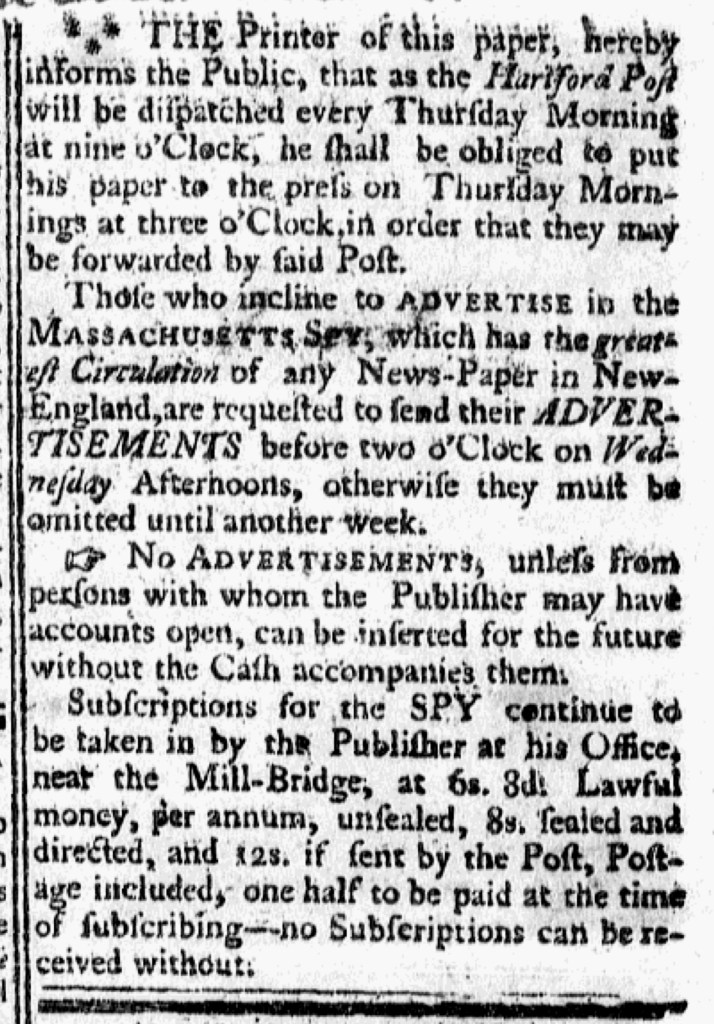
In a notice in the January 19, 1775, edition of the Massachusetts Spy, Isaiah Thomas, the printer, provided several important details about the practices he enacted for publishing his newspaper.  He opened by noting that “the Hartford Post will be dispatched every Thursday Morning at nine o’Clock.”  In order that that the Massachusetts Spy “may be forwarded by said Post,” Thomas “shall be obliged to put his paper to the press on Thursday Mornings at three o’Clock.”  Calling attention to such early mornings not only testified to the industriousness of the printer but also alerted the public that he could publish updates that arrived at his printing office merely hours before he distributed the new issue of his weekly newspaper.

Thomas also advised “[t]hose who incline to ADVERTISE in the MASSACHUSETTS SPY … to send their ADVERTISEMENTS before two o”Clock on Wednesday Afternoons, otherwise they must be omitted until another week.”  To convince them to advertise in in his newspaper, he proclaimed that it “has the greatest Circulation of any News-Paper in New-England.”  That meant that advertisers were likely to experience the greatest return on their investment by placing notices in the pages of the Massachusetts Spy.  Although compositors worked quickly, they did need some time to set type for individual advertisements and lay out all the news, editorials, advertisements, and other content for each issue.  While Thomas might welcome “Articles of Intelligence” that arrived very shortly before taking his newspaper to press, he insisted that advertisements required more time to prepare for publication.  Advertisers needed to plan accordingly.

In addition, Thomas declared, “No ADVERTISEMENTS, unless from persons with whom the Publisher may have accounts open, can be inserted for the future without the Cash accompanies them.”  He also asserted that subscriptions for the newspaper required “one half [of the annual fee] to be paid time of subscribing” and “no Subscriptions can be received without.”  Historians of the early American press often make general statements about printers extending generous credit to subscribers, expecting that some would never pay, because they understood that newspaper advertisements were a much more most significant revenue.  According to such accounts, printers supposedly insisted on receiving payment for advertisements in advance of publishing them.  While that may have been the case in some printing offices, several printers published notices indicating that they departed from such practices.  That Thomas put in place such a policy “for the future” suggests that it may have been a new policy or one that he had not previously enforced.  Similarly, Thomas joined other printers who extended credit yet also demanded that subscribers submit half of the annual fee in advance, updating the terms that he published in the colophon that appeared in each issue of the Massachusetts Spy.

Happy Birthday, Isaiah Thomas!

Isaiah Thomas, patriot printer and founder of the American Antiquarian Society, was born on January 19 (New Style) in 1749 (or January 8, 1748/49, Old Style).  It’s quite an historical coincidence that the three most significant printers in eighteenth-century America — Benjamin Franklin, Isaiah Thomas, and Mathew Carey — were all born in January.

isaiah_thomas1818
Isaiah Thomas (January 30, 1739 – April 4, 1831). American Antiquarian Society.

The Adverts 250 Project is possible in large part due to Thomas’s efforts to collect as much early American printed material as he could, originally to write his monumental History of Printing in America.  The newspapers, broadsides, books, almanacs, pamphlets, and other items he gathered in the process eventually became the initial collections of the American Antiquarian Society.  That institution’s ongoing mission to acquire at least one copy of every American imprint through 1876 has yielded an impressive collection of eighteenth-century advertising materials, including newspapers, magazine wrappers, trade cards, billheads, watch papers, book catalogs, subscription notices, broadsides, and a variety of other items.  Exploring the history of advertising in early America — indeed, exploring any topic related to the history, culture, and literature of early America at all — has been facilitated for more than two centuries by the vision of Isaiah Thomas and the dedication of the curators and other specialists at the American Antiquarian Society over the years.

Thomas’s connections to early American advertising were not limited to collecting and preserving the items created on American presses during the colonial, Revolutionary, and early national periods.  Like Mathew Carey, he was at the hub of a network he cultivated for distributing newspapers, books, and other printed goods — including advertising to stimulate demand for those items.  Sometimes this advertising was intended for dissemination to the general public (such as book catalogs and subscription notices), but other times it amounted to trade advertising (such as circular letters and exchange catalogs intended only for fellow printers, publishers, and booksellers).

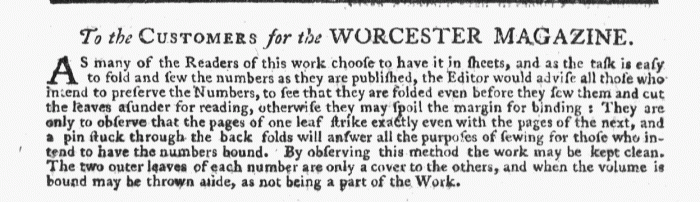
Thomas also experimented with advertising on wrappers that accompanied his Worcester Magazine, though he acknowledged to subscribers that these wrappers were ancillary to the publication:  “The two outer leaves of each number are only a cover to the others, and when the volume is bound may be thrown aside, as not being a part of the Work.”[1]

jan-30-worcerster-magazine-april-1786
Detail of Advertising Wrapper, Worcester Magazine (Second Week of April, 1786).

Thomas’s patriotic commitment to freedom of the press played a significant role in his decision to develop advertising wrappers.  As Thomas relays in his History of Printing in America, he discontinued printing his newspaper, the Massachusetts Spy, after the state legislature passed a law that “laid a duty of two-thirds of a penny on newspapers, and a penny on almanacs, which were to be stamped.”  Such a move met with strong protest since it was too reminiscent of the Stamp Act imposed by the British two decades earlier, prompting the legislature to repeal it before it went into effect.  On its heels, however, “another act was passed, which imposed a duty on all advertisements inserted in the newspapers” printed in Massachusetts.  Thomas vehemently rejected this law as “an improper restraint on the press. He, therefore, discontinued the Spy during the period that this act was in force, which was two years. But he published as a substitute a periodical work, entitled ‘The Worcester Weekly Magazine,’ in octavo.”[2] This weekly magazine lasted for two years; Thomas discontinued it and once again began printing the Spy after the legislature repealed the objectionable act.

jan-30-advertising-wrapper-worcester-magazine-4th-week-may-1786
Third Page of Advertising Wrapper, Worcester Magazine (Fourth Week of May, 1786).

Isaiah Thomas was not interested in advertising for its own sake to the same extent as Mathew Carey, but his political concerns did help to shape the landscape of early American advertising.  Furthermore, his vision for collecting American printed material preserved a variety of advertising media for later generations to admire, analyze, ponder, and enjoy.  Happy 276th birthday, Isaiah Thomas!

**********

[1] Isaiah Thomas, “To the CUSTOMERS for the WORCESTER MAGAZINE,” Worcester Magazine, wrapper, second week of April, 1786.

[2] Isaiah Thomas, The History of Printing in America: With a Biography of Printers, and an Account of Newspapers, vol. 2 (Worcester, MA: Isaac Sturtevant, 1810), 267-268.

November 17

What was advertised in a colonial American newspaper 250 years ago today?

Massachusetts Spy (November 17, 1774).

“To the whole is added, The ASSOCIATION of the Grand AMERICAN CONGRESS.”

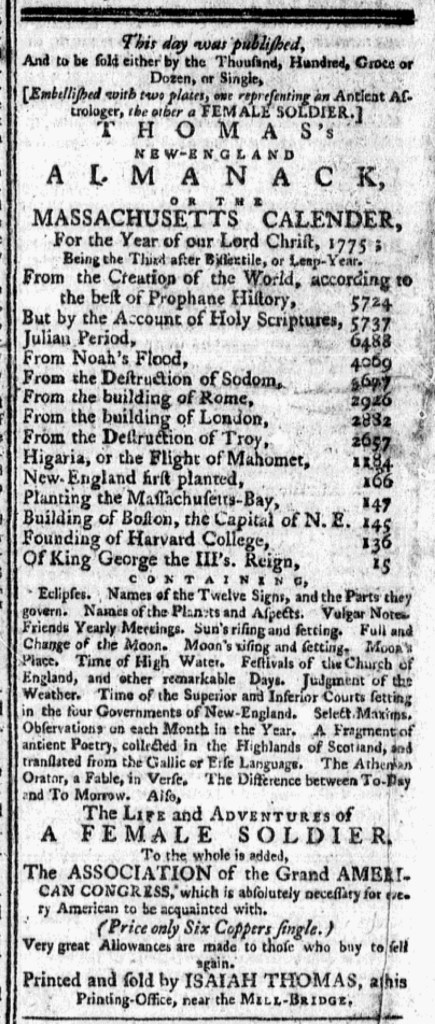
Like many colonial printers, Isaiah Thomas generated significant revenue from publishing almanacs.  From the most affluent to the most humble households in port cities and in the countryside, each year colonizers acquired these handy reference manuals that included all kinds of information.  Thomas’s “NEW-ENGLAND ALMANACK, OR THE MASSACHUSETTS CALENDER, For the Year of our Lord Christ, 1775,” for instance, had everything from the tides or “Time of High Water” to a schedule of “the Superior and Inferior Courts setting in the four Governments of New-England” to poetry.  Thomas “Embellished” the almanac with two images, “one representing an Antient Astrologer, the other a FEMALE SOLDIER.”  The latter corresponded to the “LIFE and ADVENTURES of A FEMALE SOLDIER” that the printer promoted among the content of his almanac.  Practically every almanac included the tides and many listed the dates for important meetings in Connecticut, Massachusetts, New Hampshire, and Rhode Island, so Thomas and other printers sought ways to distinguish their almanacs from others, including images and novel stories.

Thomas anticipated doing brisk business with the contents that he selected for his almanac.  He announced that he sold it “by the Thousand, Hundred, Groce or Dozen, or Single,” offering peddlers, booksellers, and shopkeepers the opportunity to purchase in volume for resale.  A single copy cost “Six Coppers,” yet Thomas promised that “Very great Allowances are made to those who buy to sell again.”  In addition to turning a profit on his almanac, this patriot printer also wanted it disseminated widely because of a particular item that he inserted among the contents.  His almanac included “The ASSOCIATION of the Grand AMERICAN CONGRESS.”  He referred to the Continental Association, a nonimportation agreement recently adopted by the First Continental Congress when it met in Philadelphia in September and October 1774.  The inclusion of the Continental Association distinguished Thomas’s almanac from others advertised in the same issue of the Massachusetts Spy, including “BICKERSTAFF’S BOSTON ALMANACK” published by Nathaniel Mills and John Hicks and “LOW’S ALMANACK” published by John Kneeland.  That newspaper also featured advertisements for two different editions of “EXTRACTS from the Votes and Proceedings of the American Continental CONGRESS,” which included the Continental Association.  Whether or not readers happened to purchase that political pamphlet, Thomas provided easy access to what they needed to know about the nonimportation agreement in an almanac that they would consult for a variety of purposes throughout the coming year.  He asserted that the Continental Association “is absolutely necessary for every American to be acquainted with” … and since so many colonizers already planned to purchase an almanac for 1775 they might as well become acquainted with the Continental Association by purchasing Thomas’s almanac, the one that he sought to distribute “by the Thousand, Hundred, Groce or Dozen” to get into as many households as possible.

September 26

What was advertised in a colonial American newspaper 250 years ago today?

Boston Evening-Post (September 26, 1774).

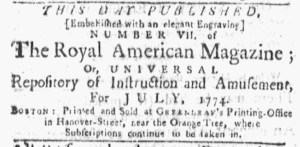
“NUMBER VII. of The Royal American Magazine.”

The Royal American Magazine experienced a disruption in publication during the summer of 1774.  In a notice in the June issue, Isaiah Thomas, the founder of the magazine, reported that the “Distresses of the Town of Boston” that resulted from the Boston Port Act forced him to suspend publication for a few months.  He hoped to resume once “the Affairs of this Country are a little better settled.”  Not long after making that announcement, however, he took to the pages of his own newspaper, the Massachusetts Spy, to inform subscribers and the public that he transferred the magazine to Joseph Greenleaf.  An address from Greenleaf appeared immediately below Thomas’s advertisement.  They were the latest entries in a marketing campaign that commenced when Thomas first revealed his intention to circulate subscription proposals in May 1773 and subsequent newspaper advertisements in June, July, August, September, October, November, and December 1773 and January, February, March, April, May, and June 1774.  The “Distresses” meant no newspaper advertisements for the magazine in July 1774, but they resumed with the notices from Thomas and Greenleaf in August.

Those notices each made four more appearances in September.  Not surprisingly, the Massachusetts Spy accounted for three of them.  For four weeks, Thomas used his own newspaper to advise subscribers and others of the change in publisher for the magazine.  The companion notices also ran once in the Boston Evening-Post on September 5.  Greenleaf’s address indicated that the July issue of the magazine “is now in the Press, and will be published without Delay.”  On September 15, the last day that they ran in the Massachusetts Spy, that newspaper also carried a new advertisement from Greenleaf, one that declared, “THIS DAY PUBLISHED … NUMBER VII. of The Royal American Magazine.”  The July issue finally became available in September!  Greenleaf’s advertisement was brief and restrained compared to many that Thomas had inserted.  It stated that the issue was “Embellished with an elegant Engraving,” but did not give a description or even a name for Paul Revere’s engraving of “Spanish Treatment at Carthagena,” nor did the advertisement incorporate an extensive list of the contents to entice readers.  Instead, it succinctly noted that the magazine was “Printed and Sold at GREENLEAF’S Printing-Office … where Subscriptions continue to be taken in.” The new publisher hoped to expand the magazine’s circulation despite a less ambitious advertising strategy than Thomas sometimes deployed.  The announcement about the July issue ran only once in the Massachusetts Spy.  It appeared in the Boston Evening-Post for the first time in its next edition four days later and again the following week.  Amid the “Distresses of the Town of Boston,” Greenleaf’s first issue of the Royal American Magazine had less fanfare than many of the issues that Thomas published.

**********

To the Subscribers of the ROYAL AMERICAN MAGAZINE”

  • September 1 – Massachusetts Spy (second appearance)
  • September 5 – Boston Evening-Post (first appearance)
  • September 8 – Massachusetts Spy (third appearance)
  • September 15 – Massachusetts Spy (fourth appearance)

“To the PUBLIC, and in particular to the Subscribers”

  • September 1 – Massachusetts Spy (second appearance)
  • September 5 – Boston Evening-Post (first appearance)
  • September 8 – Massachusetts Spy (third appearance)
  • September 15 – Massachusetts Spy (fourth appearance)

“THIS DAY PUBLISHED … NUMBER VII”

  • September 15 – Massachusetts Spy (first appearance)
  • September 19 – Boston Evening-Post (first appearance)
  • September 26 – Boston Evening-Post (second appearance)

August 28

What was advertised in a colonial American newspaper 250 years ago this month?

Massachusetts Spy (August 25, 1774).

“Suspend the Publication of the Magazine for a few Months.”

For more than a year, the Adverts 250 Project has traced Isaiah Thomas’s advertising campaign for the Royal American Magazine, from his first announcement that he intended to circulate subscription proposals in May 1773 through the notices that ran in newspapers in June, July, August, September, October, November, and December 1773 and January, February, March, April, May, and June 1774.  Last month, I noted that Thomas did not advertise the magazine in July 1774, that the sole marketing effort in the public prints was a poem “From the ROYAL AMERICAN MAGAZINE” that appeared in the “POETS CORNER” in the July 21, 1774, edition of the Massachusetts Spy, the newspaper that Thomas printed.  I also commented that newspaper advertisements do not reveal when the June 1774 issue of the magazine became available to readers.

Further investigation, however, reveals that newspaper advertisements do indeed provide that information.  The June 1774 issue of the Royal American Magazine was not published until August 1774.  Eighteenth-century magazines commonly came out at the end of the month, unlike modern magazines issued in advance of the dates on their covers.  Subscribers would have expected the June issue in late June or early July, but Thomas was more than a month late in distributing it.  He had perpetually been behind the anticipated publication schedule since the first issue.

On Thursday, August 4, the Massachusetts Spy carried a notice that “Saturday next will be published … NUMBER VI. of THE ROYAL American Magazine.”  To promote that issue, Thomas proclaimed that it would be “Embellished with elegant Engravings, I. The able Doctor, or America swallowing the bitter Draught.  II. The Hooded Serpent.”  Paul Revere produced both engravings.  The “Able Doctor,” depicting America personified as an Indigenous woman being held down by members of Parliament and forced to drink tea, protested the Boston Port Act.  It is now considered one of the most important examples of visual propaganda supporting the patriot cause produced during the imperial crisis.

By Monday, Thomas took the overdue issue to press.  The August 8 edition carried a nearly identical advertisement with the headline updated to “THIS DAY PUBLISHED.”  On August 11, an announcement received a prominent place in the Massachusetts Spy, running as the first item in the first column on the first page.  Although delinquent in publishing the June issue, Thomas privileged promoting it when he could finally declare, “This day was published … NUMBER VI. of THE ROYAL American Magazine.”  As he had done with previous issues, Thomas highlighted the engravings and provided a list of the contents to entice readers who were not already subscribers to purchase copies.  The articles included a “Description of the Hooded Serpent” to accompany the second engraving.

The June issue included an address “To the PUBLIC” in which Thomas informed “all those Gentlemen and Ladies, in this and the other Provinces, who have favoured him with their Subscriptions” that current events forced him to suspend publication of the magazine.  “The Distresses of the Town of Boston, by the shutting up of our Port,” Parliament’s response to the Boston Tea Party, had “throw[n] all Ranks of Men into Confusion,” including “those good Gentlemen … who kindly promised to assist the Editor with their various Lucrubrations.”  Thomas had regularly published advertisements seeking original content for the magazine, but now those who had volunteered to contribute had found themselves overcome by other priorities.  As a result, Thomas received “but few original Pieces.”  He could not provide readers with “that Entertainment and Instruction, which they have a Right to expect.”  Accordingly, he planned to suspend publication for a few months “until the Affairs of this Country are a little better settled” and his correspondents could once again turn their attention to supplying the magazine with content.

Not long after subscribers saw that notice in the June issue of the American Royal Magazine, Thomas took to the Massachusetts Spy with a new update on August 25.  He reported that “a Number of Gentlemen have desired that it may not be suspended.”  Not in a position to continue with the magazine at that time, Thomas “agreed with Mr. JOSEPH GREENLEAF, to carry on the Publication.”  He assured subscribers that the new publisher “will continue it to general satisfaction.”  He also instructed them to submit subscription fees for the first six issues to Greenleaf.  A notice from Greenleaf “To the PUBLIC, and in particular to the Subscribers for the ROYAL AMERICAN MAGAZINE” immediately followed.  He pledged to make the magazine “as entertaining and instructive as possible,” yet, like Thomas, needed the “Assistance of the learned and judicious in this and the neighbouring colonies.”  He was on track to make good on his promise to subscribers, declaring that the next issue “is now in the Press, and will be published without Delay.”  In addition, subscribers “may depend upon having the future Numbers published in good Season,” implicitly acknowledging that publication of previous issues had often been deferred longer than anticipated.  The new publisher concluded with a request that current subscriber continue and new subscribers “add their Names,” either at his printing office or with any other printers in Boston.

The suspension could have been the end of the Royal American Magazine, but Greenleaf managed to publish new issues through February 1775.  The Adverts 250 Project will continue to document advertisements for the magazine to compare Greenleaf’s marketing efforts to those of Thomas.

**********

“Saturday next will be published … NUMBER VI.”

  • August 4 – Massachusetts Spy (first appearance)

“THIS DAY PUBLISHED … NUMBER VI.”

  • August 8 – Boston Evening-Post (first appearance)
  • August 15 – Boston Evening-Post (second appearance)

“This day was published … NUMBER VI.” [with list of contents]

  • August 11 – Massachusetts Spy (first appearance)

To the Subscribers of the ROYAL AMERICAN MAGAZINE”

  • August 25 – Massachusetts Spy (first appearance)

“To the PUBLIC, and in particular to the Subscribers”

  • August 25 – Massachusetts Spy (first appearance)