November 23

What was advertised in a revolutionary American newspaper 250 years ago today?
Rivington’s New-York Gazetteer (November 23, 1775).

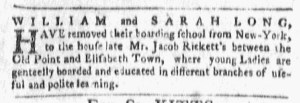
“WILLIAM and SARAH LONG, HAVE removed their boarding school from New-York.”

Late in November 1775, William and Sarah Long placed an advertisement for their boarding school “where young Ladies are genteelly boarded and educated in different branches of useful and polite learning” in the final edition of Rivington’s New-York Gazetteer, though they did not know that it would be the last issue.  They advised prospective students and their parents that they “removed … from New-York, to the house late Mr. Jacob Rickett’s between the Old Point and Elisabeth Town” in New Jersey.  What prompted the Longs to relocate outside the city?  With the siege of Boston continuing, the uncertainty of where and when British soldiers would attempt to assert their authority likely played a role in their decision.  A few months earlier, Andrew Wilson ran an advertisement for his grammar school in Morristown, New Jersey, emphasizing its distance from the coast.  He invoked the “dangerous and alarming times [for] the inhabitants of large cities” and suggested that they “may wish to have their children educated in the interior parts of the country, at a distance from probable, sudden danger and confusion.”  Similar thoughts may have inspired the Longs when they “removed” their school from New York.

On November 27, “sudden danger and confusion” did indeed occur at James Rivington’s printing office on Hanover Square.  Angry with the Tory perspective that Rivington often expressed in his newspaper, the Sons of Liberty attacked his printing office.  It was not the first time, but the damage was much more significant than the previous attack.  The Sons of Liberty destroyed Rivington’s press and type, preventing him from continuing to publish his newspaper or anything else.  The printer decided to leave the city, sailing for London.  He returned in 1777, during the British occupation of New York, and established Rivington’s New-York Gazette.  It continued the numbering of Rivington’s New-York Gazetteer.  That tile lasted for only two issues before he updated it to Rivington’s New York Loyal Gazette for several weeks and then the Royal Gazette throughout the remainder of the war.  Rivington’s newspaper changed names one more time, becoming Rivington’s New-York Gazette for just over a month before ceasing publication with the December 31, 1783, edition.  In his History of Printing in America (1810), patriot printer Isaiah Thomas noted that “for some time Rivington conducted his paper with as much impartiality as most of the editors of that period.”[1]  Adhering to that impartiality longer than other printers contributed to the perception that Rivington favored Tory sentiments when he claimed that he merely exercised freedom of the press.  Earlier in 1775, he advertised “Pamphlets published on both sides, in the unhappy dispute with Great-Britain.”  In addition to the Longs’ advertisement about their boarding school, the final issue of Rivington’s New-York Gazetteer also carried an advertisement for the Constitutional Post Office in New York.  The Second Continental Congress authorized the Constitutional Post as an alternative to the imperial system.

William and Sarah Long and their students “removed” from New York before “sudden danger and confusion” found them.  James Rivington, on the other hand, fled the city after repeated attacks on his printing office made it impossible for him to continue printing his newspaper.

**********

[1] Isaiah Thomas, The History of Printing in America: With a Biography of Printers and an Account of Newspapers (1810; New York: Weathervane Books, 1970), 511.
November 19

What was advertised in a revolutionary American newspaper 250 years ago this week?

Rivington’s New-York Gazetteer (November 16, 1775).

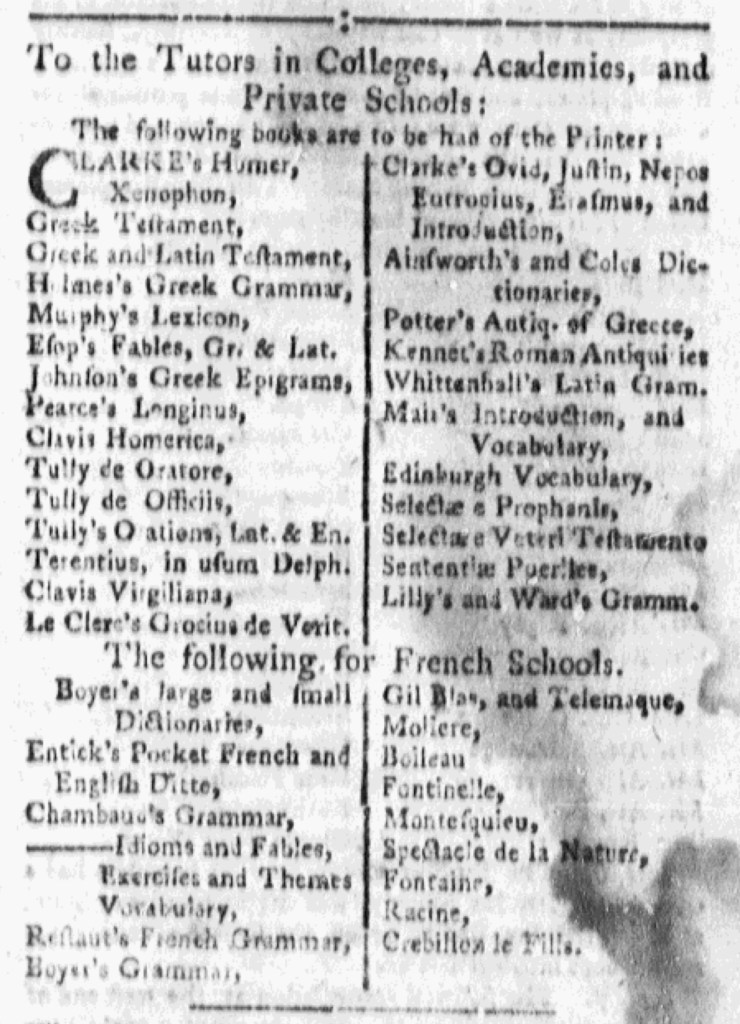
“To the Tutors in Colleges, Academies, and Private Schools.”

James Rivington, the printer of Rivington’s New-York Gazetteer, sold books as an additional revenue stream rather than relying solely on subscriptions and advertisements.  Such was the case with other printers throughout the colonies, their printing offices doubling as bookstores.  Rivington’s newspaper often carried advertisements for books, pamphlets, and almanacs that he stocked.  He printed some of them, acquired others from other colonial printers, and imported most of them from England.  Some advertisements featured a single title.  The November 16, 1775, edition, for instance, featured an advertisement for “A DICTIONARY OF THE Holy Bible” that included the prints, size, and number of volumes along with a description of the contents.  Other advertisements listed multiple titles without providing additional information.

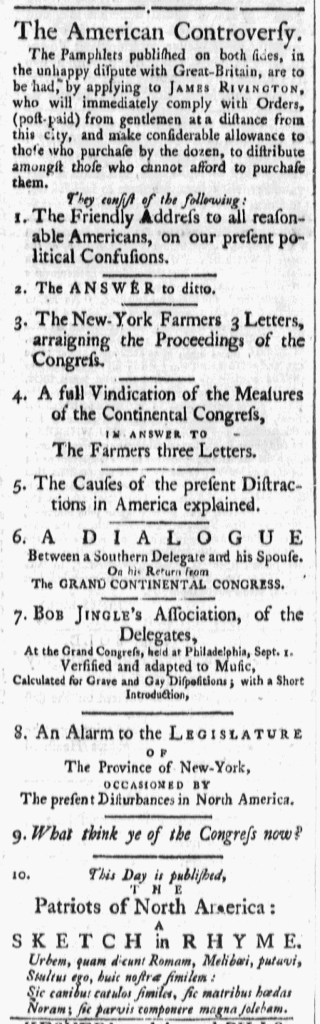
On occasion, Rivington ran advertisements that promoted books and pamphlets with a common theme.  With a headline proclaiming, “The American Controversy,” an advertisement published in February 1775 listed ten pamphlets “published on both sides, in the unhappy dispute with Great-Britain.”  He deployed the same strategy in another notice that ran on November 16, this time addressing “the Tutors in Colleges, Academies, and Private Schools.”  He then gave the titles of more than two dozen books he considered suitable for classrooms, such as “CLARKE’s Homer,” “Greek and Latin Testament,” “Esop’s Fable, Gr[eek] & Lat[in],” “Tully’s Orations, Lat[in] & En[glish],” “Ainsworth’s and Coles Dictionaries,” “Whittenhall’s Latin Gram[mar],” and “Lilly’s and Wards Gramm[ar].”  Rivington implied that those books should have been familiar to tutors.  In addition to those titles, he devoted the final third of the advertisement to books “for French Schools,” including “Boyer’s large and small Dictionaries,” “Entick’s Pocket French and English [Dictionary],” “Chambaud’s Grammar,” “[Chambaud’s] Exercises and Themes,” “Moliere,” and “Montesquieu.”  While Rivington usually marketed most books and pamphlets to general audiences and prospective customers of all backgrounds, especially when his advertisements consisted of catalogs of books available at his printing office, he occasionally attempted to boost sales by directing particular kinds of readers to carefully curated lists of titles.  In this case, tutors and schoolmasters did not need to pore over lengthy lists of books and pamphlets not relevant or not appropriate to their lessons when Rivington presented a specialized catalog for their convenience.

October 5

What was advertised in a revolutionary American newspaper 250 years ago today?

Rivington’s New-York Gazetteer (October 5, 1775).

“THE Speeches of EDMUND BURKE, Esq; on American Taxation.”

James Rivington did not know it when he published the October 5, 1775, edition, nor did readers and the rest of the community, but he would soon discontinue printing Rivington’s New-York Gazetteer.  With hindsight, we know that less than two months later, on November 27, the Sons of Liberty would attack his printing office and destroy his press and type “because of his pronounced Tory sentiments.”[1]  It was not the first time.  His home and printing office had been attacked the previous May.  For a few weeks, he had sought refuge on a British ship in the harbor.  He had been hung in effigy.  After all that, the November 23, 1775, edition would be the last issue of Rivington’s New-York Gazetteer that he would print before departing for London.  The printer returned to New York in 1777, during the British occupation, and established Rivington’s New-York Loyal Gazette.  Today, historians consider it possible that Rivington spied on behalf of the American cause, but that would not have been public knowledge in the 1770s.

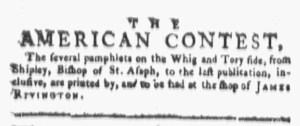
What was public knowledge was that the masthead of Rivington’s New-York Gazetteer featured the seal of Great Britain at a time when the mastheads for other newspapers did not have an image or chose some other device.  The “UNITE OR DIE” political cartoon depicting a severed snake, each segment representing a colony, even appeared in the masthead of the Pennsylvania Journal.  A few other newspapers did continue to include the seal of Great Britain in their masthead, but the printers did not have the same history of expressing positions that supported the officials considered enemies of American liberties.  Even with the seal of Great Britain in the masthead, the October 5, 1775, edition of Rivington’s New-York Gazetteer included an advertisement for “THE Speeches of EDMUND BURKE, Esq; on American Taxation, delivered April 19, 1774” and “His Speech on Moving his Resolutions of Conciliation with the Colonies, March 22d, 1775.”  Rivington printed and sold both speeches by a member of Parliament considered a friend to America.  The printer had a history of marketing “pamphlets on the Whig and Tory side” of “The American Controversy” and arguing for freedom of the press when it came to the contents of his newspaper and other items he printed and sold.  After the battles at Lexington and Concord, however, he discontinued advertising pamphlets that expressed the Tory perspective.  The advertisement for Burke’s speeches, pamphlets that he printed as well as promoted, starkly presented only one side of “THE AMERICAN CONTEST.”  Rivington seemingly changed his advertising strategy as the political situation in the colonies intensified once hostilities commenced in Massachusetts.

**********

[1] Clarence S. Brigham, History and Bibliography of American Newspapers, 1690-1820 (Worcester: American Antiquarian Society, 1947), 686.

October 2

What was advertised in a revolutionary American newspaper 250 years ago today?

Dunlap’s Pennsylvania Packet (October 2, 1775).

“THE SPEECH of EDMUND BURKE, Esq; on moving his Resolutions for Conciliation with the Colonies.”

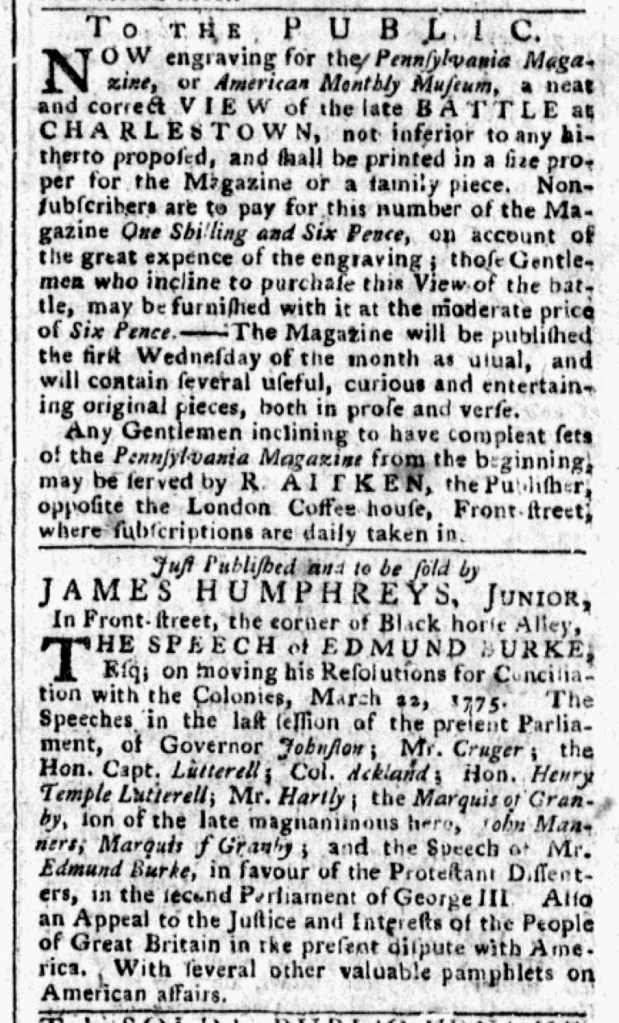
Interest in current events continued to influence some of the products advertised to colonial consumers in the October 2, 1775, edition of Dunlap’s Pennsylvania Packet.  Robert Aitken once again ran his advertisement promoting a “neat and correct VIEW of the late BATTLE at CHARLESTOWN,” now known as the Battle of Bunker Hill.  Subscribers to the Pennsylvania Magazine would receive the print as a premium, while others could purchase it separately.

Immediately below Aitken’s advertisement, James Humphreys, Jr., announced that he sold “THE SPEECH of EDMUND BURKE, Esq; on moving his Resolutions for Conciliation with the Colonies, March 22, 1775.”  In that speech, delivered less than a month before the battles at Lexington and Concord, Burke presented peace and strengthening ties with the colonies as preferable to war.  The colonies, after all, were an important market for British goods.  Burke proposed allowing the colonies to elect their own representatives to send to Parliament as well as establishing a General Assembly with the authority to regulate taxes that would meet in the colonies.  By that time, colonizers already recognized Burke as a friend and advocate for their cause.  In April 1774, he had delivered a speech in favor of repealing duties on tea.

Humphreys also advertised a collection of speeches made “in the last session of the present Parliament” by “Governor Johnston; Mr. Cruger; the Hon. Capt. Lutterell; Col. Ackland,” and several others.  That anthology included another speech by Burke, that one “in favour of the Protestant Dissenters” and religious liberty from 1773 during “the second Parliament of George III.”  In addition, Humphreys stocked an “Appeal to the Justice and Interests of the People of Great Britain in the present dispute with America” by Arthur Lee, born in Virginia yet serving as an agent for Massachusetts in London in 1775.  Humphreys concluded with a note that he also sold “several other valuable pamphlets on American affairs.”  He most likely marketed American editions published by James Rivington, the printer of Rivington’s New-York Gazetteer often derided as a Tory who supported Parliament.  Yet Rivington printed, advertised, and disseminated pamphlets representing a range of views, considering each of them opportunities to generate revenue.  Among the “valuable pamphlets” that Humphreys named in his advertisement, he selected only those that supported the American cause, though he may have made a broader range of perspectives available without listing them in the public prints.  Whatever the case, he anticipated that pamphlets about current events would attract customers.

May 20

What was advertised in a revolutionary American newspaper 250 years ago today?

Pennsylvania Ledger (May 20, 1775).

“POLITICAL PAMPHLETS, ON Both Sides of the Question.”

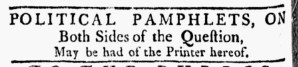
When he launched the Pennsylvania Ledger in the winter of 1775, James Humphreys, Jr., distributed proposals declaring that it would be a “Free and Impartial News Paper, open to All, and Influenced by None.”  With high hopes for operating an impartial press as the imperial crisis intensified, he soon advertised “POLITICAL PAMPHLETS … on Both Sides of the Question” in February 1775.  Several months later, he ran a notice advising that “POLITICAL PAMPHLETS, ON Both Sides of the Question, May be had of the Printer hereof” in the May 20 edition.  Doing so required both courage and commitment, especially considering recent events.

Humphreys published that advertisement a month after the battles at Lexington and Concord.  The siege of Boston continued, yet he did not allow news of the battles or the siege to dissuade him from hawking pamphlets on “Both Sides of the Question.”  Perhaps more significantly, James Rivington, the printer who also published pamphlets “on both sides, in the unhappy dispute with Great-Britain” at his “OPEN and UNINFLUENCED PRESS” in New York, had been hung in effigy in New Brunswick, New Jersey, by colonizers dissatisfied with what they considered his Loyalist sympathies.  Rivington covered that event in his newspaper, Rivington’s New-York Gazetteer, even including a woodcut depicting the scene.  Given that printers exchanged newspapers with their counterparts in other cities and towns, Humphreys likely read about the effigy; even if he did not, he almost certainly heard about it.  Even more recently, Rivington published a notice in which he acknowledged that “many Publications have appeared from my Press which have given great Offence … to many of my Fellow Citizens,” asserted that “Nothing which I have ever done, has proceeded from any Sentiments in the least unfriendly to the Liberties of this Continent,” and pledged “to conduct my Press upon such Principles as shall not give Offence to the Inhabitants of the Colonies.”  Despite his effort to clarify that he had not pursued a political agenda but instead followed his “duty as a Printer” to encourage “the Liberty of the Press,” the Sons of Liberty attacked his home and office on May 10.  Rivington took refuge on a British naval vessel.  Assistants continued publishing the newspaper, inserting his notice about his true intentions twice more.  Rivington had already discontinued advertising political pamphlets representing both sides of what he had previously called “The American Controversy” and “THE AMERICAN CONTEST.”

Although Humphreys advertised political pamphlets from “Both Sides” on May 20, word of what happened to Rivington may have prompted him to reconsider his courage in the weeks and months that followed.  He discontinued that advertisement.  In the next issue, he marketed only one pamphlet for sale at his printing office, The Group, a satire by Mercy Otis Warren that depicted a “SCENE AT BOSTON.”  That publication unabashedly supported the American cause.  A week later, that advertisement appeared on the first page of the Pennsylvania Ledger (as it had in the May 20 edition that carried the advertisement for political pamphlets on the final page), next to an advertisement for a multi-volume set of Political Disquisitions recommended for “all the friends of Constitutional Liberty, whether Britons or Americans.”  Still, the editorial perspective of the Pennsylvania Ledger, according to Isaiah Thomas, “was under the influence of the British government” and Humphreys eventually “refused to bear arms in favor of his country, and against the government of England.”[1]  He experienced sufficient difficulty that he suspended the newspaper at the end of November 1776.  In May 1775, a year and a half earlier, he grappled with what kinds of publications he would promote among the advertisements in his newspaper, first forging ahead with notices for pamphlets representing multiple perspectives and then emphasizing those that supported the American cause, perhaps doing so in hopes of avoiding the treatment that Rivington received.

**********

[1] Isaiah Thomas, The History of Printing in America: With a Biography of Printers and an Account of Newspapers (1810; New York: Weathervane Books, 1970), 398.

May 11

What was advertised in a revolutionary American newspaper 250 years ago today?

Rivington’s New-York Gazetteer (May 11, 1775).

“Many Publications have appeared from my Press which have given great Offence to the Colonies.”

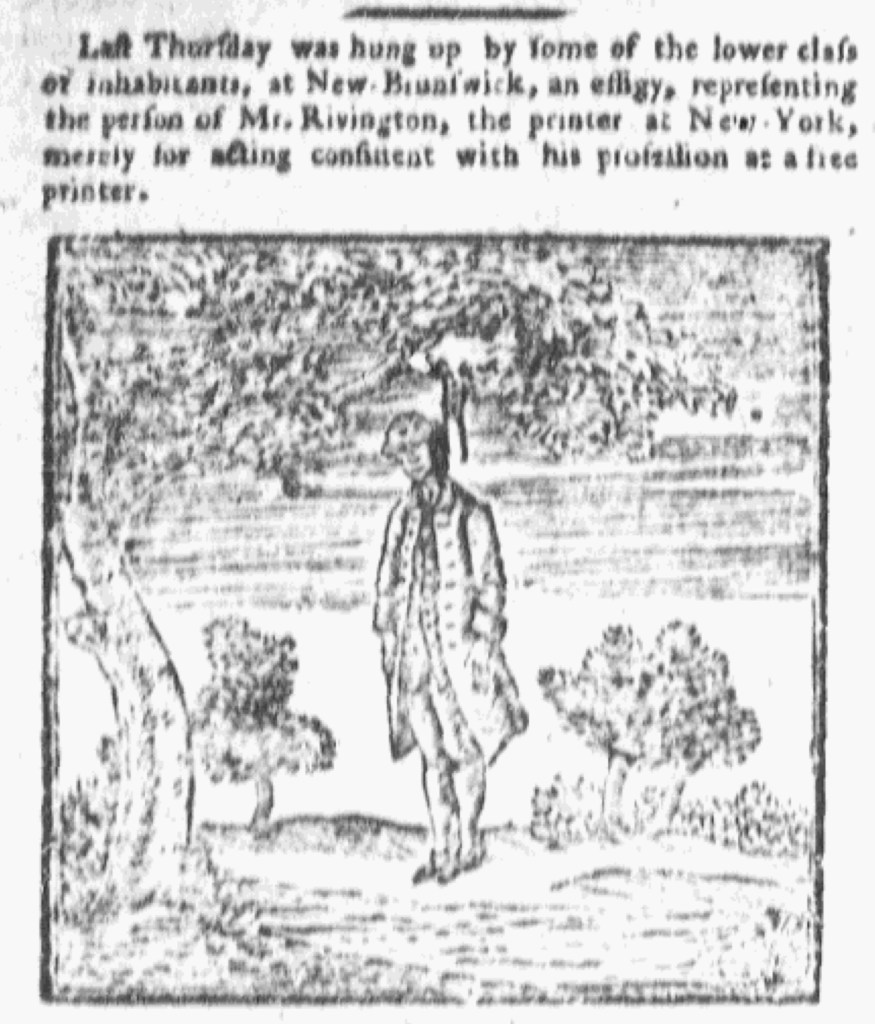
James Rivington seemed to change his tune about what he printed and sold at his printing office on Hanover Square in New York.  On April 20, the day after the battles at Lexington and Concord, the printer of Rivington’s New-York Gazetteer once again advertised “several pamphlets on the Whig and Tory side” of “THE AMERICAN CONTEST.”  Word of what had occurred in Massachusetts the previous day had not yet arrived in New York, but Rivington had other news concerning the imperial crisis to report.  That included residents of New Brunswick, New Jersey, hanging “an effigy, representing the person of Mr. Rivington … merely for acting consistent with his profession as a free printer.”  A rare woodcut depicting the scene accompanied the combination article and editorial about his “OPEN and UNINFLUENCED PRESS.”

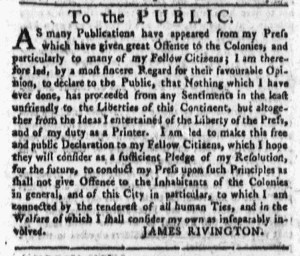
A week later, Rivington’s New-York Gazetteer carried news of Lexington and Concord.  The printer chose not to insert his advertisement hawking pamphlets representing both Whig and Tory perspectives in that issue.  In the next issue, two weeks after the battles in Massachusetts, Rivington ran a new advertisement, one that took a different tone than his coverage of the effigy.  “AS many Publications have appeared from Press which have given great Offence to the Colonies, and particularly to many of my Fellow Citizens,” the printer declared, “I am therefore led, be a most sincere Regard for their favourable Opinion, to declare to the Public, that Nothing which I have ever done, has proceeded from any Sentiments in the least unfriendly to the Liberties of this Continent, but altogether from the Ideas I entertained of the Liberty of the Press, and of my duty as a Printer.”  That being the case, “I am led to make this free and public Declaration to my Fellow Citizens, which I hope they will consider as a sufficient Pledge of my Resolution, for the future, to conduct my Press upon such Principles as shall not give Offence to the Inhabitants of the Colonies in general, and of this City in particular, to which I am connected by the tenderest of all human Ties, and in the Welfare of which I shall consider my own as inseparably involved.”  Rivington stopped short of offering an apology or stating that he regretted printing and selling newspapers and pamphlets that advanced Tory views, but he did take a less defiant tone in his effort to explain his editorial decisions.  He suggested that he would adopt a new approach, though he did not go into detail about that.  Perhaps he hoped that critics would notice that he did not advertise the problematic pamphlets.  Even if they did not, Rivington refrained from publishing an advertisement that ran counter to the message he delivered in his notice clarifying his prior actions.

That notice appeared in three consecutive issues of Rivington’s New-York Gazetteer, none of which carried advertisements for political pamphlets.  The events unfolding in Massachusetts may have encouraged the printer to take greater caution, though the masthead of his newspaper continued to proclaim that he operated an “OPEN and UNINFLUENCED PRESS.”  As far as the Sons of Liberty were concerned, however, the printer could not redeem himself.  On May 10, a week after Rivington first published his notice assuring the public that he would “conduct [his] Press upon such Principles as shall not give Offence to the Inhabitants of the Colonies,” the Sons of Liberty attacked his home and printing office.  Rivington fled to a British ship in the harbor.  Assistants maintained uninterrupted publication of the newspaper, continuing to run Rivington’s notice, while the printer petitioned the Second Continental Congress for pardon.  As Todd Andrlik documents, Rivington explained that “however wrong and mistaken he may have been in his opinions, he has always meant honestly and openly to do his duty.”  The Continental Congress forwarded the petition to the New York Provincial Congress.  Rivington received his pardon, but his reformation was not so complete as to avoid further notice from the Sons of Liberty.  In November 1775, Sons of Liberty from New Haven destroyed his press and reportedly melted down his types to make shot, bringing an end to Rivington’s New-York Gazetteer.

April 23

What was advertised in a revolutionary American newspaper 250 years ago this week?

Rivington’s New-York Gazetteer (April 20, 1775).

“Several pamphlets on the Whig and Tory side.”

Many Patriots did not care for the editorial stance that James Rivington took in his newspaper.  They considered him a Loyalist even though he declared in the masthead that he operated an “OPEN and UNINFLUENCED PRESS” that represented all views.  Similarly, he printed, advertised, and sold political pamphlets about “THE AMERICAN CONTEST … on the Whig and Tory side.”  Rivington aimed to keep colonizers informed and intended to generate revenue while doing so, believing that controversy could be good for business during the imperial crisis.

Late in 1774 and throughout the first months of 1775, Rivington regularly ran advertisements that listed the variety of political pamphlets available at his printing office.  He inserted an abbreviated version in the April 20, 1775, edition.  Colonizers in New York had not yet received word of the events at Lexington and Concord the previous morning.  Rivington instead published other news, including a recent instance of “some of the lower class of inhabitants, at New-Brunswick” hanging “an effigy, representing the person of Mr. Rivington … merely for acting consistent with his profession as a free printer.”  He not only covered that story but also illustrated it with a woodcut depicting the effigy hanging from a tree.

Rivington’s New-York Gazetteer (April 20, 1775).

The image almost certainly attracted attention, in part because news items in eighteenth-century newspapers so rarely featured illustrations of any sort.  Elsewhere in the same issue, readers encountered only five other images.  The masthead contained the coat of arms of Great Britain, as usual, and the drop cap for a letter to the editor appeared within a smaller version of the coat of arms.  A stock image of a ship adorned an announcement that the Earl of Dunmore would soon sail for London.  Similarly, a stock image of a horse being led by a man helped promote the stud services of Lath, Match ‘Em, Pilgrim, and Bashaw.  Abraham Delanoy’s woodcut depicting lobster traps was the only other image created to match the content of an advertisement or a news item.

The scarcity of images made the scene of the effigy even more conspicuous.  Rivington wrote a sarcastic description of the event and then affirmed “that his press has been open to publications from ALL PARTIES.”  He challenged “his enemies to produce an instance to the contrary,” noting that he treated his role as printer like “a public office” and reasoned that “every man has a right to have recourse” via his press.  “But the moment he ventured to publish sentiments which were opposed to the dangerous views and designs of certain demagogues,” Rivington asserted, “he found himself held up as an enemy to his country.”  His support for “LIBERTY OF THE PRESS” made him a target for “a most cruel tyranny,” as demonstrated by “very recent transactions” that included the effigy in New Brunswick.  His description of how some Patriots comported themselves along with his insistence on continuing to sell political pamphlets “on the Whig and Tory side” did not endear Rivington to “his enemies.”  Within in a month, a mob of Sons of Liberty would attack his printing office and destroy his press.  Rivington escaped, seeking refuge on a British naval ship in the harbor.

February 9

What was advertised in a colonial American newspaper 250 years ago today?

Rivington’s New-York Gazetteer (February 9, 1774).

“Pamphlets published on both sides, in the unhappy dispute with Great-Britain.”

As the imperial crisis intensified in the winter of 1775, James Rivington continued to print a newspaper “at his OPEN and UNINFLUENCED PRESS” in New York.  He also ran a bookstore, peddling “Pamphlets published on both sides, in the unhappy dispute with Great-Britain.”  Both Patriot and Tory printers professed to operate free presses that delivered news and editorials from various perspectives, yet the public associated most newspapers with supporting one side over the other and even actively advocating for their cause.  Tory printers invoked freedom of the press as a means of justifying their participation in public discourse rather than allowing Patriot printers to have the only say.  When it came to advertising books and pamphlets about current events, Tory printers, especially Rivington, took the more balanced approach.

For Rivington, it was a matter of generating revenue as much as political principle.  He saw money to be made from printing and selling pamphlets about “The American Controversy.”  That was the headline he used for an advertisement that listed ten pamphlets in the February 9, 1775, edition of Rivington’s New-York Gazetteer.  He previously ran a similar advertisement for “POLITICAL PAMPHLETSon the Whig and Tory Side of the Question” and another about “The American Contest” that included some of the same pamphlets as well as others.  In his “American Controversy” advertisement, Rivington once again offered some familiar titles and new ones.  He made clear that the first two represented different positions, “The Friendly Address to all reasonable Americans, on our present political Confusions” and “The ANSWER to ditto,” though he did not indicate which took which side.

The printer positioned this venture as a service that kept the public better informed of the arguments “on both sides.”  He sought to disseminate his pamphlets beyond New York to “gentlemen at a distance from this city,” promising to “immediately comply with Orders.”  In turn, customers could do their part in making the pamphlets available far and wide since Rivington made “considerable allowance” or deep discounts “to those who purchase by the dozen, to distribute amongst those who cannot afford to purchase them.”  Though he portrayed himself as a fair dealer who marketed pamphlets “on both sides,” he did not express any expectation that customers would purchase or distribute both Patriot and Tory pamphlets.  Rivington presented readers with the freedom to consume (and further disseminate) the ideas they wished, seemingly hoping the public would allow him the same freedom in printing the content that he wished.  Whether he was sincere in such idealism or sought to justify printing editorials and pamphlets that many found objectionable, Rivington increasingly ran afoul of Patriots who did not share his outlook on freedom of the press when it came to disseminating news and opinion that favored the Tory side in “the unhappy dispute with Great-Britain.”

January 1

What was advertised in a colonial American newspaper 250 years ago this week?

Rivington’s New-York Gazetteer (December 29, 1774).

“The American Contest.”

In the final issue of Rivington’s New-York Gazetteer for 1774, James Rivington continued advertising pamphlets “written on the Whig and Tory Side of the Question.”  He inserted an advertisement similar to the “POLITICAL PUBLICATIONS” catalog that he ran on December 15.  Both listed nine tracts that Rivington sold to readers or to “Gentlemen living at a Distance … to distribute amongst their Friends.”  Some of the titles appeared a second time.  Rivington eliminated some, added others, and reorganized the order accordingly.

For instance, a pamphlet documenting the Continental Association, a nonimportation agreement adopted by the First Continental Congress had been first in the previous iteration, but Rivington listed it fourth in the new one.  A new entry led the catalog: “The Congress Canvassed, OR, An Examination into the Conduct of the Delegates, At the Grand Continental Congress, Addressed to the Merchants of New-York, By the FARMER, A.W.”  Rivington had previously advertised that he would soon publish that piece, having included “Free Thoughts on the Proceedings of the Continental Congress” among the “POLITICAL PUBLICATIONS” in his earlier catalog.  That item appeared once again, paired this time with “A full Vindication of the Measures of the Continental Congress IN ANSWER TO Free Thoughts on the Proceedings of the said Congress.”  Again, Rivington had previously advertised “A full Vindication” separately, but collated together “Free Thoughts” and the pamphlet that responded to it in the new catalog.  The enterprising printer aimed to help prospective customers craft a narrative when selecting among his offerings.

Rivington gave this catalog a new headline.  Instead of “POLITICAL PUBLICATIONS,” he called it “The American Contest.”  That dramatic flourish did not exaggerate the tensions in New York and other colonies as the imperial crisis intensified.  Within months, the Revolutionary War would commence with battles at Lexington and Concord in Massachusetts.  As Rivington reported on current events and political debates, he often took a more balance approach than many of his fellow printers who made their support for the Patriot cause very plain.  The masthead for his newspaper proclaimed that it was “PRINTED at his OPEN and UNINFLUENCED PRESS.”  Rivington enacted the same policy for the pamphlets he printed, marketed, and sold.  No other American printer so vigorously represented both perspectives in “The American Contest” in the advertisements in their newspapers.

**********

January 1, 1775, fell on a Sunday.  Colonial printers distributed newspapers every day except Sunday.  The Adverts 250 Project will commence examining advertisements from 1775 tomorrow.

December 18

What was advertised in a colonial American newspaper 250 years ago this week?

Rivington’s New-York Gazetteer (December 15, 1774).

“POLITICAL PUBLICATIONS … written on the Whig and Tory Side of the Question.”

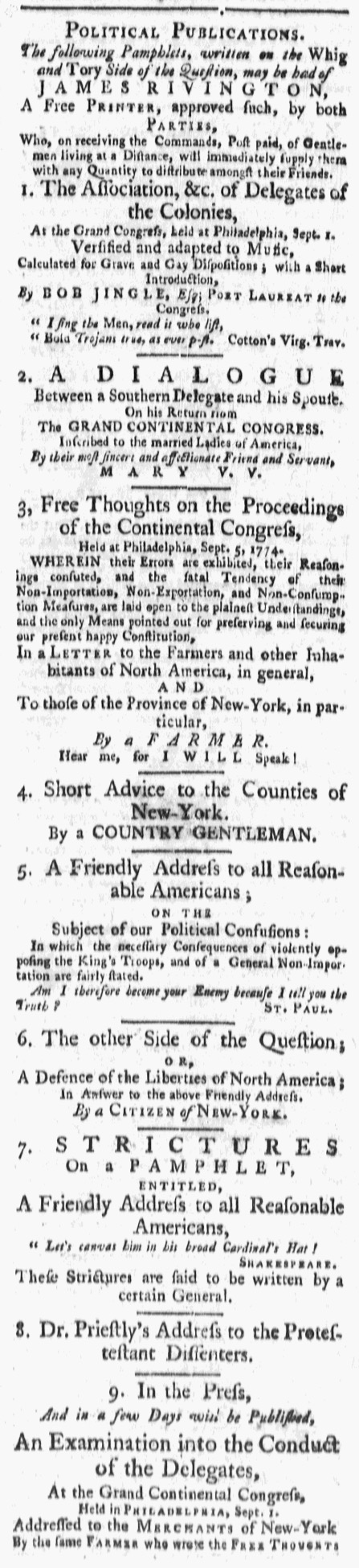
In chronicling the momentous events of 1774, the Adverts 250 Project has frequently featured advertisements for books, pamphlets, and other items related to the imperial crisis as it intensified following the Boston Tea Party and the Coercive Acts passed by Parliament in retaliation.  Most printers increasingly privileged the Patriot’s perspective, both in terms of the news and editorials they selected for their newspapers and the works that they published, advertised, and sold.  Yet they did not uniformly do so.

James Rivington, a Loyalist, proclaimed in the masthead of Rivington’s New-York Gazetteer that his newspaper was “PRINTED at his OPEN and UNINFLUENCED PRESS.”  In Revolutionary Networks: The Business and Politics of Printing the News, 1763-1789, Joseph M. Adelman notes that “Rivington’s bookselling career was about making money rather than promoting a political ideology, so much so that he wanted to capitalize on relatively popular anti-imperial political tracts.”[1]  One of his advertisements in the December 15, 1774, edition of his newspaper listed nine “POLITICAL PUBLICATIONS” that he sold.  He explained that he stocked pamphlets “written on the Whig and Tory Side of the Question.”  He demonstrated that was the case in the descriptions of some of those tracts.  For instance, he carried “A Friendly Address to all Reasonable Americans; ON THE Subject of our Political Confusions: In which the necessary Consequences of violently opposing the King’s Troops, and of a General Non-Importation are fairly stated” and “The other Side of the Question; OR, A Defence of the Liberties of North America; In Answer to the above Friendly Address.”  Debates over current events extended beyond the town common and newspaper editorials into pamphlet wars during the imperial crisis.

Those nine “POLITICAL PUBLICATIONS” included “Free Thoughts on the Proceedings of the Continental Congress,” in which “a FARMER” commented on the widely published and advertised account of the meetings held in Philadelphia in September and October.  In that pamphlet, “their Errors are exhibited, their Reasonings confuted, and the fatal tendency of their Non-Importation, Non-Exportation, and Non-Consumption Measures, are laid open to the plainest Understandings, and the only Means pointed out for preserving and securing our present happy Constitution.”  On the first page of the same issue, Rivington advertised “A full Vindication of the Measures of the Continental Congress, IN ANSWER TO Free Thoughts on the Proceedings of the said Congress.”  The advertisement mocked “a FARMER” and his pamphlet, stating that in this response “his Sophistry is exposed, his Cavils confuted, his Artifices detected, and his Wit ridiculed.”  Rivington added his own note: “The Printer, with humble Deference, presumes that this answer will meet with a gracious reception at the hands of every reader who has expressed disapprobation to the Freethoughts of Farmer.”  For those who appreciated that pamphlet, however, Rivington announced that he would soon publish “THE CONGRESS CANVASSED; OR, An Examination into the Conduct of the Delegates … By the FARMER … Who wrote Free Thoughts on their Proceedings.”  Rivington believed that political controversy meant business as he published, advertised, and sold works “on the Whig and Tory Side of the Question.”  Seeking to maximize revenues, he suggested that “Gentlemen living at a Distance” submit orders for “any Quantity to distribute amongst their Friends.”

Rivington simultaneously asserted that he was “A Free PRINTER, approved such, by both PARTIES,” yet many observers did not care for his “OPEN and UNINFLUENCED” approach that undermined the Patriots’ perspective.  Adelman explains that “Patriots eventually targeted Rivington and intended to destroy his business, by force if necessary.”  In December 1774, as Rivington published these advertisements, an anonymous group of Patriots sent a letter to Stephen Ward and Stephen Hopkins in Newport.  They “urged Ward and Hopkin to obtain a general agreement in Rhode Island not to purchase his New-York Gazetteer or deal with anyone advertising in it.”[2]  Less than a year later, a contingent from the Sons of Liberty marched from New Haven to New York to capture Loyalist leaders and silence Rivington.  They seized his types, reportedly melting them down for shot, and destroyed his press.  Seeking to represent both sides (and generate revenues while doing so) came with consequences for the printer.

**********

[1] Joseph M. Adelman, Revolutionary Networks: The Business and Politics of Printing the News, 1763-1789 (Baltimore: Johns Hopkins University Press, 2019), 127.

[2] Adelman, Revolutionary Networks, 129.