
What was advertised in a revolutionary American newspaper 250 years ago this week?
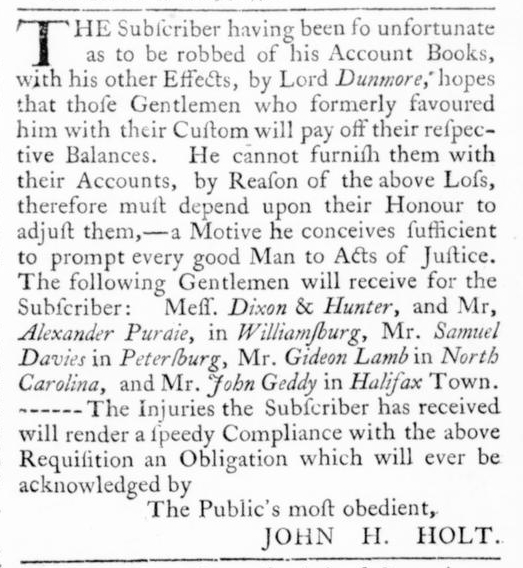
The war disrupted business throughout the colonies and the new nation. For merchants and shopkeepers, that meant they did not have the same access to the goods they sold to consumers. For some, it also meant that their records were lost or destroyed. Such was the case for John H. Holt. In the fall of 1776, he took to the pages of John Dixon and William Hunter’s Virginia Gazette to lament that he had “been so unfortunate as to be robbed of his Account Books, with his other Effects, by Lord Dunmore,” the last royal governor of Virginia, and the forces that he commanded.
Holt addressed “those Gentlemen who formerly favoured him with their Custom” in hopes that they “will pay off their respective Balances.” Since he no longer had possession of his ledgers, he explained, he “cannot furnish them with their Accounts” and “therefore must depend upon their Honour to adjust them.” He considered that “a Motive … sufficient to prompt every good Man to Acts of Justice.” Before and during the war, newspapers frequently ran advertisements placed by merchants, shopkeepers, and others calling on their customers and other associates to settle accounts. Most, however, did not offer such a compelling tale to encourage them to make payment. Holt hoped that his experience at the hands of Dunmore would prompt his customers to make good on what they owed him rather than take advantage of the situation. “The Injuries the Subscriber has received,” he declared, “will render a speedy Compliance with the above Requisition an Obligation which will ever be acknowledged” by him.
To make it easier for his customers to fulfill that “Obligation,” Holt designated local agents in several towns: “Mess. Dixon & Hunter, and Mr, Alexander Purdie, in Williamsburg, Mr. Samuel Davies in Petersburg, Mr. Gideon Lamb in North Carolina, and Mr. John Geddy in Halifax Town.” That list included the printers of the newspaper in which he advertised as well as the printer of the other newspaper published in Williamsburg, demonstrating one of the many roles that printers sometimes assumed on behalf of their customers. Some advertisements instructed readers to “enquire of the printer” for more details, but in this case Holt’s customers were to conduct business with printers who acted as surrogates for the advertiser, collecting money in addition to dispensing information.