October 9

GUEST CURATOR: Jordan Russo

What was advertised in a colonial American newspaper 250 years ago today?

oct-9-1091766-boston-news-letter
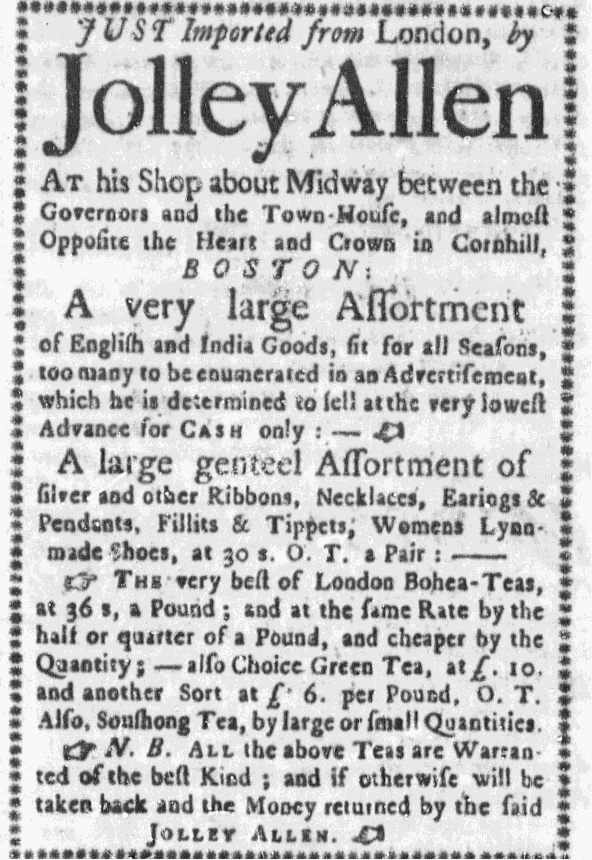
Massachusetts Gazette (October 9, 1766).

“A large and general Assortment of silver and other Ribbons, Necklaces, Earings and Pendants.”

This advertisement caught my eye because Jolley Allen ran a store in Boston. I live nearby in Medway, Massachusetts. Allen probably thought the items he sold would be bought mostly by women. His advertisement lists many items that women would want to look more fashionable, including “silver and other Ribbons, Necklaces, Earings and Pendants.” As Linda Baumgarten, Curator of Textiles at the Colonial Williamsburg Foundation, explains, “Like us, eighteenth-century people needed clothing for warmth and comfort, but they quickly abandoned those needs if fashion or the occasion dictated.”

Another reason Allen directed his advertisement towards women was because “the exercise of choice in the marketplace may have been a liberating experience” for women.[1] The choice of where to shop and what to purchase allowed women to bring business where they wanted. Jolley Allen probably knew this was the case and listed so many items to attract women to his store.

**********

ADDITIONAL COMMENTARY: Carl Robert Keyes

This advertisement may look familiar to readers who visit the Adverts 250 Project regularly. Guest curator Nicholas Commesso selected an advertisement by Jolley Allen to feature and analyze on September 29, less than two weeks ago. Doesn’t this advertisement deviate from the methodology established for the project, a commitment to feature a new advertisement every day? Why did I allow Jordan to choose this advertisement instead of sending her back to the Massachusetts Gazette or either of the other two newspapers printed in colonial America on October 9, 1766?

I could justify that decision by noting that Allen’s extensive advertisement merits attention more than once. It possessed features commonly found across advertisements during the colonial period, such as the implicit emphasis on female consumers that Jordan examined today. Allen also incorporated a variety of distinctive features into his advertisement, such as the money-back guarantee that Nick examined or the unique decorative border that was the focus of my analysis. This single advertisement included a multitude of significant aspects that tell us about colonial culture and commerce and the development of marketing techniques in eighteenth-century America. Considering how much was “going on” in Allen’s advertisement, no short analysis by a guest curator (nor my own slightly extended additional commentary) could do this advertisement justice.

Still, that was not the deciding factor when Jordan submitted this advertisement for my consideration and I approved it and told her to move forward with research and writing. After all, I did not know at that time that she would take a different approach than Nick did in his analysis. Although this advertisement looks familiar, it is actually a different advertisement than the one Nick examined on September 29. The copy was almost identical, though today’s version added an additional sentence after the nota bene. In addition, careful analysis reveals that the type was set differently, both for the body of the advertisement and the decorative border, which should come as no surprise considering that today’s advertisement was printed in the Boston News-Letter, but Allen’s advertisement featured on September 29 came from the Boston Evening-Post. While this might seem like a technicality (after all, Allen composed only one advertisement but submitted it to multiple newspapers), that the “same” advertisement appeared in more than one publication tells us something interesting about colonial entrepreneurs attempting to maximize exposure for their advertisements, as guest curator Elizabeth Curley demonstrated with John Taylor’s advertisements last week.

**********

[1] T.H. Breen, “An Empire of Goods: The Anglicization of Colonial America, 1690-1776,” Journal of British Studies 25, no. 4 (October 1986): 489.
 

September 29

GUEST CURATOR: Nicholas Commesso

What was advertised in a colonial American newspaper 250 years ago today?

sep-29-9291766-boston-evening-post
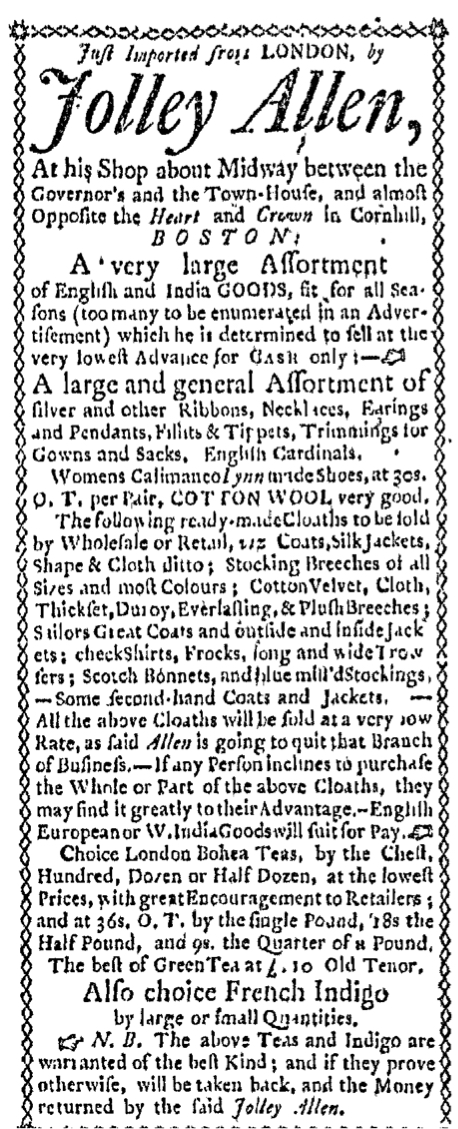
Boston Evening-Post (September 29, 1766).

“Warranted of the best Kind; and if they prove otherwise, will be taken back, and the Money returned.”

Jolley Allen’s lengthy advertisement from the Boston Evening-Post features countless common products seen in numerous other advertisements, including tea, silks, textiles, and jewelry. In addition to a long list of merchandise, this one had something else included at the end. Many of the advertisements I have looked at claimed to be selling their assortment of goods the cheapest, and they promised the highest quality products around. However, Allen is the first one I have seen who actually backed it up. This advertisement concluded with a guarantee that if the “Teas and Indigo” were not of the “best Kind,” they “will be taken back, and the Money returned by the said Jolley Allen.

Allen put his name and reputation on the line. He displayed his character in a way favorable to consumers. With the expansion of consumer culture in the colonies, it would have been easy for shopkeepers to make all sales final, yet with more shops opening, consumers could take their business elsewhere. Allen was committed to his name, his shop, and his goods, and made it a point for his shop to stand out from the rest. After further research, however, I also learned that Allen was a Loyalist entrepreneur; it’s interesting that he became a successful businessman regardless of his controversial political views.

**********

ADDITIONAL COMMENTARY: Carl Robert Keyes

Jolley Allen operated his business in an increasingly politicized colonial marketplace. His own politics, however, were not apparent in this particular advertisement. That he was a Loyalist, we learn from other sources from the period.

That’s not to say, however, that all newspaper advertisement published during the imperial crisis of the 1760s and 1770s lacked a political valence. As soon as the colonists learned of the Stamp Act, many advertisers made explicitly partisan appeals as part of their marketing messages, often promoting domestic manufactures or condemning the effects that Parliament’s actions would have on commerce. After the Stamp Act was repealed, some entrepreneurs inserted their own brief celebratory proclamations into their advertisements; even when they did not directly connect the Stamp Act to the merchandise they advertised, they assumed that their political views would influence potential customers to visit their shops.

As a Loyalist, Jolley Allen certainly did not condemn Parliament nor celebrate the demise of the Stamp Act in his advertisements. The advertisements he published in 1766 were devoid of politics, yet Boston was not so large that his political views would have been unfamiliar to friends, neighbors, and potential customers. Perhaps that played a role in inspiring some of the innovative aspects of his advertisements: he needed to overcome suspicions of his allegiances and used distinctive marketing to do so. Nick identified Allen’s reputation and stature as an honest trader as one means of promoting his shop “Opposite the Heart and Crown in Cornhill, BOSTON.” Although not the first colonial advertiser to offer some form of money-back guarantee, he did make an offer that was not a standard part of eighteenth-century advertising. In addition, his advertisements consistently featured distinctive graphic design elements, namely a decorative border, intended to draw more eyes than competitors’ advertisements that appeared elsewhere on the page. Allen also advertised extensively, placing the same advertisement in all four newspapers published in Boston in 1766, thus reaching the largest possible audience of potential customers despite the political leanings of any particular newspaper or its printer.

July 7

What was advertised in a colonial newspaper 250 years ago today?

Jul 7 - 7:7:1766 Boston Post-Boy
Boston Post-Boy (July 7, 1766).

JUST Imported from London, by Jolley Allen.”

Shopkeeper Jolley Allen almost certainly played a role in designing this advertisement. As I have noted previously, the available evidence suggests that advertisers tended to write their own copy and printers tended to make decisions about layout and fonts when they set the type. Printers often adopted formats that were consistent from advertisement to advertisement, giving all commercial notices that appeared in a given newspaper similar visual qualities and making them easy to recognize at a glance.

Allen’s advertisement had a distinctive border that set it apart from other advertisements in the Boston Post-Boy. It seemed unlikely that the printer went through the additional effort of setting ornamental type of his own volition. What was more probable, I hypothesized, was that Allen made special arrangements with the printer (and perhaps paid more) to arrange for this special feature.

Jul 7 - 7:7:1766 Boston Evening-Post
Boston Evening-Post (July 7, 1766).

Allen’s advertisement in other newspapers published in Boston on the same day suggested that was indeed the case. His advertisement in the Boston Evening-Post also had a decorative border, though it was composed of different ornaments. Otherwise, the advertisement had the same copy and nearly identical layout. Another version of the advertisement appeared in the Boston-Gazette. While the copy was the same, the border consisted of yet another style of printing ornaments and the format had two columns within the advertisement. Finally, Allen’s advertisement had previously appeared in Boston’s other newspaper (the only one not distributed on Mondays), the Massachusetts Gazette. Except for yet another method of creating the decorative border, it was nearly identical to the advertisements in the Boston Post-Boy and the Boston Evening-Post. The copy was the same and the format nearly identical.

Jolley Allen placed his advertisement in four newspapers. In each instance, it had a decorative border that would have drawn attention to it, especially since such borders were not a standard part of other advertisements in any of those publications. Allen almost certainly designed that portion of his advertisement, even if he left it to the individual printers to make decisions about setting the rest of the type. Realizing that advertisements often tended to look the same, Allen devised a graphic design innovation intended to set his own apart from the crowd.

Jul 7 - 7:7:1766 Boston-Gazette
Boston-Gazette (July 7, 1766).
Jul 7 - 7:3:1766 Massachusetts Gazette
Massachusetts Gazette (July 3, 1766).