February 22

GUEST CURATOR: Shannon Holleran

What was advertised in a colonial American newspaper 250 years ago this week?

feb-22-2211767-providence-gazette
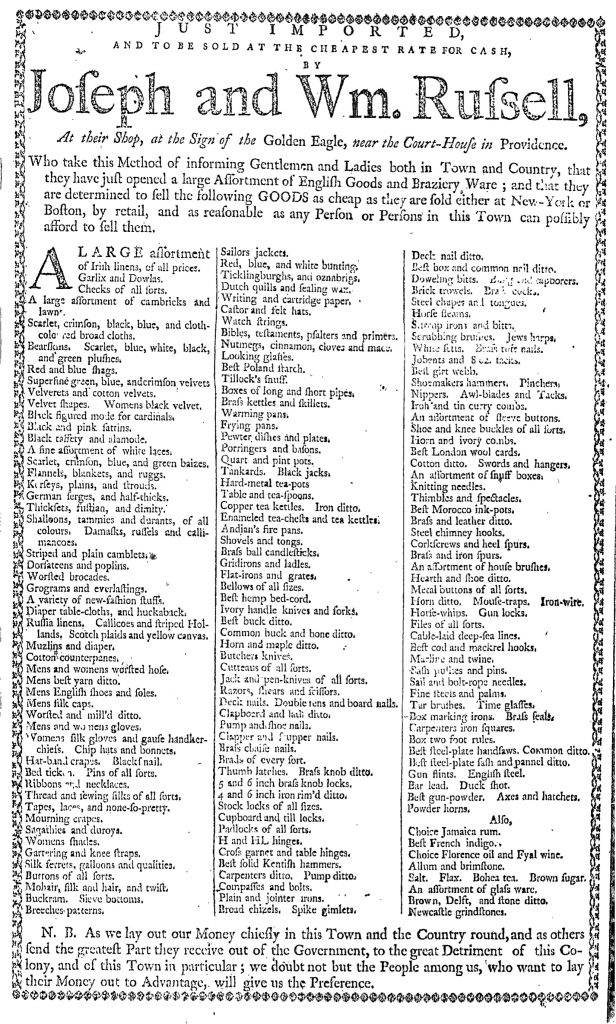
Providence Gazette (February 21, 1767).

“Powder horns.”

The “Powder horns” near the end of Joseph and William Russell’s full-page advertisement made me curious. I discovered that a powder horn was used for holding gun powder (which the Russells also sold).

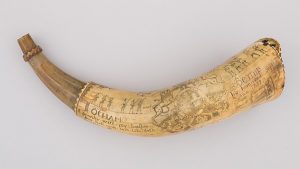
Many powder horns from this period have intricate engravings on them. Some people took up horn carving as an occupation. One of the best-known horn carvers of this time period was Jacob Gay, who often carved his initials onto the powder horns he created. Historians are now able to spot the artwork he created by the “J G” engraved on a powder horn.
feb-22-powder-horn
Powder horn engraved by Jacob Gay (dated 1759).  Metropolitan Museum of Art.  Visit the museum’s online record for this object to see additional photos and other eighteenth-century powder horns.

Many powder horns have specific styles based on the period they were made and the battles that occurred at that time. Powder horns decorated just before and during the American Revolution often indicated New England’s anti-British feelings. Also, many of the engraved horns depicted battles fought during the Revolution. In addition to being used to reflect battles, powder horn engravings were also expressive of camp life during the Revolution.

In the midst of the Revolution, many powder horns were also used as forms of identification. Following the Battles of Lexington and Concord, many soldiers began engraving their names or initials on their powder horns. As a result, historians are now able to identify many of the soldiers who fought in battles of the Revolution.

For more information and examples, see William H. Guthman’s “Powder Horns Carved in the Provincial Manner, 1744-1777.”

**********

ADDITIONAL COMMENTARY: Carl Robert Keyes

Joseph and William Russell’s full-page advertisement, the first published in the Providence Gazette, first appeared three months earlier, on November 22, 1766. Since then, it ran multiple times, either because the Russells were keen on advertising or because Mary Goddard and Company needed any sort of content to fill the pages when faced with the combination of a dearth of new paid notices and post riders carrying news from other colonies chronically arriving too late for any of it to appear in the current issue. As a result, residents of Providence and readers of the newspaper printed there were exposed to the Russells’ full-page advertisement on many occasions.

Due to the prominence and frequency it appeared in late 1766 and early 1767, this advertisement has also reappears fairly regularly as a point of reference when examining other paid notices in the Providence Gazette – or trying to explain the absence of those notices. While the methodology for the project, when strictly observed, prohibits featuring this advertisement a second time, there’s room for making exceptions when doing so yields productive observations about advertising practices and consumer culture in eighteenth-century America.

Shannon is the first student in my Revolutionary America class to take on responsibilities for guest curating the Adverts 250 Project. In turn, this is the first time students in that class have encountered the Russells’ advertisement, giving us an opportunity to discuss what was possible when it came to advertising in the revolutionary era compared to what was much more common. Revisiting this advertisement serves a second pedagogical purpose. For her work in preparing today’s entry, Shannon considered the variety of goods listed in this lengthy advertisement before choosing one to examine in greater detail. In the end, she took a closer look at an item not previously incorporated into the Adverts 250 Project, simultaneously expanding her own knowledge about an aspect of early American material culture and enhancing the project.

Finally, by choosing this advertisement Shannon contributes to an ongoing analysis of the advertising content of the Providence Gazette. This advertisement repeatedly occupied one-quarter of the space in any issue in which it appeared, quite a bit of space for the printers to yield. As mentioned above, Goddard and Company seemed to have difficulty attracting advertisers, especially when comparing their newspaper to counterparts published in Boston, Charleston, New York, and Philadelphia. That is a story that could not be told if the Russells’ full-page advertisement were permanently excluded from further consideration simply because the Adverts 250 Project previously featured it.


January 17

What was advertised in a colonial American newspaper 250 years ago today?

jan-17-1171767-providence-gazette
Providence Gazette (January 17, 1767).

“A Very large and new Assortment consisting of almost every Kind suitable for Town and Country.”

Regular readers of the Providence Gazette may have raised their eyebrows when they encountered Joseph and William Russell’s claim that “Their Assortment [of consumer goods] is too large for an Advertisement of Particulars in this Paper.” Such an assertion belied the numerous lengthy list advertisements that appeared in American newspapers throughout the eighteenth century. More significantly, it contradicted the Russells’ recent marketing strategies in the Providence Gazette itself. Less than two months earlier, the Russells had inaugurated the first full-page advertisement in that publication, a commercial notice divided into three columns that listed hundreds of items from their “large Assortment of English Goods and Braziery Ware.” The Russells placed that advertisement multiple times over the next several weeks before yielding the space to other advertisers, shopkeepers who also experimented with full-page advertising once they observed competitors initiate the practice. Almost every issue of the Providence Gazette published since late November included a full-page advertisement on the final page.

That may explain the remarkable statement that “an Advertisement of Particulars” from among the Russells’ “Very large and new Assortment” of goods was “too large” to be included “in this Paper.” That portion of the advertisement may not have been written by either of the Russells but may have instead been an editorial comment inserted by the printers. Perhaps “this Paper” referred specifically to that particular issue, already filled with other content, including a full-page list advertisement for Thompson and Arnold’s “Shop near the Great Bridge.” If the suspect claim was indeed an editorial explanation, it might also have been a promise that a more complete accounting of the Russells’ “Fresh GOODS, JUST IMPORTED FROM LONDON” would appear in a subsequent issue.

At any rate, the comment rang particularly false because the Russells’ advertisement appeared in the first column on the first page of that issue (perhaps given such a prominent place – the only advertisement that appeared on the front page of a newspaper that usually reserved paid notices for the final two pages – as a consolation for the printer not being able to accommodate a larger or lengthier advertisement). As a result, the Russells’ advertisement was printed directly to the right of Thompson and Arnold’s full-page advertisement before the broadsheet was folded in half to create a four-page issue. Although separated as the first and last pages most of the time, those two advertisements appeared next to each other any time a reader opened the newspaper. In the absence of listing their merchandise, the Russells resorted to promising that “Customers may have a fine Choice,” enough variety to compete with the hundreds of items Thompson and Arnold listed in their advertisement elsewhere in the same issue.

December 1

GUEST CURATOR: Nicholas Sears

What was advertised in a colonial American newspaper 250 years ago today?

dec-1-1211766-boston-evening-post
Boston Evening-Post (December 1, 1766).

“A Parcel of choice JAMAICA SUGARS.”

Since this advertisement from the December 1, 1766, edition of the Boston Evening-Post advertised Jamaican sugar I decided to focus on the plantations the English established in the Caribbean. England was in the race to become the most important economic power in Europe. In order to do that England needed colonies, including Jamaica (taken from the Spanish in 1655), to produce of one of the most popular staple crops.

For this goal plantations needed a large labor force. At first the Spanish utilized natives of the area and African slaves. European diseases became a problem for plantation owners as Indian populations dwindled. Later, English planters also found it difficult to persuade indentured servants to work in the harsh environment so by the end of the seventeenth century they focused on primarily using enslaved Africans because they were able to acquire more of them. The demand for African laborers also rose because they too were dying from diseases and the conditions they worked under. According to the British National Archives, between 1702 and 1808 around “840,000 Africans were shipped to Jamaica and a further 100,000 imported into Virginia and Chesapeake.” Overall, around “four million slaves were brought to the Caribbean, and almost all ended up on the sugar plantations.”

The constant demand for sugar in the colonies as well as England itself drove up the need for African slaves in the Caribbean. Since the cost for slaves was low, planters were able to produce more sugar, which in turn drove down the cost. Boston did not have as many slaves as other parts of the colonies, but readers of the Boston Evening-Post who purchased “choice JAMAICA SUGARS” were part of an economy that depended on slavery.

**********

ADDITIONAL COMMENTARY: Carl Robert Keyes

Joseph Russell was a busy auctioneer. He was also a busy advertiser. Nick has selected one of three advertisements Russell placed in the December 1, 1766, issue of the Boston Evening-Post. The printers grouped the three advertisements together at the top of the third and final column on the third page.

dec-1-1211766-consecutive-adverts-boston-evening-post
Boston Evening-Post (December 1, 1766).

The first announced an auction to be held “TO-MORROW,” December 2. Given how soon that auction was slated to take place, “TO-MORROW” appeared in a larger font than anything else in any of Russell’s advertisements. Only one other advertisement on the same and the facing page included font that large: shopkeeper Richard Salter’s name in his advertisement for imported goods. As a result, Russell’s advertisement likely caught readers’ eyes and demanded their attention. The large font gave his impending auction the sense of urgency required to attract prospective bidders in the final hours before the vendue began. The advertisement named a series of goods nearly identical to those listed in Russell’s advertisement that appeared in the Massachusetts Gazette three days earlier (featured earlier this week). It repeated ancillary material verbatim, including a nota bene announcing that “Goods are daily selling off at private Sale at the above Auction-Room, VERY CHEAP.”

Russell’s second advertisement promoted the auction of “choice JAMAICA SUGARS” to take place “On THURSDAY next 4th of December,” the advertisement that Nick selected to examine today. Russell’s final advertisement previewed an auction scheduled to take place a week after that, “On THURSDAY the 11th Instant.” At that time, Russell planned to sell different sorts of merchandise than what appeared in either of the other two advertisements: “A great Variety of genteel House Furniture” and “Glass and China Ware.”

In these advertisements Russell used time to his advantage in three different ways. In the first, he created a sense of urgency. The auction was imminent. Readers needed to make plans to attend or risk being shut out of the deals. However, those unable to make it to that auction could still shop at their leisure, as the nota bene about goods “daily selling off at private Sale” made clear. In the latter two advertisements, he advised the public of upcoming auctions with sufficient time to generate interest. Potential buyers had plenty of time to envision bidding on “Mahogany Tables, Looking Glasses,” and other furnishings, perhaps imagining the deals they might get at auction. Depending on their personalities, readers would have reacted to each use of time in different ways. Some would have been more susceptible to the excitement of an impending auction. Others would have responded better to planning for a vendue more than a week away or shopping at their convenience in “the Auction Room in Queen-Street.” Russell creatively deployed all three strategies to attract as many potential consumers as possible.

November 29

GUEST CURATOR: Nicholas Sears

What was advertised in a colonial American newspaper 250 years ago today?

nov-29-11291766-providence-gazette
Providence Gazette (November 29, 1766).

“A large Assortment of English Goods and Braziery Ware.”

Joseph and William Russell sold a lot of items at their shop, which made it slightly difficult to digest this advertisement when I first looked at it. They listed many different types of products, ranging from clothing to cooking supplies to other household items. What I found interesting about this advertisement was how it reflected the consumer revolution in colonial America.

According to Colonial Williamsburg’s description of the consumer revolution, colonists wanted to show their “rising standard of living and their style and worth” through their purchases. In addition, “[a]s society became more mobile, houses, land, and livestock alone no longer communicated social rank. By the end of the seventeenth century, ordinary men and women began to demand consumer goods that indicated their status.” For example, in this advertisement the Russells sold things like “superfine green, blue, and crimson velvets” as well as “Dutch quills and sealing wax,” “Watch strings,” “Table and tea-spoons,” and even “Ivory handle forks and knives.”

Many people in the colonies wanted to live more refined lives. They bought imported fabrics to make fashionable clothes. They also bought chairs and other furniture, silverware and other housewares, latches and other hardware, and other imported goods in stores like the one from this advertisement. The consumer revolution made life easier for colonists who bought more items since they had more disposable income.

**********

ADDITIONAL COMMENTARY: Carl Robert Keyes

Today’s advertisement may look familiar to readers who visit the Adverts 250 Project regularly. It was the second printing of the first full-page advertisement for consumer goods in an American newspaper, which was the subject of a special feature last week. While the project’s methodology usually forbids repeating an advertisement, I do make exceptions for good cause. In this case, today’s advertisement helps to demonstrate one of the limitations of working with digitized sources: portions of a source can be separated from the remainder of the source in ways not possible when working with an original document. This alters the way scholars then interpret those truncated sources.

Near the beginning of the semester each guest curator submitted the seven advertisements that he or she wished to study in greater detail. They were not required to submit the entire issues of the newspapers that contained their advertisements, just the advertisements themselves. As a result, I sorted through a pile of advertisements printed one per page, completely disembodied from the context of their original sources. I approved each advertisement based on whether it marketed consumer goods and services and whether it had been featured previously.

When Nicholas submitted this advertisement I noticed that its format deviated from that of standard eighteenth-century newspaper advertisements, but it did so in the same ways as earlier advertisements by Thompson and Arnold and other shopkeepers who experimented with decorative borders around oversized advertisements that spanned multiple columns. At a glance, I assumed that Joseph and William Russell’s advertisement was yet another example of a trade card transformed into a newspaper advertisement in the pages of the Providence Gazette. I approved this advertisement for inclusion in the project, figuring that I would note that it provided further evidence that advertisers paid attention to their competitors’ marketing and adapted new and innovative methods when they saw them.

Before I write my commentary on any of the advertisements selected by the guest curators, I always look through the entire issue in order to gain a greater appreciation for the context in which they appeared. That was how I first discovered that the Russells’ advertisement did not merely replicate a new mode recently adopted by other shopkeepers. Their full-page advertisement in the November 22, 1776, issue of the Providence Gazette was different, a further evolution of innovations involving the size of newspaper advertisements.

I made this discovery about the original November 22 publication of the Russells’ advertisement only after I had approved Nick’s submission of the November 29 iteration and dispatched him to do his research. I did not want to be a week late drawing attention to the importance of this advertisement in my additional commentary section attached to his analysis, so I went ahead and wrote a special feature on November 22. In his use of this advertisement to provide an overview of the consumer revolution of the eighteenth century, Nick demonstrates how much more there was to say about this advertisement (and how much remains to be said given the extensive list of merchandise). In that regard, it hardly matters that Joseph and William Russell’s advertisement has been featured twice on the Adverts 250 Project.

Still, my appreciation for the significance of this advertisement occurred belatedly because the processes of digitization and reproduction altered its size and separated it from the rest of the issue. As a result, I did not understand the nature of the advertisement when I first viewed it. In contrast, had I been working with an original copy of the Providence Gazette the materiality of the text would have made this advertisement’s significance apparent at a glance.

The First Full-Page Advertisement in an American Newspaper

I usually refrain from selecting an additional advertisement to examine on days that my students are serving as guest curators, but I am making an exception in this case because Joseph and William Russell’s advertisement on the final page of the November 22, 1766, issue of the Providence Gazette was just too significant to allow it to pass without acknowledgment. I believe that this is the first full-page advertisement that appeared in an American newspaper!

nov-22-11221766-full-page-providence-gazette
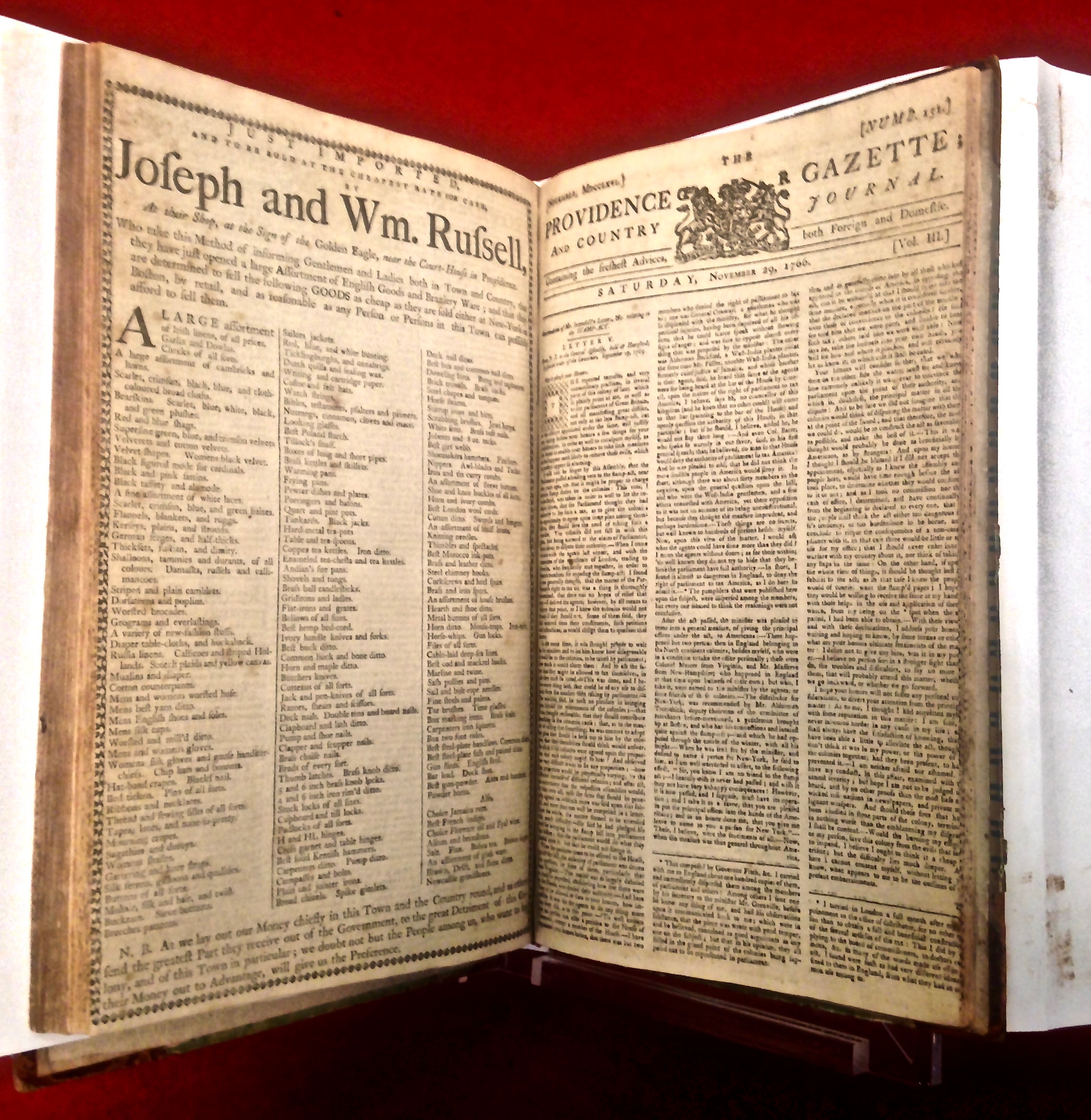
Providence Gazette (November 22, 1766, left; November 29, 1766, right). Courtesy American Antiquarian Society.

For months I have been tracking the innovative layouts designed by Mary Goddard and Company when they began publishing the revived Providence Gazette in the summer of 1766. Between August and November, a trio of advertisers – Thompson and Arnold, Benjamin and Edward Thurber, and Samuel Nightingale, Jr. – placed advertisements that featured decorative borders to set them apart from everything else on the page. Each spanned two columns, dominating the pages on which they appeared. They deviated so significantly from standard eighteenth-century advertisements that they certainly would have attracted the attention of readers. No matter the goods they listed or the appeals the shopkeepers made, these advertisements already caused a visual sensation even before colonists read any of the copy.

Each of these advertisements looked like it could have been printed separately as a trade card that the shopkeepers would have distributed on their own, perhaps recording purchases on the reverse. For the issues of the Providence Gazette in which they appeared, it looked like the oversized advertisements had been positioned in one corner of a page and then the remaining columns built around them.

Given that Mary Goddard and Company were experimenting with size, format, and other graphic design elements on the advertising pages of the Providence Gazette, it probably should not have come as any surprise to find a full-page advertisement occupying the final page of the November 22, 1766, issue. Still, I could not believe my eyes when I saw the digitized image in Readex’s America’s Historical Newspapers database. I needed confirmation, so I visited the American Antiquarian Society and examined the original issue.

nov-22-11221766-full-page-providence-gazette
Providence Gazette (November 22, 1766).

If trade cards had inspired the design of the earlier advertisements, then broadsides must have inspired Joseph and William Russell’s full-page advertisement. Mary Goddard and Company had already played around with mixing genres by placing a trade card within the pages of a newspaper. Making a broadside the entire final page of the newspaper was the logical next step, one that was even more likely to attract notice. Imagine a reader holding up this issue of the Providence Gazette while perusing the pages in the middle. Instead of columns of smaller advertisements typical of other newspapers, observers would have been confronted by a single advertisement larger than any they had preciously encountered in an American newspaper.

I frequently argue that many of the advertising innovations of the twentieth century had precursors in the eighteenth century. Here we see yet another example of eighteenth-century printers and advertisers creating sophisticated marketing materials that have been largely forgotten or overlooked.