October 12

What was advertised in a revolutionary American newspaper 250 years ago today?

New-York Journal (October 12, 1775).

“I Acknowledge that I have at several times spoken in favour of the laws of Taxation.”

Lemuel Bower wanted to return to the good graces of his community in the fall of 1775.  Events that occurred since the previous April – the battles at Lexington and Concord, the siege of Boston, the Battle of Bunker Hill, the Second Continental Congress appointing George Washington as commander in chief of the Continental Army, an American invasion of Quebec – had intensified feelings about the imperial crisis and, apparently, made for a difficult situation for Bower since he had expressed Tory sentiments in the past.  In hopes of moving beyond that, he composed a statement that appeared in the October 12, 1775, edition of the New-York Journal.

“I Acknowledge,” Bower confessed, “I have at several times spoken in favour of the laws of Taxation, and against the measures pursued by America to procure Redress, and have thereby justly merited the displeasure of my country.”  To remedy that, “I beg forgiveness, and so solemnly promise to submit to the rules of the Continental and Provincial Congresses,” including abiding by the nonimportation and nonconsumption provisions in the Continental Association.  Furthermore, Bower pledged, “I never will speak or act in opposition to their order, but will conduct according to their directions, to the utmost of my power.”  He did not state that he had a change of heart, only that he would quietly act as supporters of the American cause were supposed to act rather than engage in vocal opposition.  As William Huntting Howell has argued, such compliance, especially when expressed in a public forum, may have been more important to most Patriots than whether Bower truly agreed with them.[1]  How he acted and what he said was more important than what he believed as long as he kept his thoughts to himself.

Bower did indeed express his regrets and his promise to behave better in a public forum.  He concluded his statement with a note that “this I desire should be published in the public prints.  When it appeared in the New-York Journal, it ran immediately below a notice from the Committee of Inspection and Observation in Stanford, New York, that labeled two Loyalists as “enemies to the liberties of their country” and instructed the public “to break off all commerce, dealings and connections with them.”  That was the treatment that Bower sought to avoid!  That notice appeared immediately below news from throughout the colony.  Bower’s statement ran immediately above paid advertisements.  The two statements concerning the political principles of colonizers thus served as a transition from news to advertising in that issue of the New-York Journal.  Did John Holt, the printer, treat them as paid notices?  Did he require Bower to pay to insert his statement?  Or did the Patriot printer publish one or both gratis?  Perhaps he printed the statement from the Committee of Inspection and Observation for free but made Bower pay to publish his penance.  Whatever the case, Bower’s statement was not clearly a news item nor an advertisement but could have been considered both simultaneously by eighteenth-century readers.

**********

[1] William Huntting Howell, “Entering the Lists: The Politics of Ephemera in Eastern Massachusetts, 1774,” Early American Studies 9, no. 1 (Winter 2011): 187-217.

October 5

What was advertised in a revolutionary American newspaper 250 years ago today?

Rivington’s New-York Gazetteer (October 5, 1775).

“THE Speeches of EDMUND BURKE, Esq; on American Taxation.”

James Rivington did not know it when he published the October 5, 1775, edition, nor did readers and the rest of the community, but he would soon discontinue printing Rivington’s New-York Gazetteer.  With hindsight, we know that less than two months later, on November 27, the Sons of Liberty would attack his printing office and destroy his press and type “because of his pronounced Tory sentiments.”[1]  It was not the first time.  His home and printing office had been attacked the previous May.  For a few weeks, he had sought refuge on a British ship in the harbor.  He had been hung in effigy.  After all that, the November 23, 1775, edition would be the last issue of Rivington’s New-York Gazetteer that he would print before departing for London.  The printer returned to New York in 1777, during the British occupation, and established Rivington’s New-York Loyal Gazette.  Today, historians consider it possible that Rivington spied on behalf of the American cause, but that would not have been public knowledge in the 1770s.

What was public knowledge was that the masthead of Rivington’s New-York Gazetteer featured the seal of Great Britain at a time when the mastheads for other newspapers did not have an image or chose some other device.  The “UNITE OR DIE” political cartoon depicting a severed snake, each segment representing a colony, even appeared in the masthead of the Pennsylvania Journal.  A few other newspapers did continue to include the seal of Great Britain in their masthead, but the printers did not have the same history of expressing positions that supported the officials considered enemies of American liberties.  Even with the seal of Great Britain in the masthead, the October 5, 1775, edition of Rivington’s New-York Gazetteer included an advertisement for “THE Speeches of EDMUND BURKE, Esq; on American Taxation, delivered April 19, 1774” and “His Speech on Moving his Resolutions of Conciliation with the Colonies, March 22d, 1775.”  Rivington printed and sold both speeches by a member of Parliament considered a friend to America.  The printer had a history of marketing “pamphlets on the Whig and Tory side” of “The American Controversy” and arguing for freedom of the press when it came to the contents of his newspaper and other items he printed and sold.  After the battles at Lexington and Concord, however, he discontinued advertising pamphlets that expressed the Tory perspective.  The advertisement for Burke’s speeches, pamphlets that he printed as well as promoted, starkly presented only one side of “THE AMERICAN CONTEST.”  Rivington seemingly changed his advertising strategy as the political situation in the colonies intensified once hostilities commenced in Massachusetts.

**********

[1] Clarence S. Brigham, History and Bibliography of American Newspapers, 1690-1820 (Worcester: American Antiquarian Society, 1947), 686.

August 8

What was advertised in a revolutionary American newspaper 250 years ago today?

Dunlap’s Maryland Gazette (August 8, 1775).

“A SERMON, PREACHED … the DAY recommended by the Honorable CONTINENTAL CONGRESS for A GENERAL FAST.”

On July 20, 1775, the “DAY recommended by the Honorable CONTINENTAL CONGRESS for A GENERAL FAST Throughout the TWELVE UNITED COLONIES of NORTH-AMERICA,” Thomas Coombe delivered a sermon to “the Congregations of CHIRST CHURCH and ST. PETER’s” in Philadelphia.[1]  Less than three weeks later, John Dunlap advertised a local edition of the sermon “PUBLISHED BY REQUEST” and sold in Baltimore in Dunlap’s Maryland Gazette.  He also printed a Philadelphia edition of the sermon, which apparently sold well enough to convince him to publish a second edition.  Solomon Southwick, printer of the Newport Mercury, produced yet another edition, as did James Magee in Belfast, Ireland.

According to researchers at the William Reese Company, a prominent antiquarian rare book dealer specializing in American, Coombe “was an Anglican minister and Loyalist in Philadelphia, and formerly the Chaplain for the Marquis of Rockingham.”  Both the advertisement and the title page noted the latter credential.  The sermon “calls for restraint amongst the citizenry of Philadelphia in the wake of the opening battles of the American Revolution.”  After the colonies declared independence, Coombe was imprisoned for his political stance, but “allowed to return to England in 1779.”  Publishing and disseminating this sermon, like various other sermons advertised during the summer of 1775, allowed the public greater access to discussions about how to respond to the imperial crisis after hostilities commenced in Massachusetts.  Colonizers read newspapers that carried reports about current events and editorials, examined pamphlets that outlined perspectives drawn from political philosophy ancient and modern, and participated in town meetings and everyday conversations about the deteriorating relationship between the colonies and Britain.  Sermons that circulated in print gave them even greater access to public discourse.  Just as they read news about events they had not witnessed when they perused newspapers, they became members of a congregation or audience when then read sermons printed and sold by early American printers.

Dunlap did something savvy in marketing the Baltimore edition of Coombe’s sermon.  He devoted the entire first page of the August 8, 1775, edition of Dunlap’s Maryland Gazette to the first portion of the sermon.  It spilled over onto the second page, along with a note: “To be Concluded in our next.)”  The printer gave readers a taste of the sermon.  Those who could not wait a week for the next issue or who wanted a copy in a single pamphlet could purchase the sermon at Dunlap’s printing office.  Those who did wait for the August 15 edition of the newspaper were disappointed.  The first page featured a portion of “The SPEECH of EDMUND BURKE, Esq; on moving his Resolutions for Conciliation with the Colonies, March 22, 1775,” along with a familiar note, “[To be Continued.]”  The remainder of Coombe’s sermon did not appear in that issue, nor in the Postscript, additional pages, that supplemented it.  Dunlap did continue Burke’s speech in the August 22 edition, but he neglected to provide the remainder of Coombe’s sermon.  The advertisement for the sermon, however, did appear on August 15 and August 22, enticing readers who wanted to finish what they had started.

**********

[1] Why twelve “UNITED COLONIES” instead of thirteen?  Georgia had not yet sent delegates to the Second Continental Congress.

May 20

What was advertised in a revolutionary American newspaper 250 years ago today?

Pennsylvania Ledger (May 20, 1775).

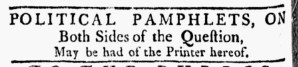
“POLITICAL PAMPHLETS, ON Both Sides of the Question.”

When he launched the Pennsylvania Ledger in the winter of 1775, James Humphreys, Jr., distributed proposals declaring that it would be a “Free and Impartial News Paper, open to All, and Influenced by None.”  With high hopes for operating an impartial press as the imperial crisis intensified, he soon advertised “POLITICAL PAMPHLETS … on Both Sides of the Question” in February 1775.  Several months later, he ran a notice advising that “POLITICAL PAMPHLETS, ON Both Sides of the Question, May be had of the Printer hereof” in the May 20 edition.  Doing so required both courage and commitment, especially considering recent events.

Humphreys published that advertisement a month after the battles at Lexington and Concord.  The siege of Boston continued, yet he did not allow news of the battles or the siege to dissuade him from hawking pamphlets on “Both Sides of the Question.”  Perhaps more significantly, James Rivington, the printer who also published pamphlets “on both sides, in the unhappy dispute with Great-Britain” at his “OPEN and UNINFLUENCED PRESS” in New York, had been hung in effigy in New Brunswick, New Jersey, by colonizers dissatisfied with what they considered his Loyalist sympathies.  Rivington covered that event in his newspaper, Rivington’s New-York Gazetteer, even including a woodcut depicting the scene.  Given that printers exchanged newspapers with their counterparts in other cities and towns, Humphreys likely read about the effigy; even if he did not, he almost certainly heard about it.  Even more recently, Rivington published a notice in which he acknowledged that “many Publications have appeared from my Press which have given great Offence … to many of my Fellow Citizens,” asserted that “Nothing which I have ever done, has proceeded from any Sentiments in the least unfriendly to the Liberties of this Continent,” and pledged “to conduct my Press upon such Principles as shall not give Offence to the Inhabitants of the Colonies.”  Despite his effort to clarify that he had not pursued a political agenda but instead followed his “duty as a Printer” to encourage “the Liberty of the Press,” the Sons of Liberty attacked his home and office on May 10.  Rivington took refuge on a British naval vessel.  Assistants continued publishing the newspaper, inserting his notice about his true intentions twice more.  Rivington had already discontinued advertising political pamphlets representing both sides of what he had previously called “The American Controversy” and “THE AMERICAN CONTEST.”

Although Humphreys advertised political pamphlets from “Both Sides” on May 20, word of what happened to Rivington may have prompted him to reconsider his courage in the weeks and months that followed.  He discontinued that advertisement.  In the next issue, he marketed only one pamphlet for sale at his printing office, The Group, a satire by Mercy Otis Warren that depicted a “SCENE AT BOSTON.”  That publication unabashedly supported the American cause.  A week later, that advertisement appeared on the first page of the Pennsylvania Ledger (as it had in the May 20 edition that carried the advertisement for political pamphlets on the final page), next to an advertisement for a multi-volume set of Political Disquisitions recommended for “all the friends of Constitutional Liberty, whether Britons or Americans.”  Still, the editorial perspective of the Pennsylvania Ledger, according to Isaiah Thomas, “was under the influence of the British government” and Humphreys eventually “refused to bear arms in favor of his country, and against the government of England.”[1]  He experienced sufficient difficulty that he suspended the newspaper at the end of November 1776.  In May 1775, a year and a half earlier, he grappled with what kinds of publications he would promote among the advertisements in his newspaper, first forging ahead with notices for pamphlets representing multiple perspectives and then emphasizing those that supported the American cause, perhaps doing so in hopes of avoiding the treatment that Rivington received.

**********

[1] Isaiah Thomas, The History of Printing in America: With a Biography of Printers and an Account of Newspapers (1810; New York: Weathervane Books, 1970), 398.

May 13

What was advertised in a revolutionary American newspaper 250 years ago today?

Pennsylvania Ledger (May 13, 1775).

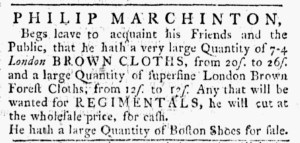
“Any that will be wanted for REGIMENTALS, he will cut at the wholesale price.”

After word of the battles at Lexington and Concord arrived in Philadelphia, Philip Marchinton took to the pages of the Pennsylvania Ledger to “acquaint his Friends and the Public, that he hath a very large Quantity of … London BROWN CLOTHS … and a large Quantity of superfine London Brown Forest Cloths” for sale at his shop.  He listed the prices for each type of textile, also noting that “Any that will be wanted for REGIMENTALS, he will cut at the wholesale price.”  In other words, he offered a discount to customers who purchased cloth to make uniforms.

Doing so made good business sense, but it did not necessarily reveal Marchinton’s politics at that moment or the decisions he would make once the colonies declared independence.  Although he set prices that favored American patriots just after the war began, Marchinton ultimately identified as a Loyalist and migrated to Nova Scotia.  According to the Dictionary of Canadian Biography, Marchinton was born in England around 1736, served a “commercial apprenticeship” before migrating to Philadelphia in 1771, and “established himself as a general merchant.”  He tried to remain neutral, even “agreeing to serve in the local militia but refusing to renounce his allegiance to the crown” during the early stages of the war.  Marchinton later “declared himself a loyalist during Philadelphia’s occupation by British forces” in 1777 and 1778, leaving him “no choice but to leave the city when the army abandoned it in June 1778.”  He spent the rest of the war in British-occupied New York, leaving in November 1783.  After spending a few months in Bermuda, he settled in Halifax, Nova Scotia, became a prosperous merchant, and held public office.

Marchinton had experience with using favorable prices as a marketing strategy.  In October 1773, he placed an advertisement in the Pennsylvania Gazette and the Pennsylvania Journal, declaring that “it is in his power to sell” all sorts of textiles “as low as any shop or store in the city.”  Responding to current events in the spring of 1775 provided an opportunity for the merchant to devise a promotion aimed at men who needed fabric for uniforms, a gesture that he likely expected would garner good will among the public and draw customers to his shop to make other purchases as well.  Like many colonizers, Marchinton apparently supported resistance aimed at securing a redress of grievances, but over time he found that he could not endorse independence.  His advertisement in the Pennsylvania Ledger testified to his entrepreneurial ingenuity rather than his deeply held political beliefs.

May 11

What was advertised in a revolutionary American newspaper 250 years ago today?

Rivington’s New-York Gazetteer (May 11, 1775).

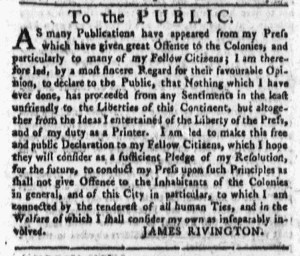
“Many Publications have appeared from my Press which have given great Offence to the Colonies.”

James Rivington seemed to change his tune about what he printed and sold at his printing office on Hanover Square in New York.  On April 20, the day after the battles at Lexington and Concord, the printer of Rivington’s New-York Gazetteer once again advertised “several pamphlets on the Whig and Tory side” of “THE AMERICAN CONTEST.”  Word of what had occurred in Massachusetts the previous day had not yet arrived in New York, but Rivington had other news concerning the imperial crisis to report.  That included residents of New Brunswick, New Jersey, hanging “an effigy, representing the person of Mr. Rivington … merely for acting consistent with his profession as a free printer.”  A rare woodcut depicting the scene accompanied the combination article and editorial about his “OPEN and UNINFLUENCED PRESS.”

A week later, Rivington’s New-York Gazetteer carried news of Lexington and Concord.  The printer chose not to insert his advertisement hawking pamphlets representing both Whig and Tory perspectives in that issue.  In the next issue, two weeks after the battles in Massachusetts, Rivington ran a new advertisement, one that took a different tone than his coverage of the effigy.  “AS many Publications have appeared from Press which have given great Offence to the Colonies, and particularly to many of my Fellow Citizens,” the printer declared, “I am therefore led, be a most sincere Regard for their favourable Opinion, to declare to the Public, that Nothing which I have ever done, has proceeded from any Sentiments in the least unfriendly to the Liberties of this Continent, but altogether from the Ideas I entertained of the Liberty of the Press, and of my duty as a Printer.”  That being the case, “I am led to make this free and public Declaration to my Fellow Citizens, which I hope they will consider as a sufficient Pledge of my Resolution, for the future, to conduct my Press upon such Principles as shall not give Offence to the Inhabitants of the Colonies in general, and of this City in particular, to which I am connected by the tenderest of all human Ties, and in the Welfare of which I shall consider my own as inseparably involved.”  Rivington stopped short of offering an apology or stating that he regretted printing and selling newspapers and pamphlets that advanced Tory views, but he did take a less defiant tone in his effort to explain his editorial decisions.  He suggested that he would adopt a new approach, though he did not go into detail about that.  Perhaps he hoped that critics would notice that he did not advertise the problematic pamphlets.  Even if they did not, Rivington refrained from publishing an advertisement that ran counter to the message he delivered in his notice clarifying his prior actions.

That notice appeared in three consecutive issues of Rivington’s New-York Gazetteer, none of which carried advertisements for political pamphlets.  The events unfolding in Massachusetts may have encouraged the printer to take greater caution, though the masthead of his newspaper continued to proclaim that he operated an “OPEN and UNINFLUENCED PRESS.”  As far as the Sons of Liberty were concerned, however, the printer could not redeem himself.  On May 10, a week after Rivington first published his notice assuring the public that he would “conduct [his] Press upon such Principles as shall not give Offence to the Inhabitants of the Colonies,” the Sons of Liberty attacked his home and printing office.  Rivington fled to a British ship in the harbor.  Assistants maintained uninterrupted publication of the newspaper, continuing to run Rivington’s notice, while the printer petitioned the Second Continental Congress for pardon.  As Todd Andrlik documents, Rivington explained that “however wrong and mistaken he may have been in his opinions, he has always meant honestly and openly to do his duty.”  The Continental Congress forwarded the petition to the New York Provincial Congress.  Rivington received his pardon, but his reformation was not so complete as to avoid further notice from the Sons of Liberty.  In November 1775, Sons of Liberty from New Haven destroyed his press and reportedly melted down his types to make shot, bringing an end to Rivington’s New-York Gazetteer.

April 27

What was advertised in a revolutionary American newspaper 250 years ago today?

Norwich Packet (April 27, 1775).

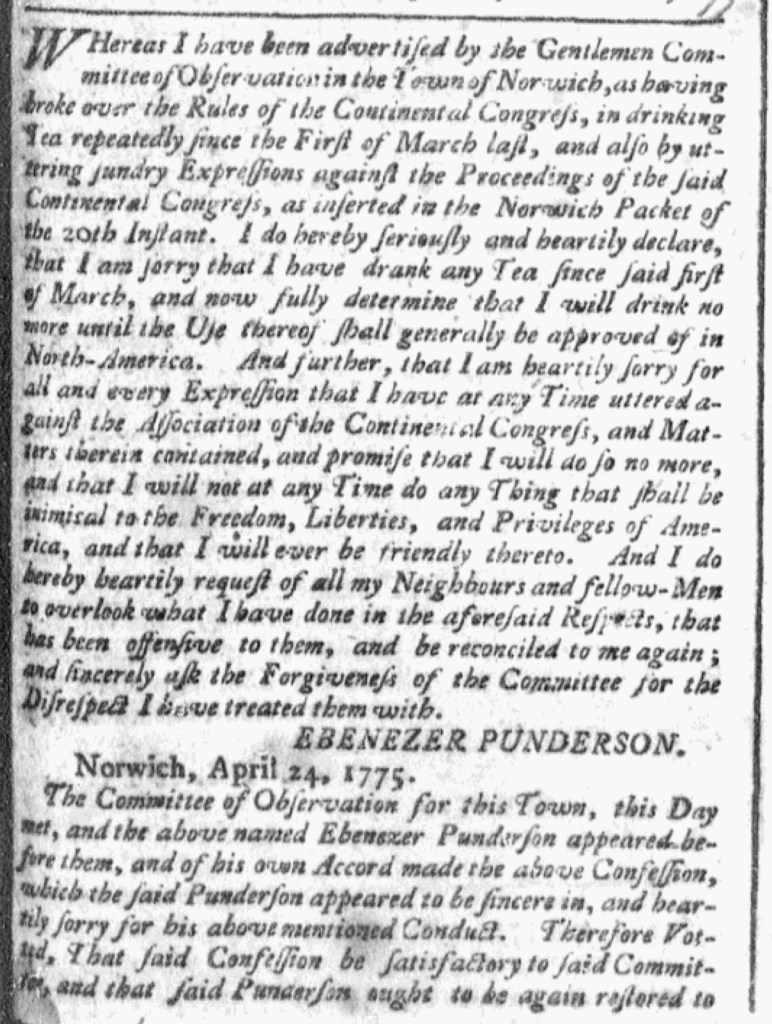
I am sorry that I have drank any Tea.”

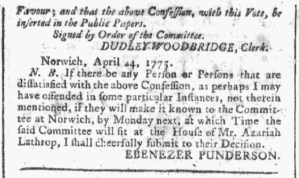
Ebenezer Punderson had the misfortune of appearing in an advertisement placed in the Norwich Packet by the local Committee of Inspection in the issue that carried the first newspaper coverage of the battles of Lexington and Concord.  The committee accused him of drinking tea in violation of the Continental Association, disparaging the First Continental Congress, and refusing to meet with the committee to discuss his conduct.  In turn, the committee advised the public not to carry on any “Trade, Commerce, Dealings or Intercourse” with Punderson.

Perhaps Punderson would have weathered that sort of public shaming under other circumstances, but news of events at Lexington and Concord made his politics even more unpalatable and his situation more dire.  From what ran in the newspaper, it did not take him long to change his tune, meet with the committee, and publish an apology for his behavior.  In a missive dated four days after the committee’s advertisement, Punderson reiterated the charges against him and “seriously and heartily” declared the he was “sorry I have drank any Tea since the first of March” and “will drink no more until the Use thereof shall generally be approved in North-America.”  In addition, he apologized for “all and every Expression that I have at any Time uttered against the Association of the Continental Congress.”  Furthermore, Punderson pledged that he “will not at any Time do any Thing that shall be inimical to the Freedom, Liberties, and Privileges of America, and that I will ever be friendly thereto.”  He requested that his “Neighbours and fellow-Men to overlook” his transgression and “sincerely ask[ed] the Forgiveness of the Committee for the Disrespect I have treated them with.”

Norwich Packet (April 27, 1775).

Punderson apparently convinced the committee to give him another chance.  Dudley Woodbridge, the clerk, reported that Punderson “appeared before them, and of his own Accord made the above Confession” and seemed “heartily sorry for his … conduct.”  In turn, the committee voted to find Punderson’s confession “satisfactory” and recommended that he “be again restored to Favour” in the community.  The committee also determined that “the above Confession, with this Vote, be inserted in the Public Papers,” perhaps less concerned with restoring Punderson’s good name than the example his recantation set for other Tories.  When the notice appeared in the Norwich Packet, Punderson inserted an additional note that extended an offer to meet with anyone “dissatisfied with the above Confession” and asserted that he would “cheerfully submit” to any further decisions the Committee of Inspection made in response.

Yet what appeared in the Norwich Packet did not tell the whole story.  According to Steve Fithian, Punderson “attempted to flee to New York but was captured and returned to Norwich where he spent eight days in jail and only released after signing a confession admitting to his loyalist sympathies.”  He did not stay in Norwich long after that.  “Several weeks later he fled to Newport, Rhode Island and boarded a ship which took him to England where he remained for the entire Revolutionary War.”  Apparently, he convincly feigned the sincerity he expressed, well enough that the committee accepted it.  While imprisoned, Punderson wrote a letter to his wife about his ordeal.  After arriving in England, he published an account with a subtitle that summarized what he had endured: The Narrative of Mr. Ebenezer Punderson, Merchant; Who Was Drove Away by the Rebels in America from His Family and a Very Considerable Fortune in Norwich, in Connecticut.  Just as the Committee of Inspection used print to advance a version of events that privileged the patriot cause, Punderson disseminated his own rendering once he arrived in a place where he could safely do so.

**********

The Committee of Inspection’s notice appeared with the advertisements in the April 20, 1775, edition of the Norwich Packet.  Punderson’s confession, however, ran interspersed with news items in the April 27 edition.  It may or may not have been a paid notice, but it was certainly an “advertisement” in the eighteenth-century meaning of the word.  At the time, according to the Oxford English Dictionary, an advertisement was a “(written) statement calling attention to anything” and “an act of informing or notifying.”  Advertisements often delivered local news in early American newspapers.  Punderson definitely made news as the imperial crisis became a war.

April 23

What was advertised in a revolutionary American newspaper 250 years ago this week?

Rivington’s New-York Gazetteer (April 20, 1775).

“Several pamphlets on the Whig and Tory side.”

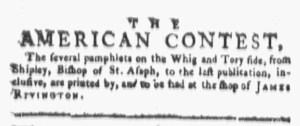
Many Patriots did not care for the editorial stance that James Rivington took in his newspaper.  They considered him a Loyalist even though he declared in the masthead that he operated an “OPEN and UNINFLUENCED PRESS” that represented all views.  Similarly, he printed, advertised, and sold political pamphlets about “THE AMERICAN CONTEST … on the Whig and Tory side.”  Rivington aimed to keep colonizers informed and intended to generate revenue while doing so, believing that controversy could be good for business during the imperial crisis.

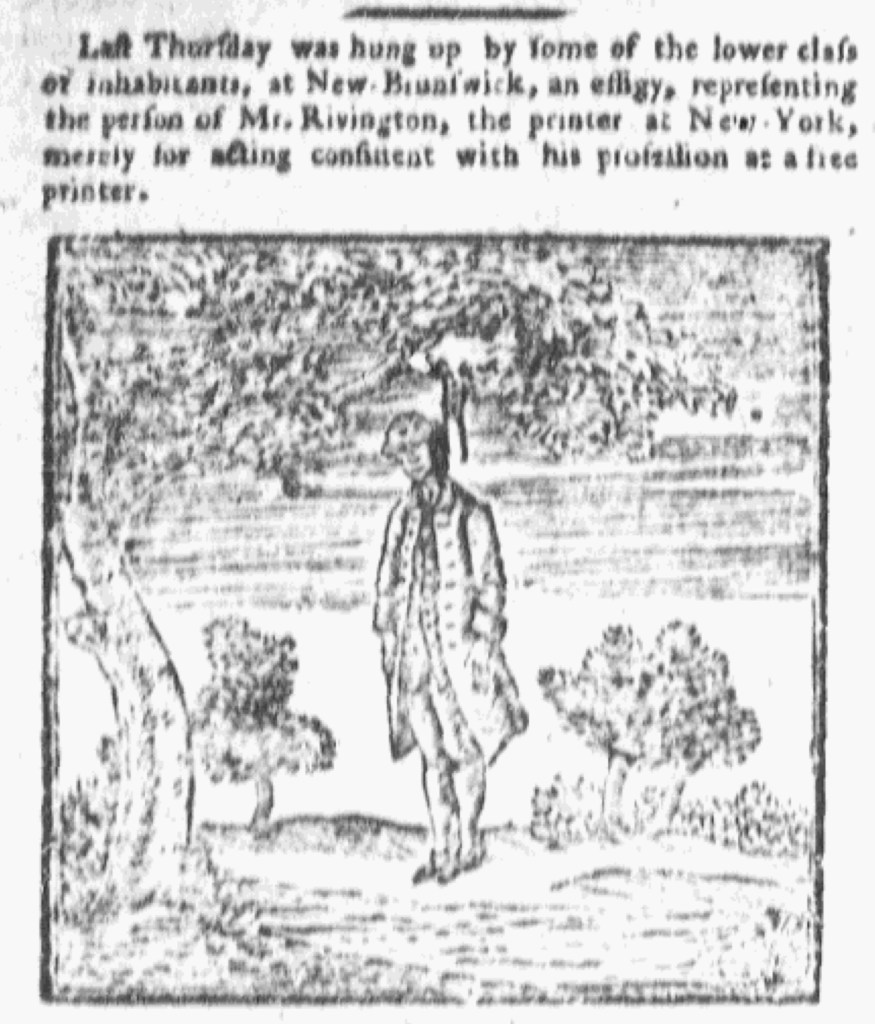
Late in 1774 and throughout the first months of 1775, Rivington regularly ran advertisements that listed the variety of political pamphlets available at his printing office.  He inserted an abbreviated version in the April 20, 1775, edition.  Colonizers in New York had not yet received word of the events at Lexington and Concord the previous morning.  Rivington instead published other news, including a recent instance of “some of the lower class of inhabitants, at New-Brunswick” hanging “an effigy, representing the person of Mr. Rivington … merely for acting consistent with his profession as a free printer.”  He not only covered that story but also illustrated it with a woodcut depicting the effigy hanging from a tree.

Rivington’s New-York Gazetteer (April 20, 1775).

The image almost certainly attracted attention, in part because news items in eighteenth-century newspapers so rarely featured illustrations of any sort.  Elsewhere in the same issue, readers encountered only five other images.  The masthead contained the coat of arms of Great Britain, as usual, and the drop cap for a letter to the editor appeared within a smaller version of the coat of arms.  A stock image of a ship adorned an announcement that the Earl of Dunmore would soon sail for London.  Similarly, a stock image of a horse being led by a man helped promote the stud services of Lath, Match ‘Em, Pilgrim, and Bashaw.  Abraham Delanoy’s woodcut depicting lobster traps was the only other image created to match the content of an advertisement or a news item.

The scarcity of images made the scene of the effigy even more conspicuous.  Rivington wrote a sarcastic description of the event and then affirmed “that his press has been open to publications from ALL PARTIES.”  He challenged “his enemies to produce an instance to the contrary,” noting that he treated his role as printer like “a public office” and reasoned that “every man has a right to have recourse” via his press.  “But the moment he ventured to publish sentiments which were opposed to the dangerous views and designs of certain demagogues,” Rivington asserted, “he found himself held up as an enemy to his country.”  His support for “LIBERTY OF THE PRESS” made him a target for “a most cruel tyranny,” as demonstrated by “very recent transactions” that included the effigy in New Brunswick.  His description of how some Patriots comported themselves along with his insistence on continuing to sell political pamphlets “on the Whig and Tory side” did not endear Rivington to “his enemies.”  Within in a month, a mob of Sons of Liberty would attack his printing office and destroy his press.  Rivington escaped, seeking refuge on a British naval ship in the harbor.

April 6

What was advertised in a colonial American newspaper 250 years ago today?

Supplement to the New-York Journal (April 6, 1775).

“Assurance … that when the difference is settled between England and the colonies, of having my store constantly supplied.”

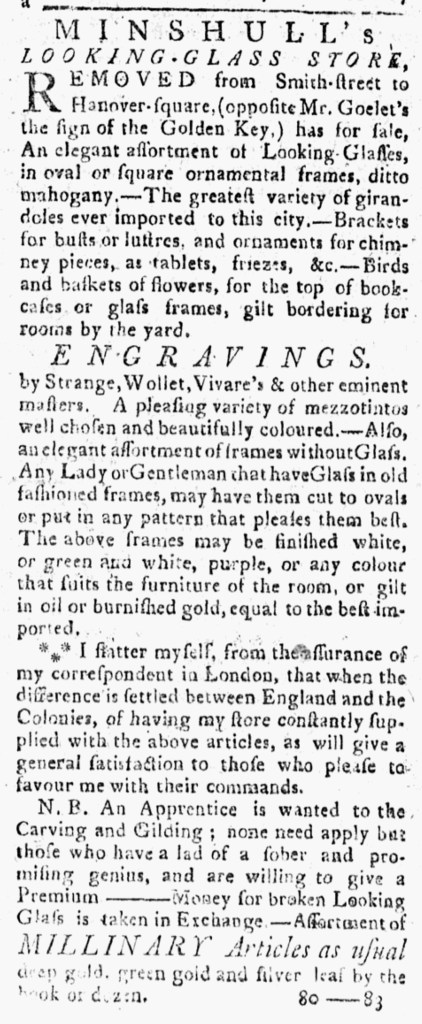
In the spring of 1775, the proprietor of “MINSHULL’s LOOKING-GLASS STORE” ran a newspaper advertisement to announce that he had “REMOVED” from Smith Street to a new location “opposite Mr. Goelet’s [at] the sign of the Golden Key” on Hanover Square in New York.  In addition to an “elegant assortment” of looking glasses, he stocked other items for decorating homes and offices, including brackets for displaying busts, arrangements of flowers and birds “for the top of bookcases,” and the “greatest variety of girandoles” or candleholders “ever imported to the city.”  He also devoted a separate paragraph, with its own headline, to a “pleasing variety” of mezzotint “ENGRAVINGS” and the choices for frames.

John Minshull confided that he had “assurances of my correspondent in London, that when the difference is settled between England and the Colonies, of having my store constantly supplied with the above articles, as will give a general satisfaction” to his customers.  Readers realized that he referred to the imperial crisis and the effects of the Continental Association, the nonimportation agreement devised by the First Continental Congress in response to the Coercive Acts.  Minshull did not state that he imported his inventory before that pact went into effect on December 1, 1774.  Instead, he allowed readers to make that assumption, especially when he noted that he would not receive any new merchandise from England until the colonies and Parliament reached an accord.

That did not happen.  Within weeks of Minshull placing his advertisement, the Revolutionary War began with the Battles of Lexington and Concord in Massachusetts.  A little over a year later, the British occupied New York and remained in the city until 1783.  Yet Minshull persevered, continued operating his shop, and, according to an advertisement in the November 8, 1780, edition of the Royal Gazette, “imported in the Fleet from England, A large Assortment of LOOKING GLASSES, adapted to the present mode of Town and Country.”  He apparently managed to maintain his connections with his correspondents and suppliers in London.

Perhaps Minshull abided by the Continental Association in 1775 as a matter of political principle.  Perhaps he did so merely to stay in the good graces of his customers and the community.  The latter seems more likely since, according to Luke Beckerdite, “a ‘John Michalsal’ was included in a list of Loyalists” in 1775 and “a ‘John Minchull’ subsequently fled to Shelburne, Nova Scotia,” a haven for Loyalists during and immediately after the war.  From August 1782 through February 1783, ran an advertisement in the Royal Gazette for his “remaining Stock” that he sold “Cheap! Cheap! Cheap!”  It appears that Minshull had a going-out-of-business sale before evacuating from New York when the war ended.  Before that, he resumed business as usual when circumstances changed under the British occupation, weathering the storm and attempting to earn his livelihood during uncertain times.  When the “difference [was] settled between England and the Colonies,” he no longer sold looking glasses or anything else in New York.

February 11

What was advertised in a colonial American newspaper 250 years ago today?

Supplement to the Pennsylvania Ledger (February 11, 1775).

“POLITICAL PAMPHLETS … on Both Sides of the Question.”

As the imperial crisis intensified in late 1774 and early 1775, most American newspapers became increasingly partisan, even those that claimed that they did not take a side in the contest between Patriots and Parliament.  Printers sometimes ran advertisements for pamphlets that did not align with the principles most often espoused in their publications, but few made a point of declaring that they did so.  James Rivington, printer of Rivington’s New-York Gazetteer and a noted Loyalist, took the most strident approach in a series of advertisements for “POLITICAL PUBLICATIONSwritten on the Whig and the Tory Side of the Question.”  Sporting headlines like “The American Contest” and “The American Controversy,” those advertisements listed several pamphlets, many of them written in response to others also advertised.

Yet Rivington was not alone.  In the supplement that accompanied the third issue of the new Pennsylvania Ledger, James Humphreys, Jr., the printer, inserted a short notice that announced, “Most of the POLITICAL PAMPHLETS That have been published, on Both Sides of the Question, May be had of the Printer hereof.”  On the first page, he once again ran the proposals for the newspaper, stating that he established a “Free and Impartial News Paper, open to All, and Influenced by None.”  Despite that assertion, “[i]t was supposed that Humhreys’s paper would be in the British interest,” according to Isaiah Thomas in his History of Printing in America (1810).[1]  He further explained that “in times more tranquil than those in which it appeared, [Humphreys] might have succeeded in his plan” to “conduct his paper with political impartiality.”[2]

When it came to marketing strategies for political pamphlets, printers associated with supporting the Tory “Side” took the more evenhanded approach of drawing attention to their commitment to selling and disseminating work on “Both Sides of the Question.”  In Rivington’s case, doing so was a matter of generating revenue as much as operating an impartial press and bookstore.  For Humphreys, on the other hand, doing so seemed to fall in line with the commitment he made in his proposals for the Pennsylvania Ledger.  Even taking those motivations into account, both printers may have considered it necessary to profess that they sold pamphlets on “Both Sides” to justify how many titles they sold that argued from the Tory perspective.

**********

[1] Isaiah Thomas, The History of Printing in America: With a Biography of Printers and an Account of Newspapers (1810; New York: Weathervane Books, 1970), 399.

[2] Thomas, History of Printing, 439.