November 9

What was advertised in a revolutionary American newspaper 250 years ago today?
Maryland Gazette (November 9, 1775).

“All work sent home as soon as done by the return of post.”

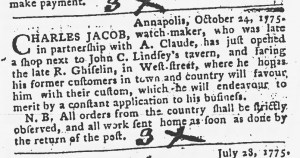
After his partnership with Abraham Claude ended, watchmaker Charles Jacob opened his own shop in Annapolis in the fall of 1775.  He placed an advertisement in the Maryland Gazette in hopes that “his former customers in town and country will favour him with their custom,” though he also intended for the notice to draw the attention of new customers.  Mentioning both his partnership with Claude and the clientele they had established demonstrated to prospective new customers that Jacob had the experience to serve them well.  In addition, he pledged “constant application to his business” or, in other words, an industriousness that customers would find more than satisfactory.

For the convenience of customers who lived outside Annapolis, Jacob provided an eighteenth-century version of mail order service.  In a nota bene, he stated that “orders from the country shall be strictly observed, and all work sent home as soon as done by the return of the post.”  In other words, he gave the same attention to watches sent to him to clean or repair as if the customer had visited his shop.  He did not give priority to customers who resided in Annapolis, nor did he delay returning watches to their owners when he finished working on them.  Prospective customers did not need to worry that their watches might end up sitting on a workbench or tucked away in a drawer and forgotten while Jacob attended to other projects.  Instead, he ran an orderly shop.

Jacob may have occupied the same location where he and Claude previously kept shop.  In their earlier advertisements, including one in the October 1, 1773, edition of the Maryland Gazette, they gave their address as “opposite Mr. Ghiselin’s, in West-Street.  In his new advertisement, Jacob declared that he “has just opened a shop next to John C. Lindsey’s tavern, and facing the late R. Ghiselin, in West-street.”  A familiar location may have helped him retain some of the customers that frequented the shop when he ran it in partnership with Claude.
October 19

What was advertised in a revolutionary American newspaper 250 years ago today?

Maryland Gazette (October 19, 1775).

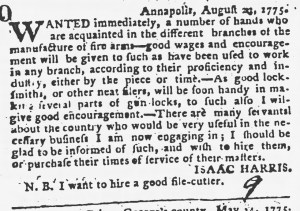
“WANTED immediately, a number of hands who are acquainted in the different branches of the manufacture of fire arms.”

In the late summer and early fall of 1775, Isaac Harris took to the pages of the Maryland Gazette with a call for “a number of hands who are acquainted in the different branches of the manufacture of fire arms.”  The timing of Harris’s advertisement, dated August 23, coincided with a new stage of the imperial crisis that started more than a decade earlier when Parliament attempted to regulate trade with the colonies following the conclusion of the Seven Years War.  The crisis had intensified at various moments, including passage of the Stamp Act in 1765 and imposition of duties on certain imported goods via the Townshend Acts in the late 1760s.  Events in Boston had often fueled the crisis, including the Boston Massacre in March 1770 and the destruction of tea by dumping it into the harbor in December 1773.  Parliament responded with the Coercive Acts, including the Boston Port Act and the Massachusetts Government Act, to punish the unruly Patriots, yet colonizers in other places believed that they could also be subject to similar treatment.

Yet only recently had hostilities commenced when Harris composed his advertisement and submitted it to the printing office in Annapolis.  News of the battles at Lexington and Concord in April 1775, the ensuing siege of Boston, the Battle of Bunker Hill in June 1775, and the appointment of George Washington as commander-in-chief of the Continental Army inspired colonizers to make preparations to defend their liberties.  Harris may have been among their ranks as he set about making firearms in Maryland.  He offered “good wages” to workers with experience in any aspect of producing firearms, paying them “according to their proficiency and industry, either by the piece or time.”  In addition, he thought that “good locksmiths, or other neat filers, will be soon handy in making several parts of gun locks.”  Colonizers with experience in other occupations could apply their skill to this endeavor.  Harris also sought indentured servants to join this enterprise, offering to hire them or “purchase their times of service [from] their masters.”  According to his advertisement, Harris planned to make a significant investment in acquiring the labor to support what he called “the necessary business” of making firearms.  Readers almost certainly made a connection between Harris’s plan to make firearms and the events that continued to unfold in Massachusetts.

July 13

Who was the subject of an advertisement in a revolutionary American newspaper 250 years ago today?

Maryland Gazette (July 13, 1775).

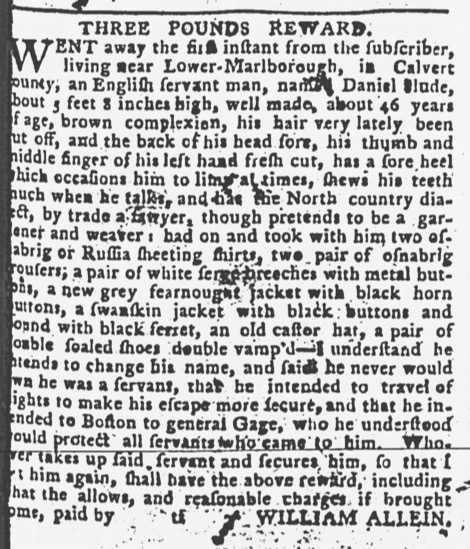
“An English servant man … intended to Boston to general Gage, who he understood would protect all servants who came to him.”

William Allein of Lower Marlborough in Calvert County turned to the Maryland Gazette to seek assistance in recovering an enslaved man and an indentured servant in the summer of 1775.  He ran two advertisements in the July 13 edition, one concerning Mial, an enslaved man who became a fugitive for freedom at the beginning of May, and Slude, an “English servant man” who “WENT away” in early July.  Allein expected newspaper readers to observe strangers to assess whether they matched the descriptions he published, offering rewards to those who participated in securing Mial and Slude and returning them to him.

Allein gave a physical description of Slude, including recent injuries (“his thumb and middle finger on his left hand fresh cut” and “a sore heel which occasions him to limp at times”) that could make him easier to recognize, and detailed the clothing that Slude wore or took with him.  His “North country dialect” also distinguished the indentured servant.  According to Allein, Slude was “by trade a sawyer, though he pretends to be a gardener and weaver.”  He would engage in other subterfuge as well, changing his name and traveling by night to avoid detection.

Compared to many of his counterparts who placed other advertisements for runaway indentured servants, apprentices, and convict servants and enslaved people who liberated themselves, Allein was well informed about where Mial and Slude were likely headed.  “I have heard that [Mial] proposed going towards Alexandria in Virginia,” Allein declared.  As for Slude, “I understand that … he intended to Boston to general Gage, who he understood would protect all servants who came to him.”  Current events influenced Slude when he planned the route for making his escape; he apparently relied on rumors, hoping for their veracity.  Word of the battles at Lexington and Concord and the ensuing siege of Boston quickly spread throughout the colonies, as did news of the Battle of Bunker Hill.

Yet not all the news was always accurate, not even the accounts printed in newspapers.  The confusion created openings for men like Slude to embrace the reports that they wanted to believe.  In the end, however, Mial may have been more successful in eluding Allein than Slude was.  The advertisement describing Mial ran for many weeks, but the notice about Slude appeared only once.  The indentured servant heading to Boston may have been recognized and captured shortly after it appeared, prompting Allein to discontinue the advertisement.  If Mial made it to Virginia and managed to avoid capture until November, he might have joined Lord Dunmore, the royal governor, when he issued a proclamation that offered freedom to enslaved people and indentured servants “appertaining to Rebels” if they joined “His MAJESTY’s Troops” in “reducing this Colony to a proper Sense of their Duty.”

June 29

What was advertised in a revolutionary American newspaper 250 years ago today?

Maryland Gazette (June 29, 1775).

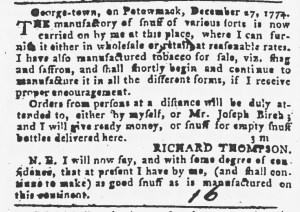
“THE manufactory of snuff of various sorts is now carried on by me at this place.”

On the eve of the American Revolution, Richard Thompson attempted to establish a market for snuff produced in Virginia.  In “The Beginnings of Tobacco Manufacture in Virginia,” Jacob M. Price argues that “there is not even a hint of a local manufacture” of snuff in Virginia from the middle of the 1730s through the late 1760s.  Most of the snuff came from Great Britain with  occasional “bottles, boxes, and kegs of snuff … appear from time to time in notices of arriving cargoes from Antigua, Boston, New York, and Salem.”  According to Price, Thompson “moved his business from Bladensburg [Maryland] to the falls of the Potomac and tried to crash the Virginia market in 1772,” placing a lengthy advertisements in the October 8 edition of William Rind’s Virginia Gazette.  “Little more is known,” Price continues, “of this early Maryland industrial pioneer and of his seemingly premature efforts to introduce a ‘patriotic’ tobacco and snuff manufacture into the Chesapeake.”[1]

An advertisement in the June 29, 1775, edition of the Maryland Gazette, published in Annapolis, reveals that Thompson continued to produce snuff at “George-town, on the Potowmack” at that time.  The “manufactory of snuff of various sorts is now carried on by me at this place,” Thompson proclaimed, “where I can furnish it either in wholesale or retail, at reasonable rates.”  In addition, Thompson had “manufactured tobacco for sale, viz. shag and saffron, and shall shortly begin and continue to manufacture it in all the different forms, if I receive proper encouragement.”  According to the date on the advertisement, Thompson first asked for that encouragement on December 27, 1774, no doubt hoping that the Continental Association, a nonimportation agreement devised by the First Continental Congress in response to the Coercive Acts, created favorable conditions for snuff produced in the colonies.  Patriotic colonizers had an obligation to support his enterprise, to give him that “proper encouragement,” but they did not have to settle for a product inferior to snuff produced elsewhere in the colonies.  In a nota bene, Thompson declared, “I will now say, and with some degree of confidence, that at present I have by me, (and shall continue to make) as good snuff as is manufactured on this continent.”  Even if his business got off to a rocky start, as Price suggests, Thompson asserted that he made improvements over time.  He composed his advertisement less than a month after the Continental Association went into effect (and a notation, “3m,” indicated that it would appear in the Maryland Gazette for three months), yet apparently decided that the time was right to revive it more than six months later after learning of the battles at Lexington and Concord.  Those battles and the events that followed meant that friends of the American cause, after all, had even more reason to support his endeavor.

**********

[1] Jacob M. Price, “The Beginnings of Tobacco Manufacture in Virginia,” Virginia Magazine of History and Biography 64, no. 1 (January 1956): 9, 12, 14.

April 13

What was advertised in a colonial American newspaper 250 years ago today?

Maryland Gazette (April 13, 1775).

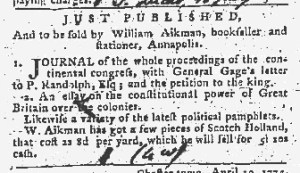
“JOURNAL of the whole proceedings of the continental congress.”

An advertisement by William Aikman, a bookseller and stationer in Annapolis, in the April 13, 1775, edition of the Maryland Gazette proclaimed, “JUST PUBLISHED, And to be sold … JOURNAL of the whole proceedings of the continental congress” and “An essay on the constitutional power of Great Britain over the colonies.”  While Aikman no doubt sold those items, they had not been “JUST PUBLISHED,” nor had he published them.

Readers understood that “JUST PUBLISHED” did not always mean that an item was hot off the presses; sometimes that phrase was a vestige of an advertisement originally composed and disseminated weeks or months earlier and printed once again without revisions.  Readers also understood that “JUST PUBLISHED, and to be sold by” did not necessarily mean that the retailer was also the publisher, merely that the retailer sold an item that had been published by someone, somewhere.  Keeping that in mind yields a better understanding of the production and dissemination of the items that Aikman advertised.

Although printers in many towns, including Anne Catharine Green and Son in Annapolis, produced and advertised local editions of the Extracts from the Votes and Proceedings of the American Continental Congress in the weeks after the First Continental Congress concluded its meetings in Philadelphia near the end of October 1774, only two printing offices published the complete Journal of the Proceedings of the Congress in the following months.  William Bradford and Thomas Bradford printed an edition in Philadelphia, as did Hugh Gaine in New York.  Aikman most likely stocked and advertised the Bradfords’ edition, especially considering that they also printed John Dickinson’s Essay on the Constitutional Power of Great-Britain over the Colonies in America in 1774.  Gaine did not publish a New York edition of that volume.

Aikman’s advertisement also stated that he carried “a variety of the latest political pamphlets,” but he did not list additional titles.  Perhaps he followed the lead of James Rivington in New York and tried to profit from selling pamphlets “on both sides, in the unhappy dispute with Great-Britain.”  As the imperial crisis reached its boiling point in April 1775, Aikman took to the pages of the Maryland Gazette to hawk two items published by the Bradfords in 1774 that became more timely and relevant as well as the “latest political pamphlets” that provided even more for colonizers to consider as they learned about and participated in current events.

March 30

What was advertised in a colonial American newspaper 250 years ago today?

Maryland Gazette (March 30, 1775).

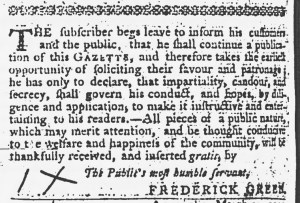
“He shall continue a publication of this GAZETTE.”

On March 30, 1775, the colophon for the Maryland Gazette stated, “ANNAPOLIS: Printed by FREDERICK GREEN,” for the first time.  In the previous issue, it read, “ANNAPOLIS: Printed by ANNE CATHARINE GREEN and SON.”  Anne Catharine Green had been publishing the newspaper since April 16, 1767, upon the death of her husband, Jonas.  She commenced a partnership with her son, William, in January 1768, but it ended with his death in August 1770.  In January 1772, she commenced another partnership, that one with another son, Frederick.  When she died on March 23, 1775, he became the sole publisher.

On that occasion, he inserted his own notice in the Maryland Gazette, placing it first among the advertisements in the March 30 edition.  Frederick “inform[ed] his customers and the public, that he shall continue a publication of this GAZETTE.”  He offered assurances of his editorial strategy, pledging that “impartiality, candour, and secrecy, shall govern his conduct.”  Through “diligence and application,” he intended to make the newspaper “instructive and entertaining to his readers.”  To that end, “All pieces of a public nature, which may merit attention, and be thought conducive to the welfare and happiness of the community, will be thankfully received, and inserted gratis.”  As had been the case when he worked alongside his mother, the printer needed to cultivate relationships with readers who would supply content to fill the pages of his newspaper.

Maryland Gazette (March 30, 1775).

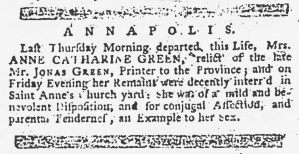
Elsewhere on the same page, Frederick ran a death notice in memory of his mother.  Thick black borders appeared above and below it, a common practice readily recognized as a sign of mourning.  “Last Thursday Morning,” the notice reported, “departed this Life, Mrs. ANNE CATHARINE GREEN, relict of the late Mr. JONAS GREEN, Printer to the Province.”  Her son remembered her “mild and benevolent Disposition,” declaring that “for conjugal Affection, and parental Tenderness” she was “an Example to her Sex.”  He did not elaborate on the service she provided to Annapolis and the rest of the colony.  Throughout most of her tenure as printer, the Maryland Gazette had been the only newspaper published in Maryland.  Anne Catharine Green was one of several women who ran printing offices in colonial America during the imperial crisis that culminated in a war for independence.  Along with Margaret Draper, Sarah Goddard, and Clementina Rind, she contributed to the dissemination of news and shaping of public opinion as momentous events occurred.

March 16

What was advertised in a colonial American newspaper 250 years ago today?

Maryland Gazette (March 16, 1775).

“WE have perused the manuscript copies of your book … and think it a work of public utility.”

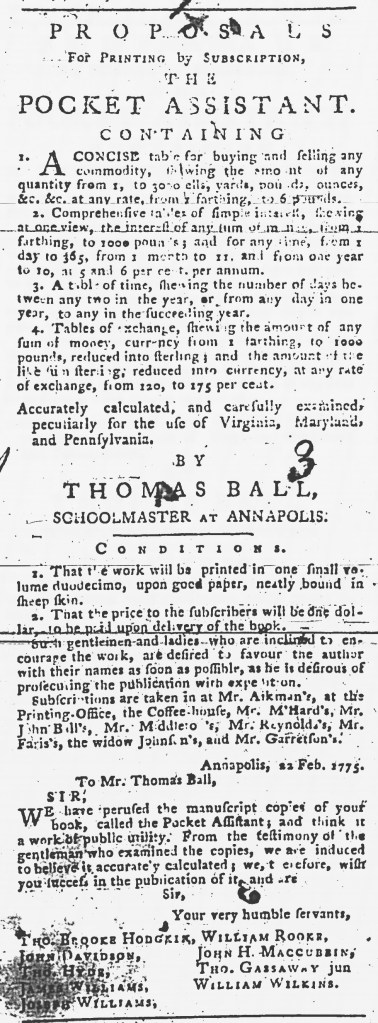
Thomas Ball, a schoolmaster in Annapolis, had an entrepreneurial spirit.  He wrote and distributed subscription proposals for “THE POCKET ASSISTANT,” a reference manual that included a “CONCISE table for buying and selling any commodity … at any rate,” “Comprehensive tables of simple interest,” a “table of time, shewing the number of days between any two in the year, or from any day in one yea, to any in the succeeding year,” and “Tables of exchange.”  Merchants, brokers, shopkeepers, and others would certainly find each of those calculations helpful when conducting business.

Ball claimed that each table as “Accurately calculated and carefully examined” so subscribers could trust them.  To that end, he added an endorsement from nine residents of Annapolis after the “CONDITIONS” for subscribing.  “WE have perused the manuscript copies of your book, called the Pocket Assistant,” they declared, “and think it a work of public utility.  From the testimony of the gentleman who examined the copies, we are induced to believe it accurately calculated; we, therefore, wish you success in the publication of it.”  Ball engaged in a bit of sleight of hand: the signatories did not report that they had confirmed the calculations themselves, only that they trusted the unnamed “gentleman” who had looked over them.  Still, Ball considered that recognition significant enough that it might sway prospective subscribers to reserve copies so he could move forward with the project.

The schoolmaster also enlisted the assistance of several local agents who accepted subscriptions on his behalf.  Subscribers could submit their names at popular places for doing business, including the coffeehouse where merchants regularly gathered and the printing office where Anne Catharine Greene and Son published the Maryland Gazette, as well as at William Aikman’s circulating library.  Seven other men and women also took the names of subscribers, though none of them collected any money.  Subscribers only paid “upon delivery of the book,” provided that the proposals generated enough interest to justify Ball taking the “small volume” to press.  Even a carefully orchestrated marketing campaign, however, did not guarantee success.  Many subscription proposals did not result in publication.  Unfortunately for Ball, it does not appear that his Pocket Assistant made it to press.

September 29

What was advertised in a colonial American newspaper 250 years ago today?

Maryland Gazette (September 29, 1774).

“It is probable a non-importation agreement may be soon entered into by the colonies.”

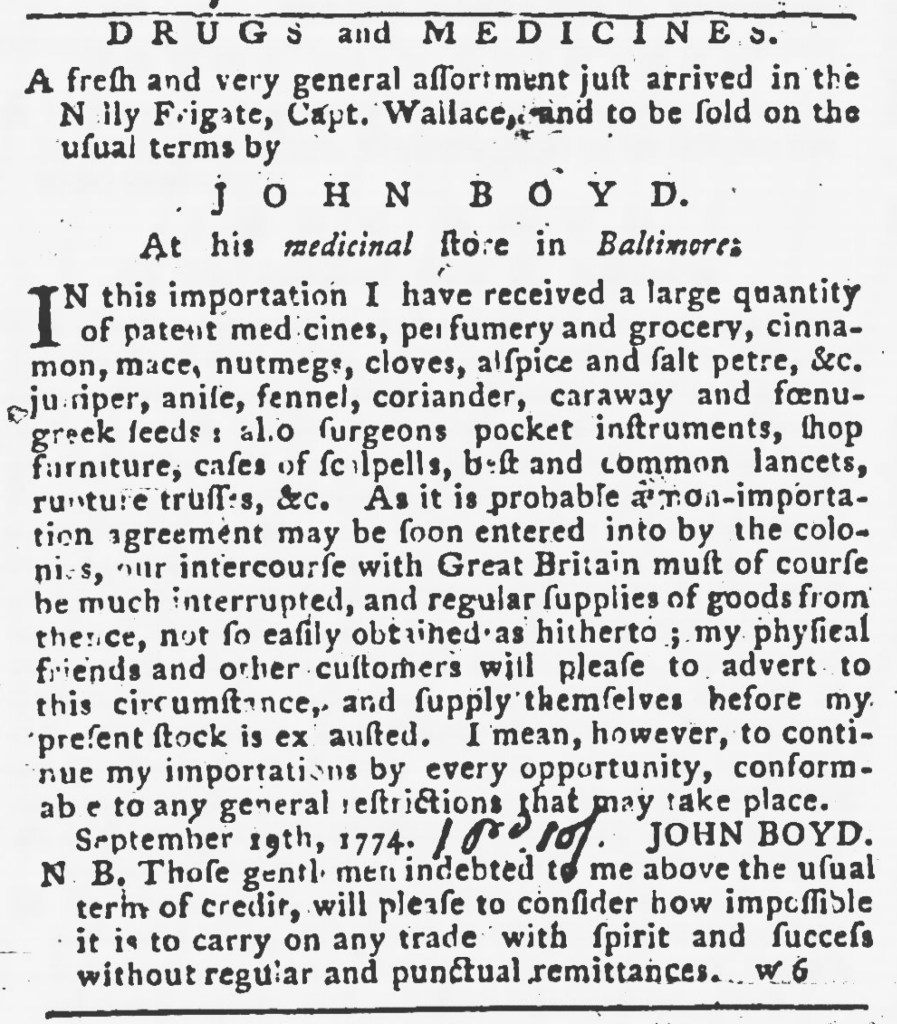
In the fall of 1774, John Boyd advertised the “DRUGS and MEDICINES” available at “his medicinal store in Baltimore” in both the Maryland Gazette, published in Annapolis, and the Maryland Journal, published in Baltimore.  The latter was still so new that the apothecary realized many of his prospective customers still relied on the former as their local newspaper.  He reported that he just imported a “fresh and very general assortment” of patent medicines, “perfumery and grocery” items, spices, and medical equipment.

Boyd also leveraged current events in hopes of moving his merchandise.  At that moment, the First Continental Congress was meeting in Philadelphia, deliberating over responses to the Coercive Acts passed after the Boston Tea Party.  He reminded readers that “it is probable a non-importation agreement may be soon entered into by the colonies” and when that happened “our intercourse with Great Britain must of course be much interrupted, and regular supplies of goods from thence, not so easily obtained as hitherto.”  That being the case, he advised doctors, his “physical friends,” and his other customers to “supply themselves before my present stock is exhausted.”  In other words, they needed to make purchases while the items they needed or wanted were still available.  A boycott would result in scarcity and, eventually, empty shelves, storerooms, and warehouses.  Boyd was not the only entrepreneur making that argument.  In Charleston, Samuel Gordon recommended to “the Ladies” that they needed to buy his textiles, accessories, and housewares while supplies lasted because “a Non-importation Agreement will undoubtedly take Place here.”  Boyd’s advertisement made clear that it was not solely “the Ladies” who needed to worry about politics causing disruptions in the marketplace.

He vowed to do what he could to limit the effects, stating that he would “continue my importations by every opportunity,” though he carefully clarified that he would do so “conformable to any general restrictions that may take place.”  He would continue accepting shipments for as long as possible, replenishing his stock to ward off scarcity, yet there would come a time that he would have to yield to whatever agreement colonizers adopted.  His advertisement preemptively suggested to prospective customers that they should check with him when they discovered that other apothecaries no longer stocked their usual wares.  Colonizers had experienced nonimportation twice in the past decade, first in response to the Stamp Act and later in response to the duties on certain imported goods in the Townshend Acts.  Savvy entrepreneurs like Boyd reminded them how to prepare for what looked to be inevitable disruptions.

September 22

What was advertised in a colonial American newspaper 250 years ago today?

Maryland Gazette (September 22, 1774).

“YES, YOU SHALL BE PAID; BUT NOT BEFORE YOU HAVE LEARNED TO BE LESS INSOLENT.”

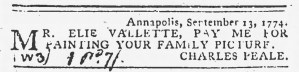
The saga continued.  Elie Vallette, the clerk of the Prerogative Court in Annapolis and author of the Deputy Commissary’s Guide, did not bow to the public shaming that Charles Willson Peale, the painter, undertook in the pages of the Maryland Gazette in September 1774.  Earlier in the year, Peale had painted a family portrait for Vallette and then attempted through private correspondence to get the clerk to pay what he owed.  When Vallette did not settle accounts, Peale turned to the public prints.  He started with a warning shot in the September 8 edition of the Maryland Gazette: “IF a certain E.V. does not immediately pay for his family picture, his name shall be published at full length in the next paper.”  Peale meant it.  He did not allow for any delay in Vallette taking note of the advertisement and acting on it.  A week later, he followed through on his threat, resorting to all capitals to underscore his point, draw more attention to his advertisement, and embarrass the recalcitrant clerk.  “MR. ELIE VALLETTE,” Peale proclaimed in his advertisement, “PAY ME FOR PAINTING YOUR FAMILY PICTURE.”

That still did not do the trick.  Instead, it made Vallette double down on delaying payment.  He responded to Peale’s advertisement, attempting to put the young painter in his place.  In a notice also in all capitals, he lectured, “MR. CHARLES WILSON PEALE; ALIAS CHARLES PEALE – YES, YOU SHALL BE PAID; BUT NOT BEFORE YOU HAVE LEARNED TO BE LESS INSOLENT.”  Vallette sought to shift attention away from his own debt by critiquing the decorum of an artist he considered of inferior status.  That strategy may have worked, though only for a moment.  Peale’s advertisement did not run in the next issue of the Maryland Gazette.  That could have been because Peale instructed the printer, Anne Catharine Green, to remove his notice and returned to working with Vallette privately.  Even if that was the case, it was only temporary.  “MR. ELIE VALLETTE, PAY ME FOR PAINTING YOUR FAMILY PICTURE” appeared once again in the October 6 edition.  Peale was not finished with his insolence.  He placed the advertisement again on October 13 and 20.  Vallette did not run his notice a second time, perhaps considering it beneath him to continue to engage Peale in the public prints.  He had, after all, made his point, plus advertisements cost money.  That being the case, the painter eventually discontinued his notice.  Martha J. King notes that Vallette “eventually settled his account about a year later.”[1]  For a time, advertisements in the only newspaper printed in Annapolis became the forum for a very public airing of Peale’s private grievances and Vallette’s haughty response.

**********

[1] Martha J. King, “The Printer and the Painter: Portraying Print Culture in an Age of Revolution,” Transactions of the American Philosophical Society 109, no. 5 (2021): 79.

September 15

Who was the subject of an advertisement in a colonial American newspaper 250 years ago today?

Maryland Gazette (September 15, 1774).

“MR. ELIE VALLETTE, PAY ME FOR PAINTING YOUR FAMILY PICTURE.”

Charles Willson Peale followed through on his threat.  He had placed an advertisement in the September 8, 1774, edition of the Maryland Gazette warning that “IF a certain E.V. does not immediately pay for his family picture, his name shall be published at full length in the next paper.”  The subject of the painter’s notice had not heeded it, perhaps mistakenly believing that Peale would not have the audacity to actually do what he suggested.  If that was the case, he miscalculated because a week later the very first advertisement in the next issue of the Maryland Gazette proclaimed, “MR. ELIE VALLETTE, PAY ME FOR PAINTING YOUR FAMILY PICTURE.”  Using all capital letters signaled the artist’s frustration; it also called greater attention to the advertisement.

Another advertisement involving Vallette appeared on the next page of the newspaper.  That one, which had first appeared four months earlier, promoted the Deputy Commissary’s Guide, a book that Vallette had authored and invested many months in acquiring subscribers before taking it to press.  He had advertised extensively in the Maryland Gazette.  His name did not happen to appear in the most recent advertisement; instead, it gave the title of the book and featured an endorsement by William Fitzhugh, the colony’s commissary general.  Martha J. King suggests that Vallette did not place the advertisement for the Deputy Commissary’s Guide, asserting that Anne Catherine Greene, the printer of both the Maryland Gazette and Vallette’s book, ran that notice.[1]  To whatever extent Vallette was or was not involved in continuing to advertise the Deputy Commissary’s Guide following publication, he was proud enough of his achievement as an author that the book with its engraved title page appeared in the foreground of the family portrait Peale painted.  Peale’s notices may not have been the kind of acclaim that Vallette desired, but the painter had given him public notice after seeking payment in private letters for several months.

Readers of the Maryland Gazette witnessed one side of the feud as it escalated from one week to the next in September 1774.  Some may have found the spectacle entertaining, a good bit of gossip.  Now that he had been named in the public prints, how would Vallette react?  Would the disagreement escalate even more?  Readers had a new reason to peruse the advertisements in the next edition of the Maryland Gazette.

**********

[1] Martha J. King, “The Printer and the Painter: Portraying Print Culture in an Age of Revolution,” Transactions of the American Philosophical Society 109, no. 5 (2021): 79.