September 15

Who was the subject of an advertisement in a colonial American newspaper 250 years ago today?

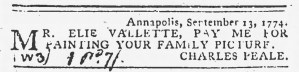
Maryland Gazette (September 15, 1774).

“MR. ELIE VALLETTE, PAY ME FOR PAINTING YOUR FAMILY PICTURE.”

Charles Willson Peale followed through on his threat.  He had placed an advertisement in the September 8, 1774, edition of the Maryland Gazette warning that “IF a certain E.V. does not immediately pay for his family picture, his name shall be published at full length in the next paper.”  The subject of the painter’s notice had not heeded it, perhaps mistakenly believing that Peale would not have the audacity to actually do what he suggested.  If that was the case, he miscalculated because a week later the very first advertisement in the next issue of the Maryland Gazette proclaimed, “MR. ELIE VALLETTE, PAY ME FOR PAINTING YOUR FAMILY PICTURE.”  Using all capital letters signaled the artist’s frustration; it also called greater attention to the advertisement.

Another advertisement involving Vallette appeared on the next page of the newspaper.  That one, which had first appeared four months earlier, promoted the Deputy Commissary’s Guide, a book that Vallette had authored and invested many months in acquiring subscribers before taking it to press.  He had advertised extensively in the Maryland Gazette.  His name did not happen to appear in the most recent advertisement; instead, it gave the title of the book and featured an endorsement by William Fitzhugh, the colony’s commissary general.  Martha J. King suggests that Vallette did not place the advertisement for the Deputy Commissary’s Guide, asserting that Anne Catherine Greene, the printer of both the Maryland Gazette and Vallette’s book, ran that notice.[1]  To whatever extent Vallette was or was not involved in continuing to advertise the Deputy Commissary’s Guide following publication, he was proud enough of his achievement as an author that the book with its engraved title page appeared in the foreground of the family portrait Peale painted.  Peale’s notices may not have been the kind of acclaim that Vallette desired, but the painter had given him public notice after seeking payment in private letters for several months.

Readers of the Maryland Gazette witnessed one side of the feud as it escalated from one week to the next in September 1774.  Some may have found the spectacle entertaining, a good bit of gossip.  Now that he had been named in the public prints, how would Vallette react?  Would the disagreement escalate even more?  Readers had a new reason to peruse the advertisements in the next edition of the Maryland Gazette.

**********

[1] Martha J. King, “The Printer and the Painter: Portraying Print Culture in an Age of Revolution,” Transactions of the American Philosophical Society 109, no. 5 (2021): 79.

June 30

What was advertised in a colonial American newspaper 250 years ago today?

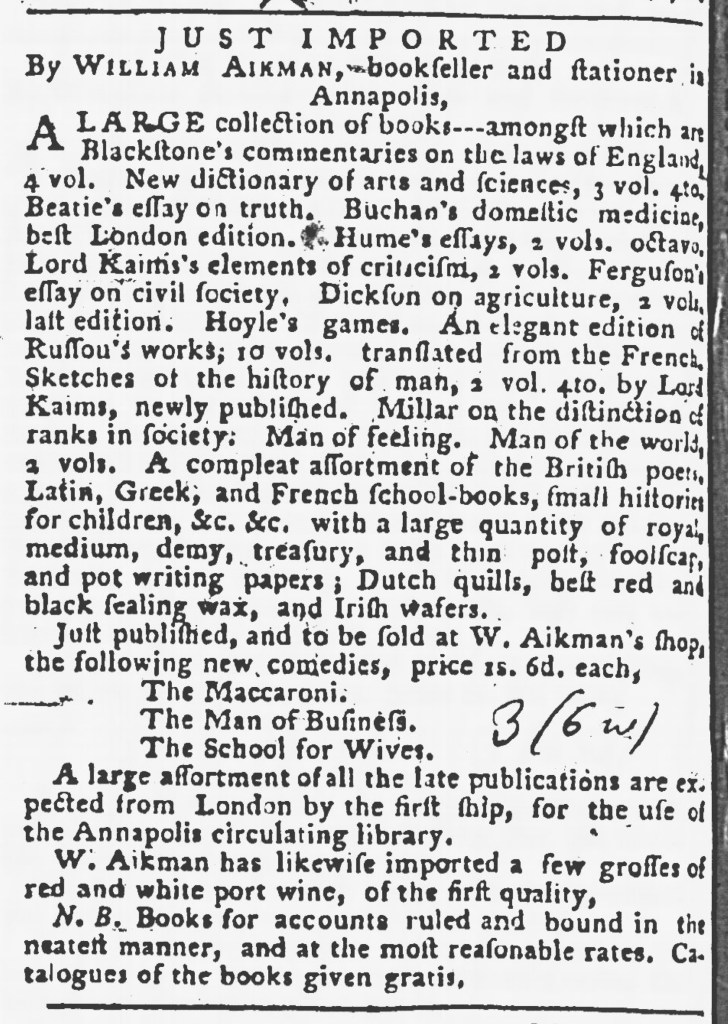
Maryland Gazette (June 30, 1774).

“Just published … the following new comedies.”

In the spring and summer of 1774, William Aikman, “bookseller and stationer in Annapolis,” advertised a “LARGE collection of books” in the Maryland Gazette.  He listed all sorts of titles, including “Blackstone’s commentaries on the laws of England” in four volumes, “Buchan’s domestic medicine, best London edition,” and “Russou’s works, … translated from the French.”  In addition, he stocked a variety of books from several genres, ranging from a “compleat assortment of the British poets” to “Latin, Greek, and French school-books” to “small histories for children.”  Aikman had something for every reader.

The bookseller also devoted a portion of his advertisement to three “new comedies” that sold for one shilling and six pence each.  These works, “Just published,” most likely were reprints that he acquired from John Dunlap in Philadelphia.  In 1774, Dunlap printed American editions of Robert Hitchcock’s The Macaroni: A Comedy, as It Is Performed at the Theatre Royal, George Coleman’s The Man of Business: A Comedy: As It is Acted at the Theatre-Royal in Covent-Garden, and Hugh Kelly’s The School for Wives: A Comedy: As It Is Performed at the Theatre-Royal in Drury Lane.  Perusing those works gave readers in the colonies, in Philadelphia or Annapolis or anywhere else that Dunlap distributed his reprinted editions, a taste of the theater scene in the cosmopolitan center of the empire.

In addition, Aikman announced that a “large assortment of all the late publications are expected from London by the first ship, for the use of the Annapolis circulating library.”  That was another venture that the enterprising bookseller and stationer oversaw.  A year earlier, he opened that library and advertised the subscription fees for joining for a month, a quarter, six months, or a year.  In the fall of 1773, he advertised that his Annapolis Circulating Library provided delivery service to Baltimore, both a convenience for members there and an attempt to undercut a competing library proposed by a competitor who did not manage to establish a library there.

Overall, Aikman’s advertisement revealed multiple trajectories for producing, distributing, and acquiring books on the eve of the American Revolution.  Booksellers received most of their inventory from English printers, though printers in the colonies published both American editions and original works.  Those printers worked with printers and booksellers in other towns to exchange, market, and sell books and pamphlets printed in the colonies.  For their part, readers could purchase books or join circulating libraries to increase their access to larger libraries than they could afford on their own.

June 2

What was advertised in a colonial American newspaper 250 years ago today?

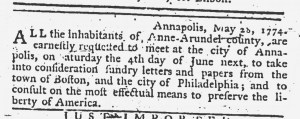
Maryland Gazette (June 2, 1774).

“Meet … to consult on the most effectual means to preserve the liberty of America.”

Advertisements in eighteenth-century newspapers served a variety of purposes.  Sometimes they carried news.  During the imperial crisis, colonizers used advertisements to help them organize.  Consider a notice that ran in the June 2, 1774, edition of the Maryland Gazette.  It advised, “ALL the inhabitants of Anne-Arundel county, are earnestly requested to meet at the city of Annapolis, on Saturday the 4th day of June next, to take into consideration sundry letters and papers from the town of Boston, and the city of Philadelphia.”  The organizers also planned for the participants to “consult on the most effectual means to preserve the liberty of America.”  Those “sundry letters and papers” referred to news of the Boston Port Act.  As punishment for the Boston Tea Party, Parliament closed and blockaded Boston Harbor, starting June 1 and continuing until the residents of that town paid for the tea destroyed the previous December.

More details from some of those “sundry letters and papers” appeared elsewhere in that issue of the Maryland Gazette, including “Extracts of private letters from London, dated April 7 and 8, to private persons in New-York and Philadelphia” on the front page, yet the call to meeting was not among the news items.  It appeared among the advertisements, though it received a privileged place as the first advertisement.  It ran immediately after the list of vessels that entered and cleared the customs house in Annapolis, traditionally the final news item.  The printers, Anne Catherine Green and Son, also ran a note that the “conclusion of the essay on the advantages of a classical education, is postponed for want of room” and “Advertisements omitted will be inserted next week.”  Yet they not only made certain to include the advertisement about the meeting to discuss news related to the Boston Port Act and how to respond but also placed it where readers who might not read the advertisements as closely as the news and editorials would be more likely to see it.  John Holt had done the same with a call to meeting that ran in the May 19 edition of the New-York Journal.  The press played an important role in “preserv[ing] the liberty of America” during the era of the American Revolution, but not solely in the sections of newspapers that carried coverage of current events.  Advertisements also contributed to keeping readers informed and mobilizing colonizers to resist legislation passed by Parliament.

May 12

What was advertised in a colonial American newspaper 250 years ago today?

Maryland Gazette (May 12, 1774).

“I do hereby recommend [this guide] to the several deputy commissaries within this province.”

Publishing the Deputy Commissary’s Guide took more than a year.  The first advertisement, Elie Vallette’s lengthy subscription proposal, ran in the February 25, 1773, edition of the Maryland Gazette.  It featured an excerpt and notable image depicting how each copy would be personalized for the subscriber.  The original version ran for several weeks before an abbreviated version appeared; it eliminated the excerpt but retained the image.  Such visual distinctiveness made even the shorter advertisement the focal point among other newspaper notices.  In the summer of 1773, Vallette ran a new advertisement, this one featuring an endorsement from several prominent “gentlemen of the law” who testified to the “general utility” of the volume.  At that time, Vallette stated that the work “Is now in the Press, and will be speedily published.”

Yet subscribers still had to wait for their copies.  In May 1774, Vallette ran a notice to announce that The Deputy Commissary’s Guide was “JUST PUBLISHED, And ready to be delivered to the subscribers, neatly bound, at the respective places where they were subscribed for.”  Local agents in towns throughout the colony had collected subscriptions on behalf of Vallette.  He now set about sending copies to each of them to distribute, including additional copies or “a few remaining books” for “non-subscribers” who decided that they did indeed wish to purchase this helpful guide.  To aid in selling those surplus copies, Vallette included a recommendation for The Deputy Commissary’s Guide from William Fitzhugh, the colony’s commissary general.  Fitzhugh declared that he had “perused” the work and “approving of the regulations therein made … I do hereby recommend [the book] to the several deputy commissaries within this province” to aid them in a variety of their duties.  What better endorsement could Vallette and his reference guide have received?!

Vallette had no guarantee of success when he first distributed subscription proposals for The Deputy Commissary’s Guide.  Many proposed books did not gain sufficient numbers of subscribers to make them viable ventures for authors and printers.  Even after taking the book to press, Vallette still hustled to sell leftover copies.  His latest advertisement was not as lengthy or flashy as previous ones, but he likely figured that a key testimonial provided the best incentive to acquire the book once it hit the market.

April 14

GUEST CURATOR:  Clare Teskey

What was advertised in a colonial American newspaper 250 years ago today?

Maryland Gazette (April 14, 1774).

“A neat post coach.”

John King’s advertisement for this “coach” first interested me because, according to Ron Vineyard at Colonial Williamsburg, coaches were bought mainly by the gentry (or upper class) in eighteenth-century America. Upon further consideration, however, I noticed that this was an advertisement for a “post coach,” which confused me, as I thought that only the postal system would have use for “post coaches.” Most people rode horses or travelled by foot at this time, but those who had the luxury of owning a coach could decide between different kinds of coaches. In “Wheeled Carriages in Eighteenth-Century Virginia,” Mary Goodwin identified “plain,” “neat ornamented,” “town,” “travelling,” and “elegant crane neck” coaches among the variety of coaches that buyers could choose from, as well as “post coaches.” Depending on the size and price of the coach, buyers had certain preferences about the coach they would purchase. While “post coaches” were typically used by the postal system for the distribution of mail in the colonies, they could also be bought by private owners, who may have enjoyed the style, price, and other features of the vehicles.

**********

ADDITIONAL COMMENTARY:  Carl Robert Keyes

John King sought to sell a used post coach.  In his advertisement in the April 14, 1774, edition of the Maryland Gazette, he noted that the wheels “are as good as new, and the carriage in good order, having been through a thorough repair last year,” assuring prospective customers that even though the carriage was used it was in good order.  He also had a “genteel phaeton” for sale at his stables in Annapolis, that carriage also presumably used.

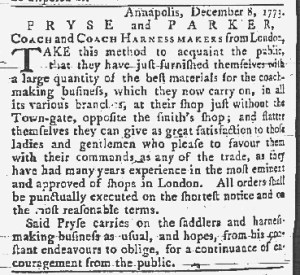
In selling secondhand carriages, King competed with Pryse and Parker, “COACH and COACH HARNESSMAKERS from London,” and the new carriages they built according to the instructions they received then customers placed orders.  In the same issue that carried King’s advertisement, Pryse and Parker once again inserted their notice to inform the public that they acquired “the best materials for the coachmaking business, which they now carry on, in all its various branches.”  Colonizers in the market for a coach had the option, if they wished, to order a new one made to their specifications, one that matched the latest styles in London and port cities in the colonies.

Yet new coaches were more expensive than secondhand coaches, not unlike new and used cars today.  Consumers made decisions that took into account price, quality, fashion, and prestige.  The eighteenth-century marketplace for carriages anticipated some of the common practices of the modern automobile industry, especially when it came to used carriages.  For instance, Adino Paddock, a coachmaker in Boston, advertised that he “will take second hand Chaises in part Pay for new,” a version of trading in a new vehicle to reduce the cost of a new one.  He also offered for sale a “very good second-hand Coach, Curricule, and several Chaises, some almost new.”  Paddock operated a precursor to a used car lot, making bargains available to those who chose not to invest in new carriages.  With a “neat post coach” and a “genteel phaeton” for sale at his stables, King adopted a similar business model.

January 13

Who was the subject of an advertisement in a colonial American newspaper 250 years ago today?

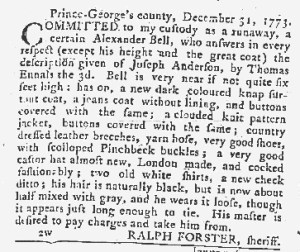
Maryland Gazette (January 13, 1774).

“Alexander Bell, who answers in every respect … the description given of Joseph Anderson.”

Thomas Ennalls offered a reward for the capture and return of “an Irish servant man” who ran away from him in Dorchester County, Maryland, at the end of November 1773.  In an advertisement that first ran in the December 16 edition of the Maryland Gazette, Ennalls described Joseph Anderson’s age, appearance, clothing.  The runaway, “about thirty years of age,” had “a thin visage” and “wears his own hair tied behind” his head.   His apparel included “an old surtout coat, … a knit pattern jacket …, old leather breaches, a pair of ribbed worsted stockings, [and an] English hat cut in the fashion.”  Anderson worked as a schoolmaster, but that position of trust did not prevent him from stealing “about eighteen or twenty pounds in cash” when he broke his indenture contract and ran away. Ennalls suspected that the unscrupulous schoolmaster “may change his name.”

Ralph Forster, the sheriff in Prince George’s County, carefully followed advertisements about runaway indentured servants, convict servants, and apprentices that appeared in the Maryland Gazette.  He also placed notices about suspected runaways that he detained.  In an advertisement that first appeared in the January 13, 1774, edition of the Maryland Gazette, he described “a certain Alexander Bell, who answers in every respect (except his height and the great coat) the description given of Joseph Anderson, by Thomas Ennals.”  Bell was “very near if not quite six feet high,” slightly taller than Anderson’s “five feet nine or ten inches high.”  If he was indeed Anderson, he had changed his name as Ennalls anticipated and may have sold, traded, or discarded the coat.  The rest of the clothing indeed matched, including “a clouded knit pattern jacket, … country dressed leather breeches, yarn hose, [and] a very good castor hat almost new, London made, and cocked fashionably.”  Forster’s requested that his prisoner’s “master … pay charges and take him.”

Among the many purposes served by advertisements in eighteenth-century newspapers, colonizers used them as an infrastructure for surveillance and enforcement in their efforts to maintain order when indentured servants, convict servants, and apprentices ran away from their masters.  They served a similar purpose for capturing enslaved people who liberated themselves and returning them to their enslavers.  Printers enhanced the power and authority already exercised by colonizers like Ennalls and Forster when they sold them space in their newspapers.

January 9

What was advertised in a colonial American newspaper 250 years ago this week?

Maryland Gazette (January 6, 1774).

“They have had many years experience in the most eminent and approved of shops in London.”

The partnership of Pryse and Parker constructed coaches and other sorts of carriages as well as harnesses at their shop in Annapolis.  In December 1773, they placed an advertisement in the Maryland Gazette to inform prospective customers that they “just furnished themselves with a large quantity of the best materials for the coach-making business.”  They introduced themselves as “from London,” though that did not necessarily mean that they were recent arrivals in Annapolis.  After all, some artisans continued to burnish their London credentials for years after they set up shop in colonies.  Pryse and Parker’s advertisement did not indicate how long they had pursued their trade in town, though a brief note at the end advised that Pryse “carries on the saddlers and harness-making business as usual, and hopes … for a continuance of encouragement from the public.”  That suggested that Pryse had been in Annapolis long enough to gain some familiarity, even if the partnership with Parker was relatively new.  Just over a year earlier, Pryse did indeed advertise on his own.

No matter how long they had been making carriages in Annapolis, Pryse and Parker considered it helpful to their marketing efforts to tout their connections to the most cosmopolitan city in the empire.  In addition to identifying themselves as “from London,” they trumpeted that “they have had many years experience in the most eminent and approved of shops in London.”  Although they stated that they “flatter themselves they can give as great satisfaction to those ladies and gentlemen who please to favour them with their commands, as any of the trade,” Pryse and Parker thought that the time they labored in those “most eminent and approved of shops in London” should distinguish them from their competitors.  They expected that the local gentry who could afford to purchase and maintain coaches and carriages would place a premium on acquiring those items from artisans with the kind of background they boasted.  Even as colonizers protested against the Tea Act and other measures enacted by Parliament, many of them continued to consider links to London a selling point when engaging the services of artisans.

July 15

What was advertised in a colonial American newspaper 250 years ago today?

Maryland Gazette (July 15, 1773).

“Catalogues both of the library and the books he has for sale to be had at his shop.”

On July 15, 1773, William Aikman once again took to the pages of the Maryland Gazette to promote the circulating library that the bookseller and stationer recently opened in Annapolis.  He inserted the same advertisement that appeared in the previous issue, seeking subscribers for the library and hawking books, stationery, and writing supplies.  In addition to deploying the newspaper notice, Aikman used other forms of advertising.

For instance, he concluded his notice with a nota bene that advised, “Catalogues both of the library and the books he has for sale to be had at his shop.”  According to Robert Winans in A Descriptive Checklist of Book Catalogues Separately Printed in America, 1639-1800, the Maryland Historical Society has the only known copy of a book catalog that may have been the one that Aikman mentioned in his newspaper advertisement.  It contains “854 consecutively numbered medium and full author and title entries, arranged alphabetically,” falling short of the “1200 volumes” that Aikman tallied in his newspaper advertisement.  However, that sole copy lacks a title page and other evidence suggests that additional pages may have been lost as well.

Trade Card for William Aikman’s Circulating Library (Annapolis, 1773). Courtesy American Antiquarian Society.

In addition to publishing at least one book catalog, Aikman also distributed an item that may have served as a trade card, a bookplate, or membership card.  The copperplate engraving features an ornate border that encloses the words “W. AIKMAN’S Circulating Library” in the upper portion of the cartouche and an advertisement for his book and stationery shop in the lower portion: “All kinds of Books, Letter Cases, Message Cards, Gilt &Plain Paper, Wax, &c. Sold at his Shop, Annapolis, at the British Prices, for Cash Only.  Paper rul’d, Books bound in the neatest manner.”  The final portion of that advertisement echoed the services that Aikman listed in his newspaper advertisement.  Images of a globe and a pen and inkpot resting on two books outside the border testified to both the world of knowledge and the products available at Aikman’s circulating library and bookshop.  The upper portion of the cartouche also included “No” with space to write in a number.  The number “474” appears in manuscript on the copy in the collections of the American Antiquarian Society.  That number may have been associated with a book in the numbered catalog or a subscriber to the circulating library, depending on whether Aikman used the engraved card as a bookplate or a membership card.

Aikman’s marketing efforts extended beyond newspaper advertisements.  He also distributed book catalogs and engraved cards to draw attention to his bookshop and circulating library, joining other entrepreneurs who diversified the kinds of advertisements that circulated in the colonies during the era of the American Revolution.

July 11

What was advertised in a colonial American newspaper 250 years ago this week?

Maryland Gazette (July 8, 1773).

“The library will be of real utility to the publick.”

In the summer of 1773, William Aikman, a bookseller and stationer, opened a circulating library in Annapolis.   Like other libraries founded in eighteenth-century America, Aikman’s new venture was a subscription library that required users to pay fees to borrow books.  The bookseller accumulated and lent “12 hundred volumes on the most useful sciences, history, poetry, agriculture, voyages, travels, miscellanies, plays, with all the most approved of novels, magazines and other books of entertainment,” but library patrons had to pay for borrowing privileges.

Aikman provided an overview of those fees, a sliding scale that gave greater bargains to patrons who subscribed for longer periods. The nominal difference in the fees for six months compared to a year seemed designed for Aikman to attract yearly subscribers that he could then promote to prospective subscribers.  Just as newspaper printers boasted about their extensive circulation in their efforts to entice new subscribers and, especially, advertisers, the bookseller likely realized that some colonizers would subscribe to his library for an entire year when they learned how many others had already done so.  The perceived popularity of this service had the potential to spawn even more demand.  Aikman’s pricing structure encouraged patrons to subscribe for longer periods, enhancing the appearance of the popularity of the new venture.

  • 5 shillings per month
  • 12 shillings per quarter
    • saving 3 shillings or 20% compared to the monthly rate
  • 20 shillings for six months
    • saving 4 shillings or 17% compared to the quarterly rate
    • saving 10 shillings or 33% compared to the monthly rate
  • 1 guinea (or 21 shillings) per year
    • saving 19 shillings or 48% compared to the semiannual rate
    • saving 27 shillings or 56% compared to the quarterly rate
    • saving 39 shillings or 65% compared to the monthly rate

The bookseller also offered a nightly rate, three pence, for patrons who desired access to the library but did not wish to pay for an entire month or longer.  Depending on the patron’s perspective, the nightly rate was either a bargain or exorbitant.  It granted entry to those who might not have been able to commit to the monthly, quarterly, semiannual, or annual rates, but at a much higher cost per night.

Whether patrons opted to check out books by the night or purchase subscriptions to borrow two books at a time for a year, Aikman considered his new circulating library an important service “of real utility to the publick.”  He requested “encouragement from the friends of literature” to make it a successful venture that met the needs of the community as well as generating revenues for the proprietor.

June 3

What was advertised in a colonial American newspaper 250 years ago today?

Maryland Gazette (June 3, 1773).

“He hath opened an inn and tavern, at the sign of the Fountain … in Market-street, Baltimore.”

As summer arrived in 1773, Daniel Grant opened a new inn and tavern in Baltimore.  To attract patrons, he inserted advertisements in the Maryland Gazette, published in Annapolis, and the Pennsylvania Packet, published in Philadelphia, to supplement word-of-mouth news of his establishment in Baltimore.  That city did not yet have its own newspaper, though William Goddard had recently opened a printing office there and distributed subscription proposals for the Maryland Journal.  Even if Grant could have advertised in a local newspaper, it benefited him to alert colonizers throughout the regions served by the Maryland Gazette and the Pennsylvania Packet that they could avail themselves of his services if they had occasion to travel to Baltimore.  Besides, those newspapers were the local newspapers, at least for another few months until Goddard commenced publication of the Maryland Journal near the end of August.

As part of his marketing efforts, Grant emphasized his experience running a tavern “at the sign of the Buck, near Philadelphia.”  He extended “his most grateful thanks to the gentlemen who did mum the honour to frequent his former house.”  In addition, he declared that “it shall ever be his study to please” and “he hopes for a continuance of their favours” when they visited Baltimore.  Such sentiments communicated to those who had not previously visited the tavern “at the sign of the Buck” that Grant had successfully cultivated a clientele and would offer the same quality of service to patrons at the inn and tavern “at the sign of the Fountain … in Market-street, Baltimore.”  He pledged that “those who choose to favour him with their custom, may be assured of his best endeavours to merit their approbation.”  To that end, he promoted the “late and commodious house” that he converted into an inn and tavern and asserted that he “hath provided everything for the accommodation of gentlemen, their servants, and horses, in the best manner.”  Apparently, Grant also operated a stable or made arrangements with a nearby associate to provide hosteling services.  Whatever their needs and desires, Grant promised prospective patrons a pleasant stay at his inn and tavern.